
Citi(C)

Search documents
高盛、花旗:若非农再恶化,美联储9月或激进降息50基点,利率终点3%或更低
美股IPO· 2025-08-05 09:08
Core Viewpoint - The latest employment data indicates a significant slowdown in the U.S. economy and labor market, leading Wall Street to believe that a policy shift from the Federal Reserve is imminent, with predictions of interest rate cuts starting as early as September [1][3][4]. Economic Indicators - Goldman Sachs reported that potential monthly job growth in the U.S. plummeted from 206,000 in Q1 to 28,000 in July, suggesting a severe weakening in the labor market [3][4]. - The July non-farm payrolls added only 73,000 jobs, significantly below expectations, and previous months' data was revised down by 258,000, indicating a rapid deceleration rather than a moderate slowdown [4][6]. Federal Reserve's Policy Outlook - Both Goldman Sachs and Citigroup predict a high likelihood of a 25 basis point rate cut in September, with the possibility of a more aggressive 50 basis point cut if economic data worsens [3][12]. - Goldman Sachs anticipates three consecutive 25 basis point cuts in September, October, and December 2025, potentially lowering the federal funds rate to a range of 3.0-3.25% [9][12]. Political Dynamics - The resignation of Federal Reserve Governor Adriana Kugler and the recent dissenting votes at the FOMC meeting suggest a strengthening of dovish forces within the Fed, paving the way for quicker easing policies [8][9]. - The potential appointment of new Fed governors by President Trump could further shift the balance of power within the FOMC towards a more accommodative stance [8]. Broader Economic Context - Goldman Sachs projects that the U.S. real GDP growth rate will only be 1.2% in the first half of 2025, indicating a significant slowdown compared to potential growth rates [6][7]. - Citigroup also notes that potential economic activity growth has fallen below potential, justifying a reduction in policy rates to neutral or lower levels [7]. Currency Implications - The anticipated shift in Fed policy contrasts sharply with other major central banks, which may lead to a weakening of the U.S. dollar due to reduced interest rate differentials [15]. - Goldman Sachs has a bearish outlook on the dollar, citing a high real trade-weighted exchange rate and a significant current account deficit as contributing factors [15][16].


高盛、花旗:若非农再恶化,美联储9月或激进降息50基点,利率终点3%或更低
Hua Er Jie Jian Wen· 2025-08-05 07:17
Economic Slowdown - The U.S. economy is showing clear signs of slowdown, particularly in the labor market, prompting expectations for an imminent interest rate cut by the Federal Reserve [1][2] - Recent employment data indicates a significant drop in potential monthly job growth from 206,000 in Q1 to 28,000 in July, reinforcing concerns about economic stagnation [1][2] - Goldman Sachs and Citigroup predict a high likelihood of a 25 basis point rate cut in September, with the possibility of a more aggressive 50 basis point cut if data worsens [1][10] Labor Market Weakness - The labor market is rapidly weakening, with July's non-farm payrolls adding only 73,000 jobs, far below expectations, and previous months' data revised down by 258,000 [2][4] - Goldman Sachs notes that the trend in potential job growth has sharply declined, well below the breakeven point of approximately 90,000 jobs needed to maintain market stability [2][4] - The negative revisions in wage data for May and June further confirm market weakness, suggesting that the labor market is not just slowing but experiencing a rapid deceleration [2][4] Federal Reserve's Policy Shift - Political dynamics in Washington, including the resignation of Fed Governor Adriana Kugler, may influence the Fed's decision-making and lead to a more dovish stance [5] - The recent FOMC meeting saw two governors voting against a rate hike for the first time since 1993, indicating a growing internal support for easing monetary policy [5] - Goldman Sachs anticipates that the appointment of new governors by President Trump could further shift the balance of power within the FOMC, facilitating earlier and faster rate cuts [5] Economic Growth Projections - Goldman Sachs projects that the U.S. real GDP growth rate will only be 1.2% annualized in the first half of 2025, significantly below its estimated potential growth rate [4] - Both Goldman Sachs and Citigroup agree that potential economic activity growth has slowed below potential, justifying a reduction in policy rates to neutral or lower levels [4] Interest Rate Forecasts - Goldman Sachs expects the Fed to cut rates by 25 basis points in September, October, and December of 2025, with further cuts in the first half of 2026, bringing the federal funds rate to a range of 3.0-3.25% [7] - Citigroup's baseline scenario predicts a policy rate drop to 3%, with risks leaning towards even lower rates if economic conditions deteriorate further [10] Currency Implications - The Fed's policy shift contrasts sharply with other major central banks, potentially weakening the U.S. dollar due to reduced interest rate differentials [13] - Goldman Sachs forecasts that even with a reduction to 3%-3.25% by mid-2026, the European Central Bank may maintain its deposit rate at 2%, further diminishing the dollar's appeal [13] - Concerns over U.S. economic governance and data quality may also exert downward pressure on the dollar, as indicated by recent market reactions to changes in labor statistics leadership [13]
花旗(C.US)在亚太地区任命三位投行新高管 进一步扩展其投行和资本市场业务
Zhi Tong Cai Jing· 2025-08-05 06:05
Core Viewpoint - Citigroup has appointed three new investment banking executives in the Asia-Pacific region to drive growth in its financial sponsor and leveraged finance businesses, further expanding its investment banking and capital markets operations [1] Group 1: Executive Appointments - Vikram Chavali has been appointed as Managing Director and Global Asset Management Head for JANA (Japan, North Asia, and Australia) and South Asia [1] - Deepak Dangayach will serve as Managing Director and Co-Head of Debt Capital Markets (DCM) for the Asia-Pacific region [1] - Adrian Khoo will continue in his role as Co-Head of Debt Capital Markets (DCM) for the Asia-Pacific region [1]
美国经济:美联储加息后就业疲软,似曾相识的情景重现-US Economics_ Soft jobs post-FOMC, like deja vu all over again
2025-08-05 03:15
Summary of Key Points from the Conference Call Industry Overview - The report focuses on the **US labor market** and its implications for the economy and Federal Reserve policy Core Insights and Arguments - **Job Growth and Revisions**: The US economy added **73k new jobs** in July, which was below consensus expectations. There were **258k downward revisions** to the previous two months' payroll growth, indicating a significant weakness in the labor market [5][7][10] - **Unemployment Rate**: The unemployment rate rose from **4.117% to 4.248%**, with household employment declining by **260k**. The participation rate also fell for the third consecutive month from **62.3% to 62.2%** [6][10] - **Sector Performance**: Job gains were concentrated in healthcare, while goods-producing industries lost **13k workers** each month for the last three months. Leisure and hospitality added only **5k workers** in July and **4k** in June, indicating weakness in other sectors [5][8][9] - **Future Projections**: The report anticipates a continued rise in the unemployment rate in the coming months, potentially reaching **4.5%** if the labor market remains sluggish. This could lead to a **50bp rate cut** by the Federal Reserve if the trend persists [11][12] Additional Important Insights - **Labor Market Dynamics**: The report highlights that the low unemployment rate is not due to strong hiring but rather a slowdown in both labor demand and supply. This suggests downside risks to employment [7][9] - **Economic Growth**: There is a significant slowdown in real GDP growth expected in **2025** compared to **2024**, which may prompt the Fed to return policy rates to neutral or below [11] - **Potential Rate Cuts**: The base case scenario suggests a **25bp cut** in September, with the possibility of further cuts if economic conditions do not improve [11][12] - **Discouraged Workers**: The number of discouraged workers is rising, indicating that some of the drop in participation is a result of soft hiring conditions [9] This summary encapsulates the critical points discussed in the conference call regarding the US labor market and its implications for economic policy and investment strategies.
中国经济:当政治局会议遇上贸易谈判-China Economics_ When Politburo Session Meets Trade Negotiation
2025-08-05 03:15
Summary of Key Points from the Conference Call Industry Overview - **Industry**: China Economics - **Context**: The conference call discusses the outcomes of the mid-year Politburo meeting and US-China trade negotiations Core Insights and Arguments 1. **GDP Target and Stimulus**: The Politburo is determined to meet a 5% GDP target for the year but shows no urgency for large-scale stimulus following a strong performance in the first half of 2025. Incremental measures will likely be implemented to support this goal [1][3][5] 2. **Monetary Policy**: The meeting removed previous mentions of "timely rate and RRR cut," indicating that rate cuts are not a near-term priority. The focus will be on maintaining abundant liquidity and lowering financing costs [5][3] 3. **Fiscal Policy**: The Politburo plans to accelerate government bond issuance without hinting at an interim budget revision. This could support credit impulses in the summer [5][9] 4. **Consumption Focus**: There is a shift in consumption policies towards services, with new growth areas being cultivated. The absence of mentions regarding equipment upgrades suggests a potential policy shift [5][3] 5. **Property Sector**: Limited attention was given to the property sector, with "urban renewal" being the only focus. The Politburo did not reiterate intentions to stabilize the property market, indicating that local governments may bear the burden of any necessary actions [5][3] 6. **Trade Negotiations**: The recent US-China trade talks ended with a 90-day extension of tariffs, which was below expectations. The focus on structural issues may complicate future negotiations [7][8] Additional Important Points 1. **Future Planning**: The fourth Plenary Session is scheduled to discuss the 15th Five-Year Plan, with expectations for high-level guidance but no major policy shifts anticipated [4][6] 2. **Regulatory Focus**: The leadership emphasized regulating disorderly competition and local government behavior, aligning with expectations for supply-side reforms [5][3] 3. **Market Sentiment**: The outcomes of the Politburo meeting and trade talks may weigh on near-term market sentiment, creating uncertainty in the economic outlook [1][7] This summary encapsulates the key points discussed in the conference call, providing insights into the current economic strategies and challenges facing China.
北美银行监管新时代:下一步如何A New Era for Bank Regulation_ What‘s Next_
美银· 2025-08-05 03:15
Investment Rating - The report maintains an "In-Line" investment rating for the industry, with a cautious view on midcap banks and a positive outlook for large cap banks [5][3]. Core Insights - The regulatory landscape for US banks is expected to undergo significant changes, with proposals for lower capital requirements likely to double excess capital and risk-weighted asset (RWA) capacity at large cap banks [1][4]. - The Federal Reserve is moving quickly on regulatory reforms, with a broad consensus anticipated on many proposals, including stress test transparency and GSIB surcharge adjustments [3][4]. - The expected increase in excess capital for large cap banks is projected to rise from $118 billion in Q2 2025 to $228 billion following the implementation of new regulations [7][9]. Summary by Sections Regulatory Changes - Key changes anticipated over the next year include lower stress capital buffers (SCBs) from the 2025 stress test, enhanced stress test transparency, and reforms to the GSIB surcharge and supplementary leverage ratio (SLR) [7][10]. - The Basel III Endgame finalization is expected to provide clarity for banks to optimize capital, supporting loan demand and capital markets activity [10][11]. Capital and RWA Capacity - Large cap banks currently have $118 billion of excess capital, which is expected to increase to $157 billion after a lower 2025 SCB, $172 billion post-SLR reform, and $228 billion post-GSIB surcharge reform [9][17]. - Incremental RWA capacity for large cap banks is projected to double from $0.9 trillion in Q2 2025 to $1.9 trillion following regulatory changes [9][19]. Earnings Impact - A sensitivity analysis indicates that optimizing excess capital could lead to a median increase of 24% in consensus 2026 earnings per share (EPS) across large cap banks, midcap banks, and consumer finance coverage [10][34]. - Regional banks are expected to benefit significantly from faster M&A approvals, which should enhance capital positions and growth opportunities [10][11]. Company-Specific Opportunities - Citigroup is projected to increase its excess capital from $16 billion to $31 billion post-GSIB surcharge reform, with significant buyback plans [32]. - Bank of America is expected to see its excess capital rise from $10 billion to $33 billion, with strong buyback potential and loan growth [32]. - JPMorgan Chase anticipates an increase in excess capital from $38 billion to $60 billion, benefiting from lower GSIB surcharges [32]. - Goldman Sachs is positioned to benefit from a rebound in capital markets, with expected buybacks of $17 billion in 2025 [32][33]. - Wells Fargo is projected to increase its excess capital from $13 billion to $34 billion, allowing for organic growth and share repurchases [32].


美国制药与生物技术:特朗普总统给制药业的最惠国待遇信函,更多是政治压力,而非引发更大担忧的事由-US Pharmaceuticals and Biotechnology_ President Trump‘s MFN letter to pharma appears more as political pressure than cause for increased concern
2025-08-05 03:15
Flash | Geoff Meacham, Ph.D.AC +1-404-443-4701 geoffrey.meacham@citi.com 31 Jul 2025 14:48:47 ET │ 8 pages Jarwei Fang +1-212-816-3582 jarwei.fang@citi.com US Pharmaceuticals and Biotechnology President Trump's MFN letter to pharma appears more as political pressure than cause for increased concern CITI'S TAKE President Trump's letters (Bloomberg here, 7/31) sent to 17 of the largest Biopharmas seeking MFN pricing is likely to cause downward pressure on the DRG index. However, we caution against knee-jerk r ...
【环球财经】美联储9月降息预期持续升温 纽约金价4日续涨0.37%
Xin Hua Cai Jing· 2025-08-05 00:00
新华财经纽约8月4日电(记者徐静)纽约商品交易所黄金期货市场交投最活跃的2025年12月黄金期价4 日上涨12.6美元,收于每盎司3428.60美元,涨幅为0.37%。 花旗银行还将黄金预期交易区间从之前的3100美元至3500美元上调至3300美元至3600美元。 上周五发布的美国7月就业报告整体悲观,强化了市场对于美联储将在9月重启降息的预期,这继续推动 黄金和白银价格走高。 在此背景下,美元指数在上周五盘中"闪崩"之后4日继续走低,也助力了贵金属价格上涨。衡量美元对 六种主要货币的美元指数当天下跌0.36%,在汇市尾市收于98.786。 消息面上,花旗银行4日宣布,将未来三个月金价预测从6月份的每盎司3300美元上调至3500美元。 花旗银行在一份报告中说:"2025年下半年,通胀担忧将持续升温,加之美元走弱,将推动金价小幅上 涨,创下历史新高。" 当天9月交割的白银期货价格上涨34美分,收于每盎司37.445美元,涨幅为0.92%。 (文章来源:新华财经) ...
“7月就业爆雷,9月降息50个基点”——去年夏天正在重演?
华尔街见闻· 2025-08-04 12:15
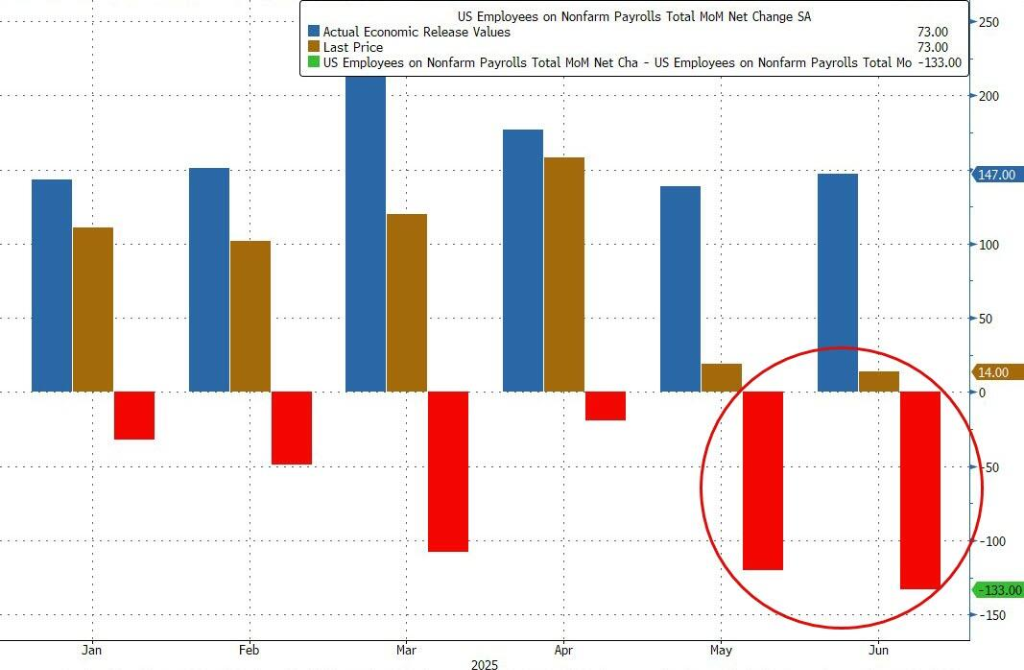
Core Viewpoint - The sudden cooling of the U.S. job market is prompting Wall Street traders and economists to recall the Federal Reserve's policy path from last summer, raising expectations for potential interest rate cuts in September [1][5]. Employment Data Overview - The latest non-farm payroll data for July shows a significant slowdown in the U.S. labor market, with only 73,000 new jobs added, far below market expectations. Additionally, the employment figures for May and June were revised down by a total of 258,000 jobs [2][4]. - The private sector added only 3,000 jobs in June and 83,000 in July, while the manufacturing sector has seen job losses for three consecutive months, averaging a decrease of 13,000 jobs per month [2]. Unemployment Rate and Labor Participation - The unemployment rate increased from 4.117% to 4.248%, with household employment surveys indicating a reduction of 260,000 jobs. The labor force participation rate has declined for three consecutive months, from 62.3% to 62.2% [4]. - The average job growth over the past three months is only 35,000 jobs, with potential revisions indicating that actual job growth may be negative [4]. Market Reactions and Federal Reserve Expectations - The unexpected weakness in the employment report has sparked discussions about the Federal Reserve potentially repeating last year's scenario of holding rates steady in July and then implementing significant cuts in September. The probability of a rate cut in September has surged from 38% to over 70% [5][6]. - According to CME data, the likelihood of a rate cut in September has risen to nearly 90%, with a 89.6% chance of a 25 basis point cut. However, the market currently sees no chance of a 50 basis point cut [6]. Inflation Concerns and Economic Outlook - A key difference from last year is the inflation concerns stemming from the Trump administration's tariffs, which could complicate the Federal Reserve's decision-making process [7]. - Analysts suggest that the Federal Reserve must determine whether the economic slowdown is a temporary phenomenon or indicative of a more profound deterioration. They expect that if the labor market remains weak, rates could be lowered below 3% next year [8].
X @Bloomberg
Bloomberg· 2025-08-04 09:30
人事变动 - Citigroup 在亚洲进行了两项重要的人事招聘,以加强对金融机构和债务资本市场的覆盖 [1] - 这些招聘是近期投资银行部门一系列高级任命的一部分 [1]