
Citi(C)

Search documents
华尔街策略师淡看经济放缓信号 坚信夏季股市仍有上行空间
智通财经网· 2025-06-10 01:55
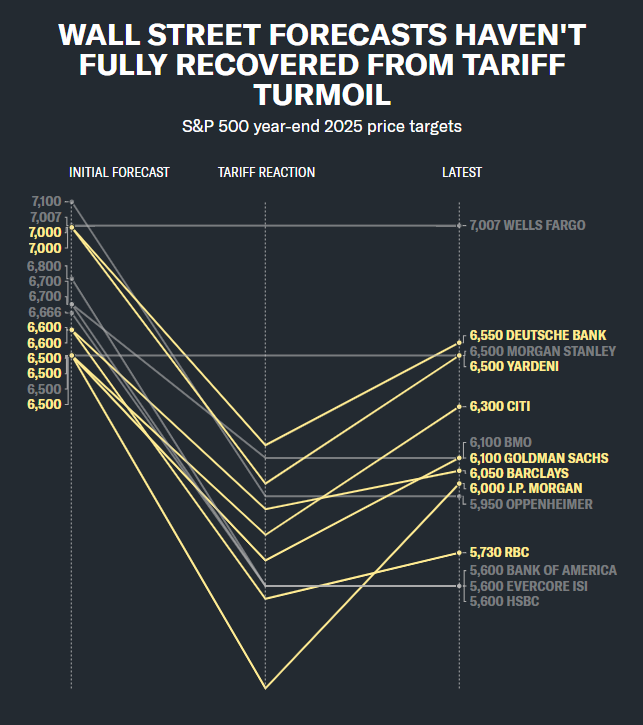
Group 1 - Despite signs of a cooling labor market and slowing economic activity, Wall Street strategists remain optimistic about summer stock market performance, maintaining S&P 500 year-end target prices in the range of 6300-6500 points, believing the worst impact of tariffs may have passed [1][4] - The S&P 500 index closed at 6010 points, approximately 2% below its historical high, following a nearly 30% correction earlier this year [1][4] - Recent economic data shows weakness, with May ADP private sector employment adding only 37,000 jobs, the lowest in over two years, and initial jobless claims rising to the highest level since October 2024 [4][5] Group 2 - Goldman Sachs' chief U.S. equity strategist, David Kostin, noted that the slowdown in economic data was anticipated, and historical analysis shows that soft economic data often bottoms out before hard economic data [5][8] - Kostin's research indicates that the correlation between the S&P 500 index returns and soft data is currently higher than that with hard data, predicting the S&P 500 could reach 6500 points in the next 12 months if the recovery in soft data continues [5][8] - Citigroup's U.S. equity strategy head, Scott Chronert, raised the S&P 500 target from 5800 to 6300 points, citing a significant reduction in trade uncertainty following the pause in tariff increases between the U.S. and China [5][8] Group 3 - Despite acknowledging potential risks from rising interest rates and high valuations, strategists believe that as long as the economic slowdown does not exceed expectations, growth sectors, particularly large tech stocks, still hold investment value [8] - The dual support from easing trade tensions and improving soft data is becoming a key basis for strategists' optimistic outlook [8]


员工被通知前1小时还在改bug,花旗中国区金融服务公司裁员4000人,有员工获补偿“N+6+3”
Hua Xia Shi Bao· 2025-06-09 23:50
华夏时报(www.chinatimes.net.cn)记者 李明会 北京报道 近日,花旗集团宣布推进全球简化工作,作为其中一部分,将精简全球技术解决中心——花旗金融信息服务(中 国)有限公司(下称"花旗金融")在上海和大连的技术人员,包含第三方人员(约500人)在内,约减少4000名技 术人员。 在此次裁员中受到影响的宋女士在接受《华夏时报》记者采访时表示,"虽然'一锅端'来得非常突然,但'N+6+3个 月带薪假'的大礼包还是让我'意满离'(网络流行语,意为满意离开)。" 此次人员调整是否影响花旗在华战略? 对此,花旗相关工作人员在6月9日接受《华夏时报》记者采访时表示,此次调整不影响花旗银行(中国)有限公 司(下称"花旗中国")。花旗坚定在中国长期发展,持续服务企业和机构客户的跨境银行需求。 突然的裁员 国家企业信用信息公示系统显示,花旗在中国内地有三家金融信息服务公司,分别在上海、大连和广州。根据公 示,位于上海和大连的两家处于存续(在营、开业、在册)状态,位于广州的公司为在营(开业)企业,而此次 裁员仅涉及上海和大连两地技术人员,包含500名外包员工在内,裁员约涉及4000人。 "仅仅保留了非常少的员工 ...

波动中把握结构性机遇!多家外资机构展望三季度投资
天天基金网· 2025-06-09 05:20
Core Viewpoint - The global investment market in Q3 is characterized by uncertainty, influenced by geopolitical factors and trade policies, presenting both challenges and opportunities for investors [1] Group 1: HSBC Insights - HSBC emphasizes the importance of structural growth in Asia, particularly in China, India, and Singapore, which are expected to mitigate some impacts of the US-China trade war [2] - The bank maintains a diversified investment strategy, adjusting its outlook for US stocks to positive, anticipating a slowdown in economic growth to 1.6% by 2025, while still facing uncertainties [2][3] - HSBC suggests a focus on quality bonds and low-correlation assets, such as gold, to enhance portfolio diversification amid ongoing geopolitical risks [3] Group 2: Standard Chartered Insights - Standard Chartered upgrades its global stock outlook to overweight, citing improved market technical indicators and resilience in economic activity and corporate earnings as key factors [4] - The bank also increases its allocation to US stocks slightly, while emphasizing the importance of diversification across major regions, particularly favoring Chinese stocks due to stimulus measures [4] - Standard Chartered lowers its stance on gold to a core holding, anticipating a period of consolidation, while still finding high-quality bonds attractive in the current yield environment [4] Group 3: OCBC Insights - OCBC highlights that the current weakness of the US dollar is influenced by trade policies, geopolitical factors, and global capital flows, rather than solely by interest rate cuts [5] - The bank advocates for a dynamic asset allocation strategy that increases exposure to safe-haven assets like gold and yen, while also focusing on currencies and equities driven by internal demand in Asia [5] - OCBC notes that some companies are shifting production to ASEAN countries, indicating a transition from simple exports to building local supply and industrial chains [5]


花旗:美国经济- 关税生效后进口暴跌
花旗· 2025-06-09 01:42
Investment Rating - The report indicates a tightening trade balance with a significant drop in imports, suggesting a potential positive impact on GDP in the second quarter [1][5][10]. Core Insights - The trade balance in April tightened to -$61.6 billion, a substantial improvement from -$138.3 billion in March, driven by a nearly 20% month-over-month decline in imports [3][5]. - The decline in imports is attributed to the implementation of substantial tariffs, front-loading of goods, and uncertainty regarding future tariff policies [1][5][7]. - Imports from China are expected to decrease further due to high tariffs of 145% that were not delayed until mid-May, impacting trade dynamics significantly [8][9]. Summary by Sections Trade Balance and Imports - The trade balance with Canada improved from -$4.9 billion to -$2.6 billion, while the balance with Mexico tightened to -$13.5 billion, reflecting declines in imports of 17.2% and 10.3% respectively [4]. - Imports from the EU fell by 35.7%, contributing to a tighter trade balance of -$17.9 billion [4]. - Overall, imports from China decreased by 18.9%, leading to a trade balance of -$19.7 billion [4]. Economic Implications - The significant drop in imports is expected to provide a mechanical boost to GDP in the second quarter, although some of this effect may be offset by weaker inventories and consumption [10]. - The effective tariff rate on goods imported to the US was around 7% as of April, indicating a substantial increase in trade costs [11][13]. Future Outlook - The report anticipates a potential rebound in imports in May as tariff clarity improves, although ongoing uncertainty and policy changes are likely to create volatility in trade data throughout the year [5][7][9].
花旗:中国经济- 中国出口追踪-出货韧性延续至 6 月
花旗· 2025-06-09 01:42
Investment Rating - The report forecasts exports to grow approximately 4% YoY in May despite tariff shocks [1][3]. Core Insights - China's shipping activities have shown resilience, with a narrowing contraction in containership departures for the US, from -32.9% YoY to -14.8% YoY in the 15 days ending June 4 [2][13]. - Overall cargo throughput in China remained steady, with a reported 4.8% YoY increase in cargo throughput volume for the week ending June 1, slightly down from 5.4% YoY the previous week [3][14]. - Container exports volume continued to exhibit double-digit growth, recorded at 12.3% YoY for the week ending May 30, although this was a decrease from 15.5% YoY a week prior [3][9]. Summary by Sections Export Trends - Exports to the US are experiencing a shallow rebound ahead of summer, but still face tariff impacts and increased volatility [2]. - US import bills from China for seaborne routes have declined significantly, down 38.8% YoY in the week ending May 31 [2][8]. Cargo Throughput - The Ministry of Transport (MoT) reported a 4.8% YoY increase in overall cargo throughput volume, indicating continued expansion in shipping activities [3][14]. - The growth in container exports volume per PortWatch/IMF was noted at 12.3% YoY, reflecting ongoing strength in the sector [3][9]. Container Departures - The contraction in container departures from China to the US has narrowed, indicating a potential recovery in shipping activities [2][13].
被裁的花旗员工:最高能拿“N+9”离职赔偿,“没有想到这么突然”
Sou Hu Cai Jing· 2025-06-06 10:42
Group 1 - Citigroup announced a significant reduction of approximately 3,500 technology personnel at its global technology solution centers in Shanghai and Dalian as part of a global workforce simplification initiative [2][4] - Including around 500 affected third-party personnel, nearly 4,000 individuals lost their jobs overnight [3][4] - The layoffs are part of Citigroup's plan to cut about 20,000 jobs by the end of 2026, which will reduce its total workforce by approximately 10% [3][4] Group 2 - Employees affected by the layoffs have the option for severance packages, with the highest compensation being "N+6+3," which includes a three-month buffer period where salaries and benefits continue [5][6] - The company has been undergoing strategic adjustments, including the sale of its personal retail wealth management business in mainland China to HSBC, affecting over 300 employees [6][7] - Citigroup's financial performance showed a revenue increase of 3% year-over-year to $81.1 billion and a net profit increase of 37% to $12.7 billion for the year 2024 [6][8] Group 3 - Citigroup has a long history in China, being the first American bank to operate there since 1902, and has been adjusting its business focus towards corporate and institutional clients [6][8] - Recent leadership changes include the appointment of Zhang Wenjie as the new president of Citigroup China, following the resignation of the previous president [8][9] - Zhang brings 30 years of experience in corporate and institutional banking, having previously held senior positions at major financial institutions [9]
花旗金融裁员近3500人 员工称涉及内网登录权限已被取消
经济观察报· 2025-06-05 21:37
Core Viewpoint - Citi Financial is undergoing a significant workforce reduction, impacting approximately 4,000 employees in its global technology solutions centers in Shanghai and Dalian as part of a global strategy to streamline operations and reduce reliance on third-party personnel [2][4][5]. Group 1: Workforce Reduction Details - Citi Financial will cut about 3,500 employees directly and around 500 third-party personnel in its Shanghai and Dalian centers [2]. - The layoffs are part of a broader global assessment of the technology department aimed at simplifying operations and reducing software and personnel dependencies [4]. - Affected employees will receive compensation based on their termination date, with three tiers of severance pay: "N+6" for those terminated by June 25, "N+3" for those between June 26 and July 16, and "N+1" for those between July 17 and September 19 [5][8]. Group 2: Operational Changes and Future Plans - The layoffs are part of a continued effort to consolidate office spaces globally, with similar reductions previously occurring in the U.S., Indonesia, the Philippines, and Poland [5]. - The Shanghai and Dalian centers previously provided fintech and operational services for Citi's global markets, but some roles will be eliminated, while others will be integrated into other technology centers [5]. - The operations, HR, and finance departments in China will remain unchanged for now, with future evaluations of personnel deployment and site strategy expected [5][10]. Group 3: Employee Communication and Support - Affected employees will still have access to internal emails and can participate in meetings via Zoom to receive updates on the situation [10]. - Starting from the announcement date, affected employees will not be able to access certain internal systems, although their salaries will continue to be paid until their departure [7][10]. - Employees have expressed mixed feelings about the layoffs, with some appreciating the severance packages while others are concerned about their financial future [8].

【财闻联播】苏超爆火,江苏景区预订猛增超300%!这家A股公司监事涉内幕交易被立案
券商中国· 2025-06-05 20:33
Macro Dynamics - The State Council has announced the fourth national agricultural census to be conducted in 2026, focusing on rural households and agricultural production conditions [1] - The People's Bank of China will conduct a 10 trillion yuan reverse repurchase operation to maintain liquidity in the banking system, with a term of 3 months [2] Automotive Industry - The retail sales of passenger cars in China reached 1.93 million units in May, a year-on-year increase of 13%, with cumulative sales of 8.80 million units in 2023, up 9% [3] - The Ministry of Commerce emphasizes the importance of the automotive industry as a pillar of the national economy and plans to enhance policies to stimulate automotive consumption [6] Sports and Tourism - The ongoing Jiangsu Province City Football League has led to a surge in tourism, with a 305% increase in scenic area bookings from June 2 to June 8 [4] Rare Earth Exports - The Ministry of Commerce stated that China will approve export license applications for rare earths that meet regulations, emphasizing the dual-use nature of these materials [5] Financial Institutions - Citigroup announced a global simplification initiative, reducing approximately 3,500 technical staff in its global technology solutions centers, but operations in China will remain unaffected [7] Market Data - The ChiNext Index rose by 1.17%, with significant gains in CPO and computing power rental concepts, while the pharmaceutical sector experienced a pullback [8] - The financing balance of the two markets increased by 22.62 billion yuan, with the Shanghai Stock Exchange reporting a balance of 907.55 billion yuan [9] Company Dynamics - Wens Foodstuff Group reported a 14.23% year-on-year increase in pig sales revenue for May, totaling 5.32 billion yuan [12] - Yara International's supervisor is under investigation for insider trading, but the company's operations remain normal [13] - Haitai Development is planning to acquire a controlling stake in Zhixueyun Technology [14] - Wentech Technology's shareholder plans to reduce its stake by up to 3% [15]




Corporate layoffs have ramped up in recent weeks. Here are the companies making cuts
CNBC· 2025-06-05 18:47
Core Insights - Mass layoffs continue to impact corporate America despite the end of government cost-cutting initiatives by Elon Musk [1][2] - Companies are under pressure to reduce costs amid global economic uncertainty, leading to layoffs as a strategy to manage expenses [2][3] Company-Specific Layoffs - Procter & Gamble plans to cut 7,000 jobs, approximately 15% of its non-manufacturing workforce, as part of a restructuring program [5][6] - Microsoft announced a reduction of about 6,000 staff, representing around 3% of its total workforce, aimed at reducing management layers [7] - Citigroup intends to cut around 3,500 positions in China, primarily affecting its IT services unit, as part of a broader plan to reduce its global workforce by 10% [10][11] - Walmart is set to eliminate about 1,500 jobs to simplify operations, affecting various teams including global technology and e-commerce fulfillment [12][13] - Klarna has reduced its workforce by 40% and plans to lay off an additional 10% globally, citing investments in AI as a key factor [14] - CrowdStrike will cut 500 employees, about 5% of its staff, attributing the layoffs to the impact of AI on the market [15] - The Walt Disney Company plans to cut several hundred jobs across various divisions as part of an efficiency initiative [16] - Chegg announced layoffs of 248 employees, or about 22% of its workforce, as it adapts to the rise of AI in education [17] - Amazon will eliminate about 100 jobs in its devices and services division, part of ongoing cost-trimming efforts [18] - Warner Bros. Discovery will lay off fewer than 100 employees as part of a reorganization into two divisions [19]





花旗集团在华减员约3500人花旗银行(中国)不受影响
Zheng Quan Shi Bao· 2025-06-05 17:57
Group 1 - Citigroup announced a reduction of approximately 3,500 technology personnel in its global technology and business support departments as part of its ongoing efforts to streamline operations [1] - The adjustments will not affect Citibank (China) Co., Ltd. or its Guangzhou global technology solutions center [1] - The restructuring aims to simplify organizational structure, reduce reliance on third-party personnel, and decrease the scale of software used, aligning with Citigroup's 2025 financial plan [1] Group 2 - Citigroup emphasized its commitment to continue investing in its business in China to support corporate and institutional clients [2] - The company is seeking to establish a wholly-owned securities and futures company in China [2] - Zhang Wenjie has been appointed as the President of Citigroup China and will oversee business development and operational management [2]