
salesforce(CRM)

Search documents
[DowJonesToday]Dow Jones Rallies as Software Giants Rebound Amid AI Optimism
Stock Market News· 2026-02-25 12:10
Market Overview - The Dow Jones Industrial Average increased by 370.44 points (+0.7590%) to reach 49,174.50, indicating a recovery from recent market volatility [1] - A significant rebound in the enterprise software sector was a primary driver of this market movement, alleviating investor concerns about the impact of artificial intelligence [1] - Dow Futures also showed positive movement, up 126.00 points (+0.2559%) to 49,362.00, reflecting a shift in trader sentiment [1] Key Company Performances - Salesforce (CRM) led the gains, rising by 3.41% to $185.42, with investor optimism surrounding its Agentforce platform and monetization of autonomous AI agents [2] - IBM (IBM) saw a 3.34% increase to $229.32, recovering from previous sector concerns [2] - Other technology companies contributing to the index's strength included Apple (AAPL), up 2.41% to $272.14, and Amazon (AMZN), up 1.91% to $208.56 [2] Sector Performance - The healthcare sector was a notable laggard, with UnitedHealth Group (UNH) declining by 3.10% to $273.95 due to challenges from a rising Medical Care Ratio (MCR) and disappointing Medicare Advantage enrollment figures for 2026 [3] - Other decliners in the healthcare sector included Travelers (TRV), down 0.79%, and McDonald's (MCD), down 0.35% [3] - Despite the healthcare sector's struggles, the Dow was supported by strong performances from Home Depot (HD), which rose by 2.05% to $384.48, and Caterpillar (CAT), up 1.59% [3]



一边650亿神话,一边SaaS崩塌:AI牛市的终极审判夜
美股研究社· 2026-02-25 11:33
Core Viewpoint - The upcoming earnings reports from NVIDIA and Salesforce represent a critical moment in the AI era, highlighting a clash between infrastructure (NVIDIA) and application (Salesforce) business models [1][3]. Group 1: NVIDIA Insights - NVIDIA is expected to report quarterly revenue approaching or challenging $65 billion, driven by its data center business and significant investments in computing power from cloud providers and sovereign funds [5]. - The growth of NVIDIA's revenue is heavily reliant on a few tech giants, and any signals of a slowdown in capital expenditure or order delivery could shift market sentiment from "supply shortage" to "peak cycle" concerns [5][6]. - The valuation of NVIDIA is based on two assumptions: sustained long-term growth in AI inference and training demand, and the ability to maintain high gross margins due to technological barriers [5]. Group 2: Salesforce Insights - Salesforce has faced significant declines this year, driven by investor fears that AI could replace traditional software functions, threatening the value of SaaS models [7]. - The emergence of AI as an "orchestration layer" suggests that rather than replacing SaaS, AI may force it to evolve, as existing systems' data and processes are essential for AI to generate accurate outputs [7][9]. - If Salesforce's earnings report shows stable orders and that AI products enhance average revenue per user (ARPU), it could alleviate fears of a "software apocalypse" and lead to a technical rebound in the sector [8][9]. Group 3: Market Dynamics - The current market split reflects the varying stages of the AI industry chain, with the first phase focused on infrastructure and the second on application and business model validation [10]. - If NVIDIA continues to grow while SaaS shows a slowdown, it indicates that AI remains in the infrastructure expansion phase, potentially leading to concerns about a "hardware bubble" due to a lack of cash flow from applications [10][11]. - The performance of both companies will be crucial in determining the future direction of the market, with NVIDIA representing "the height of belief" and Salesforce embodying "the depth of reality" [14].


Software Stocks: Navigating the SaaSpocalypse
Investing· 2026-02-25 10:13
Group 1 - The article provides a market analysis focusing on major indices such as Nasdaq 100 and SPDR® S&P 500® ETF Trust, indicating trends and performance metrics [1] - It highlights the performance of Invesco QQQ Trust, noting its significance in tracking the tech-heavy Nasdaq index [1] - Salesforce Inc. is mentioned as a key player in the market, with insights into its financial performance and market positioning [1]


Salesforce Gears Up For Q4 Print; Here Are The Recent Forecast Changes From Wall Street's Most Accurate Analysts
Benzinga· 2026-02-25 09:25
Core Viewpoint - Salesforce, Inc. is set to release its fourth-quarter earnings on February 25, with expectations of increased earnings per share and revenue compared to the previous year [1]. Financial Performance - Analysts anticipate Salesforce will report earnings of $3.04 per share, an increase from $2.78 per share in the same quarter last year [1]. - The consensus estimate for quarterly revenue is $11.18 billion, up from $9.99 billion reported in the previous year [1]. Analyst Expectations - The company has exceeded revenue estimates in seven of the last ten quarters, although it missed expectations in the most recent third quarter [2]. - Salesforce shares rose by 4.1% to close at $185.42 on Tuesday [2].
AI智能体收费关卡来袭?软件企业思考如何应对AI风险
Xin Lang Cai Jing· 2026-02-25 09:19
Core Insights - The software industry is facing significant uncertainty due to the impact of AI agents, leading to investor concerns about the future of the sector [3][22] - HubSpot's CEO indicated that the company plans to monitor and monetize data extraction by AI agents, contrasting with the traditional model of free data flow among applications [4][23] - Major software companies have seen stock prices drop by 20% to 30% this year, with fears that AI agents could reduce the demand for individual user licenses [3][22] Group 1 - HubSpot's CEO's comments suggest a shift towards charging for data access, moving away from the open data sharing model that has characterized the industry for over two decades [4][27] - Concerns about security risks associated with allowing AI agents access to sensitive enterprise data are growing, with potential threats from hackers and misconfigured AI [4][23] - Executives from traditional software companies are attempting to reassure investors and employees about their market positions amid rising competition from AI startups [5][25] Group 2 - The introduction of new AI products by companies like OpenAI and Anthropic has intensified investor anxiety regarding the software industry's future [6][26] - Some companies are already using AI agents to reduce reliance on traditional software, as seen in Valvoline's case, where they saved approximately $115,000 by automating cybersecurity tasks [34][36] - The competitive landscape is shifting, with companies like Microsoft and ServiceNow emphasizing their unique advantages over AI startups while also expressing concerns about the implications of AI advancements [12][31]





Navatar Launches AI-Powered CRM Operating Model On Salesforce for Alternative Asset Managers
Globenewswire· 2026-02-25 06:00
Core Insights - Alternative assets have transitioned from niche allocations to essential components of institutional and wealth portfolios, prompting managers to explore diverse strategies and channels as competition increases and limited partners (LPs) demand more transparency [1] Group 1: Industry Trends - Private markets managers are currently operating in siloed data environments, and to fully leverage AI, they need coherent operating models rather than isolated tools [2] - The demand for transparency and efficiency in alternative asset management is driving the need for advanced operating models that minimize manual work [1][2] Group 2: Navatar's AI-Powered Model - Navatar has developed an AI-powered CRM operating model that features a single AI Deal Engine, which integrates various functions such as sourcing, diligence, capital deployment, and investor engagement [3] - The AI continuously captures intelligence and maintains institutional context, automating workflows across the private markets lifecycle without relying on manual updates [3] Group 3: Functionality and Applications - Navatar's AI is designed to serve as a firm-wide intelligence layer for both multi-strategy platforms and focused managers, capturing signals from daily workflows and transforming them into actionable insights [4] - In the origination phase, the AI maps networks and identifies early signals, helping teams prioritize opportunities based on historical data [5] - The model extends to capital formation and investor relations, interpreting engagement across various channels and linking it to deal activity for improved fundraising precision [6] Group 4: Security and Compliance - The AI operating model is built to meet the confidentiality and regulatory requirements of alternative asset managers, ensuring client data remains secure and is not exposed to public AI models [7] - The platform includes safeguards to enhance accuracy, completeness, and traceability in critical decision-making processes [7] Group 5: Market Applications - Navatar's platform supports various sectors within private markets, including private equity, venture capital, private credit, and real estate, by providing insights that enhance decision-making and risk evaluation [8] - The AI facilitates connections between technical, operational, and market data, allowing teams to better assess value creation opportunities [8]

《2028全球智能危机》:一篇雄文引发股市恐慌背后的十个逻辑
3 6 Ke· 2026-02-25 05:52
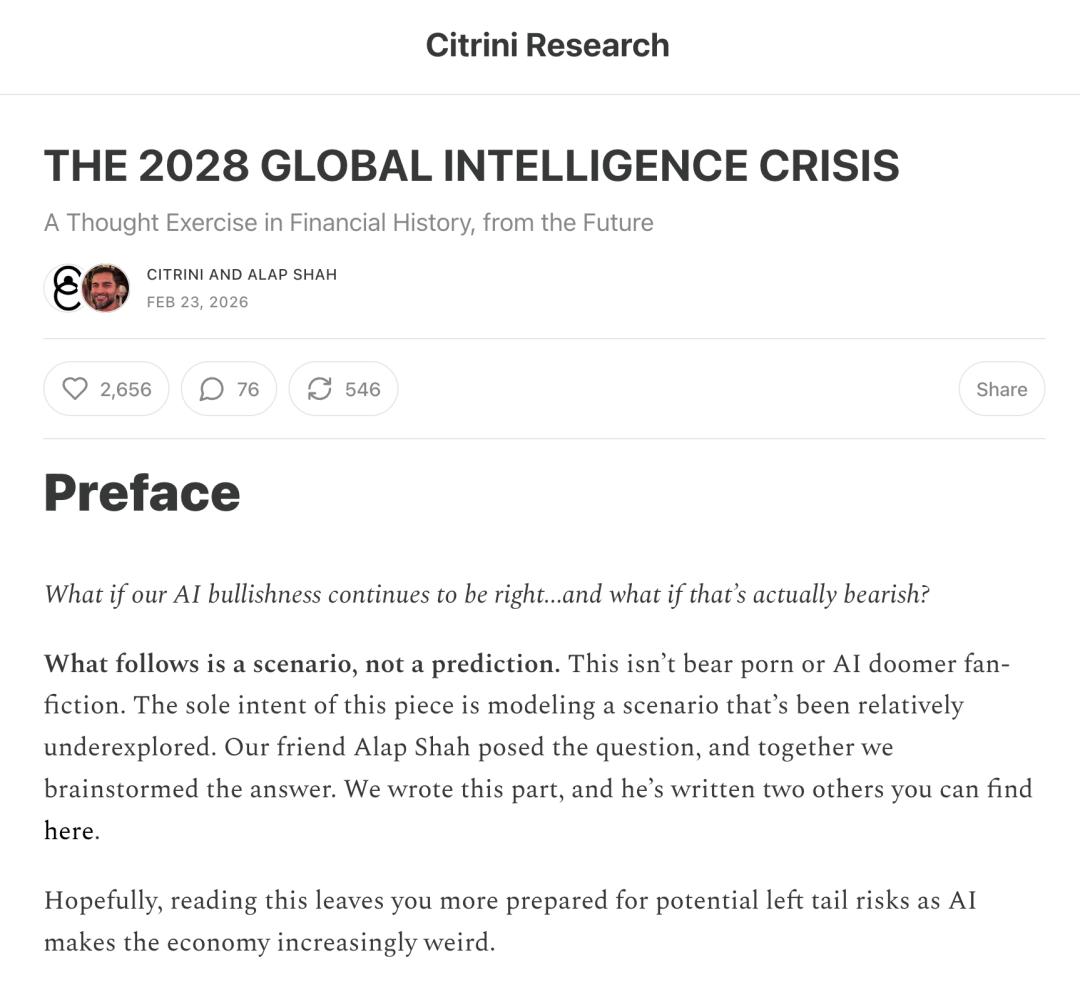
Core Viewpoint - The article discusses the potential risks associated with the rapid advancement of AI technology, suggesting that the optimism surrounding AI may signal a bear market rather than economic growth. It highlights the disconnect between GDP growth driven by AI and the actual economic benefits experienced by the general population [5][45]. Group 1: Market Reaction - On February 23, 2026, the U.S. stock market experienced a significant drop, with the Dow Jones falling over 800 points and only 27% of stocks rising [5]. - Major companies like DoorDash, MongoDB, ServiceNow, and Salesforce saw declines of 7%, 6%, and 4% respectively, while financial firms like American Express and KKR dropped over 8% [5]. Group 2: Economic Implications of AI - The article introduces the concept of "Ghost GDP," where economic output increases without benefiting the average person, as AI-driven productivity bypasses human consumption [7][25]. - A negative feedback loop is described, where AI advancements lead to layoffs, which in turn drive further investment in AI, perpetuating job losses without a self-correcting mechanism [9][10]. Group 3: Corporate Behavior - Companies threatened by AI, such as ServiceNow, are becoming aggressive adopters of AI technologies, often resulting in significant layoffs to fund these investments [12][19]. - The article notes that traditional companies are rapidly embracing AI due to the immediate threats they face, contrasting with past scenarios where new entrants disrupted established firms [19][20]. Group 4: Consumer Spending Dynamics - The article emphasizes that machines do not spend money, which poses a risk to the consumer-driven economy, as 70% of U.S. GDP is derived from human consumption [25]. - The impact of white-collar job losses on consumer spending is highlighted, noting that the affluent contribute significantly to overall consumption, and their job losses could lead to a substantial decline in spending [29][30]. Group 5: Financial Sector Risks - The growth of private credit in the U.S. has led to increased funding for software companies, which may face revenue declines as AI replaces traditional roles [30][31]. - The article warns that even high-quality mortgage loans may become problematic as borrowers lose jobs or face salary reductions due to AI advancements [33][34]. Group 6: Policy Limitations - Traditional monetary policy tools, such as interest rate cuts, may not effectively address the structural unemployment caused by AI advancements [36][38]. - The article argues that existing economic frameworks are based on the assumption of human labor scarcity, which is being challenged by AI's capabilities [40][41].


The AI Stock That Insiders Are Loading Up On for 2026
The Motley Fool· 2026-02-25 04:41
Core Insights - Insider buying is a strong bullish indicator, particularly relevant for assessing the future performance of stocks, especially in the AI sector [1][2] - The actions of insiders, who have better knowledge of the company's internal situation, can provide insights into the potential rise in stock prices [2] Company Overview: Salesforce - Salesforce has experienced a challenging market performance, with shares down 30% year-to-date as of February 19 [5] - The company has had limited insider activity recently, with only four transactions recorded: two buys and two sells [5] Insider Transactions - Harris Parker, co-founder of Salesforce, sold $31.6 million in shares in December 2025 as part of a pre-planned 10b5-1 plan, which is not indicative of the company's performance [6] - Neelie Kroes, a director, sold 3,893 shares for $929,276 in January 2026, but the reasons for such sales can vary [7] - On the buying side, Kirk David Blair, a director, purchased 1,936 shares for $500,722 in mid-December 2025, signaling confidence in Salesforce's future [9] - The most significant purchase was made by Mason Morfit, co-CEO of ValueAct Capital, whose firm bought $25 million worth of Salesforce shares on December 5, indicating strong confidence in the company's prospects [10] Insider Buying Summary - Excluding the 10b5-1 sales, net insider buying totaled approximately $24.6 million over the past three months, suggesting positive sentiment among insiders [11] - Upcoming fiscal results for 2026 are anticipated on February 25, with a product release planned for February 23, 2026, which will introduce new AI capabilities [11]
AI颠覆软件行业商业模式?美股SaaS公司股价大跌,如何转型?
Xin Lang Cai Jing· 2026-02-25 03:19
Core Insights - The article discusses the significant impact of AI on the SaaS industry, particularly following the launch of Anthropic's AI tool for legal services, which caused a sharp decline in stock prices of major SaaS companies and raised concerns about the traditional subscription model [3][4][5]. Group 1: Stock Price Decline - The launch of Anthropic's AI tool led to a single-day stock price drop of over 13% for legal information service giants like WEX Group and LexisNexis, triggering a broader sell-off in the software industry [3][5]. - The S&P North American Software Index saw a cumulative decline of 15% in January 2026, marking its worst monthly performance since the 2008 financial crisis [6]. - The term "SaaSpocalypse" was coined to describe the drastic sell-off in the SaaS sector, with over $1 trillion in market value evaporating from software companies [3][6]. Group 2: Challenges to Subscription Model - The traditional SaaS business model, which relies on a "seat-based payment" system, is being challenged by AI's ability to automate tasks previously requiring multiple employees [4][5]. - Companies like Salesforce and Intuit experienced significant stock price drops, with Salesforce's stock down 23% year-to-date and 30% from its peak in December 2025 [8][5]. Group 3: Need for Valuation Restructuring - IT budgets are becoming increasingly fixed, with major tech companies like Amazon and Alphabet allocating substantial funds (approximately $200 billion and $175-185 billion respectively) towards AI infrastructure, thereby squeezing traditional SaaS budgets [7]. - The shift in IT spending from traditional software to AI solutions has led to a reevaluation of SaaS company valuations, moving from a user-based growth model to a performance-based payment model [10][11]. Group 4: Transformation Paths for Leading Companies - Major SaaS companies like Salesforce and Microsoft are restructuring their products to create AI-native enterprise service systems rather than simply adding AI as a feature [14][15]. - Salesforce's transition has faced challenges, including a significant layoff of 4,000 customer service positions, which later resulted in service quality issues and increased customer complaints [17][19]. - Adobe has adopted a different strategy by integrating AI deeply into its Creative Cloud, allowing users to pay extra for AI features rather than reducing seat licenses [20][21]. Group 5: Industry Reconstruction Insights - The impact of AI on the SaaS industry represents a "value reconstruction" rather than a complete industry replacement, emphasizing the need for SaaS companies to redefine their core value propositions [23]. - Future software business models may evolve into hybrid models, performance-based models, or platform models, with no single approach suitable for all companies [25][26][27]. - Investors are encouraged to shift their focus from user growth to AI monetization capabilities and the quality of profits [30]. Group 6: Implications for IT Professionals - Companies must redefine product value by focusing on business outcomes rather than merely listing features, as clients prioritize efficiency and cost reduction [31][33]. - The traditional seat-based payment model is becoming obsolete, necessitating a shift to performance-based or usage-based pricing structures [34]. - Establishing industry-specific expertise and trust with clients is crucial for SaaS companies to maintain a competitive edge in the AI era [35][36].


杰富瑞下调Salesforce目标价至250美元
Ge Long Hui· 2026-02-25 03:11
杰富瑞将Salesforce的目标价从375美元下调至250美元,维持"买入"评级。(格隆汇) 相关事件 美股异动丨赛富时跌超5%,遭大摩大幅下调目标价 大摩:将赛富时目标价大幅下调至287美元 ...