Chevron(CVX)

Search documents
深夜,跳水!特朗普,签令
Zhong Guo Ji Jin Bao· 2025-08-12 00:59
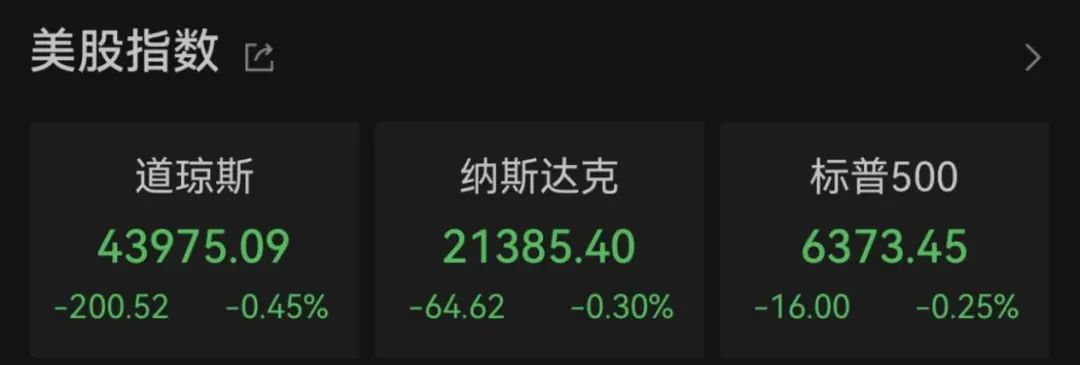
Market Overview - The US stock market opened the week with declines, with the Dow Jones falling by 200.52 points (0.45%) to close at 43,975.09 points, the Nasdaq down by 64.62 points (0.30%) at 21,385.40 points, and the S&P 500 decreasing by 16.00 points (0.25%) to 6,373.45 points [2] - A record proportion of fund managers, approximately 91%, believe that US stocks are currently overvalued, marking the highest level since 2001 [4] - Hedge funds net sold $1 billion in US stocks last week, while institutional investors focused on long positions bought $4 billion [4] Technology Sector - Nvidia and AMD have reached an agreement with the Trump administration to pay 15% of their revenue from chips sold to China to the US government in exchange for export licenses [5][7] - Nvidia will pay 15% of its revenue from H20 chips sold in China, while AMD will do the same for MI308 chips [7] - Major tech stocks mostly declined, with Apple down 0.83%, Amazon down 0.62%, and Nvidia down 0.3% [5] Energy Sector - Energy stocks experienced a broad decline, with ExxonMobil down 0.87%, Chevron down nearly 1%, and ConocoPhillips down 0.39% [8][9] - WTI crude oil prices remained stable, closing at $63.99 per barrel [8] Gold Market - Gold prices fell significantly, with spot gold dropping 1.6% to a low of $3,341.25 per ounce, marking a new low in over a week, while December futures fell 2.5% to settle at $3,404.70 per ounce [10] - The decline in gold prices is attributed to multiple negative factors, including Trump's exemption on gold tariffs, the extension of the US-China trade truce, and market anxiety over upcoming US inflation data [10]


Despite Lower Crude Prices, These Top Oil Stocks See Massive Free Cash Flow Gushers Ahead
The Motley Fool· 2025-08-12 00:06
Core Insights - The decline in crude oil prices has negatively impacted cash flows for most oil producers, with Brent prices falling over 15% from the low $80s to the mid-$60s [1] - However, companies like Chevron and ConocoPhillips are expected to generate significant incremental free cash flow in the coming years, which could enhance total returns for investors [2] Chevron - Chevron generated $8.6 billion in cash flow from operations in Q2, up from $5.2 billion in Q1, despite lower oil and gas prices [3] - The company anticipates an increase in annual free cash flow by $10 billion next year, aided by structural cost savings and the acquisition of Hess, which will add another $2.5 billion, totaling $12.5 billion in additional cash flow [4] - Chevron returned over 100% of its free cash flow in Q2, distributing $2.9 billion in dividends and repurchasing $2.6 billion in stock, while maintaining a low net debt ratio of 14.8% [5] ConocoPhillips - ConocoPhillips generated $4.7 billion in cash from operations in Q2, despite a 19% drop in realized oil and gas prices, and closed $700 million in noncore asset sales [6] - The company expects surplus cash to improve in the second half of the year, driven by higher distributions from its joint venture and tax benefits [7] - The acquisition of Marathon Oil is yielding better-than-expected synergies, with anticipated benefits rising from $500 million to over $1 billion by year-end, and an additional $1 billion expected by 2026 [8] - Long-cycle investments in liquefied natural gas and Alaska are projected to add $6 billion to annual free cash flow by 2029, leading to a total increase of $7 billion when combined with Marathon synergies [9] Industry Outlook - Both Chevron and ConocoPhillips have made substantial investments in acquisitions and organic growth projects, which are driving significant free cash flow growth [11] - These developments position the companies to continue increasing dividends and share repurchases, potentially creating substantial value for shareholders even in a low oil price environment [11]

石油巨头上半年业绩集体大幅缩水,行业转型或仍在加速
Xin Hua Cai Jing· 2025-08-11 10:56
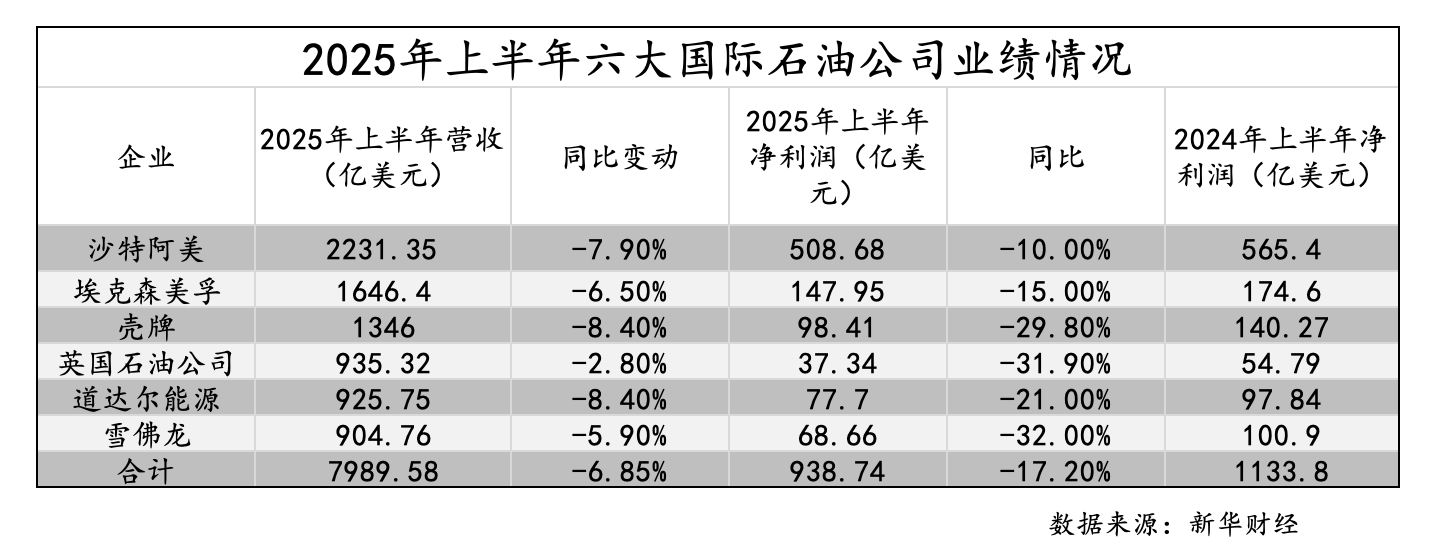
Core Viewpoint - The global oil industry is facing significant profitability challenges due to declining oil prices, with major oil companies reporting substantial decreases in revenue and net profit for the first half of 2025 compared to the previous year [1][3]. Group 1: Oil Price Trends - WTI crude oil futures averaged $67.52 per barrel in the first half of 2025, a year-on-year decline of 14.33%, while Brent averaged $70.81 per barrel, down 15.11% [1]. - Global crude oil inventories are expected to continue increasing, with an average daily growth of approximately 1.2 million barrels in the first half of 2025, maintaining a growth trend of 900,000 barrels per day in the second half [6]. Group 2: Financial Performance of Major Oil Companies - The combined adjusted profit of six major international oil companies, including Saudi Aramco, BP, Shell, Chevron, TotalEnergies, and ExxonMobil, was approximately $93.874 billion in the first half of 2025, a decrease of 17.2% from $113.38 billion in the same period of 2024 [1][2]. - Saudi Aramco reported a revenue of $223.135 billion, down 7.9%, and an adjusted net profit of $50.868 billion, down 10% [2][3]. - Other companies experienced even larger declines, with Chevron's adjusted net profit falling by 32% and BP's net profit dropping from $5.379 billion to $3.734 billion [3]. Group 3: Challenges and Strategic Responses - The oil companies are grappling with a "volume increase, price drop" dilemma, where rising transaction volumes only partially offset the impact of falling oil prices [3]. - Companies are increasingly focusing on energy transition and diversification to mitigate the risks associated with oil price volatility. For instance, Saudi Aramco is expanding its natural gas production and trade [7]. - Despite these efforts, companies face challenges in their transition strategies due to external environmental changes and internal strategic misjudgments, as seen with Shell's reduction in renewable energy investments and TotalEnergies' scaling back of solar energy goals [8]. Group 4: Future Outlook - The outlook for oil prices remains pressured, with major energy agencies predicting a continued oversupply in the global oil market through 2026, leading to sustained downward pressure on prices [5][6]. - Long-term strategies for achieving carbon neutrality are being set by companies, with China Petroleum aiming for a significant reduction in carbon emissions by 2040 and a balanced approach between oil, gas, and new energy by 2050 [8].



深度起底 “股神” 巴菲特的传奇人生:表面亏50%,实则大赚60%!
Sou Hu Cai Jing· 2025-08-11 07:36
Group 1 - Warren Buffett's Berkshire Hathaway reported a significant asset write-down of $3.8 billion on its investment in Kraft Heinz, reducing its book value to $8.4 billion from over $17 billion at the end of 2017 [4] - Despite the apparent loss, an analysis revealed that Buffett had secured nearly 60% profit due to favorable terms negotiated during the transaction, showcasing his ability to turn a perceived failure into a profitable outcome [4][5] - Buffett's investment philosophy emphasizes long-term value and strategic positioning, which has allowed him to navigate market fluctuations effectively [5] Group 2 - Buffett's cautious outlook on the current U.S. stock market is evident, as he believes the S&P 500's price-to-earnings ratio exceeding 30 indicates inflated growth expectations, suggesting potential historical investment opportunities in the next five years [16] - Berkshire Hathaway's cash reserves reached a record high of $344 billion, providing a robust buffer against market volatility as Buffett prepares to pass the reins to his successor, Greg Abel [21] - The company holds a diversified portfolio, with significant investments in Apple, American Express, and Coca-Cola, which together account for over 50% of its stock investment portfolio [18][19] Group 3 - Buffett's investment strategy includes a focus on companies with strong fundamentals, as evidenced by his long-term holdings in Coca-Cola and Apple, which have shown resilience and growth despite market challenges [27][29] - The investment approach is characterized by a preference for businesses with a competitive edge and sustainable cash flow, avoiding speculative trends such as AI investments that do not align with his expertise [20][32] - Buffett's principles emphasize the importance of understanding the intrinsic value of investments, advocating for a long-term perspective rather than short-term speculation [28][30] Group 4 - Buffett's philanthropic efforts include significant donations to charitable causes, particularly the Gates Foundation, reflecting his belief in responsible wealth distribution and opposition to hereditary wealth [36] - His lifestyle remains modest despite immense wealth, highlighting a commitment to simplicity and frugality, which has become a notable aspect of his public persona [36]



美国石油巨头巩固行业优势
Zhong Guo Hua Gong Bao· 2025-08-11 02:47
伍德麦肯兹预测,埃克森美孚二叠纪产量将在2030年前增长55%至230万桶油当量/日,并持续稳定至 2040年;雪佛龙产量预计增长25%,2030年达120万桶油当量/日。对两家巨头而言,二叠纪盆地贡献的产 量均接近总产量的三分之一,这片陆上产区不仅成本低廉,还拥有完善的基础设施网络。其优势不仅在 于规模,更在于韧性,即使美国活跃钻机总数持续下降,这些油气巨头仍通过人工智能和先进分析技术 有效控制单井成本,持续提升采收率。 来自油价网的市场人士补充道,二叠纪的战略价值不仅源于规模,更在于其独特的地质条件、基础设施 与灵活性:数千口已钻未完井、充足的管道外输能力以及中游网络,使运营商能比全球任何其他地区更 快调节生产节奏。相比之下,欧洲巨头则面临不同境遇,在二叠纪石油竞赛中,欧洲企业仍处追赶状 态,且当前入场门槛高企。油价网称,若欧洲巨头不能采取更大胆举措,美欧油气企业间的差距还会日 益扩大。 伍德麦肯兹发布数据显示,美国本土48州原油及凝析油产量已达历史新高1130万桶/日,但即将触及峰 值。该机构预测,今年年底产量将开始缓慢下降,到2027年将减少50万桶/日。但对于主导二叠纪盆地 的埃克森美孚和雪佛龙而言 ...
Top Wall Street analysts recommend these dividend stocks for steady income
CNBC· 2025-08-10 12:00
Core Viewpoint - The article discusses dividend-paying stocks as a stable income option for investors amid fluctuating trade policies, highlighting recommendations from top Wall Street analysts [1]. Chevron (CVX) - Chevron reported market-beating earnings for Q2, although earnings declined year-over-year due to lower oil prices [2]. - The company returned $5.5 billion to shareholders in Q2 through share repurchases of $2.6 billion and dividends of $2.9 billion, with a dividend yield of 4.4% [3]. - Morgan Stanley analyst Devin McDermott resumed coverage with a buy rating and a price target of $174, while TipRanks' AI Analyst has an "outperform" rating with a price target of $171 [3]. - The recent Hess acquisition is expected to enhance Chevron's growth and portfolio duration, removing a major overhang [4]. - McDermott noted that Chevron's free cash flow yield for 2026 is projected at 8%, compared to Exxon Mobil's 6% and ConocoPhillips' 7% [5]. Rithm Capital (RITM) - Rithm Capital announced better-than-expected Q2 results, paying a dividend of 25 cents per share, resulting in an annualized dividend yield of 8.2% [7]. - RBC Capital analyst Kenneth Lee raised the price forecast for RITM stock to $14 from $13, maintaining a buy rating [8]. - Rithm's Q2 earnings available for distribution (EAD) were 54 cents per share, exceeding estimates, leading to an increase in EAD estimates for 2025 and 2026 [9]. - The company is focusing on growth and return on equity enhancement, with notable cost benefits from AI initiatives [10]. AT&T (T) - AT&T delivered better-than-expected Q2 earnings, driven by strong wireless equipment revenues, and offers a quarterly dividend of $0.2775 per share, resulting in a dividend yield of about 4% [12]. - RBC Capital analyst Jonathan Atkin reiterated a buy rating with a price target of $31, while TipRanks' AI Analyst has a neutral rating with a price target of $30 [13]. - The company's revised 2025 guidance reflects cash tax benefits and an improved trajectory in the Wireline business, with free cash flow outlook adjusted to the low-to-mid $16 billion range [15]. - AT&T's free cash flow outlook for 2026 and 2027 was increased by $1 billion, supporting management's focus on capital investments for long-term growth [16].


ExxonMobil Raises Guyana Oil Capacity To 900,000 Barrels Per Day
Forbes· 2025-08-08 16:00
Core Insights - ExxonMobil has successfully launched its fourth deepwater project, Yellowtail, which has a production capacity of 250,000 barrels of oil per day (bpd), increasing the total Stabroek capacity to 900,000 bpd, surpassing previous expectations [3][4] - The Yellowtail project is a significant milestone for ExxonMobil and reflects the company's commitment to long-term growth in Guyana, with over 67% of the oil-and-gas workforce being Guyanese and more than 2,000 local businesses involved [4] - The Stabroek operations are on track to reach a production capacity of 1.7 million bpd by 2030, positioning Guyana among the top 15 oil-producing nations globally [4] Company Operations - ExxonMobil operates the Stabroek consortium with a 45% working interest, while CNOOC holds 25% and Chevron owns 30% following a successful arbitration case [6] - The Yellowtail operations utilize the ONE GUYANA floating production, storage, and offloading (FPSO) vessel, which has a storage capacity of 2 million barrels and an initial production capacity of 250,000 bpd [7] Economic Impact - Guyana has become the fastest-growing economy globally since 2020, with the government generating $6.2 billion in revenues by the end of 2024, and projections indicate revenues could reach $10 billion annually by 2030 [8][9] - Cumulative investments by the consortium partners in Guyana have reached $55 billion, with expectations for continued growth as the project expands [9]


Chevron (CVX) Reports Q2 Earnings: What Key Metrics Have to Say
ZACKS· 2025-08-07 18:01
Core Insights - Chevron reported a revenue of $44.82 billion for the quarter ended June 2025, reflecting a 12.4% decrease year-over-year and a surprise of -4.89% compared to the Zacks Consensus Estimate of $47.12 billion [1] - The earnings per share (EPS) for the quarter was $1.77, down from $2.55 in the same quarter last year, with an EPS surprise of +4.12% against the consensus estimate of $1.70 [1] Financial Performance - Chevron's total net oil-equivalent production reached 3,396 million barrels, exceeding the average analyst estimate of 3,325.97 million barrels [4] - U.S. upstream net oil-equivalent production per day was 1,695 million barrels, surpassing the four-analyst average estimate of 1,675.02 million barrels [4] - International upstream net oil-equivalent production per day was 1,701 million barrels, exceeding the four-analyst average estimate of 1,651.44 million barrels [4] - U.S. upstream net natural gas production per day was 2,864 Mcf/D, slightly above the three-analyst average estimate of 2,826.53 Mcf/D [4] - Worldwide net natural gas production per day was 7,963 Mcf/D, exceeding the three-analyst average estimate of 7,851.63 Mcf/D [4] - Worldwide net crude oil and natural gas liquids production per day was 2,068 million barrels, surpassing the three-analyst average estimate of 2,024.02 million barrels [4] Revenue Breakdown - Other income reported was -$89 million, significantly lower than the estimated $182.25 million, representing a -122.2% change year-over-year [4] - Income from equity affiliates was $536 million, slightly above the estimated $526.15 million, but down -55.6% compared to the year-ago quarter [4] - Sales and other operating revenues totaled $44.38 billion, compared to the average estimate of $44.6 billion, reflecting a -10.5% year-over-year change [4] Stock Performance - Chevron's shares returned -0.2% over the past month, while the Zacks S&P 500 composite increased by +1.2% [3] - The stock currently holds a Zacks Rank 3 (Hold), indicating potential performance in line with the broader market in the near term [3]
Chevron(CVX) - 2025 Q2 - Quarterly Report
2025-08-07 14:18
[PART I FINANCIAL INFORMATION](index=4&type=section&id=PART%20I%20FINANCIAL%20INFORMATION) This section presents Chevron's comprehensive financial information, including consolidated statements, management's analysis, market risk disclosures, and internal controls [Consolidated Financial Statements](index=4&type=section&id=Item%201.%20Consolidated%20Financial%20Statements) This section presents Chevron's consolidated financial statements, including income, balance sheet, and cash flow, highlighting a decrease in net income and total assets for the first half of 2025 [Consolidated Statement of Income](index=4&type=section&id=Consolidated%20Statement%20of%20Income) Chevron reported a significant decrease in net income and diluted EPS for Q2 and the first six months of 2025, primarily due to lower revenues Consolidated Statement of Income Highlights (in Millions, except per-share amounts) | Metric | Q2 2025 | Q2 2024 | Change | Six Months 2025 | Six Months 2024 | Change | | :--- | :--- | :--- | :--- | :--- | :--- | :--- | | **Total Revenues and Other Income** | $44,822 | $51,181 | -12.4% | $92,432 | $99,897 | -7.5% | | **Net Income Attributable to Chevron** | $2,490 | $4,434 | -43.8% | $5,990 | $9,935 | -39.7% | | **Diluted EPS** | $1.45 | $2.43 | -40.3% | $3.45 | $5.40 | -36.1% | [Consolidated Balance Sheet](index=6&type=section&id=Consolidated%20Balance%20Sheet) As of June 30, 2025, Chevron's total assets and stockholders' equity decreased, primarily due to reduced cash and share repurchases, while total liabilities remained stable Consolidated Balance Sheet Highlights (in Millions) | Metric | June 30, 2025 | Dec 31, 2024 | | :--- | :--- | :--- | | **Total Current Assets** | $34,691 | $40,911 | | **Total Assets** | $250,820 | $256,938 | | **Total Current Liabilities** | $34,827 | $38,558 | | **Long-Term Debt** | $23,276 | $20,135 | | **Total Liabilities** | $103,562 | $103,781 | | **Total Chevron Stockholders' Equity** | $146,417 | $152,318 | [Consolidated Statement of Cash Flows](index=7&type=section&id=Consolidated%20Statement%20of%20Cash%20Flows) Net cash from operations increased slightly for the first half of 2025, while investing activities saw higher outflows due to the Hess acquisition, and financing outflows decreased Consolidated Statement of Cash Flows Highlights (Six Months Ended June 30, in Millions) | Activity | 2025 | 2024 | | :--- | :--- | :--- | | **Net Cash Provided by Operating Activities** | $13,765 | $13,123 | | **Net Cash Used for Investing Activities** | ($9,050) | ($7,910) | | **Net Cash Used for Financing Activities** | ($7,649) | ($9,428) | | **Net Change in Cash** | ($2,887) | ($4,310) | [Notes to Consolidated Financial Statements](index=8&type=section&id=Notes%20to%20Consolidated%20Financial%20Statements) Detailed notes reveal significant decreases in Upstream earnings, ongoing litigation, the completion of the Hess acquisition, and the issuance of new long-term debt - On July 18, 2025, the company completed the acquisition of Hess Corporation for an aggregate purchase price of approximately **$48 billion**, including assumed debt of **$8.8 billion**[101](index=101&type=chunk)[102](index=102&type=chunk) - The company is a defendant in **33 climate change-related lawsuits** across the U.S. and **37 coastal erosion lawsuits** in Louisiana, with a **$131 million** accrual for one case despite plans to appeal[59](index=59&type=chunk)[60](index=60&type=chunk) - In Q1 2025, the company issued **$5.5 billion** in new long-term debt, with maturities ranging from 2027 to 2035[99](index=99&type=chunk)[100](index=100&type=chunk) Earnings by Segment (Six Months Ended June 30, in Millions) | Segment | 2025 | 2024 | | :--- | :--- | :--- | | **Upstream** | $6,485 | $9,709 | | **Downstream** | $1,062 | $1,380 | | **All Other** | ($1,557) | ($1,154) | | **Net Income Attributable to Chevron** | **$5,990** | **$9,935** | [Management's Discussion and Analysis of Financial Condition and Results of Operations](index=28&type=section&id=Item%202.%20Management's%20Discussion%20and%20Analysis%20of%20Financial%20Condition%20and%20Results%20of%20Operations) Management discusses the decline in Q2 2025 earnings driven by Upstream factors, partially offset by Downstream gains, while highlighting strategic initiatives, a strong financial position, and capital management [Results of Operations](index=35&type=section&id=Results%20of%20Operations) Q2 2025 saw a significant decline in Upstream earnings due to lower prices and affiliate contributions, while Downstream earnings improved, and 'All Other' charges increased Upstream Earnings (Q2 2025 vs Q2 2024, in Millions) | Segment | Q2 2025 Earnings | Q2 2024 Earnings | Key Drivers | | :--- | :--- | :--- | :--- | | **U.S. Upstream** | $1,418 | $2,161 | Lower liquids realizations (-$1.0B), partly offset by higher sales volumes (+$380M) | | **International Upstream** | $1,309 | $2,309 | Lower affiliate earnings at TCO (-$550M), lower liftings (-$320M), and lower liquids realizations (-$250M) | Downstream Earnings (Q2 2025 vs Q2 2024, in Millions) | Segment | Q2 2025 Earnings | Q2 2024 Earnings | Key Drivers | | :--- | :--- | :--- | :--- | | **U.S. Downstream** | $404 | $280 | Higher refined product margins (+$140M) and lower opex (+$100M), partly offset by lower CPChem earnings (-$150M) | | **International Downstream** | $333 | $317 | Higher refined product margins (+$190M), offset by unfavorable tax impacts (-$70M) and currency effects (-$101M) | - Net charges for 'All Other' increased by **$341 million** in Q2 2025 compared to Q2 2024, primarily due to an unfavorable fair market valuation adjustment for Hess shares, higher interest expense, and pension curtailment costs[170](index=170&type=chunk) [Liquidity and Capital Resources](index=43&type=section&id=Liquidity%20and%20Capital%20Resources) Chevron's liquidity includes $4.1 billion in cash, with total debt increasing to $29.5 billion, while the company generated strong operating cash flow, paid dividends, and continued share repurchases Key Financial Ratios and Metrics | Metric | June 30, 2025 | Dec 31, 2024 | | :--- | :--- | :--- | | **Total Debt** | $29.5 Billion | $24.5 Billion | | **Net Debt Ratio** | 14.8% | 10.4% | | **Free Cash Flow (H1)** | $6.1 Billion | $5.1 Billion (H1 2024) | - Capital expenditures for the first six months of 2025 were **$7.6 billion**, down from **$8.1 billion** in the same period of 2024[203](index=203&type=chunk) - The company repurchased **18.6 million shares** for **$2.6 billion** in Q2 2025 and expects to repurchase **$2.5-$3.0 billion** in Q3 2025[199](index=199&type=chunk) - Dividends of **$5.9 billion** were paid to common stockholders during the first six months of 2025, and a quarterly dividend of **$1.71 per share** was declared for Q3 2025[192](index=192&type=chunk) [Quantitative and Qualitative Disclosures About Market Risk](index=46&type=section&id=Item%203.%20Quantitative%20and%20Qualitative%20Disclosures%20About%20Market%20Risk) The company states that there have been no material changes in its market risk disclosures for the six months ended June 30, 2025, compared to the information provided in its 2024 Annual Report on Form 10-K - Information about market risks for the six months ended June 30, 2025, does not differ materially from that discussed in Chevron's 2024 Annual Report on Form 10-K[207](index=207&type=chunk) [Controls and Procedures](index=46&type=section&id=Item%204.%20Controls%20and%20Procedures) Management concluded that disclosure controls and procedures were effective as of June 30, 2025, with no material changes to internal control over financial reporting during the quarter - The CEO and CFO concluded that the company's disclosure controls and procedures were effective as of June 30, 2025[208](index=208&type=chunk) - There were no material changes in the company's internal control over financial reporting during the quarter ended June 30, 2025[209](index=209&type=chunk) [PART II OTHER INFORMATION](index=47&type=section&id=PART%20II%20OTHER%20INFORMATION) This section details legal proceedings, new risk factors, equity security sales, and other general corporate information [Legal Proceedings](index=47&type=section&id=Item%201.%20Legal%20Proceedings) Chevron reports a new legal proceeding from the ECMC with a potential $1.0 million civil penalty, in addition to ongoing climate change and coastal erosion lawsuits - On June 26, 2025, the Colorado Energy & Carbon Management Commission (ECMC) issued a notice of alleged violations following a well control incident, which may result in a civil penalty of **$1.0 million or more**[212](index=212&type=chunk) - The report references Note 11 for details on other significant legal proceedings, including climate change and Louisiana coastal lawsuits[212](index=212&type=chunk) [Risk Factors](index=47&type=section&id=Item%201A.%20Risk%20Factors) A new risk factor highlights the potential failure to successfully integrate the Hess acquisition and realize anticipated benefits, which could negatively impact financial results - A new risk factor has been added concerning the Hess acquisition, which closed in July 2025[214](index=214&type=chunk) - Key risks include the potential failure to successfully integrate Hess and realize anticipated benefits, such as cost synergies and production growth, which could disrupt plans and negatively affect financial results[214](index=214&type=chunk) [Unregistered Sales of Equity Securities and Use of Proceeds](index=47&type=section&id=Item%202.%20Unregistered%20Sales%20of%20Equity%20Securities%20and%20Use%20of%20Proceeds) During Q2 2025, Chevron repurchased 18.6 million shares for $2.6 billion as part of its $75 billion stock repurchase program, with $42.1 billion remaining authorized Issuer Purchases of Equity Securities (Q2 2025) | Period | Total Shares Purchased | Average Price Paid per Share | | :--- | :--- | :--- | | April 2025 | 11,783,184 | $140.41 | | May 2025 | 6,837,101 | $137.88 | | June 2025 | 635 | $144.01 | | **Total** | **18,620,920** | **$139.48** | - As of the end of Q2 2025, approximately **$42.1 billion** remained authorized for repurchase under the 2023 Program[216](index=216&type=chunk) [Other Information](index=48&type=section&id=Item%205.%20Other%20Information) The company reports that during the three months ended June 30, 2025, none of its directors or executive officers adopted, modified, or terminated a Rule 10b5-1 trading arrangement or a non-Rule 10b5-1 trading arrangement - No directors or executive officers adopted, modified, or terminated a Rule 10b5-1 trading plan during the second quarter of 2025[217](index=217&type=chunk) [Exhibits](index=48&type=section&id=Item%206.%20Exhibits) This section lists filed exhibits, including the Restated Certificate of Incorporation, CEO and CFO certifications, and Interactive Data Files (Inline XBRL) - Filed exhibits include CEO and CFO certifications under Sarbanes-Oxley rules[218](index=218&type=chunk) - The report includes Interactive Data Files (Inline XBRL) as Exhibit 101[218](index=218&type=chunk)
Post Q2 Earnings, Is Chevron a Name to Watch or One to Chase?
ZACKS· 2025-08-07 13:11
Core Insights - Chevron Corporation's Q2 earnings exceeded expectations with adjusted EPS of $1.77, surpassing the Zacks Consensus Estimate of $1.70, but down from $2.55 a year ago, indicating a complex operational environment [1][21] - The company achieved record oil-equivalent production, yet faced challenges from volatile commodity prices and margin compression [1][10] Financial Performance - Chevron's stock increased by 5.7% over the past year, outperforming peers like ExxonMobil and Shell, reflecting the company's resilience [2] - In Q2, Chevron generated $8.6 billion in operating cash flow and nearly $5 billion in free cash flow, returning $6 billion to shareholders [2] - The company paid $2.9 billion in dividends and repurchased $2.7 billion in shares during Q2, with expectations for full-year shareholder distributions to exceed 2024 levels [14][15] Acquisition and Integration - The acquisition of Hess has closed, adding valuable assets including a 30% stake in the Stabroek block in Guyana, expected to contribute 500,000 barrels per day and $1 billion in free cash flow by year-end [5] - The deal introduces approximately 301 million new shares, raising dilution concerns, which management is addressing through an aggressive buyback program [6][7] Production and Market Dynamics - Chevron's upstream production reached a record 3.396 million oil-equivalent barrels per day in Q2, but earnings from this segment declined by 39% year-over-year due to lower liquids realizations [10] - U.S. crude prices fell over 20% to $47.77 per barrel, impacting overall earnings despite improved natural gas pricing [10][11] Refining and LNG Challenges - The downstream segment saw a profit increase of 23.5% year-over-year to $737 million, but refining margins are expected to remain challenged [12] - International LNG pricing is subdued due to lower global demand and rising supply, negatively affecting Chevron's gas earnings [13] Strategic Outlook - Chevron aims to exceed 1 million BOE/d from the Permian Basin by 2027, supported by strong well performance [19] - The company is pursuing $2-3 billion in cost savings by 2026 through AI-driven initiatives [15] - Regulatory uncertainties surrounding Chevron's renewables strategy and potential legislative changes could impact future growth [20]