Fanuc(FANUY)

Search documents
上海机器人“四小龙”与国际机器人“四大家族”同台秀实力 中国工博会9月23日在沪开启
Jie Fang Ri Bao· 2025-09-13 01:11
Core Points - The 25th China International Industry Fair will open on September 23 in Shanghai, with an exhibition area of 300,000 square meters, surpassing the 2025 Hannover Messe in scale, attracting nearly 3,000 exhibitors from 28 countries and regions, indicating a potential record high in professional audience and international exhibitor ratios [1] - The fair aims to establish itself as "China's industrial 4S store," featuring three major special exhibitions and nine industry-themed exhibitions, with "high," "intelligent," and "green" as the key themes [1] - The event will showcase significant national achievements, including the C919 large passenger aircraft and the domestically produced large cruise ship "Aida·Modu," along with 1,500 projects aimed at enhancing industrial foundational capabilities [1] - The fair will also highlight innovative technologies such as the world's first "zero human experience" machining path autonomous generation intelligent machine tool and major nuclear power equipment and technology achievements [1] - The fair is evolving from a comprehensive exhibition to a specialized industry benchmark, with the robot exhibition being one of the largest and most influential in the world, featuring both domestic and international leading companies [2] Industry Insights - The fair has seen a 30% increase in pre-registered visitors compared to the previous year, with international buyers from 102 countries and regions, reflecting its growing international influence [2] - The robot exhibition is recognized as one of the largest and most influential international events in the robotics industry, showcasing the capabilities of both domestic and international leading companies [2]


智造未来可期 第二十五届工博会23日开幕
Guo Ji Jin Rong Bao· 2025-09-12 12:53
Core Points - The 25th China International Industry Fair (CIIF) will be held from September 23 to 27 at the National Exhibition and Convention Center in Shanghai, with a theme of "Industrial New Quality, Intelligent Manufacturing Without Boundaries" and an exhibition area of 300,000 square meters, expected to set historical records in scale and international participation [1][3] Group 1: Exhibition Highlights - The fair will showcase high-end, intelligent, and green technologies, serving as a core display window for industrial achievements during the 14th Five-Year Plan period [3] - Key exhibits include the C919 large passenger aircraft and the domestically produced cruise ship "Aida·Magic City," along with 1,500 projects aimed at enhancing industrial capabilities and 80 advanced manufacturing clusters from various countries [3] - Innovations in AI and manufacturing will be highlighted, such as a machine tool achieving the world's first "zero human experience" for autonomous processing paths and a domestic oral surgery robot utilizing AI for safer procedures [3] Group 2: International Participation - The event will attract nearly 3,000 exhibitors from 28 countries and regions, with international exhibitor space reaching new heights [4] - The Saudi exhibition group will present achievements related to industrial transformation and smart manufacturing as part of Saudi Arabia's Vision 2030 [4] - The fair will focus on cutting-edge fields such as superconductors, atomic-level manufacturing, brain-computer interfaces, and quantum technology, showcasing future industry results [4] Group 3: Special Exhibitions and Events - The exhibition will feature a framework of "1+3+9+10," including one high-profile opening ceremony, three major special exhibitions, nine industry-themed exhibitions, and ten key industry summits [4] - The "National New Industrialization and '14th Five-Year' Major Industrial Achievements Exhibition" will cover approximately 2,000 square meters, divided into three main areas: achievements, advanced manufacturing clusters, and industrial innovation [4][5] Group 4: Product Launches - The fair will see the debut of nearly 300 global firsts and around 200 China firsts, including advanced robotics and industrial control technologies [7] - Notable exhibits include ABB's compact collaborative robot PoWa, which boasts an industrial-grade speed of 5.8 meters per second, and a heavy-duty robot with a 5,000-kilogram load capacity from domestic company ChaiFu [7] Group 5: Visitor Engagement - The fair has received appointment requests from professional buyers from 102 countries and regions, with overseas visitor numbers doubling compared to the previous year, marking a historical high [8] - A "China Manufacturing Experience Day" will be introduced, inviting international representatives for interactive discussions on various themes [8]
全球三大机器人展:德国慕尼黑机器人展(automatica)中国工博会机器人展(RS)日本东京机器人展(iREX)
机器人大讲堂· 2025-08-23 04:07
Core Viewpoint - The 2025 China International Industrial Expo (CIIF) Robot Exhibition will be held from September 23 to 27, 2025, at the National Exhibition and Convention Center in Shanghai, showcasing over 350 renowned global enterprises across a display area of 56,000 square meters, emphasizing the integration of AI and robotics in industrial automation [4][12][19]. Group 1: Exhibition Overview - The CIIF has evolved into a significant international industrial brand exhibition since its inception in 1999, recognized by the International Exhibition Association (UFI) in 2009 [2]. - The 2025 Robot Exhibition will feature a large-scale display with participation from over 350 companies, including major international brands from countries such as Germany, Japan, and the USA, with foreign brands occupying over 40% of the exhibition area [12][19]. - The exhibition will cover the entire industrial chain, showcasing products from industrial robots to collaborative robots, smart logistics solutions, and core components [13]. Group 2: Industry Trends and Innovations - The exhibition will focus on five core areas: AI-driven robotics technology, automation solutions for SMEs, smart medical technology, mobile robotics applications, and networked production systems [8]. - The event aims to highlight the concept of "embodied industry," which enhances production efficiency and expands industrial boundaries through advanced robotics technology [13]. - The exhibition will also serve as a high-end communication platform, featuring the China Robot Summit Forum and the CIIF Robot Awards, fostering discussions on industry trends and innovations [14]. Group 3: Global Context - The CIIF Robot Exhibition is positioned as a key hub connecting cutting-edge robotics technology with China's vast market, showcasing China's unique path in the global manufacturing industry's intelligent transformation [19]. - The exhibition is part of a broader trend where global robotics events, such as the Automatica in Munich and iREX in Tokyo, highlight advancements in robotics and automation, with CIIF establishing itself as a significant player in this landscape [24].



2025储能生态对接会圆满举办!产业链共探“储能技术+智能制造”协同前行
中关村储能产业技术联盟· 2025-08-02 13:08
Core Viewpoint - The article emphasizes the integration of new generation battery technology and intelligent manufacturing as a transformative force in the energy storage industry, reshaping the global energy landscape [2][4]. Group 1: Technological Breakthroughs - The energy storage market is shifting from scale competition to value cultivation, with a focus on system-level solutions and lifecycle cost optimization [5][6]. - Zhongchuang Innovation focuses on reducing lifecycle costs through high energy density battery iterations and system integration, achieving a 25% increase in energy capacity while reducing costs by 18% [8]. - Dongfang Risen addresses the gap in the 50-120 kWh market segment by offering a modular and flexible energy storage solution, effectively lowering initial investment barriers for customers [10]. Group 2: Intelligent Manufacturing - The production processes in the battery industry are evolving, with advancements in materials, manufacturing techniques, and fast-charging technologies driving industry updates [11]. - Siemens and Festo highlight the importance of software and hardware collaboration, with Siemens developing a comprehensive digital twin solution that spans the entire battery storage lifecycle [13][14]. - Festo's new VTUX valve island platform reduces wiring costs by 30% and enhances predictive maintenance capabilities through AI [16]. Group 3: Industry Collaboration and Innovation - A roundtable discussion focused on the integration of energy storage and intelligent manufacturing, emphasizing the need for innovation in large battery technology and cost reduction strategies [23][24]. - The event highlighted the role of intelligent technologies in reshaping the foundational logic of energy storage manufacturing, moving towards a system-level ecological competitiveness [26]. - Future activities will focus on resource integration and cross-industry collaboration to support the development of the energy storage sector [29].


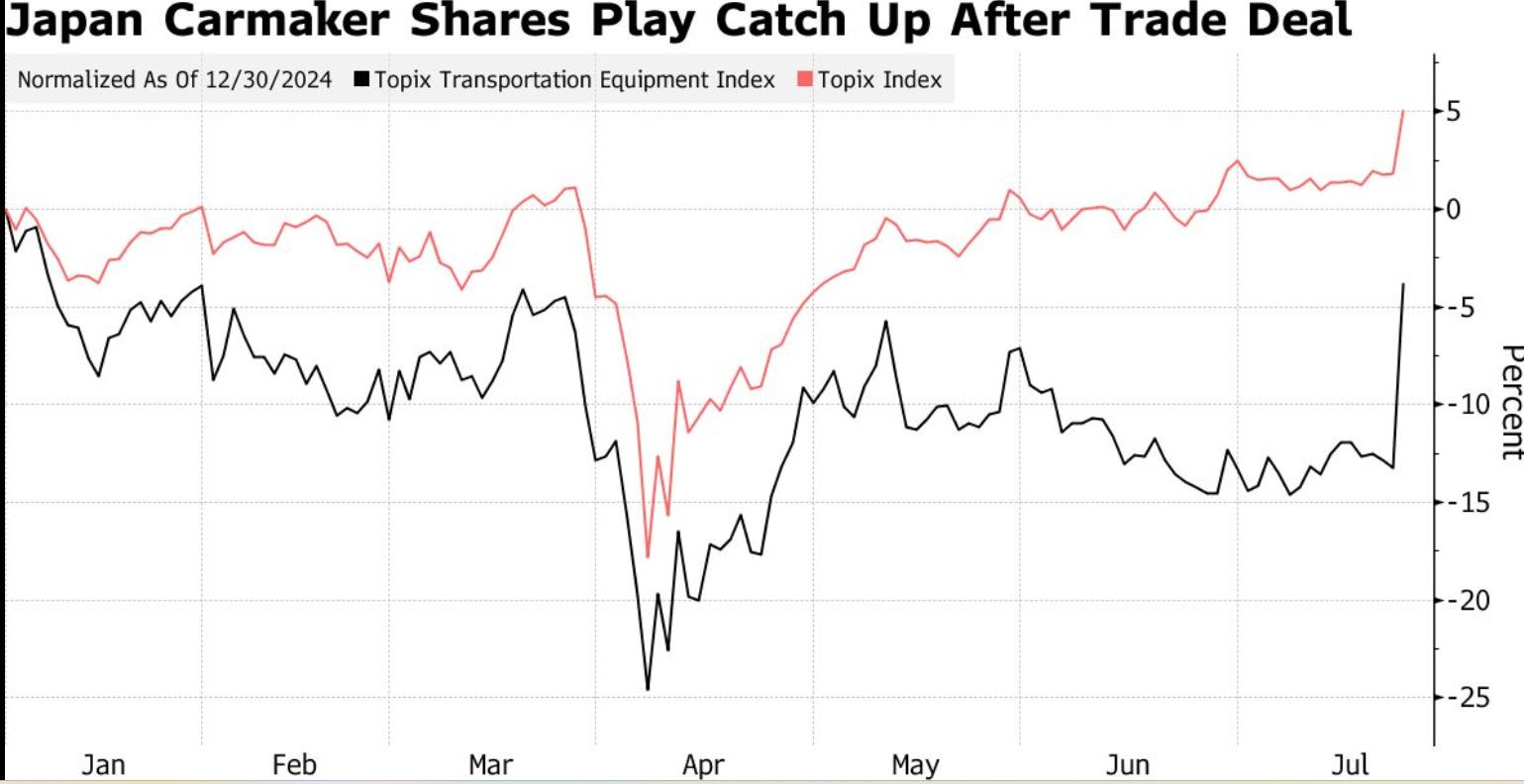
汽车狂飙,军工与地产退潮! 美日贸易协议改写日本股市输赢榜
智通财经网· 2025-07-24 02:31
Group 1: Trade Agreement Impact - The unexpected US-Japan trade agreement has transformed Japan's stock market dynamics, turning previous losers into winners, particularly benefiting large automotive manufacturers [1][2] - The agreement reduces US tariffs on Japanese cars from 25% to 15%, leading to a significant rebound in the automotive sector, with the Nikkei automotive index soaring by 11% [4] - Japan's government has committed to investing $550 billion in the US, which is expected to benefit machinery manufacturers as automotive companies may expand their investments in the US [5] Group 2: Winners - Automotive manufacturers are the biggest winners from the trade agreement, with major companies like Toyota seeing stock price increases of 14% [4] - Machinery manufacturers, such as Fanuc and Yaskawa, experienced stock price increases of 12% and 11% respectively, due to anticipated benefits from increased investment in the US [5] - Large commercial banks are expected to benefit from rising interest rates and bond yields, with a high probability of the Bank of Japan raising rates by the end of the year [6] Group 3: Losers - Defense-related stocks, previously seen as safe havens, are experiencing significant sell-offs due to rumors surrounding Prime Minister Shigeru Ishiba's potential resignation [7] - Domestic-oriented defensive stocks, such as Ryohin Keikaku and Food & Life, may face substantial selling pressure following the trade agreement [8][9] - Real estate companies are likely to be under pressure due to higher debt levels and potential increases in bond yields, which could negatively impact their fundamentals [10]

Fanuc: Positive Surprises Are In Store
Seeking Alpha· 2025-07-07 14:50
Core Insights - The article focuses on the Asia Value & Moat Stocks research service, which targets value investors looking for significant discrepancies between stock prices and intrinsic values, particularly in the Asian market, with an emphasis on Hong Kong [1] Group 1: Investment Strategy - The service seeks deep value balance sheet bargains, such as net cash stocks, net-nets, low price-to-book (P/B) stocks, and sum-of-the-parts discounts [1] - It also emphasizes wide moat stocks, which are high-quality businesses with strong earnings power available at a discount, including "Magic Formula" stocks and hidden champions [1] Group 2: Research and Updates - The author provides a range of watch lists with monthly updates to assist investors in identifying potential investment opportunities [1]

工业自动化:美国工业回流对需求的边际拉动研究
Haitong Securities International· 2025-06-13 11:09
Investment Rating - The report suggests a focus on companies benefiting from the return of the US semiconductor, biopharmaceutical, and machinery manufacturing industries, highlighting leaders in industrial automation such as Siemens, Emerson, Rockwell, ABB, FANUC, Yaskawa, and Mitsubishi Electric [5][58]. Core Insights - The added value of the US manufacturing industry was $2.6 trillion in 2022, accounting for 15.1% of global manufacturing value, ranking second globally after China [1][54]. - The proportion of US manufacturing in GDP has declined from 28.4% in 2001 to 10.7% in 2022, significantly lower than the global average of 17.5% [1][54]. - The US manufacturing sector has experienced a compound annual growth rate of 1.5% from 2017 to 2022, lagging behind the global average of nearly 3% [1][54]. - The "hollowing out" of the US manufacturing sector is characterized by a shift towards capital optimization, with significant reliance on imports for key components [2][55]. - The US government aims to reverse the decline in domestic manufacturing to ensure national security, particularly in critical sectors like semiconductors and medical supplies [2][30][55]. Summary by Sections 1. Current State of US Manufacturing - The US manufacturing sector's absolute value is not low, but its contribution to the economy is overshadowed by the service sector [1][9]. - The manufacturing sector's decline is evident in its GDP contribution compared to other major economies [1][9][12]. 2. Impact of US Reshoring on Industrial Automation - Industrial automation is crucial for reducing costs and improving efficiency through the integration of manufacturing processes [3][56]. - The US industrial automation market has significant growth potential, particularly in the context of low robot density compared to other economies [3][37]. - The competitive landscape features established giants like Siemens and ABB alongside new entrants, with increasing competition driven by technological advancements and policy support [4][57]. 3. Key Companies and Market Outlook - Major players in the industrial automation sector include Siemens, ABB, Emerson, FANUC, Yaskawa, and Mitsubishi Electric, each with distinct strengths and market positions [5][58]. - The pharmaceutical and medical technology sectors are expected to drive growth in industrial automation from 2025 to 2030, while other sectors face challenges [4][57].


Are Industrial Products Stocks Lagging Fanuc (FANUY) This Year?
ZACKS· 2025-05-29 14:47
Company Performance - Fanuc Corp. has returned approximately 3.1% since the beginning of the calendar year, outperforming the average loss of 2.6% in the Industrial Products sector [4] - The Zacks Consensus Estimate for Fanuc's full-year earnings has increased by 1.4% over the past quarter, indicating improved analyst sentiment and a stronger earnings outlook [3] - Fanuc Corp. is currently ranked 2 (Buy) in the Zacks Rank system, which emphasizes earnings estimates and revisions [3] Industry Comparison - Fanuc Corp. belongs to the Industrial Automation and Robotics industry, which is currently ranked 2 in the Zacks Industry Rank [5] - The average performance of stocks in the Industrial Automation and Robotics industry has seen a significant decline of 54.7% this year, highlighting Fanuc's relative strength [5] - In contrast, another stock in the Industrial Products sector, UniFirst, has achieved a year-to-date return of 10.4% and is also ranked 2 (Buy) [4][5] Sector Overview - The Industrial Products sector, which includes 190 individual stocks, is currently ranked 10 in the Zacks Sector Rank [2] - The Uniform and Related industry, to which UniFirst belongs, is ranked 89 and has experienced a decline of 17.1% this year [6]

Is Fanuc (FANUY) Stock Outpacing Its Industrial Products Peers This Year?
ZACKS· 2025-05-13 14:40
Company Overview - Fanuc Corp. (FANUY) is a notable stock within the Industrial Products sector, which comprises 190 individual stocks and holds a Zacks Sector Rank of 9 [2] - The Zacks Rank system focuses on earnings estimates and revisions, indicating that Fanuc Corp. currently has a Zacks Rank of 2 (Buy) [3] Performance Analysis - The Zacks Consensus Estimate for Fanuc Corp.'s full-year earnings has increased by 1.4% over the past quarter, reflecting improved analyst sentiment [4] - Year-to-date, Fanuc Corp. has gained approximately 0.9%, outperforming the average return of -1.7% for the Industrial Products sector [4] - In the Industrial Automation and Robotics industry, which includes only 2 stocks, Fanuc Corp. ranks 2 in the Zacks Industry Rank, while the industry has experienced an average loss of 63.9% this year [6] Comparison with Peers - Gorman-Rupp (GRC) is another stock in the Industrial Products sector that has outperformed, with a year-to-date return of 2.1% and a Zacks Rank of 2 (Buy) [5] - Gorman-Rupp belongs to the Manufacturing - General Industrial industry, which has a lower Zacks Industry Rank of 138 and has seen a decline of -0.3% this year [6] Investment Outlook - Investors interested in Industrial Products stocks should monitor both Fanuc Corp. and Gorman-Rupp for their strong performance trends [7]


Fanuc: Bullish For The Short Term And The Long Run
Seeking Alpha· 2025-03-06 11:33
Group 1 - The research service Asia Value & Moat Stocks targets value investors looking for Asia-listed stocks with significant discrepancies between price and intrinsic value, focusing on deep value balance sheet bargains and wide moat stocks [1] - Fanuc Corporation is highlighted as a Buy-rated stock, with previous analysis covering its operations in India and Mainland China [1] - The author of the research service provides investment ideas specifically for the Hong Kong market, emphasizing deep value and wide moat opportunities [1]