Alphabet(GOOG)

Search documents
Should You Forget Nvidia and Buy 2 Other Artificial Intelligence (AI) Stocks Instead?
The Motley Fool· 2026-02-14 13:30
Core Viewpoint - Nvidia is currently the largest company by market capitalization, but its future growth may be challenged due to high P/E ratios, competition from customers, and reliance on AI infrastructure spending [1][2]. Group 1: Nvidia's Market Position - Nvidia has experienced rapid growth, particularly in the AI sector, making it a significant player in the market [1]. - The company's current market cap stands at $4.6 trillion, with a P/E ratio of 46, indicating a premium valuation [2][12]. Group 2: Amazon's Strategy - Amazon is one of Nvidia's largest customers, investing heavily in AI-related chips for its AWS business [4]. - The company is diversifying its chip procurement by developing in-house brands, which may reduce its reliance on Nvidia over time [5]. - Amazon's revenue from North American commerce grew 10% year-over-year to $127 billion, while AWS revenue increased 24% year-over-year to $35.6 billion [7]. Group 3: Alphabet's Competitive Edge - Alphabet, the parent company of Google, has invested in its own chips, specifically Tensor Processing Units (TPUs), which are used in its data centers and cloud infrastructure [8]. - Like Amazon, Alphabet remains a customer of Nvidia but is also working to reduce its dependency on third-party chips [9]. - Alphabet's Google Search revenue rose 17%, and Google Cloud revenue increased 48%, benefiting from the AI trend [11].





字节越来越像 Google:字节跳动距离 Google 这样的头部公司,大概只差六个月
Xin Lang Cai Jing· 2026-02-14 11:08
Core Viewpoint - The recent release of Seedance 2.0 by ByteDance has significantly narrowed the gap between its AI models and those of leading companies like Google, with the difference now estimated to be as little as one to two months [62][60]. Group 1: Seedance 2.0 - Seedance 2.0 has generated excitement in the AI community, with many users expressing shock and admiration for its capabilities [64][66]. - The model demonstrates strong instruction-following abilities, effectively understanding complex prompts and generating high-quality video content [71][72]. - Users report that Seedance 2.0 has surpassed previous models in terms of performance, making it suitable for creating professional-quality animations and videos [73][74]. Group 2: Seedream 5.0 Lite - Seedream 5.0 Lite, the latest image model from ByteDance, has improved in two key areas: subject consistency and instruction-following ability [20][78]. - Users have noted that the model generates images with better consistency, reducing the "out-of-place" feeling previously experienced with earlier versions [21][78]. - The model's ability to follow complex instructions has been highlighted as a significant advancement, making it easier for users to edit images effectively [82]. Group 3: Doubao Model 2.0 - Doubao Model 2.0 has shown significant improvements in complex reasoning and agent tasks, outperforming its predecessor by a considerable margin [26][83]. - The model is designed to handle multi-modal tasks natively, integrating text, images, and video without the need for separate plugins, which enhances its efficiency [31][87]. - Doubao 2.0 has also reduced inference costs significantly, making it more accessible for commercial applications, particularly in agent scenarios where token consumption is high [45][99]. Group 4: Strategic Positioning - ByteDance's approach to AI development closely resembles that of Google, focusing on integrating models with applications to create a feedback loop that informs future model improvements [100][104]. - The company leverages its large user base and content creators to identify gaps in capabilities, allowing for targeted enhancements in its AI models [102][103]. - The synergy between model development and cloud services, particularly through Volcano Engine, positions ByteDance favorably in the competitive landscape [108][109].


AI正从美股增长引擎变成“估值粉碎机”?
财富FORTUNE· 2026-02-14 10:08
Core Viewpoint - The article discusses a significant downturn in the U.S. stock market, particularly the S&P 500 index, which fell by 1.4%, marking its largest drop since November of the previous year. This decline is attributed to fears surrounding AI's impact on various sectors, raising concerns that AI may no longer be a growth engine but rather a "valuation crusher" [1][3]. Group 1: Market Reactions - The S&P 500 index experienced a notable increase in abnormal stock fluctuations, with over 40 stocks showing deviations exceeding three standard deviations, indicating a potential collapse of market confidence [3]. - The logistics sector was heavily impacted, with C.H. Robinson experiencing an eight-fold standard deviation drop, leading to a "death spiral" of automated stop-loss orders and panic selling [3]. - Major tech companies, including Apple, Amazon, Microsoft, and Meta, were significant contributors to the index's decline, with Amazon hitting a nine-day losing streak, marking its longest since 2006 and entering a technical bear market [3][4]. Group 2: AI's Impact on Employment and Market Sentiment - A statement from Microsoft's AI CEO suggested that most white-collar jobs could be fully automated within 18 months, causing immediate market panic and a sell-off of stocks related to potentially disrupted industries [4]. - The market's fear extends to the return on investment for massive capital expenditures by tech giants, with a combined projected spending of $650 billion on AI infrastructure by Google, Meta, Microsoft, and Amazon, raising concerns about their financial health [4]. Group 3: Competitive Landscape and Pricing Power - Chinese AI companies have made significant advancements, launching competitive products that challenge the pricing and performance of existing models, which could reshape global investor expectations [5][6]. - The emergence of low-cost AI solutions, such as MiniMax's M2.5 model, threatens the pricing power of established tech giants, leading to a reevaluation of their market positions and business models [8]. - The article highlights a shift from a positive growth narrative to a negative cycle of demand shrinkage and profit contraction, as AI efficiency gains may lead to reduced overall employment [7]. Group 4: Future Market Outlook - Goldman Sachs warns that if the S&P 500 index falls below 6707 points, it could trigger systemic sell-offs amounting to $80 billion, indicating a fragile market environment [8]. - The current market situation serves as a "stress test" for business models in the AI era, determining which companies can adapt and which may struggle to maintain their competitive advantages [8].




The 5 Best Artificial Intelligence (AI) Stocks to Buy for February
The Motley Fool· 2026-02-14 10:00
Core Insights - A recent sell-off in the market has created unique buying opportunities, particularly in the artificial intelligence (AI) sector, which remains a focal point for investors [1] - The demand for AI technology continues to drive significant investment opportunities, especially in companies that provide essential hardware and cloud services [1] Group 1: AI Hardware Providers - Nvidia and Broadcom are major beneficiaries of AI spending, as they produce computing equipment crucial for AI data centers, leading to strong growth prospects [4][7] - Nvidia's GPUs are the industry standard for AI computing, and the company maintains a competitive edge with its technology stack [6] - Broadcom collaborates with AI hyperscalers to design custom AI chips, enhancing its position in the market [6][7] Group 2: Semiconductor Manufacturing - Taiwan Semiconductor (TSMC) plays a vital role in the AI ecosystem by fabricating logic chips for Nvidia and Broadcom, as well as other tech companies [8] - TSMC's advancements in 2-nanometer chip technology promise reduced power consumption, which is beneficial as AI data centers expand [10] Group 3: Cloud Computing Providers - Alphabet and Microsoft, despite recent stock sell-offs, are key players in the cloud computing industry, investing heavily to expand their AI capabilities [11] - Both companies are experiencing significant revenue growth in their cloud services, with Microsoft Azure revenue increasing by 39% and Google Cloud by 48% in their latest quarters [14] - The ongoing demand for cloud computing services supports the rationale for AI capital investment spending [12][14]



本周,“AI颠覆一切”的狼终于来了
Hua Er Jie Jian Wen· 2026-02-14 09:07
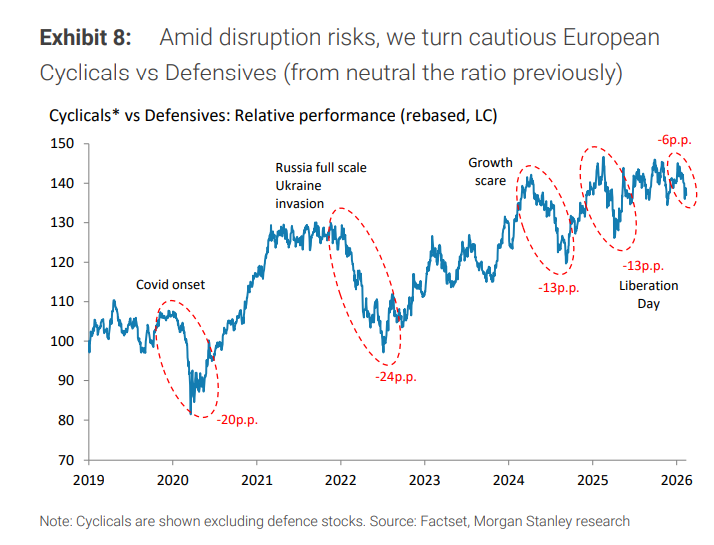
Core Insights - The market is increasingly recognizing the imminent threat of AI disruption, with the perceived risk in the MSCI Europe index rising from 4% to 24% in just over a month, including the banking sector [1][9] - Morgan Stanley has shifted its stance from neutral to cautious regarding cyclical stocks versus defensive stocks, highlighting opportunities in the European credit market for downside protection [1][15] AI Capability Advancements - The latest AI model, GPT-5.2, has achieved human expert-level performance in 71% of professional tasks, marking a significant leap in AI capabilities [5][8] - The speed of AI advancements is accelerating, with predictions that upcoming models in 2026 will far exceed current capabilities due to increased computational power [8] Market Disruption Dynamics - Initial concerns about AI's impact on the software industry have rapidly expanded to broader economic disruption risks, reminiscent of market reactions during the early COVID-19 pandemic [9][10] - Approximately 10% of the MSCI Europe index (excluding banks) is now viewed as facing substantial AI disruption risks, with this figure rising to 24% when including banks [9][10] Valuation Trends - The valuation of "disruption stocks" has decreased from a peak P/E ratio of 24x to 16.4x, with further downward potential indicated by comparisons to "uncontested disruption stocks" [10] Resilience Assessment Framework - Morgan Stanley proposes a framework to evaluate sectors and stocks based on five dimensions of risk exposure, identifying utilities, semiconductors, defense, and tobacco as the most resilient sectors [11] - Sectors such as software, commercial services, and banking are identified as facing the highest disruption risk [11] Non-AI Replicable Assets - The report emphasizes the rising value of assets that cannot be replicated by AI, including physical assets, regulatory barriers, and unique human experiences [4][12][14] Credit Market Insights - Despite AI disruption concerns affecting some credit markets, European investment-grade spreads remain low, presenting opportunities for investors to hedge against potential downturns [15] Computing Power Demand - There is a significant and growing demand for computing power, with projections indicating that the growth rate of demand will outpace current supply forecasts [16][21] - The intensity of computing requirements for AI queries is increasing rapidly, with predictions that companies may need to double their computing power every six months [19][21]

News Corporation (NWSA) PT Lowered to $39 from $40 by Citi
Insider Monkey· 2026-02-14 06:29
Core Insights - Generative AI is viewed as a transformative technology by Amazon's CEO Andy Jassy, indicating its potential to significantly enhance customer experiences across the company [1] - Elon Musk predicts that humanoid robots could create a market worth $250 trillion by 2040, representing a major shift in the global economy driven by AI innovation [2] - Major firms like PwC and McKinsey acknowledge the multi-trillion-dollar potential of AI, suggesting a broad consensus on its economic impact [3] Company and Industry Analysis - A breakthrough in AI technology is believed to be redefining work, learning, and creativity, attracting significant interest from hedge funds and top investors [4] - There is speculation about an under-owned company that may play a crucial role in the AI revolution, with its technology posing a threat to competitors [4] - Prominent figures in technology and investment, including Bill Gates and Warren Buffett, recognize AI as a major technological advancement with the potential for substantial social benefits [8] Market Trends - The AI ecosystem is expected to reshape how businesses, governments, and consumers operate globally, indicating a shift in market dynamics [2] - The investment landscape is becoming increasingly competitive, with various tech giants like Tesla, Nvidia, and Microsoft being highlighted, while a smaller company is suggested to have significant growth potential [6]



中概股全线走低、美股全线大跌,有色金属、半导体芯片、苹果重挫
Sou Hu Cai Jing· 2026-02-14 04:30
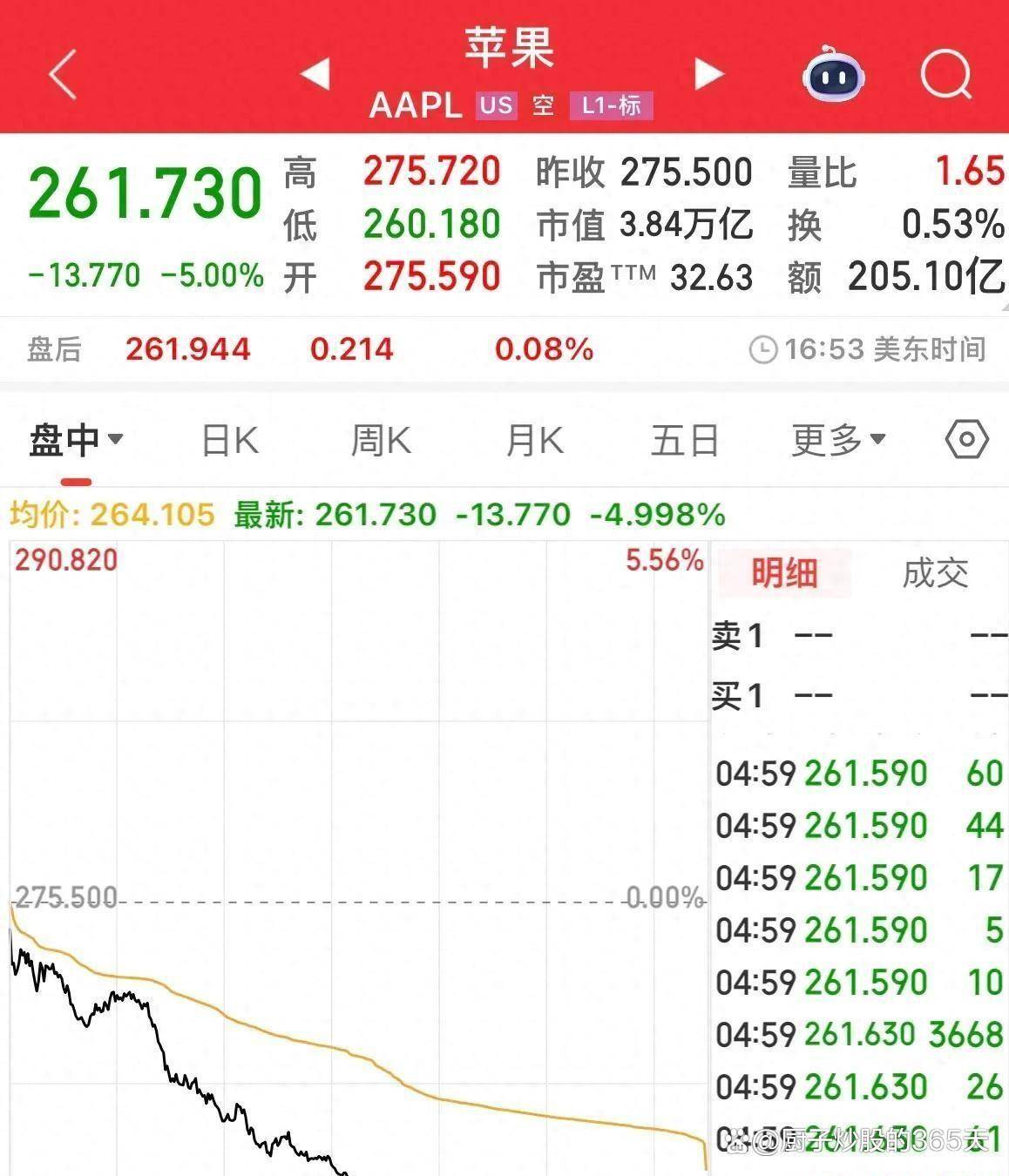
Market Overview - The US stock market experienced a significant decline, with the Dow Jones Industrial Average dropping 669.42 points (1.34%) to close at 49,451.98 points, the Nasdaq Composite falling 469.32 points (2.03%) to 22,597.15 points, and the S&P 500 decreasing by 108.71 points (1.57%) to 6,832.76 points [1][2][3] Market Sentiment - Over 4,100 stocks declined, indicating widespread market panic as investors rushed to sell assets, particularly in the tech and growth sectors. The VIX index surged, reflecting heightened risk aversion [2][3] Sector Performance - The sell-off affected nearly all sectors, with notable declines in precious metals and semiconductor stocks. The precious metals sector saw significant drops, with gold futures down 3.08% and silver futures plummeting 10.62% [4][5][6][8] - The Philadelphia Semiconductor Index fell by 2.5%, with individual stocks like AEHR Test Systems down 17.58% and Intel down over 3% [8][10] Major Companies - Apple Inc. experienced a substantial drop of 5.00%, resulting in a market cap loss of over $120 billion, attributed partly to regulatory concerns [12] - Other major tech companies also faced declines, with Tesla down 1.62%, Amazon down 2.20%, and Meta Platforms down nearly 3% [12] Financial Sector - Bank stocks fell across the board, with JPMorgan Chase down over 2%, Goldman Sachs down over 4%, and Citigroup down over 5%, driven by concerns over AI disrupting traditional wealth management [13][14] Economic Indicators - Recent economic data, including a drop in initial jobless claims and lower-than-expected existing home sales, contributed to market anxiety about potential economic overheating and prolonged high interest rates [24][25][26] Global Market Impact - The sell-off in the US markets had a ripple effect on global markets, with European indices also closing lower after initially opening higher, indicating a widespread sentiment of fear [18][19][20] AI Concerns - The market's decline was exacerbated by fears regarding the disruptive impact of AI technologies on various industries, leading to significant stock price drops in sectors perceived to be at risk [21][22][30] Storage Chip Sector - In contrast to the overall market trend, storage chip stocks saw gains, with companies like SanDisk and Seagate Technology rising significantly, reflecting a belief that AI's growth will increase demand for data storage [29]


凌晨重磅!黄金、白银,突然暴涨
Xin Lang Cai Jing· 2026-02-14 01:55
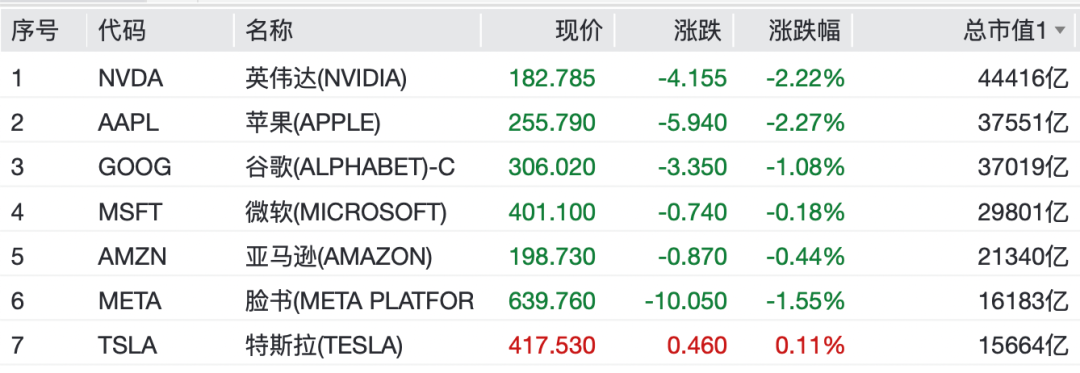
Market Performance - On February 13, the US stock market showed mixed results, with large tech stocks declining while Chinese concept stocks had varied performances [2] - The Dow Jones Industrial Average rose by 0.1% to close at 49,500.93 points, the S&P 500 increased by 0.05% to 6,836.17 points, and the Nasdaq Composite gained 0.22% to 22,546.67 points. However, all three indices experienced weekly declines, with the Nasdaq down 2.1%, the Dow down 1.23%, and the S&P 500 down 1.39% [3] Individual Stock Performance - Major tech stocks saw declines, with NVIDIA down 2.22% to $182.785, Apple down 2.27% to $255.790, and Google down 1.08% to $306.020. Microsoft fell slightly by 0.18% to $401.100, while Amazon decreased by 0.44% to $198.730. Meta Platforms dropped by 1.55% to $639.760, while Tesla saw a slight increase of 0.11% to $417.530 [4] - In the Chinese concept stock market, Tencent Music rose over 4%, while Alibaba fell over 2%, and JD Group, Baidu Group, Beike, and Li Auto all dropped by more than 1% [6] Commodity Market - Spot gold prices increased by 2.41% to a high of $5,046.261 per ounce, currently trading at $5,042.808 per ounce [8] - Spot silver prices also rose, breaking the $79 per ounce mark with a daily increase of 2.81% [8] - Gold futures contracts rose by 1.4% this week, marking an upward trend in 8 out of the last 10 weeks [9] - Silver futures contracts increased by 1.5% this week, ending a two-week decline and showing an upward trend in 11 out of the last 15 weeks [11] Market Insights - NVIDIA's CEO Jensen Huang addressed concerns about excessive spending in data centers, asserting that spending levels are reasonable and sustainable. He emphasized the growing utility and functionality of artificial intelligence, dismissing the recent sell-off in software stocks as "the most illogical thing in the world" [5] - Despite volatility in the precious metals market, demand for safe-haven assets continues to support rising gold and silver prices, according to a report by Antonio Di Giacomo from XS.com [10]


Alphabet vs. Meta Platforms: Which One Will Dominate the Next Decade?
The Motley Fool· 2026-02-14 01:05
Group 1: Core Insights - Alphabet and Meta Platforms are leading companies in the internet age, with strong financial performance driven by their popular services like Google Search, YouTube, and various social media apps [1] - The digital advertising market is expected to grow significantly, benefiting both Alphabet and Meta over the next decade [3] Group 2: Financial Performance - Alphabet's market capitalization is $3.7 trillion, with a revenue increase of 15% in 2025 and a gross margin of 59.68% [5] - Meta's market capitalization stands at $1.6 trillion, with a revenue increase of 22% in 2025 and a gross margin of 82% [6] - Both companies are highly profitable, allowing for substantial investments in AI-related capital expenditures [5][6] Group 3: Investment Considerations - Alphabet's forward price-to-earnings ratio is 28.8, while Meta's is lower at 22.5, suggesting that both stocks may be attractive investment opportunities [7] - Owning shares in both companies could be beneficial as they are well-positioned to enhance their earnings power in the future [7]

美股三大指数周线齐跌
财联社· 2026-02-14 00:39
Market Overview - The three major indices showed mixed performance, with the Dow Jones up 0.10% to 49,500.93 points, the S&P 500 up 0.05% to 6,836.17 points, and the Nasdaq down 0.22% to 22,546.67 points [3] - All three indices recorded weekly declines, with the S&P 500 down 1.4%, the Dow down 1.2%, and the Nasdaq down 2.1% [3] Economic Indicators - The U.S. Bureau of Labor Statistics reported that the January CPI rose 2.4% year-over-year and 0.2% month-over-month, both below market expectations [3] - The core CPI, excluding volatile food and energy prices, increased by 2.5% year-over-year and 0.3% month-over-month, aligning with market expectations [3] - Phil Blancato, Chief Market Strategist at Osaic, indicated that this data could pave the way for interest rate cuts and inflation control if the trend continues [3] Sector Performance - Concerns over AI disruption led to market sell-offs, affecting various sectors including software, real estate, trucking, and financial services [6] - Financial stocks such as Charles Schwab and Morgan Stanley fell by 10.8% and 4.9%, respectively, while software company Workday dropped 11% and commercial real estate firm CBRE fell 16% [6] - The media sector was also impacted, with Disney down approximately 3% and Netflix down 6% [7] Technology Stocks - Major tech stocks mostly declined, with Nvidia down 2.21%, Apple down 2.27%, Microsoft down 0.13%, Google down 1.06%, and Amazon down 0.41% [7] - Tesla saw a slight increase of 0.09%, while Oracle rose by 2.34% and Netflix increased by 1.33% [7] Chinese Stocks - The Nasdaq Golden Dragon China Index fell by 0.10%, with Alibaba down 1.89%, JD.com down 1.38%, and Pinduoduo up 0.06% [7] - NIO remained flat, while Xpeng rose by 1.36% and Li Auto fell by 1.81% [7]