Lilly(LLY)

Search documents
Lilly Stock Jumps After Q4 Earnings Beat and Strong 2026 Guidance
ZACKS· 2026-02-04 16:25
Core Insights - Eli Lilly and Company (LLY) reported strong fourth-quarter 2025 results, with adjusted earnings per share (EPS) of $7.54, exceeding the Zacks Consensus Estimate of $6.99, and a year-over-year earnings increase of 42% [1] - Revenues reached $19.3 billion, a 43% increase year over year, driven by the success of GLP-1 drugs Mounjaro and Zepbound, surpassing the Zacks Consensus Estimate of $17.87 billion [1] Revenue Drivers - Mounjaro generated sales of $7.41 billion, up 110% year over year, exceeding the Zacks Consensus Estimate of $6.65 billion [2] - Zepbound recorded sales of $4.26 billion, a 123% increase year over year, also beating the Zacks Consensus Estimate of $3.87 billion [3] Competitive Landscape - Mounjaro and Zepbound face competition from Novo Nordisk's semaglutide products, with Novo Nordisk reporting a decline in its Diabetes and Obesity Care segment sales due to competitive pressure from Lilly's offerings [4] - Despite competitive dynamics, Mounjaro and Zepbound are expected to maintain strong demand in 2026 [13] Other Drug Performance - Trulicity generated $1.04 billion in revenue, down 17% year over year, but still beating the Zacks Consensus Estimate of $1.0 billion [5] - Jardiance sales fell 36% to $768 million, missing the Zacks Consensus Estimate of $776 million [5] - Taltz brought in $1.05 billion, up 10% year over year, exceeding the Zacks Consensus Estimate of $955 million [6] - Verzenio generated $1.60 billion, up 3% year over year, but missed the Zacks Consensus Estimate of $1.62 billion [6] Full-Year Performance - For the full year 2025, Eli Lilly's sales rose 45% to $65.2 billion, significantly beating the Zacks Consensus Estimate of $63.54 billion [10] - Adjusted earnings for 2025 were $24.21 per share, an 86% increase year over year, surpassing the Zacks Consensus Estimate of $23.74 [10] 2026 Outlook - Eli Lilly expects 2026 revenues in the range of $80 billion to $83 billion, higher than the Zacks Consensus Estimate of $77.5 billion [11] - EPS for 2026 is projected to be between $33.50 and $35.00, exceeding the Zacks Consensus Estimate of $33.24 [11] Market Reaction - Following the positive quarterly earnings and optimistic 2026 outlook, Lilly's shares rose approximately 9% in pre-market trading [14] - Over the past year, Lilly's stock has increased by 19.2%, outperforming the industry average of 17.1% [14] Strategic Initiatives - Lilly is investing in obesity treatments and has several new molecules in clinical development, including orforglipron, an oral GLP-1 small molecule [16][17] - The company is diversifying its portfolio beyond GLP-1 drugs into cardiovascular, oncology, and neuroscience areas, including recent acquisitions to enhance its capabilities in oral small-molecule therapies [19]


ADP Jobs Lower, Q4 Earnings Reports Up
ZACKS· 2026-02-04 16:22
Market Overview - Pre-market futures have improved from early lows, influenced by Q4 earnings reports and private-sector job numbers, with the Dow up 142 points and the S&P 500 up 10 points, while the Nasdaq is down 66 points and the Russell 2000 is up 12 points [1] Private Sector Employment - Private-sector payrolls for January reported by ADP show an increase of only 22K, significantly below expectations, and down from a revised 37K the previous month, marking the first back-to-back monthly job gains since April and May of the previous year [2] - The services sector accounted for most of the job gains, adding 21K jobs, while goods-producing sectors only added 1K jobs. Healthcare Services led with 74K hires, followed by Financial Services with 14K and Construction with 9K. Professional & Business Services lost 57K jobs, and Manufacturing has not seen positive job growth since early 2024 [2][3] - A new ADP methodology indicates a downward revision of 212K fewer hires for the entire year of 2025, reducing total private-sector hires from 771K in 2024 to 398K in 2025 [4] Earnings Reports - Eli Lilly & Co. reported a 7.9% earnings surprise with earnings of $7.54 per share and revenues of $19.29 billion, also exceeding estimates by 7.9%, driven by strong performance in diabetes and weight loss drugs [6][7] - AbbVie reported earnings of $2.71 per share, beating estimates of $2.66, while Novartis reported $2.03 per share, surpassing consensus by 4 cents. Novartis shares rose 1.6%, while AbbVie shares fell 3% [7] - Phillips 66 reported earnings of $2.47 per share, exceeding expectations of $2.11 and significantly improving from a loss of $0.15 per share in the same quarter last year, with shares up 1.3% in pre-market trading [8]



Lilly(LLY) - 2025 Q4 - Earnings Call Transcript
2026-02-04 16:02
Eli Lilly and Company (NYSE:LLY) Q4 2025 Earnings call February 04, 2026 10:00 AM ET Company ParticipantsAdrienne Brown - President of Lilly ImmunologyDan Skovronsky - Chief Scientific and Product OfficerDave Ricks - Chair and CEOIlya Yuffa - President of Lilly USA and Global Customer CapabilitiesKen Custer - President of Lilly Cardiometabolic HealthLucas Montarce - CFOMike Czapar - SVP of Investor RelationsPatrik Jonsson - President of Lilly InternationalConference Call ParticipantsAsad Haider - Stock Anal ...
Lilly(LLY) - 2025 Q4 - Earnings Call Transcript
2026-02-04 16:02
Financial Data and Key Metrics Changes - In 2025, full-year revenue grew by 45% to $65.2 billion compared to 2024, with earnings per share increasing by 86% to $24.21 [6][10] - Q4 revenue increased by 43% compared to Q4 2024, with gross margin at 83.2%, consistent with Q4 2024 [10][11] - Non-GAAP performance margin was 47.2%, an increase of 4.2 percentage points compared to Q4 2024 [10] Business Line Data and Key Metrics Changes - Key products contributed over $13 billion to revenue in Q4, growing by 91% compared to Q4 2024 [12] - Kisunla became the U.S. market leader in amyloid-targeting therapy with over 50% share of total prescriptions, generating $109 million in revenue [12] - Zepbound revenue more than doubled compared to Q4 2024, maintaining nearly 70% share of new prescriptions in the branded obesity market [14] Market Data and Key Metrics Changes - U.S. revenue increased by 43% in Q4, driven by volume growth of Mounjaro and Zepbound, partially offset by a 7% decline in price [11] - International revenue growth was strong, with double-digit volume growth in Europe, Japan, and China, and volume doubling in the rest of the world due to Mounjaro's launch [11] Company Strategy and Development Direction - The company executed 39 business development transactions and is investing in artificial intelligence for drug discovery [7] - Plans to build multiple new manufacturing sites in the U.S. and Europe to expand manufacturing capacity [7] - The company anticipates launching Orforglipron for chronic weight management in the U.S. in Q2 2026, with a focus on expanding the addressable market [16] Management's Comments on Operating Environment and Future Outlook - Management expressed confidence in the growth trajectory of the incretin analog market and expects continued robust growth in 2026 [16] - The company is preparing for potential challenges in Medicaid access but anticipates new states will add coverage in 2027 [17] - Management highlighted the importance of patient satisfaction and real-world efficacy for new product launches [42] Other Important Information - The company distributed $1.3 billion in dividends and $1.5 billion in share repurchases in 2025 [8] - The company has one of the largest clinical stage pipelines in its history, with 36 active phase III programs [18] Q&A Session Summary Question: Metrics for Orforglipron launch - Management indicated they will track market expansion and patient satisfaction as key success factors for Orforglipron [41][43] Question: Accelerated pathways for international approvals - Management expects most international launches for Orforglipron to occur in late 2026 to 2027, with some exceptions [47] Question: International Mounjaro growth - Management noted Q4 as a strong base for 2026 growth, with a focus on market expansion and reimbursement strategies [53][54] Question: Investment in immunology - Management is reinvesting proceeds from obesity opportunities to accelerate growth in immunology and other areas [60] Question: Medicare volume ramp and employer opt-ins - Management expects Medicare access to be granted by July 1, 2026, and anticipates a bolus of patients moving into the Medicare space [65][66] Question: Combo therapies with Zepbound - Management sees significant opportunities in combination therapies for immune diseases and is pursuing various studies [75]
Lilly(LLY) - 2025 Q4 - Earnings Call Transcript
2026-02-04 16:00
Eli Lilly and Company (NYSE:LLY) Q4 2025 Earnings call February 04, 2026 10:00 AM ET Speaker5Ladies and gentlemen, thank you for standing by, and welcome to the Lilly Q4 2025 earnings conference call. At this time, all participants are in listen-only mode. Later, we will be conducting a question-and-answer session, and instructions will be given at that time. Should you request assistance during the call, please press Star, then zero, and an operator will assist you offline. I would now like to turn the con ...
Eli Lilly Stock Eyes Best Day Since October After Quarterly Beat
Schaeffers Investment Research· 2026-02-04 15:52
Eli Lilly And Co (NYSE:LLY) stock is up 7.7% to trade at $1,080.69 at last glance, after the pharmaceutical name reported a top- and bottom-line beat for the fourth quarter and issued an upbeat forecast for 2026. The company attributed the strong showing to Zepbound and Mounjaro sales. LLY is today pacing for for its best day since October as it tests overhead pressure at the $1,100 level, which has kept price action in check since a Jan. 8, record high of $1,113.98. The equity is bouncing off the rising 80 ...
Eli Lilly shares soar after Q4 beat, strong forecast on weight-loss drugs
Proactiveinvestors NA· 2026-02-04 15:42
About this content About Angela Harmantas Angela Harmantas is an Editor at Proactive. She has over 15 years of experience covering the equity markets in North America, with a particular focus on junior resource stocks. Angela has reported from numerous countries around the world, including Canada, the US, Australia, Brazil, Ghana, and South Africa for leading trade publications. Previously, she worked in investor relations and led the foreign direct investment program in Canada for the Swedish government ...

ENPH Earnings Power Rally, LLY Gains on GLP-1s, CMG Slides
Youtube· 2026-02-04 15:30
All right, joining me right now to talk about some of the stocks to watch and moves. Diane King Hall is with me and first up Diane, we're looking at Nphase and it was running right. >> Oh my goodness, eyepopping move here.I wasn't even expecting it to uh be this high out the gate. Up more than 31% off the back of its quarterly results. Uh let's go through the numbers for InPhase.Uh adjusted earnings per share came in at 71 cents. Uh Street was looking for 54 cents. So that's a big beat there.revenue coming ...



Eli Lilly Proves Its GLP-1 Dominance Again, Raising My Price Target
Seeking Alpha· 2026-02-04 15:26
Freelance Financial Writer | Investments | Markets | Personal Finance | RetirementI create written content used in various formats including articles, blogs, emails, and social media for financial advisors and investment firms in a cost-efficient way. My passion is putting a narrative to financial data. Working with teams that include senior editors, investment strategists, marketing managers, data analysts, and executives, I contribute ideas to help make content relevant, accessible, and measurable. Having ...
纳指低开 AMD大跌13% 中国金龙指数大跌|美股开盘
Mei Ri Jing Ji Xin Wen· 2026-02-04 15:22
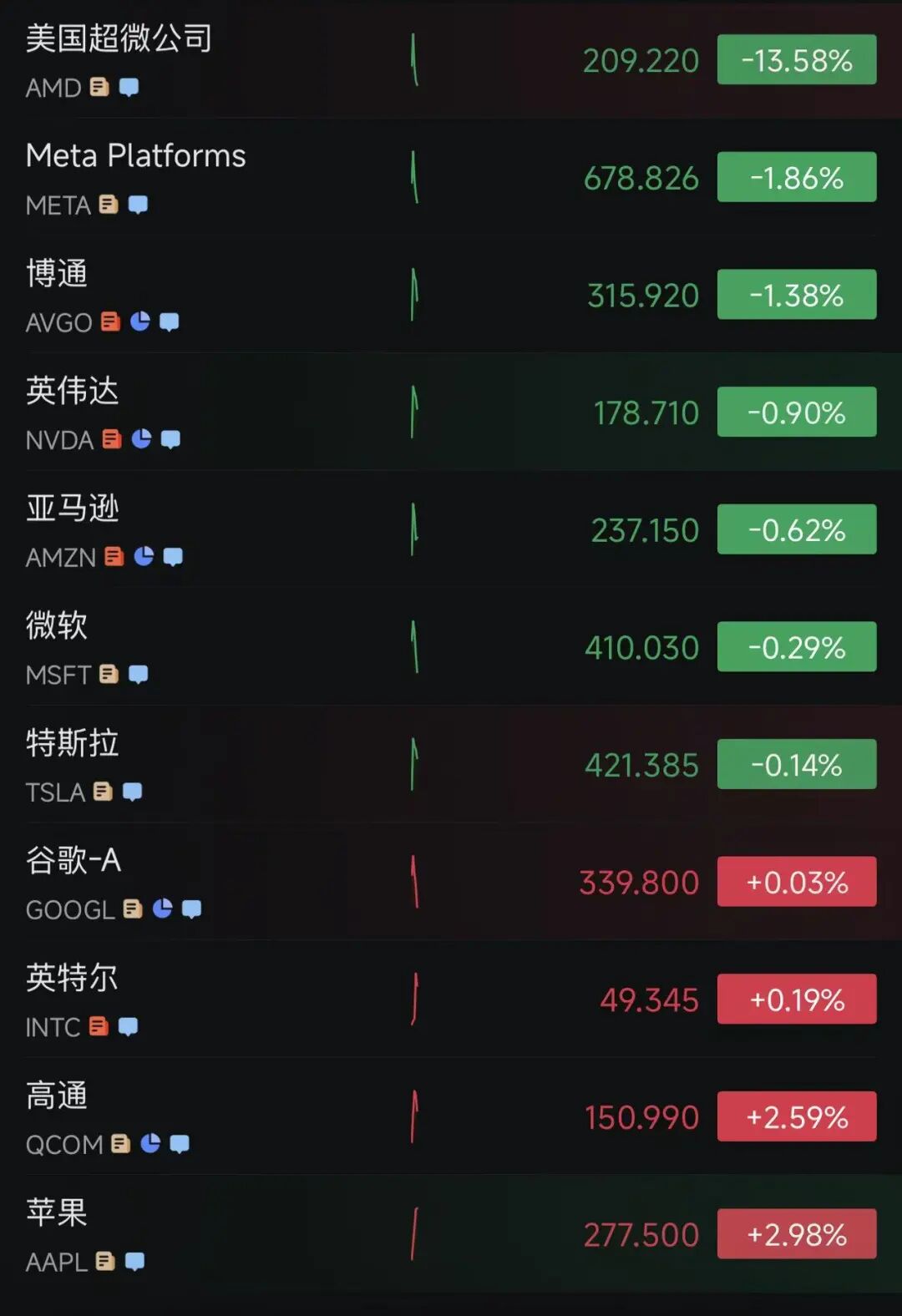
Market Overview - On February 4, US stock indices opened mixed, with the Nasdaq down 0.87%, the Dow Jones up 0.21%, and the S&P 500 down 0.29% [1] - Most tech stocks declined, with AMD dropping over 13% due to Q1 guidance falling short of some analysts' expectations [1][2] - Other notable declines included Meta down 1.86%, Nvidia down 0.9%, Amazon down 0.62%, and Microsoft down 0.29% [1] Company Performance - AMD's stock price was reported at $209.22, reflecting a decrease of 13.58% [2] - Meta Platforms' stock price was $678.826, down 1.86% [2] - Nvidia's stock price was $178.710, down 0.90% [2] - Amazon's stock price was $237.150, down 0.62% [2] - Microsoft’s stock price was $410.030, down 0.29% [2] - Tesla's stock price was $421.385, down 0.14% [2] - Intel's stock price was $49.345, up 0.19% [2] - Qualcomm's stock price was $150.990, up 2.59% [2] - Apple's stock price increased by 2.98% [1] Chinese Stocks - The Nasdaq Golden Dragon China Index fell over 2%, closing at 7457.16 points [3] - Major Chinese stocks experienced declines, with Kingsoft Cloud down 7.39%, NetEase down 6.93%, and Bilibili down 6.12% [3][4] - Baidu and Futu Holdings both dropped over 4.7%, while Tencent Music fell over 4.2% [3] Commodity Market - On February 4, spot gold rose by 0.93% to $4987.59, while spot silver increased by over 4.1%, reaching $89.57 per ounce [5][6] - Brent crude oil rose by 0.07% to $67.38 per barrel, while WTI crude oil fell to $63.19 per barrel, down 0.03% [6] Employment Data - In January, the US ADP employment numbers increased by 22,000, below the forecast of 45,000 and the previous value of 41,000 [8]