
Lilly(LLY)

Search documents
美股异动 | 礼来(LLY.US)大跌近14% 口服减肥药疗效不及预期
智通财经网· 2025-08-07 14:09
Core Viewpoint - Eli Lilly's stock dropped nearly 14% to $642.12 following disappointing results from a late-stage study of its experimental oral weight-loss drug orforglipron, which showed a weight reduction of approximately 11%, falling short of Wall Street expectations [1] Group 1: Drug Performance - The highest dosage of orforglipron helped patients achieve an average weight loss of 12.4% over 72 weeks [1] - Analysts had anticipated orforglipron to perform similarly to Novo Nordisk's Wegovy, which achieved a 14.9% weight loss over 68 weeks in a 2021 trial [1] - Some analysts even expected orforglipron to exceed the performance of Novo Nordisk's popular product [1]
礼来(LLY.US)大跌近14% 口服减肥药疗效不及预期
Zhi Tong Cai Jing· 2025-08-07 14:06
周四,礼来(LLY.US)大跌近14%,报642.12美元。消息面上,礼来一项后期研究显示,从统计结果来 看,其实验性口服减肥药orforglipron帮助患者成功减重约11%,该结果低于华尔街的预期。就试验本身 而言,服用orforglipron最高剂量在72周内帮助患者平均减重12.4%。至少有三位分析师表示,市场原本 期待orforglipron能像2021年试验中诺和诺德Wegovy那样,在68周内实现14.9%的减重效果,甚至还有一 些分析师则预计这种药物的效果将超过诺和诺德的热门产品。 ...
美股开盘丨三大指数集体高开 英特尔跌超2%


Di Yi Cai Jing· 2025-08-07 14:04
Market Performance - The Dow Jones Industrial Average increased by 0.59% [1] - The Nasdaq Composite rose by 0.75% [1] - The S&P 500 index gained 0.55% [1] Company Performance - Eli Lilly experienced a decline of over 9% [1] - Intel saw a drop of more than 2% [1] - Honda Motor Company fell by over 2% [1] - Apple Inc. rose by more than 2% [1]
Lilly(LLY) - 2025 Q2 - Quarterly Report
2025-08-07 13:59
[Form 10-Q Filing Information](index=1&type=section&id=Form%2010-Q%20Filing%20Information) This section details the registrant, filing period, filer status, and common stock outstanding for the Form 10-Q - Registrant: **Eli Lilly and Company, Indiana**[2](index=2&type=chunk) - Period Ended: **June 30, 2025**[2](index=2&type=chunk) - Filer Status: **Large accelerated filer**[5](index=5&type=chunk) - Common Stock Outstanding (as of August 4, 2025): **946,456,759 shares**[6](index=6&type=chunk) [Forward-Looking Statements](index=3&type=section&id=Forward-Looking%20Statements) This section warns that forward-looking statements carry inherent risks and uncertainties, which may cause actual results to differ - Forward-looking statements inherently involve many risks and uncertainties that could cause actual results to differ from those expressed, and investors should not place undue reliance on them[10](index=10&type=chunk) - Key risk factors include significant costs and uncertainties in pharmaceutical R&D, impact of acquisitions, intense competition, pricing pressures, regulatory actions, safety/efficacy concerns, intellectual property expiration, supply chain issues, reliance on third parties, risks from emerging technologies (e.g., AI), global macroeconomic conditions, foreign currency fluctuations, and litigation[10](index=10&type=chunk) [Trademarks and Trade Names](index=4&type=section&id=Trademarks%20and%20Trade%20Names) This section clarifies that all trademarks and trade names are property of their owners, and their use does not waive rights - All trademarks or trade names referred to in this report are the property of the company or their respective owners[13](index=13&type=chunk) - The use of trademarks and trade names without ® and ™ symbols is for convenience and should not be construed as waiving rights[13](index=13&type=chunk) [PART I. Financial Information](index=5&type=section&id=PART%20I.%20Financial%20Information) This part presents unaudited consolidated financial statements, management's discussion, notes, market risk, and controls [Item 1. Financial Statements](index=5&type=section&id=Item%201.%20Financial%20Statements) This item provides unaudited consolidated financial statements, covering operations, comprehensive income, balance sheets, equity, and cash flows, and related notes [Consolidated Condensed Statements of Operations](index=5&type=section&id=Consolidated%20Condensed%20Statements%20of%20Operations) This section presents unaudited consolidated statements of operations for the three and six months ended June 30, 2025 and 2024 Consolidated Condensed Statements of Operations (Three Months Ended June 30) | Metric | 2025 (Millions) | 2024 (Millions) | Change (%) | | :----------------------------- | :-------------- | :-------------- | :--------- | | Revenue | $15,557.7 | $11,302.8 | 37.6% | | Net income | $5,660.5 | $2,967.0 | 90.8% | | Diluted EPS | $6.29 | $3.28 | 91.8% | Consolidated Condensed Statements of Operations (Six Months Ended June 30) | Metric | 2025 (Millions) | 2024 (Millions) | Change (%) | | :----------------------------- | :-------------- | :-------------- | :--------- | | Revenue | $28,286.2 | $20,070.8 | 40.9% | | Net income | $8,419.8 | $5,209.9 | 61.6% | | Diluted EPS | $9.35 | $5.76 | 62.3% | - Acquired in-process research and development (IPR&D) charges significantly increased for the six-month period to **$1,725.5 million in 2025** from **$264.8 million in 2024**[16](index=16&type=chunk) [Consolidated Condensed Statements of Comprehensive Income](index=6&type=section&id=Consolidated%20Condensed%20Statements%20of%20Comprehensive%20Income) This section presents unaudited consolidated statements of comprehensive income for the three and six months ended June 30, 2025 and 2024 Consolidated Condensed Statements of Comprehensive Income (Three Months Ended June 30) | Metric | 2025 (Millions) | 2024 (Millions) | Change (%) | | :--------------------- | :-------------- | :-------------- | :--------- | | Net income | $5,660.5 | $2,967.0 | 90.8% | | Other comprehensive income (loss) | $58.6 | $(79.0) | N/A | | Comprehensive income | $5,719.1 | $2,888.0 | 97.9% | Consolidated Condensed Statements of Comprehensive Income (Six Months Ended June 30) | Metric | 2025 (Millions) | 2024 (Millions) | Change (%) | | :--------------------- | :-------------- | :-------------- | :--------- | | Net income | $8,419.8 | $5,209.9 | 61.6% | | Other comprehensive income (loss) | $605.9 | $(51.5) | N/A | | Comprehensive income | $9,025.7 | $5,158.4 | 74.9% | - Other comprehensive income (loss) shifted from a loss in 2024 to a gain in 2025, contributing to the overall increase in comprehensive income[18](index=18&type=chunk) [Consolidated Condensed Balance Sheets](index=7&type=section&id=Consolidated%20Condensed%20Balance%20Sheets) This section presents unaudited consolidated balance sheets as of June 30, 2025, and December 31, 2024 Consolidated Condensed Balance Sheets (June 30, 2025 vs. December 31, 2024) | Asset Category | June 30, 2025 (Millions) | Dec 31, 2024 (Millions) | Change (%) | | :----------------------------- | :----------------------- | :---------------------- | :--------- | | Total current assets | $49,854.0 | $32,739.7 | 52.3% | | Prepaid expenses | $18,019.8 | $8,340.5 | 116.0% | | Inventories | $11,013.8 | $7,589.2 | 45.1% | | Property and equipment, net | $20,529.7 | $17,102.4 | 20.0% | | Total assets | $100,922.6 | $78,714.9 | 28.2% | Consolidated Condensed Balance Sheets (Liabilities - June 30, 2025 vs. December 31, 2024) | Liability Category | June 30, 2025 (Millions) | Dec 31, 2024 (Millions) | Change (%) | | :----------------------------- | :----------------------- | :---------------------- | :--------- | | Total current liabilities | $39,019.9 | $28,376.6 | 37.5% | | Sales rebates and discounts | $14,537.4 | $11,539.3 | 26.0% | | Short-term income taxes payable | $6,958.0 | $1,116.4 | 523.3% | | Long-term debt | $34,180.1 | $28,527.1 | 19.8% | | Total liabilities | $82,573.5 | $64,443.3 | 28.1% | - Total equity increased by **28.6% to $18,349.1 million** as of June 30, 2025[20](index=20&type=chunk) [Consolidated Condensed Statements of Shareholders' Equity](index=8&type=section&id=Consolidated%20Condensed%20Statements%20of%20Shareholders'%20Equity) This section presents unaudited consolidated statements of shareholders' equity for the six months ended June 30, 2025 Eli Lilly and Company Shareholders' Equity (June 30, 2025 vs. January 1, 2025) | Metric | June 30, 2025 (Millions) | Jan 1, 2025 (Millions) | | :----------------------------- | :----------------------- | :--------------------- | | Total Eli Lilly and Company shareholders' equity | $18,272.9 | $14,192.1 | | Net income | $8,419.8 | N/A | | Cash dividends declared | $(2,692.2) | N/A | | Other comprehensive income, net of tax | $605.9 | N/A | - The company repurchased **909 thousand shares** of common stock for **$692.2 million** during the three months ended June 30, 2025[22](index=22&type=chunk)[183](index=183&type=chunk) - As of June 30, 2025, **$13.11 billion** remained under the **$15.00 billion** share repurchase program authorized in December 2024[22](index=22&type=chunk)[24](index=24&type=chunk) [Consolidated Condensed Statements of Cash Flows](index=10&type=section&id=Consolidated%20Condensed%20Statements%20of%20Cash%20Flows) This section presents unaudited consolidated statements of cash flows for the six months ended June 30, 2025 and 2024 Consolidated Condensed Statements of Cash Flows (Six Months Ended June 30) | Cash Flow Category | 2025 (Millions) | 2024 (Millions) | Change (%) | | :----------------------------- | :-------------- | :-------------- | :--------- | | Net Cash Provided by Operating Activities | $4,752.5 | $2,632.2 | 80.
美股三大指数集体高开 礼来跌超9% 英特尔跌超2%
Di Yi Cai Jing· 2025-08-07 13:53
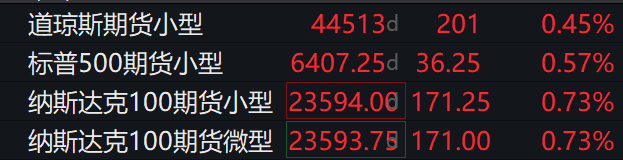
Market Performance - The Nasdaq China Golden Dragon Index opened slightly higher, currently up over 1% with notable gains in companies such as ZTO Express and Miniso, both rising over 4%, and GDS Holdings up over 3% [1] - The US stock market opened with all three major indices showing gains: the Dow Jones up 0.59%, the Nasdaq up 0.75%, and the S&P 500 up 0.55% [2] - Futures for the three major US indices were also up, with Dow futures rising 0.45%, S&P 500 futures up 0.57%, and Nasdaq futures increasing by 0.73% [3] Company-Specific Movements - Eli Lilly saw a significant drop of over 9%, while Intel and Honda both fell over 2%. In contrast, Apple experienced an increase of over 2% [2] - Intel's pre-market decline expanded to 5% following comments from Trump demanding the resignation of Intel's CEO [3]

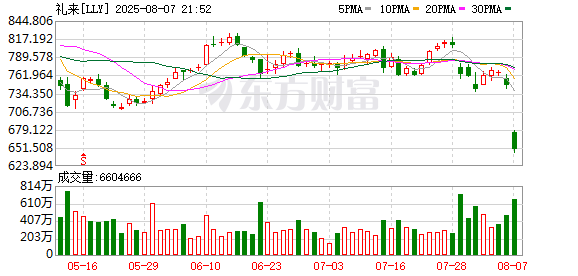
礼来下跌9.69%,报674.075美元/股,总市值6388.45亿美元
Jin Rong Jie· 2025-08-07 13:53
财务数据显示,截至2025年03月31日,礼来收入总额127.28亿美元,同比增长45.17%;归母净利润 27.59亿美元,同比增长23.02%。 大事提醒: 8月7日,礼来(美东)盘前披露2025财年中报(数据来源于纳斯达克官网,预计披露日期为美国当地时 间,实际披露日期以公司公告为准)。 资料显示,礼来公司("礼来")是一家全球医疗保健领先公司,将关怀与发现结合起来,为全世界的人们提 供更好的生活。礼来成立于一个多世纪前,由一位致力于创造满足实际需求的高品质药物的人创立。 在 全球范围内,礼来的员工致力于为需要的人发现并带来改变生活的药物,提高对疾病的了解和管理,并通过 慈善事业和志愿服务回馈社区。 本文源自:金融界 作者:行情君 8月7日,礼来(LLY)开盘下跌9.69%,截至21:30,报674.075美元/股,成交19.83亿美元,总市值6388.45 亿美元。 ...
礼来口服减重药数据公布 平均减重12.4%
Di Yi Cai Jing· 2025-08-07 13:51
礼来还称,Orforglipron能降低所有人群的心脏病风险指标,包括胆固醇、甘油三酯和血压。 礼来当天公布财报显示,在美国市场,GLP-1类药物替尔泊肽(包括降糖药和减重药)市场份额在第二 季度增至57%,其中降糖药第二季度的销售额为52亿美元,减重药销售额为33.8亿美元,均高于分析师 预期。礼来还将年销售额上调为600亿美元至620亿美元。 目前,礼来与丹麦制药巨头诺和诺德正在GLP-1药物领域展开激烈竞争。根据诺和诺德此前公布的一项 三期研究数据,口服司美格鲁肽用药68周后,患者体重降幅至少达14.9%。诺和诺德预计,口服版司美 格鲁肽有望于今年年底前获得美国FDA批准。 礼来执行副总裁、心血管代谢健康事业部总裁Kenneth Custer表示,与注射型GLP-1减重药相比,口服减 重药更易于生产和包装,是一种有前景的替代方案,可用于早期干预和长期疾病管理。 当地时间8月7日,礼来公布了一项口服减重药的重磅三期临床数据,患者用药72周后平均实现减重 12.4%。同日,礼来公布第二季度业绩,上调全年利润预期。 不过,由于此前市场对于这款口服减重药数据预期更高,礼来股价在盘前交易中下跌了约10%。 礼来公 ...
美股三大指数集体高开,礼来跌超9%
Mei Ri Jing Ji Xin Wen· 2025-08-07 13:46
每经AI快讯,美股三大指数集体高开,道指涨0.59%,纳指涨0.77%,标普500指数涨0.5%。礼来跌超 9%,此前实验显示,礼来口服药物Orforglipron平均减重11.2%,低于预期;诺和诺德涨超6%。 ...

礼来口服减重药数据公布,平均减重12.4%
Di Yi Cai Jing· 2025-08-07 13:43
Core Insights - Eli Lilly plans to submit a global regulatory application for Orforglipron by the end of this year and is making significant investments to meet expected demand [1][3] - The latest clinical data shows that patients using Orforglipron for 72 weeks achieved an average weight loss of 12.4 kg, which is a 12.4% reduction [3] - Despite positive clinical results, Eli Lilly's stock fell approximately 10% in pre-market trading due to market expectations being higher for the oral weight loss drug [1][3] Group 1: Clinical Data and Market Competition - In a study involving over 3,000 adults with obesity or weight-related comorbidities, the highest dose of Orforglipron resulted in an average weight loss of 12.4 kg over 72 weeks [3] - Eli Lilly is in intense competition with Novo Nordisk in the GLP-1 drug market, with Novo Nordisk's oral semaglutide showing a weight loss of at least 14.9% over 68 weeks [3] - Eli Lilly's Executive Vice President Kenneth Custer highlighted that oral GLP-1 drugs are easier to produce and package compared to injectable forms, making them a promising alternative for early intervention and long-term disease management [3] Group 2: Financial Performance - Eli Lilly reported that its market share for GLP-1 drugs in the U.S. increased to 57% in Q2, with sales of diabetes drugs reaching $5.2 billion and weight loss drugs generating $3.38 billion, both exceeding analyst expectations [4] - The company has raised its annual sales forecast to between $60 billion and $62 billion [4]
研发创新赋能慢病防控 减重治疗走向“便捷口服时代”
Zheng Quan Ri Bao Wang· 2025-08-07 13:43
Core Insights - The rising obesity issue has made "weight management" a significant focus, with GLP-1 class drugs gaining attention for their effectiveness in weight loss [1][2] - The recent phase 3 study, Attain-1, of the oral GLP-1RA drug orforglipron by Eli Lilly shows promising results, indicating a potential shift in obesity treatment options [1][2] Group 1: Study Overview - Attain-1 is a global phase 3 study involving 3,127 participants, including a broad representation from China, aimed at comparing orforglipron (6mg, 12mg, and 36mg) with a placebo in adults with obesity-related comorbidities but without diabetes [2] - The study lasted 72 weeks and demonstrated statistically significant improvements in all primary and key secondary endpoints across all dosage groups [2] Group 2: Efficacy and Safety - The highest dosage group of orforglipron resulted in an average weight loss of 12.4 kg, with 39.6% of participants achieving a weight reduction of 15% or more [1] - Orforglipron also showed a reduction in cardiovascular risk markers, including non-HDL cholesterol, triglycerides, and systolic blood pressure, with safety profiles consistent with existing injectable GLP-1 receptor agonists [2] Group 3: Market Implications - The oral formulation of orforglipron, which does not require dietary restrictions, is expected to lower treatment adherence barriers and enhance convenience in chronic disease management [3] - Eli Lilly plans to submit orforglipron for regulatory review by the end of the year, preparing for its global market launch to address urgent public health needs [2][3]