
Lilly(LLY)

Search documents
礼来公司20250807
2025-08-07 15:03
Summary of Eli Lilly's Q2 2025 Earnings Call Company Overview - **Company**: Eli Lilly - **Date**: Q2 2025 Earnings Call Key Financial Performance - Gross margin reached **85%**, up **3%** year-over-year, driven by lower production costs and optimized product mix, partially offset by price declines [2][3] - Non-GAAP operating margin at **40.5%**, an increase of over **6 percentage points** year-over-year [4] - Earnings per share (EPS) increased by **61%** to **$6.31**, including a negative impact of **$0.14** from the acquisition of IPR and depreciation [4] - Revenue growth of **38%** in the U.S., primarily due to strong sales of **Mounjaro**, despite an **8%** price decline [3][5] - European revenue grew by **77%**, reflecting strong performance from the Montana business [5] - Revenue in China increased by **19%**, mainly due to increased sales from the Montana business [5] - Total revenue expected to be between **$60 billion** and **$62 billion** for 2025, with non-GAAP operating margin projected between **43%** and **45.5%** [3][13] Market Performance - U.S. market revenue growth driven by **Mounjaro**, **Bydureon**, and **Trulicity** sales [3] - International sales growth of **12%** in oncology, with U.S. prescriptions up **454%** [3][10] - Montana product line achieved **$5.2 billion** in global sales, becoming a leader in the type 2 diabetes prescription market [12] Research and Development Highlights - Multiple new clinical projects initiated, with increased R&D investment [6] - Acquisition of **Site One Therapeutics** and **Verb Therapeutics** to expand non-opioid pain and cardiovascular gene therapy portfolios [6] - FDA approval for new dosing schedule of **Casirol** and positive results from **Surpass CDOT** and **Brewing CLL 314** Phase III trials [7] - **Atern** Phase I trial showed significant weight loss in obese patients, with safety comparable to injectable GLP-1 drugs [8] Addressing Global Health Challenges - Eli Lilly is actively addressing the global obesity challenge with new drug submissions planned [8] - The company supports government reforms to share the costs of medical research more equitably and reduce consumer costs in the U.S. pharmaceutical market [9] Pricing and Cost Management - Eli Lilly's **Lily Direct** model offers affordable medications, with weight loss drugs priced over **50%** lower than previous prices and insulin prices reduced by **70%** [9] - The company emphasizes the need for urgent reforms in the U.S. pharmaceutical market to lower consumer costs [9] Future Expectations - Anticipated production capacity in the second half of 2025 expected to be at least **1.8 times** that of the second half of 2024 [14] - Continued focus on expanding market share in the obesity and diabetes sectors, with new product launches planned [12][20] Conclusion Eli Lilly's Q2 2025 performance reflects strong revenue growth across multiple markets, significant advancements in R&D, and a commitment to addressing global health challenges while managing costs effectively. The company is well-positioned for future growth with a robust pipeline and strategic acquisitions.

礼来口服减重药数据公布 ,礼来口服减重药72周平均减重12.4%
Di Yi Cai Jing· 2025-08-07 14:55
【#礼来口服减重药数据公布# ,#礼来口服减重药72周平均减重12.4%#】 当地时间8月7日,礼来公布了一项口服减重药的重磅三期临床数据,患者用药72周后平均实现减重 12.4%。同日,礼来公布第二季度业绩,上调全年利润预期。 礼来公布的最新临床数据显示,在超过3000名肥胖或至少伴有一种体重相关合并症的超重但无糖尿病的 成人中,每日服用一次的GLP-1口服减重药Orforglipron,在72周用药时,最高剂量组平均减重12.4kg, 减重幅度达12.4%。 不过,由于此前市场对于这款口服减重药数据预期更高,礼来股价在盘前交易中下跌了约10%。 ...
深夜大涨,美国退休金突发
Zheng Quan Shi Bao· 2025-08-07 14:54
Group 1: 401K Retirement Savings Plan Changes - The U.S. President Trump is set to sign an executive order allowing alternative assets such as private equity, real estate, and cryptocurrencies to be included in 401K retirement savings plans, potentially opening up approximately $12.5 trillion in retirement account funds to these sectors [3][4] - The executive order will instruct the Department of Labor to reassess guidelines regarding alternative asset investments in retirement plans and clarify the government's fiduciary responsibilities when offering funds that include alternative investments [3][4] Group 2: Eli Lilly's Weight Loss Drug Performance - Eli Lilly reported second-quarter earnings that exceeded market expectations, with revenue of $15.557 billion, a 38% year-over-year increase, and net income of $5.661 billion, a 91% increase [8] - Despite strong earnings, the company's stock plummeted by 13% due to disappointing results from its experimental weight loss drug orforglipron, which helped patients lose about 11% of their weight, falling short of market expectations [8] Group 3: Unemployment Claims and Federal Reserve - The U.S. Department of Labor reported an increase of 38,000 in continuing unemployment claims, reaching 1.97 million, indicating growing difficulty for unemployed individuals to find new jobs [6] - Following a significant downward revision of employment data, there are heightened concerns among investors and economists regarding further deterioration in the labor market, which may influence expectations for a potential interest rate cut by the Federal Reserve in September [6] Group 4: Intel CEO Controversy - President Trump called for Intel CEO Pat Gelsinger to resign, citing serious conflicts of interest, which led to a more than 2% drop in Intel's stock price following the announcement [10] - Intel stated that it values national security and the integrity of its role in the U.S. defense ecosystem, indicating ongoing communication regarding the issues raised by Trump [10]

深夜,大涨!美国退休金突发!
证券时报· 2025-08-07 14:48
Group 1: 401K Retirement Savings Plan Changes - The U.S. President Trump is set to sign an executive order allowing alternative assets such as private equity, real estate, and cryptocurrencies to be included in 401K retirement savings plans, potentially opening up approximately $12.5 trillion in retirement account funds to these sectors [3][4]. - The 401K plan is a retirement savings plan established under the 1978 Internal Revenue Code, where both employees and employers contribute to a fund that can be invested in various securities [3]. - The new executive order will instruct the Department of Labor to reassess guidelines regarding alternative asset investments in retirement plans and clarify the government's fiduciary responsibilities when offering funds that include alternative investments [3]. Group 2: Market Reactions - Following the announcement of the executive order, Bitcoin experienced a price surge, and private equity stocks like Apollo Group saw slight increases in pre-market trading [5]. - The news is expected to be a significant move by the Trump administration to integrate private assets into fixed contribution accounts and is part of efforts to promote the cryptocurrency industry [4]. Group 3: Eli Lilly's Weight Loss Drug Performance - Eli Lilly reported second-quarter earnings that exceeded market expectations, with revenues of $15.557 billion, a 38% year-over-year increase, and net profits of $5.661 billion, a 91% increase [10]. - Despite strong earnings, the company's stock plummeted by 13% due to disappointing results from its experimental weight loss drug orforglipron, which helped patients lose about 11% of their weight, falling short of market expectations [10][11]. - Analysts suggest that the underperformance of Eli Lilly's drug may lead investors to reconsider the competitive landscape of GLP-1 obesity medications, potentially benefiting Novo Nordisk's oral semaglutide [11]. Group 4: Labor Market Indicators - The U.S. Department of Labor reported an increase of 38,000 in the number of individuals continuing to claim unemployment benefits, reaching 1.97 million, indicating growing difficulties for unemployed individuals in finding new jobs [8]. - This data follows a government employment report that showed a more significant than expected slowdown in job growth, raising concerns among investors and economists about the labor market's further deterioration [8].

Here's Why Eli Lilly (LLY) is a Strong Growth Stock
ZACKS· 2025-08-07 14:45
Taking full advantage of the stock market and investing with confidence are common goals for new and old investors, and Zacks Premium offers many different ways to do both.The research service features daily updates of the Zacks Rank and Zacks Industry Rank, full access to the Zacks #1 Rank List, Equity Research reports, and Premium stock screens, all of which will help you become a smarter, more confident investor.Zacks Premium includes access to the Zacks Style Scores as well. What are the Zacks Style Sco ...
美股异动 | 诺和诺德(NVO.US)涨近6% 因竞争对手礼来(LLY.US)口服减肥药效果不及预期
智通财经网· 2025-08-07 14:39
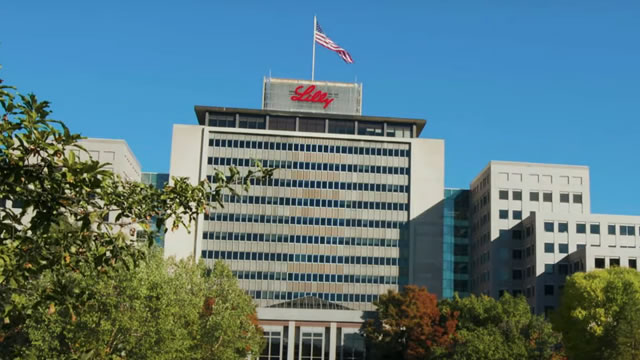
智通财经APP获悉,周四,诺和诺德(NVO.US)股价走高,截至发稿,该股涨近6%,报47.99美元。消息 面上,该公司竞争对手礼来(LLY.US)的首个小分子口服GLP - 1药物Orforglipron实现平均减重11.2%,低 于预期的13%至15%或更多。 ...

诺和诺德(NVO.US)涨近6% 因竞争对手礼来(LLY.US)口服减肥药效果不及预期
Zhi Tong Cai Jing· 2025-08-07 14:37
Core Viewpoint - Novo Nordisk's stock price increased by nearly 6% to $47.99 following news about a competitor's drug performance [1] Group 1: Company Performance - Novo Nordisk's stock price rose significantly, indicating positive market sentiment towards the company [1] - The competitor Eli Lilly's first oral GLP-1 drug, Orforglipron, achieved an average weight loss of 11.2%, which was below the expected range of 13% to 15% or more [1] Group 2: Market Reaction - The market reacted positively to Novo Nordisk's stock, reflecting investor confidence in its products compared to competitors [1] - The underperformance of Eli Lilly's drug may create a competitive advantage for Novo Nordisk in the GLP-1 market [1]
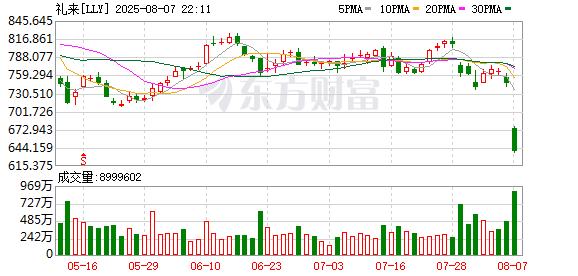
礼来跌近14%,创下自2000年8月以来最大单日跌幅
Mei Ri Jing Ji Xin Wen· 2025-08-07 14:10
(文章来源:每日经济新闻) 每经AI快讯,8月7日,礼来跌近14%,创下自2000年8月以来最大单日跌幅。 ...
美股异动 | 礼来(LLY.US)大跌近14% 口服减肥药疗效不及预期
智通财经网· 2025-08-07 14:09
Core Viewpoint - Eli Lilly's stock dropped nearly 14% to $642.12 following disappointing results from a late-stage study of its experimental oral weight-loss drug orforglipron, which showed a weight reduction of approximately 11%, falling short of Wall Street expectations [1] Group 1: Drug Performance - The highest dosage of orforglipron helped patients achieve an average weight loss of 12.4% over 72 weeks [1] - Analysts had anticipated orforglipron to perform similarly to Novo Nordisk's Wegovy, which achieved a 14.9% weight loss over 68 weeks in a 2021 trial [1] - Some analysts even expected orforglipron to exceed the performance of Novo Nordisk's popular product [1]