Lockheed Martin(LMT)

Search documents
X @Bloomberg
Bloomberg· 2026-01-29 12:54
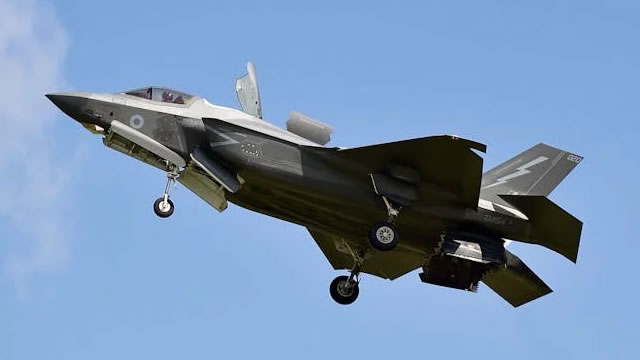
Lockheed Martin’s fourth-quarter earnings missed analyst estimates despite record deliveries of its stealthy F-35 fighter jets and a 9.1% increase in sales https://t.co/OmehDCGUyt ...

洛克希德股价盘前上涨5.1%
Xin Lang Cai Jing· 2026-01-29 12:52
每经AI快讯,1月29日,洛克希德股价盘前上涨5.1%。 每经AI快讯,1月29日,洛克希德股价盘前上涨5.1%。 ...
Lockheed Martin Guides FY26 In Line With Estimates - Update
RTTNews· 2026-01-29 12:39
While reporting financial results for the third quarter on Tuesday, defense company Lockheed Martin Corp. (LMT) initiated its earnings and net sales guidance for the full-year 2026, in line with analysts' estimates.For fiscal 2025, the company now projects earnings of in a range of $29.35 to $30.25 per share on net sales between about $77.50 billion and $80.00 billion.On average, analysts polled expect the company to report earnings of $29.41 per share on net sales of $77.85 billion for the year. Analysts' ...


Corporate Earnings Show Mixed Results Amidst Geopolitical Shifts and IPO Anticipation
Stock Market News· 2026-01-29 12:38
分组1 - Lockheed Martin (LMT) reported Q4 2025 net sales of $20.38 billion, exceeding the estimated $19.85 billion, while EPS was $5.80, slightly below the estimate of $5.86 [2][9] - The Aeronautics division, responsible for the F-35 fighter jet, achieved net sales of $8.52 billion, surpassing the $7.96 billion estimate, with 48 F-35 deliveries in the quarter [2][9] - Lockheed Martin's operating profit reached $2.33 billion, outperforming the $2.22 billion estimate, and its backlog grew 10% year-over-year to $193.62 billion [2][9] 分组2 - Blackstone (BX) is preparing for "one of the largest IPO pipelines in history," indicating a potential resurgence in the IPO market [3][9] 分组3 - Comcast (CMCSA) reported adjusted EPS of 84 cents, beating the estimated 75 cents, but revenue of $32.31 billion slightly missed the $32.36 billion estimate [4][9] - The company faced challenges in its domestic broadband segment, losing 181,000 customers, worse than the estimated loss of 168,194 [4] - Peacock streaming service reported an adjusted EBITDA loss of $552 million, larger than the estimated loss of $456.2 million [4] 分组4 - Sherwin-Williams (SHW) reported Q4 2025 adjusted EPS of $2.23 on net sales of $5.60 billion, both surpassing analyst estimates [5] - The Paint Stores Group net sales of $3.13 billion slightly missed the $3.16 billion estimate [5] - For 2026, Sherwin-Williams provided an adjusted EPS outlook of $11.50 to $11.90, below the analyst consensus of $12.39 [5] 分组5 - Nasdaq (NDAQ) announced Q4 adjusted EPS of $0.96, exceeding the $0.91 estimate, with annualized recurring revenue reaching $3,051 million [6] - Nasdaq projected fiscal year adjusted operating expenses between $2,455 million and $2,535 million [6] 分组6 - Geopolitical developments include Russia's Finance Ministry proposing export duties on diamond exports and the EU Council adopting new sanctions against Iran [7]


洛克希德·马丁2025年销售额增长6% 达到750亿美元
Xin Lang Cai Jing· 2026-01-29 12:37
Core Insights - Lockheed Martin's sales for 2025 are projected to grow by 6%, reaching $75 billion [1] - The net profit for 2025 is estimated at $5 billion, translating to earnings per share of $21.49 [1] - The company expects operating cash flow of $8.6 billion and free cash flow of $6.9 billion for 2025 [1] - As of the end of 2025, the backlog of orders has reached a record $194 billion [1] - In Q4 2025, sales amounted to $20.3 billion, compared to $18.6 billion in Q4 2024 [1] - The net profit for Q4 2025 is reported at $1.3 billion [1]
Lockheed Martin forecasts upbeat 2026 profit, revenue amid rising geopolitical tensions
Reuters· 2026-01-29 12:27
Core Viewpoint - Lockheed Martin forecasts 2026 profit and revenue above Wall Street estimates, driven by sustained demand for fighter jets and weapons amid increasing geopolitical uncertainty [1] Group 1 - The company anticipates continued demand for its fighter jets and weapons [1]
Lockheed Martin(LMT) - 2025 Q4 - Annual Results
2026-01-29 12:25
Exhibit 99.1 "This notable start to 2026 reinforces our confidence in Lockheed Martin's continued operational and financial growth in the year ahead. We expect sales and reported segment operating profit growth of approximately 5% and 25% year-over-year, respectively, and free cash flow between $6.5 to $6.8 billion, an increase compared to our prior expectation. With a strong emphasis on operational performance and clear alignment with our customers' national defense priorities, we will continue to deliver ...
Lockheed Martin Reports Fourth Quarter and Full Year 2025 Financial Results
Prnewswire· 2026-01-29 12:20
Core Insights - Lockheed Martin Corporation reported a strong financial performance for the fourth quarter of 2025, with sales of $20.3 billion, a 9.2% increase from $18.6 billion in the same quarter of 2024. Net earnings reached $1.3 billion, or $5.80 per share, compared to $527 million, or $2.22 per share, in the previous year [1][6][12] Financial Performance - The company achieved a total sales increase of 6% year-over-year, reaching $75.0 billion in 2025, up from $71.0 billion in 2024 [6][19] - Net earnings for 2025 were $5.0 billion, or $21.49 per share, which included a pension settlement charge of $479 million [6][10] - Cash from operations was $8.6 billion in 2025, with free cash flow of $6.9 billion after a pension contribution of $860 million [6][8] Operational Highlights - Lockheed Martin's backlog reached a record $194 billion at the end of 2025, indicating strong demand for its products and services [2][6] - The company invested over $3.5 billion in production capacity and next-generation technologies throughout 2025 to meet increasing demand [2][3] Segment Performance - Aeronautics segment sales increased to $8.5 billion in Q4 2025, up from $8.0 billion in Q4 2024, driven by higher sales on classified programs and the F-35 program [17][18] - The Missiles and Fire Control segment saw sales rise to $4.0 billion in Q4 2025, an 18% increase from $3.4 billion in Q4 2024, attributed to production ramp-up in tactical and strike missile programs [21][22] - Rotary and Mission Systems segment sales were $4.6 billion in Q4 2025, up from $4.3 billion in Q4 2024, primarily due to higher sales on Integrated warfare systems and Sikorsky helicopter programs [25][26] - Space segment sales increased to $3.2 billion in Q4 2025, compared to $2.9 billion in Q4 2024, driven by higher sales volume for strategic and missile defense programs [29][30] 2026 Financial Outlook - The company expects sales for 2026 to be between $77.5 billion and $80.0 billion, with business segment operating profit projected between $8.4 billion and $8.7 billion [12][38] - Free cash flow is anticipated to be between $6.5 billion and $6.8 billion for 2026, reflecting continued strong operational performance [12][39]

Lockheed Martin and U.S. Department of War Sign Framework Agreement to Quadruple THAAD Interceptor Production Capacity
Prnewswire· 2026-01-29 11:45
Core Insights - Lockheed Martin is significantly increasing the production of THAAD interceptors from 96 per year over the next seven years, in collaboration with the Department of War [2] - A new Munitions Acceleration Center is being established in Camden, Arkansas, to enhance workforce capabilities in advanced manufacturing and robotics [1] Investment and Production Expansion - Lockheed Martin has invested over $7 billion since President Trump's first term, with approximately $2 billion allocated for munitions production acceleration [5] - The company plans a multibillion-dollar investment over the next three years to expand production and modernize over 20 facilities across multiple states [5] - The THAAD framework agreement is the second of its kind, following a recent agreement for PAC-3 MSE interceptors [5] Job Creation and Manufacturing Growth - Lockheed Martin is creating tens of thousands of high-quality American jobs in manufacturing, engineering, and skilled trades to meet rising production demands [5] - Since 2016, deliveries of six critical munitions have increased by over 220%, with a projected additional increase of 245% to support PAC-3 and THAAD capabilities [5] - Manufacturing jobs have grown by over 60% since President Trump's first term, with an additional ~50% growth projected by 2030 [5]