PJSC LUKOIL(LUKOY)

Search documents
Exclusive-Exxon in talks with Iraq about buying Lukoil stake in giant West Qurna 2 oilfield, sources say
Yahoo Finance· 2025-12-02 14:54
Core Viewpoint - Exxon Mobil is interested in acquiring Lukoil's majority stake in the West Qurna 2 oilfield in Iraq, marking a significant return of the U.S. company to the region as Lukoil seeks to divest its international assets due to U.S. sanctions [1][2]. Group 1: Exxon Mobil's Interest and Actions - Exxon has approached the Iraqi oil ministry regarding the acquisition of Lukoil's stake in West Qurna 2 [1]. - The U.S. Treasury has allowed potential buyers to negotiate with Lukoil until December 13, but specific deals will require approval [2]. - Exxon previously operated the adjacent West Qurna 1 project before exiting last year [3]. Group 2: Lukoil's Situation - Lukoil is attempting to sell its international assets following U.S. sanctions, with its largest foreign asset being a 75% operational stake in West Qurna 2 [2]. - The West Qurna 2 oilfield produces approximately 470,000 barrels per day, accounting for about 9% of Iraq's total oil output [2]. Group 3: Iraqi Oil Ministry's Position - The Iraqi oil ministry has expressed a preference for Exxon to take over Lukoil's stake, citing Exxon's capacity and experience [5]. - Iraq is actively inviting U.S. oil companies to negotiate for the takeover of West Qurna 2 [5]. Group 4: Recent Developments - In October, Exxon signed a non-binding agreement with Iraq to assist in developing the Majnoon oilfield and expanding oil exports [4]. - Iraq is seeking to accelerate oil and gas production by offering more favorable terms to foreign companies [4].

克宫派定心丸:印度进口俄油下滑只是暂时的,俄方有“黑科技”
Jin Shi Shu Ju· 2025-12-02 14:33
Group 1 - The Kremlin spokesperson, Peskov, stated that India's imports of Russian oil may only decline for a "very short time" as Moscow plans to use "advanced technology" to circumvent Western sanctions and increase supply [1] - India is set to reduce its Russian oil purchases to a three-year low this month due to Western sanctions, particularly those imposed by Washington on major Russian oil producers like Rosneft and Lukoil [1] - Peskov emphasized that Russia is working to create a "necessary environment" for buyers seeking to purchase its oil, asserting that the oil trade volume may experience a negligible decline in the short term [1] Group 2 - Indian refiners, including Mangalore Refinery and Petrochemicals Ltd, Hindustan Petroleum Corporation, and HPCL-Mittal Energy Ltd, have ceased purchasing Russian oil [2] - State-owned Indian Oil Corporation has ordered Russian oil from non-sanctioned entities, while Bharat Petroleum Corporation is in advanced negotiations for imports [2] - Nayara Energy, backed by Russia and partially owned by Rosneft, is currently processing Russian oil, as other suppliers have withdrawn due to UK and EU sanctions [2]
Exclusive: Exxon Mobil approached Iraq about buying Lukoil's West Qurna oilfield stake, sources say
Reuters· 2025-12-02 07:34
Core Viewpoint - Exxon Mobil is interested in acquiring Lukoil's majority stake in the West Qurna 2 oilfield in Iraq, indicating a strategic move to expand its oil production capabilities in the region [1] Group 1: Company Actions - Exxon Mobil has approached the Iraqi oil ministry regarding the potential acquisition of Lukoil's stake [1] - The interest in West Qurna 2 reflects Exxon Mobil's ongoing strategy to enhance its portfolio in key oil-producing regions [1] Group 2: Industry Context - The West Qurna 2 oilfield is a significant asset in Iraq's oil sector, highlighting the competitive landscape among major oil companies [1] - The move may signal a shift in investment dynamics in the Middle East, particularly concerning Russian assets amid geopolitical tensions [1]

VTB CEO says Russian firms are eyeing Global South for expansion
Yahoo Finance· 2025-12-01 15:11
Group 1 - Russian companies are focusing on expansion opportunities in the Global South despite Western sanctions, as stated by Andrei Kostin, CEO of VTB [1][2] - VTB has been involved in foreign acquisitions of oil companies, including the acquisition of India's Essar Oil, now known as Nayara Energy, in 2017 [2] - Nayara Energy is targeting the domestic Indian market exclusively, with no plans for exports, and continues to operate despite previous sanctions [3] Group 2 - Kostin believes that Russian oil companies like Rosneft and Lukoil will find new opportunities similar to VTB's shift in focus after sanctions [4] - The demand for Russian oil remains strong, and any restrictions that increase oil prices benefit exporters [4] - VTB plans to expand its presence in India by opening an office in Mumbai, recognizing India's potential to increase exports to Russia, particularly in machinery and pharmaceuticals [6]
普京回应美国制裁两家俄石油企业:我不理解
Huan Qiu Wang· 2025-12-01 09:52
据俄新社报道,对于美国此前在阿拉斯加州美俄领导人会晤后"突然"宣布制裁两家俄罗斯石油企业,俄 总统普京11月27日表示不理解。 普京与特朗普今年8月15日在美国阿拉斯加州安克雷奇举行会晤,双方均表示会晤"富有成果",但未就 俄乌停火等问题达成任何协议。两个多月后,美国方面宣布,决定制裁俄罗斯石油公司和卢克石油公 司,原因与俄乌冲突有关。 责任编辑:刘础琪 普京回答记者提问时的画面图源:俄媒视频截图 根据克里姆林宫网站11月27日发布的消息,普京当天回答记者提问,就包括俄乌冲突在内多个议题作出 表态。谈及俄美就解决俄乌冲突保持接触,普京说,他曾前往阿拉斯加与美方举行了有关会谈。 "我想说,总体上,我们持以下观点:我们都明白对方立场以及制止战斗行动所需措施。"普京表 示,"随后我们各自返回,因为我的同行特朗普总统和我都认为,我们需要返回各自首都,仔细考虑, 与有关机构、部门以及盟友磋商。后来,我们也同意推进有关工作。" 普京接着称,但后来美国"突然"宣布对两家俄罗斯石油企业实施制裁,"这是为什么?说实话,我不理 解发生的事情"。 ...
India Signals a 50% Cut in Russian Oil Imports Under U.S. Sanctions Pressure
Yahoo Finance· 2025-12-01 09:30
Core Viewpoint - India is expected to reduce its imports of Russian crude oil by 50%, while still seeking ways to circumvent U.S. sanctions to maintain some oil flow [1][2]. Group 1: Import Reductions - A former foreign minister indicated that India will gradually decrease oil purchases from Russia, projecting a 50% reduction, although some oil will continue to be imported [1]. - Indian companies and banks are likely to diversify their oil sources to avoid U.S. sanctions, leading to a steady decline in orders from Russia [2]. Group 2: Current and Future Import Data - U.S. sanctions on Russian oil companies Rosneft and Lukoil have already led to a decrease in new orders from Indian refiners, with Kpler data showing imports from Russia at 1.855 million barrels daily in November, up from 1.48 million barrels daily in October [3]. - Expectations for November indicate a potential drop in imports to around 1 million barrels daily, a decrease of 47% compared to previous levels, marking the lowest imports since 2022 [5]. - Over the first nine months of the year, India imported a total of 5.4 million tons of Russian crude, spending approximately $2.43 billion [5].
英国将对卢克石油公司的制裁推迟到明年2月
Sou Hu Cai Jing· 2025-11-27 19:44
Core Viewpoint - The UK government has postponed sanctions against the international business arm of Russian oil company Lukoil, reflecting a cautious approach by Western nations towards the energy giant [1] Group 1: Sanction Details - The UK Financial Sanctions Implementation Office announced that the grace period for sanctions against Lukoil International Limited and its subsidiaries will be extended until February 26 of next year [1] - The sanctions were originally set to take effect at midnight on November 28 [1] Group 2: Context of Sanctions - Lukoil, along with another Russian energy giant, Rosneft, faced sanctions from the US in October, with some of those measures also receiving delayed implementation [1]
创5年来新高!美国制裁俄油促使买家转向替补供应 VLCC运价继续飙涨
智通财经网· 2025-11-24 07:05
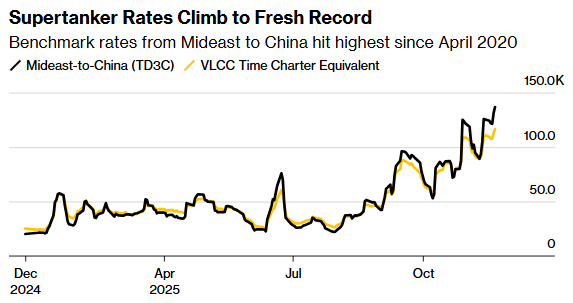
Group 1 - The cost of chartering Very Large Crude Carriers (VLCCs) has surged to its highest level in over five years, driven by buyers seeking alternatives to sanctioned Russian oil and increased supply from Middle Eastern and U.S. producers [1] - The benchmark freight rate for VLCCs transporting oil from the Middle East to China rose to nearly $137,000 per day, marking a 576% increase year-to-date and the highest level since April 2020 [1] - A broader index covering multiple VLCC routes also reached $116,400 per day, setting a new five-year high [1] Group 2 - The increase in VLCC bookings is attributed to U.S. sanctions on Russian oil companies, which took effect last week, prompting buyers, particularly from India and China, to seek alternative suppliers [4] - Analysts noted that the rise in rates aligns with increased production from the U.S. and OPEC+ countries, especially Middle Eastern producers preparing to offer more crude oil to buyers [4] - The surge in VLCC rates has also benefited the entire tanker fleet, with smaller vessels experiencing higher earnings as Suezmax tankers have entered the Middle East to transport cargo typically handled by VLCCs [4]
X @Bloomberg
Bloomberg· 2025-11-21 17:34
A fuel retailer in Finland filed for corporate restructuring because US sanctions on Russia’s Lukoil left it unable to conduct business https://t.co/JcFmIIMKaL ...
How Trump's Attack on Russia's Economy Is Ricocheting Through Oil Markets
WSJ· 2025-11-21 17:00
Core Viewpoint - U.S. sanctions on Russia's largest oil producers, Lukoil and Rosneft, are now in effect and are beginning to challenge Moscow's ability to sell crude oil, which is crucial for its economy [1] Group 1: Impact of Sanctions - The sanctions are targeting Russia's largest oil producers, specifically Lukoil and Rosneft, which are vital to the country's oil exports [1] - The effectiveness of these sanctions will be tested as they impact Moscow's economic stability and its ability to generate revenue from oil sales [1] Group 2: Economic Implications - Crude oil sales are described as the economic lifeblood of Russia, indicating the significant role that oil exports play in the country's overall economy [1] - The sanctions may lead to a decrease in oil revenue, which could have broader implications for Russia's economic health and fiscal policies [1]