LVMH(LVMUY)

Search documents
Silvia Venturini Fendi to step down from creative direction of LVMH label Fendi
Reuters· 2025-09-29 15:56
Silvia Venturini Fendi is stepping down from LVMH label Fendi and becoming honorary president of the fashion house, the French luxury group said on Monday. ...


欧莱雅高管洗牌;雅诗兰黛大幅降薪丨二姨看时尚
2 1 Shi Ji Jing Ji Bao Dao· 2025-09-29 11:59
Group 1: Major Corporate Changes - L'Oréal announced significant adjustments to its executive committee, with new appointments set to take effect in January 2026, aiming to enhance its strategic focus in the U.S. market [2] - Estée Lauder is undergoing a substantial salary reduction for its executive team, with a total annual compensation decrease of 28% for FY2025, reflecting a collective compromise amid poor performance and declining stock prices [3] - Burberry's global procurement and marketing director has left the company, indicating challenges in retaining key executives during its transformation strategy [11] Group 2: Market Performance and Reactions - H&M reported better-than-expected Q3 results for FY2025, with net sales increasing by 2% year-on-year, leading to a 10% surge in stock price [6][5] - Brunello Cucinelli's stock plummeted by 15% following allegations of regulatory violations in the Russian market, highlighting the fragility of luxury brand valuations [7] - LVMH continues to expand its media asset portfolio, indicating a strategic move to enhance its influence in the media landscape [9] Group 3: Strategic Developments - Ralph Lauren secured a significant legal victory in China, confirming its "POLO" trademark as a well-known brand, which strengthens its position in the market [4] - LVMH's Kendo has sold its beauty brand KVD Beauty to Windsong Global, marking its first brand sale and a shift in strategy to streamline its offerings [9] - Reports suggest that L'Oréal is primarily interested in retaining only the profitable beauty business of Armani, with a licensing agreement extended until 2050 [13]

快时尚巨头,为何扎堆做美妆?
Hu Xiu· 2025-09-26 10:29
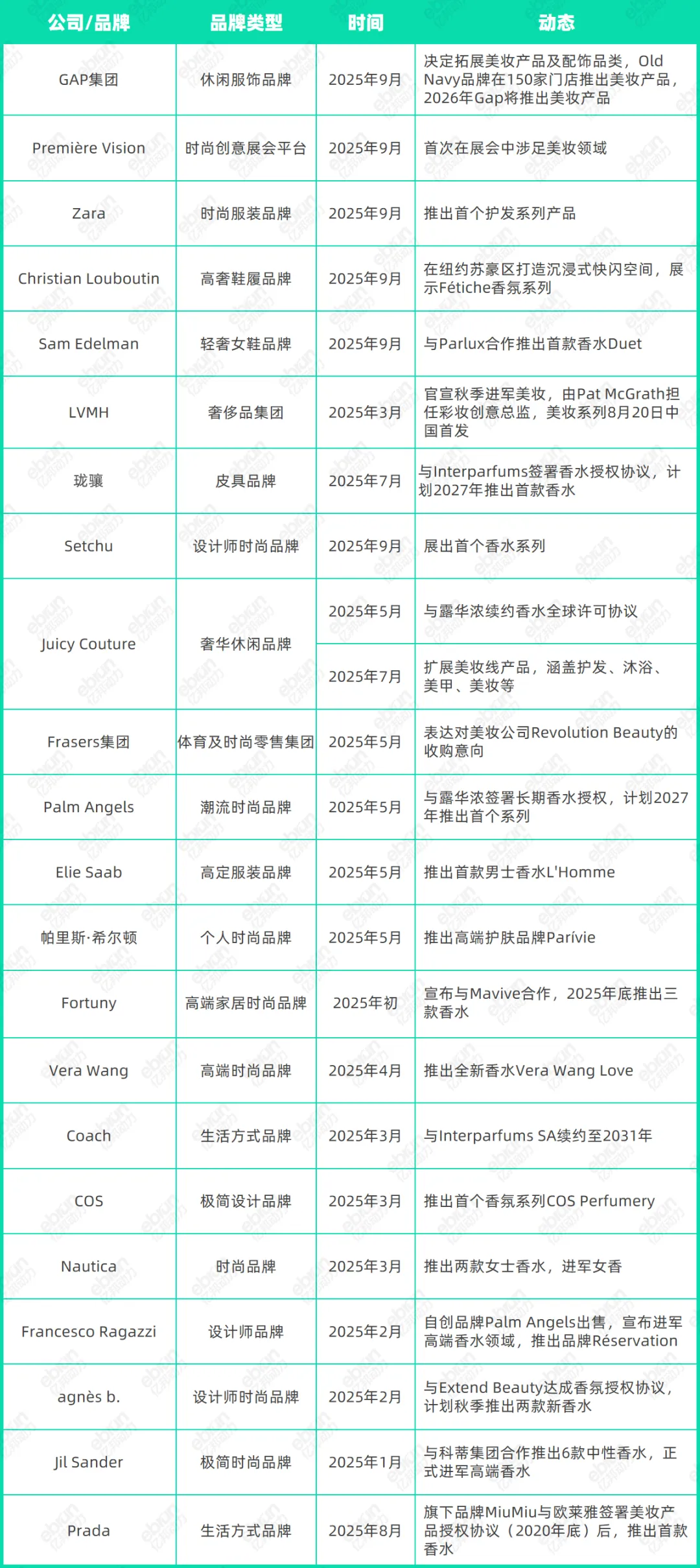
Core Viewpoint - The fashion industry is increasingly venturing into the beauty sector as a response to declining sales, with several major brands launching beauty products to explore new growth opportunities [3][10][46]. Group 1: Fashion Brands Entering Beauty - In September 2025, major fashion brands like Gap, Zara, and H&M announced significant moves into the beauty industry, indicating a trend among fashion companies to diversify their product offerings [5][16]. - Gap Group plans to launch beauty products in 150 Old Navy stores, with some featuring beauty consultants, aiming to leverage its financial stability for growth [12][10]. - Zara has introduced its first hair care line, including shampoo and conditioner, marking its entry into the hair care segment after previously launching cosmetics and fragrances [15][14]. Group 2: Performance of Fashion Brands - Gap Group reported a 4.85% increase in net sales for Q2 2024, ending a three-year decline, but the growth rate has slowed significantly compared to previous years [7][10]. - Zara's parent company, Inditex, experienced a modest 1.6% sales growth in H1 2025, with Zara itself showing the slowest growth in five years at 0.9% [13][14]. - H&M's net sales fell by 1.87% in the same period, with a notable decline in net profit, indicating a downward trend for the brand [16][17]. Group 3: LVMH's Beauty Strategy - LVMH launched its own beauty brand in 2025, with a focus on luxury makeup products, including 55 lipstick shades, aiming to enhance its beauty segment's profitability [32][33]. - Despite the launch, LVMH's overall sales and profits saw significant declines in H1 2025, with a 4.48% drop in net sales and a 21.59% decrease in net profit [34][35]. - The beauty segment's operating profit margin remains lower than the group's average, highlighting challenges in achieving profitability through self-created beauty brands [39][40]. Group 4: Designer Brands and Fragrance - Designer brands are increasingly entering the fragrance market, with several launching new perfume lines in collaboration with established fragrance companies [20][22]. - The trend reflects a broader strategy among fashion brands to transform into lifestyle brands, leveraging their design expertise while outsourcing production and distribution to fragrance giants [22][24]. - Notably, Christian Louboutin's fragrance line, managed by Puig, has faced challenges, with its makeup segment experiencing a decline in sales [30][28]. Group 5: Market Outlook and Challenges - The collective move into beauty by fashion brands raises questions about the sustainability of this strategy amid economic downturns [46]. - The beauty market's appeal remains strong, but the success of these ventures will depend on the brands' ability to adapt and innovate in a competitive landscape [46].



不确定性冲击全球奢侈品市场 路威酩轩(LVMUY.US)加码韩国构建多元化支点
智通财经网· 2025-09-25 02:00
Group 1 - LVMH is increasing its expansion efforts in South Korea to diversify its global business due to geopolitical and economic uncertainties affecting major markets like the US [1] - The flagship stores of Louis Vuitton and Dior in Seoul's Cheongdam area are set for expansion, with Dior's renovation possibly starting in 2027, including a permanent restaurant [1] - Bulgari is considering opening its first flagship store in South Korea, while Tiffany's flagship store is scheduled to open in Cheongdam in 2027 [1] Group 2 - The South Korean market is seen as a bright spot for luxury brands due to strong consumer love for luxury goods, economic resilience, and high consumer confidence [1] - Sales of Louis Vuitton, Hermès, and Chanel in South Korea grew nearly 10% last year, reaching $3.3 billion [1] - The increase in luxury sales is also driven by a surge in tourists from China and Japan, along with the depreciation of the Korean won, with tourist spending reaching a record 9.26 trillion won (approximately $6.6 billion) last year [1] Group 3 - Other luxury brands are also optimistic about the strong demand in the South Korean market, with Richemont reporting a 20% sales increase in Korea for the fiscal year ending in March [2] - Richemont opened a new flagship store for its Swiss watch brand Vacheron Constantin in Seoul, featuring Korean art exhibitions and private lounge spaces [2] - Hermès has relocated and expanded its flagship store in Seoul, reopening in August [2]
CAC 40 Drifts Lower On Valuation Concerns, Rate Uncertainty
RTTNews· 2025-09-24 11:01
Market Overview - French stocks are experiencing weakness due to concerns about the Federal Reserve's rate cuts and high equity valuations as noted by Fed Chair Jerome Powell [1] - The benchmark CAC 40 index is down 20.34 points or 0.26% at 7,851.68 [2] Company Performance - Stellantis is the biggest loser in the CAC 40 index, down 3.4% [2] - Hermes International has decreased nearly 2%, while Renault, EssilorLuxottica, Capgemini, L'Oreal, Euronext, Publicis Groupe, and Saint Gobain are down between 1% to 1.7% [2] - LVMH and Pernod Ricard are both down nearly 1% [3] - Atos SE shares have increased by 4.7% after securing a major cybersecurity contract from the European Commission [3] - Carrefour is gaining approximately 2.3%, while Thales, Bouygues, Kering, and Legrand are up between 1.3% to 1.6% [3]


法国首富阿尔诺呛声财富税,富人会再次“集体出走”吗?
Di Yi Cai Jing· 2025-09-23 09:29
Core Points - The current wealth tax proposal in France is primarily politically motivated, aiming to address widespread anxiety over wealth distribution in society [1] - The wealth tax debate has resurfaced as a central political issue in France, with significant public demonstrations against government austerity measures [3][4] - The proposed "Zucman tax" targets individuals with net assets exceeding €100 million, suggesting a minimum tax rate of 2%, potentially generating between €10 billion to €25 billion in revenue [1][3] - The wealthiest 75 families in France pay an effective tax rate that is only half of the next income tier, indicating a regressive tax system [5] - Critics warn that the wealth tax could lead to capital flight, as seen in previous attempts to tax the wealthy [5][6] Industry Insights - The wealth tax proposal has been met with strong opposition from business leaders, who argue it could undermine economic freedom and discourage investment [6] - The debate reflects broader economic dissatisfaction among the French populace, particularly in the context of rising inflation and stagnant economic reforms [4][7] - There is a call for a shift in focus from wealth redistribution to expanding the overall economic "cake," emphasizing the need for growth in sectors like digitalization and green energy [7][8]
LVMH集团董事长阿尔诺到访上海 参观老铺黄金门店
Ge Long Hui A P P· 2025-09-17 07:18
Group 1 - Bernard Arnault, the chairman and CEO of LVMH, was spotted in Shanghai on September 16, marking his third consecutive year visiting China [1] - During his visit, Arnault and his team visited the Lao Pu Gold store in Shanghai's IFC Mall, where he closely observed various gold items and commented on their craftsmanship as "very exquisite and interesting" [1]
X @Bloomberg

Bloomberg· 2025-09-12 14:30
Giorgio Armani names LVMH, EssilorLuxottica and L’Oreal as preferred buyers for a stake in the company, according to a copy of the designer’s will that was opened on Friday https://t.co/W9bp3zfTln ...
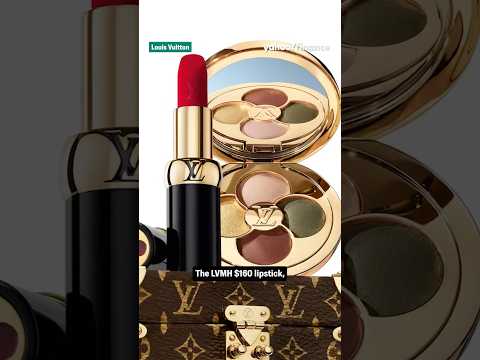
Louis Vuitton is selling $160 lipstick.
Yahoo Finance· 2025-08-20 23:30
Market Positioning & Strategy - LVMH launched a $160 lipstick, generating both positive and negative buzz [1] - The industry observes this as a strategic move to reinforce LVMH's market position and lead [1] - The industry views the success of LVMH's $160 lipstick as uncertain, especially with Hermes setting a high standard with an $80 lipstick [1] Competitive Landscape - The market for $160 lipstick is considered virtually non-existent [1] - Hermes is positioned at the top of the market with an $80 lipstick [1]
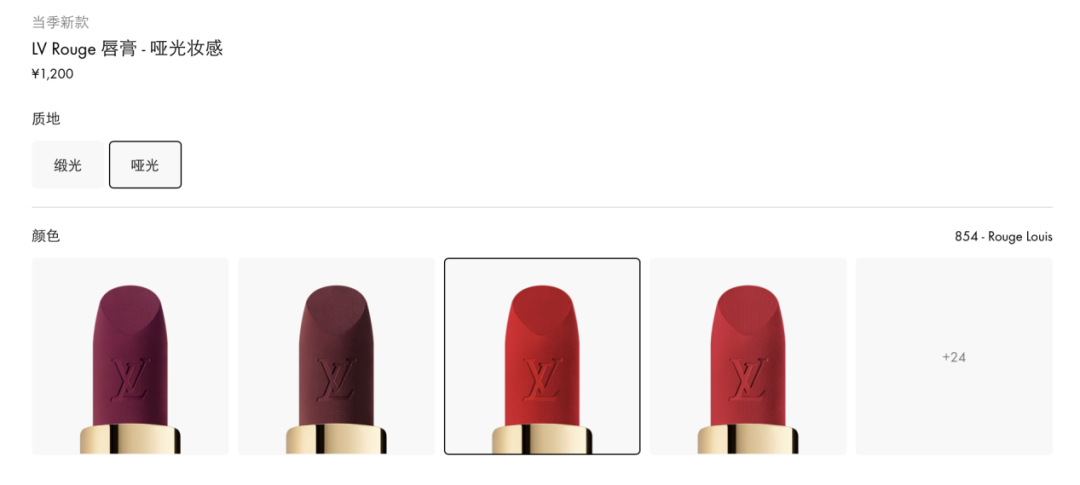
售价1200元!LV口红贵过爱马仕
Zhong Guo Ji Jin Bao· 2025-08-20 15:24
Core Viewpoint - LV has launched a high-priced beauty product line, with lipsticks priced at 1200 yuan each, setting a new industry benchmark and sparking significant online discussion [1]. Group 1: Product Launch and Pricing - LV's beauty product line was officially launched on August 20, with a flagship beauty boutique opening in Nanjing [1]. - The lipstick and lip balm are priced at 1200 yuan, while the refill is priced at 510 yuan, significantly higher than competitors like Prada (420 yuan), Celine (590 yuan), Chanel (around 420 yuan), and Dior (400-760 yuan) [1]. Group 2: Market Context and Performance - The luxury goods sector has faced challenges, with Bain & Company predicting a 1% market contraction in 2024 and a further decline of 2%-5% in 2025, potentially marking the largest drop in 15 years [8]. - LVMH's revenue fell by 4% to 39.81 billion euros in the first half of the year, with a 22% drop in net profit to 5.69 billion euros, and a decline of 8% in the fashion and leather goods segment [8]. - Despite the overall downturn, the beauty segment showed resilience, with LVMH's perfume and cosmetics division achieving revenue of 4.082 billion euros, remaining stable [8]. Group 3: Consumer Behavior and Market Trends - High-net-worth individuals are showing stable spending trends in high-end beauty, with a slight growth of 1% [9]. - The global high-end cosmetics and perfume market is projected to reach approximately 63.3 billion USD in 2025, growing to 83 billion USD by 2029 [9]. - Beauty products generally have higher profit margins than traditional luxury goods and are seen as more accessible luxury items, which can help maintain brand loyalty during economic downturns [10].