Marriott International(MAR)

Search documents
Marriott International(MAR) - 2025 Q3 - Earnings Call Transcript
2025-11-04 14:30
Financial Data and Key Metrics Changes - Third quarter adjusted EBITDA rose 10% to $1.35 billion, exceeding expectations, while adjusted EPS grew 9% [13][15] - Global REVPAR increased by 0.5%, driven by nearly 1% ADR growth, offsetting a 30 basis point decline in occupancy [13][15] - Total gross fee revenues increased 4% year-over-year to $1.34 billion, primarily due to rooms growth and strong co-branded credit card fee growth [13][14] Business Line Data and Key Metrics Changes - REVPAR growth was strongest in the luxury segment, which rose 4%, while select service brands in the US and Canada saw declines [6][7] - Incentive management fees (IMFs) totaled $148 million, down 7% year-over-year, primarily due to declines in the US and Canada [14] - Owned lease and other revenue net of expenses rose 16% compared to the prior year, driven by contributions from newly acquired properties [14] Market Data and Key Metrics Changes - International REVPAR grew 2.6%, outperforming the US and Canada, where REVPAR was down 0.4% [4][5] - APEC region saw nearly 5% REVPAR growth, driven by robust ADR growth and higher demand from international travelers [4][5] - Greater China faced challenges with flat REVPAR due to weaker macro conditions, although market share continued to grow [5][6] Company Strategy and Development Direction - The company aims for strong net rooms growth in 2025 and beyond, with a pipeline of over 596,000 rooms, including 250,000 under construction [8][18] - The launch of new brands like Outdoor Collection by Marriott Bonvoy reflects the company's strategy to diversify offerings and enhance guest experiences [9][10] - Continued focus on technology transformation and AI integration to improve operational efficiency and customer experience [11][12] Management's Comments on Operating Environment and Future Outlook - Management anticipates global REVPAR growth of 1-2% in Q4, with stronger growth expected internationally compared to the US and Canada [15][16] - The company expects full-year 2025 REVPAR to rise between 1.5% and 2.5% year-over-year, with a positive impact from next summer's World Cup [16][18] - Management remains optimistic about the future, citing strong cash flow performance and a commitment to shareholder returns [19] Other Important Information - Membership in the Marriott Bonvoy loyalty program grew to nearly 260 million, up 18% year-over-year, enhancing customer engagement [10] - The company is committed to maintaining an investment-grade rating while returning excess capital to shareholders through dividends and share repurchases [19] Q&A Session Summary Question: Can you provide details on the credit card program and renewal? - Management acknowledged ongoing negotiations and highlighted the growth of the Bonvoy program, which has doubled in membership since 2017, indicating strong potential for future credit card fees [22][25][26] Question: What are the trends in franchisee health and owner requests? - Management noted record signings and efforts to enhance top-line performance, indicating strong franchisee health despite macroeconomic challenges [33][34] Question: Can you elaborate on investment spending trends? - Management clarified that increased investment spending is related to non-development expenditures and technology transformation, not a change in key money philosophy [37][38] Question: What is the outlook for business transient travel? - Business transient REVPAR was flat, with government transient down 15%, but larger corporate clients showed encouraging strength [57][58] Question: How is the development environment in APAC and China? - Management reported strong rooms growth and signings in Asia, particularly in Greater China, with a 24% year-over-year increase in room signings [51][56] Question: Are there any changes in underlying seasonality? - Management observed an extension of peak seasonality into the fall, with no significant shifts in the mix of U.S. customers in Europe [65][67]

Marriott International(MAR) - 2025 Q3 - Earnings Call Transcript
2025-11-04 14:30
Financial Data and Key Metrics Changes - Third quarter adjusted EBITDA rose 10% to $1,350 million, exceeding expectations [17] - Adjusted EPS grew 9% year over year [17] - Global RevPAR increased by 0.5%, driven by nearly 1% ADR growth, offsetting a 30 basis point decline in occupancy [17] - Total gross fee revenues increased 4% year over year to $1,340 million, primarily due to rooms growth and strong co-branded credit card fee growth [17][18] Business Line Data and Key Metrics Changes - RevPAR growth was strongest in the luxury segment, which rose 4%, while select service brands in the U.S. and Canada saw declines [8][9] - Incentive management fees (IMFs) totaled $148 million, down 7% year over year, primarily due to declines in the U.S. and Canada [18] - Owned, leased, and other revenue, net of expenses, rose 16% compared to the prior year, driven by contributions from the Sheraton Grand Chicago and improved performance at other hotels [18] Market Data and Key Metrics Changes - International RevPAR grew 2.6%, outperforming the U.S. and Canada, where RevPAR was down 0.4% [5] - RevPAR in the Asia-Pacific (APAC) region increased nearly 5%, driven by robust ADR growth and higher demand from international travelers [6] - The operating environment in Greater China remains challenged, with RevPAR flat year over year, impacted by multiple typhoons [7] Company Strategy and Development Direction - The company aims to drive growth by expanding its global portfolio, which grew by 4.7% year over year to over 1.75 million rooms [4] - The launch of new brands, such as Outdoor Collection by Marriott Bonvoy and Series by Marriott, reflects the company's strategy to diversify offerings [12][13] - The company continues to focus on technology transformation to enhance customer experience and operational efficiency [15] Management's Comments on Operating Environment and Future Outlook - Management expressed optimism about future RevPAR growth, expecting an increase of 1% to 2% in Q4 and 1.5% to 2.5% for the full year 2025 [20][22] - The impact of the upcoming World Cup is anticipated to contribute around 30 to 35 basis points to full year global RevPAR growth [21] - Management acknowledged ongoing macroeconomic uncertainties but highlighted strong demand in the luxury segment and resilience among high-end consumers [8][9] Other Important Information - Membership in the Marriott Bonvoy loyalty program grew to nearly 260 million, up 18% year over year [13] - The company expects full year capital returns to shareholders to be roughly $4 billion while maintaining leverage in the lower part of the net debt to EBITDA range [26] Q&A Session Summary Question: Credit card program and renewal conversation - Management discussed ongoing negotiations with credit card partners, emphasizing the growth of the Bonvoy program and its attractiveness to financial services partners [32][33] Question: Health of franchisee and RevPAR trends - Management noted record signings globally, indicating strong franchisee interest despite RevPAR slowing [41][42] Question: Investment spending trends - Management clarified that increased investment spending is related to non-development expenditures and tech transformation investments [45][47] Question: Business transient trends - Management reported flat global business transient RevPAR, with government transient down 15% year over year, but larger corporate clients showed strength [76][78] Question: Development environment in APAC and China - Management highlighted strong rooms growth and signings in APAC, particularly in India and Indonesia, while noting challenges in Greater China [70][73] Question: Changes in underlying seasonality - Management observed an extension of peak seasonality in Europe, with no significant shifts in U.S. customer demand [90][94]
万豪国际Q3收入及调整后每股收益超预期 收窄全年盈利指引
Ge Long Hui A P P· 2025-11-04 14:25
Core Viewpoint - Marriott International Group reported third-quarter earnings with revenue of $6.49 billion, exceeding analyst expectations of $6.46 billion, and showing a year-over-year growth of over 3.6% [1] - Adjusted earnings per share (EPS) were $2.47, surpassing analyst expectations of $2.38, and reflecting a year-over-year increase of over 9% [1] - The company provided guidance for fourth-quarter adjusted EPS to be between $2.54 and $2.62, slightly below analyst expectations of $2.64 [1] - For the full year 2025, the company adjusted its EPS guidance from a range of $9.85 to $10.08 to a new range of $9.98 to $10.06, compared to analyst expectations of $10.04 [1] Financial Performance - Third-quarter revenue: $6.49 billion, up over 3.6% year-over-year [1] - Adjusted EPS for Q3: $2.47, up over 9% year-over-year [1] - Fourth-quarter adjusted EPS guidance: $2.54 to $2.62 [1] - 2025 full-year EPS guidance revised: $9.98 to $10.06 [1]
Marriott International (MAR) Tops Q3 Earnings and Revenue Estimates
ZACKS· 2025-11-04 14:11
Marriott International (MAR) came out with quarterly earnings of $2.47 per share, beating the Zacks Consensus Estimate of $2.41 per share. This compares to earnings of $2.26 per share a year ago. These figures are adjusted for non-recurring items.This quarterly report represents an earnings surprise of +2.49%. A quarter ago, it was expected that this hotel company would post earnings of $2.64 per share when it actually produced earnings of $2.65, delivering a surprise of +0.38%.Over the last four quarters, ...


Marriott's Luxury Hotels Help Lift Revenue and Profit
WSJ· 2025-11-04 12:44
Marriott International narrowed its full-year earnings outlook after logging higher profit and revenue in the third quarter, as ongoing strength in the luxury segment more than offset reduced governme... ...
Marriott International(MAR) - 2025 Q3 - Quarterly Results
2025-11-04 12:00
Marriott International Reports Third Quarter 2025 Results NEWS For a summary of quarterly highlights, please visit: https://news.marriott.com/static- assets/component-resources/newscenter/earnings/2025/2025-q3-earnings-infographic.pdf BETHESDA, MD – November 4, 2025 - Marriott International, Inc. (Nasdaq: MAR) today reported third quarter 2025 results. Anthony Capuano, President and Chief Executive Officer, said, "Our third quarter results demonstrated continued strong execution of our growth strategy, the ...
The 35 richest families in America, ranked
Yahoo Finance· 2025-10-31 23:53
Group 1 - Timothy Mellon anonymously donated $130 million to fund paychecks for US Armed Forces during a government shutdown [1] - Andrew Mellon, a prominent figure from the Gilded Age, served as US Secretary of the Treasury and founded Union Steel and acquired Gulf Oil [2] - The Hughes family's wealth originates from Public Storage Inc., which owns 9% of the self-storage space in the US as of 2023 [3] Group 2 - The article ranks the 35 richest families in the US based on estimated net worths from Forbes as of February 2024 [4] - Notable families include the Hearsts, Newhouses, Waltons, and Pritzkers, who built wealth through various industries including publishing, retail, and hospitality [5][6] Group 3 - The Rollins family, through Rollins Inc., owns Orkin, the largest pest control corporation in the US, with the family holding about 40% of the company [7][8] - The Chao family, with a net worth of $14.2 billion, founded Westlake Corporation, a leader in petrochemicals, generating $12.1 billion in revenue in 2024 [9][10] Group 4 - The Haslam family, with a net worth of $14.4 billion, built wealth through the Pilot Company, which is now fully owned by Berkshire Hathaway [11] - The Crown family, with a net worth of $14.7 billion, has diverse holdings through Henry Crown & Company, including ski resorts and manufacturing firms [13] Group 5 - The Stryker family, with a net worth of $15.9 billion, owns 11% of Stryker Corporation, which had sales exceeding $20 billion in 2023 [15][16] - The Meijer family operates a grocery store chain with over 500 locations and an estimated annual revenue of $22 billion [18] Group 6 - The Marriott family, with a net worth of $15.9 billion, owns hotel brands like Sheraton and Ritz-Carlton, with the family holding approximately 16% of the company's shares [20][21] - The Johnson family, with a net worth of $16 billion, has ties to Johnson & Johnson, a global pharmaceutical brand [23][24] Group 7 - The Kohler family, with a net worth of $16.2 billion, has transitioned from manufacturing farm tools to bathroom fixtures, generating $9 billion in revenue in 2024 [25] - The Brown family, with a net worth of $16.5 billion, owns Brown-Forman Corp., known for brands like Jack Daniel's [27] Group 8 - The Dorrance family, with a net worth of $17 billion, controls over 50% of Campbell Soup Company, which generates more than $9 billion in annual revenue [29] - The du Pont family, with a net worth of $18.1 billion, has a long-standing fortune from the chemicals giant DuPont, founded in 1802 [30] Group 9 - The Ziff family, with a net worth of $18.5 billion, grew their wealth through Ziff Davis Inc. and investments via Ziff Brothers Investments [32][34] - The Butt family, with a net worth of $18.8 billion, operates H.E. Butt grocery stores, generating over $46 billion in revenue in 2024 [36] Group 10 - The Taylor family, with a net worth of $19 billion, controls Enterprise Mobility, which reported $35 billion in revenue in the 2023 fiscal year [38] - The Smith family, with a net worth of $19.8 billion, has significant holdings in Illinois Tool Works and Northern Trust [42] Group 11 - The Reyes family, with a net worth of $19.9 billion, leads Reyes Holdings, a major food-and-beverage distributor [44] - The Busch family, with a net worth of $20 billion, has historical ties to Anheuser-Busch, which was fully bought out for $52 billion in 2008 [45] Group 12 - The Hearst family, with a net worth of $22.4 billion, controls Hearst Corporation, a major media conglomerate [47] - The Newhouse family, with a net worth of $24.1 billion, derives wealth from Advance Publications, which owns Condé Nast [49] Group 13 - The Hunt family, with a net worth of $24.8 billion, built their fortune through Hunt Oil Company and various real estate investments [50] - The Lauder family, with a net worth of $25.9 billion, operates Estée Lauder, generating over $15 billion in revenue in fiscal year 2024 [53] Group 14 - The Cox family, with a net worth of $26.8 billion, has diversified interests in cable, media, and automotive industries, generating about $20 billion in revenue annually [56] - The Duncan family, with a net worth of $30 billion, controls Enterprise Products Partners, which has seen its fortune more than double since 2010 [57] Group 15 - The Cathy family, with a net worth of $33.6 billion, operates Chick-fil-A, which remains family-owned and has seen significant growth [59] - The SC Johnson family, with a net worth of $38.5 billion, produces well-known cleaning products and is led by fifth-generation family members [61] Group 16 - The Pritzker family, with a net worth of $41.6 billion, founded Hyatt Hotels and has been involved in various investments and political activities [63] - The Johnson family, with a net worth of $44.8 billion, controls Fidelity, one of the largest mutual-fund companies, generating over $32 billion in revenue in 2024 [66] Group 17 - The Cargill-MacMillan family, with a net worth of $60.6 billion, owns 88% of Cargill Inc., which generated over $160 billion in revenue in 2024 [68] - The Koch family, with a net worth of $116 billion, expanded their father's oil-refinery firm into a conglomerate generating roughly $125 billion in annual revenue [70] Group 18 - The Mars family, with a net worth of $117 billion, operates Mars Inc., which generated over $50 billion in revenue in 2024 [73] - The Walton family, with a net worth of $267 billion, founded Walmart, which reported $648.1 billion in revenue in 2024, making it the largest retailer globally [75]




New Marriott Bonvoy Research reveals importance of AI for holiday planning and new trends for 2026
Hospitality Net· 2025-10-24 08:42
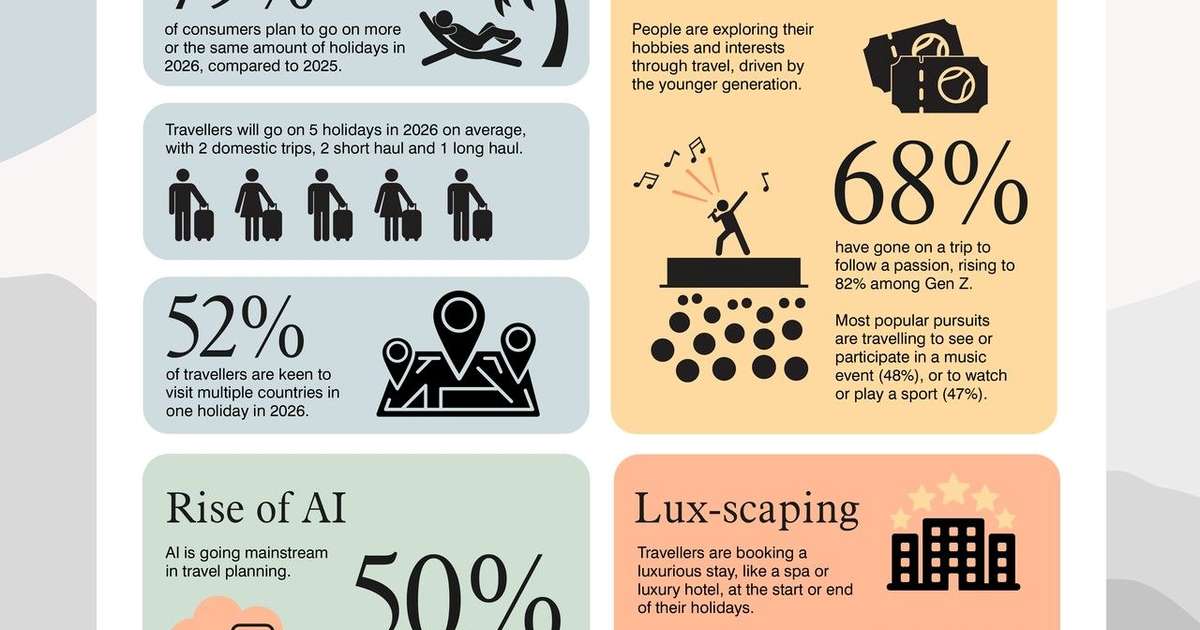
Core Insights - 79% of travelers in EMEA plan to take more or the same number of holidays in 2026 compared to 2025, with 39% intending to increase their holiday count [1][10] - The average traveler in EMEA is planning five holidays in 2026, including two domestic trips, two short-haul breaks, and one long-haul trip [2] Travel Trends - Popular destinations for EMEA travelers in 2026 include Oslo, Algiers, Muscat, Split, Zagreb, and Copenhagen [3] - The trend of 'lux-scaping' is emerging, where 59% of travelers have indulged in luxury experiences at the start or end of their trips, with 22% having done so in the past year [6][7] - 'Passion pursuits' are gaining traction, with 68% of travelers having previously planned holidays around specific interests, particularly music and sports [11][12] Technology and AI - 50% of travelers have used AI for trip planning, a significant increase from 41% last year, with 14% using it all the time [4][5] - 50% of travelers express comfort in booking accommodations through AI platforms in the future [5][19] Accommodation Preferences - Key factors for accommodation include cleanliness (89%), price (88%), and location (87%), with increasing importance placed on being solo and pet-friendly [15] - All-inclusive holidays are the most sought-after type of experience, with 45% planning such trips in 2026 [16] Sustainability - 73% of travelers consider the environmental impact of their holiday plans, with 32% checking the sustainability of their accommodation before booking [17] Demographic Insights - Younger travelers, particularly Gen Z and millennials, are reshaping the travel landscape, with 82% of Gen Z and 77% of millennials having engaged in passion pursuits [13][22] - Country hopping is on the rise, with 52% of travelers likely to visit multiple countries in one trip, especially among those aged 25-34 [14][21]
Touchstone Exploration Announces £6.32 Million (US$8.44 Million) Private Placement and Retail Offer of up to £0.68 Million (US$0.91 Million)
Accessnewswire· 2025-10-24 07:00
Group 1 - The announcement contains inside information as defined by the Market Abuse Regulation (596/2014/EU) and is part of UK domestic law due to the European Union (Withdrawal) Act 2018 [1]

飞猪:“双11”开卖24小时,近300个商家活动商品成交额翻倍
Sou Hu Cai Jing· 2025-10-22 16:36
Core Insights - The "Double 11" shopping festival saw significant sales growth in the travel sector, with major brands like Marriott International and Shanghai Disneyland achieving transaction volumes exceeding 100 million yuan within 24 hours [1] - Emerging travel destinations gained popularity, with domestic locations like Xinjiang and Guizhou recording over 500% growth in sales compared to last year, while international destinations like Denmark and Finland saw over 1000% increase [3] - New travel products debuted during the festival, with strong sales performance from first-time participants like LEGO Resort and Disney Cruise, indicating a trend towards unique travel experiences [3][4] Group 1 - Major brands such as Marriott International and Shanghai Disneyland achieved transaction volumes exceeding 100 million yuan within the first 24 hours of "Double 11" [1] - Nearly 300 merchants saw their sales double compared to last year, with outbound travel destinations like Singapore and Italy performing particularly well [1] - Family-friendly travel services remained popular, with products like "Kaitian 999" and "Marriott Group 370+" achieving sales of over 100,000 and 60,000 units respectively [1] Group 2 - Emerging destinations in China, such as southern Xinjiang and Guizhou, recorded over 500% growth in sales, while international destinations like Norway and Iceland saw over 1000% increase [3] - New travel products, including Japan multi-city charter services, achieved sales of over 40,000 units, showcasing the demand for unique travel experiences [3][4] - New merchants like 趣欧旅游 and BUER旅游 reported strong sales, with their products achieving over 10 million yuan in sales on the first day of "Double 11" [4]