
Marriott International(MAR)

Search documents
飞猪“双11”开卖24小时 近300个商家成交额同比翻倍
Zheng Quan Ri Bao Wang· 2025-10-22 07:43
Group 1 - The core point of the articles highlights the significant sales performance during the "Double 11" shopping festival, with many brands achieving transaction amounts exceeding 100 million yuan within the first 24 hours [1][2] - Major brands such as Marriott International, Chime Long Tourist Resort, All Nippon Airways, Wanda Hotels and Resorts, China Southern Airlines, and Shanghai Disneyland have seen their sales figures double compared to last year [1] - The outbound travel segment has shown remarkable growth, with destinations like Singapore, Italy, Switzerland, and Finland recording sales that have surpassed the total sales of last year's "Double 11" [1] Group 2 - Emerging destinations have gained popularity among consumers, with domestic locations like Xinjiang, Shanxi, and Guizhou recording over 500% growth in transaction amounts compared to last year [2] - Internationally, Nordic destinations such as Denmark, Finland, and Norway have seen transaction amounts increase by over 1000% year-on-year, indicating a trend towards deeper travel experiences [2] - New travel products debuted during the "Double 11" event have performed well, including offerings from Shanghai LEGO Resort and Disney Cruise Line, which have achieved record sales [2]



飞猪:双11开卖24小时,近300个商家成交额翻倍
Xin Lang Ke Ji· 2025-10-22 05:45
Core Insights - The Double Eleven shopping festival saw significant sales growth, with major brands like Marriott International, Chime Long Tourist Resort, All Nippon Airways, Wanda Hotels and Resorts, China Southern Airlines, and Shanghai Disneyland achieving transaction amounts exceeding 100 million [1] - Nearly 300 merchants reported transaction amounts that doubled compared to last year, indicating a strong market performance [1] - Outbound tourism showed remarkable results, with destinations such as Singapore, Italy, Switzerland, Finland, UAE, Egypt, Norway, Morocco, Austria, and Denmark surpassing last year's total sales during the Double Eleven period [1] Sales Performance - Family-friendly travel services remained popular among consumers, with products like "Kaiyuan 999 National 18 Store Exchange" selling over 100,000 units, and "Marriott Group 370+ Store 3-Night Exchange" selling over 60,000 units [1] - The "Toy Story/Shanghai Disneyland Hotel" package, allowing early park entry, sold over 40,000 units, showcasing strong demand for unique experiences [1] - All Nippon Airways' economy class tickets for two, including taxes, sold over 50,000 units, reflecting a trend towards family-oriented travel options [1]
县城消费崛起:山姆抢滩超级县,国际酒店品牌布局小县城
Di Yi Cai Jing Zi Xun· 2025-10-21 10:03
Core Insights - The rise of county-level consumption is driven by economic development and improved infrastructure, leading major brands to expand into these markets [1][2][4] - Sam's Club has opened its fourth store in Suzhou, targeting strong economic counties and cities, with a focus on customized and high-quality products [1] - The county market is becoming increasingly vital, with the county and township market accounting for 38.8% of total retail sales in the first three quarters of the year [2] Group 1: Market Expansion - Major brands, including international hotel chains and coffee shops, are entering county markets due to saturation in first and second-tier cities [3][4] - The hotel industry is seeing significant growth in county tourism, with brands like Hilton and Marriott establishing a presence in these areas [3] - Starbucks has expanded to 7,758 stores in China, covering over 1,000 county-level markets, indicating a competitive push into lower-tier cities [3] Group 2: Economic Factors - The county market offers lower property and operational costs compared to urban centers, making it attractive for businesses [4] - Rapid economic growth, urbanization, and rising income levels in counties are contributing to increased consumer spending [4] - Counties serve as crucial points for rural revitalization, enhancing local attractiveness and investment environments through the presence of high-quality brands [4]


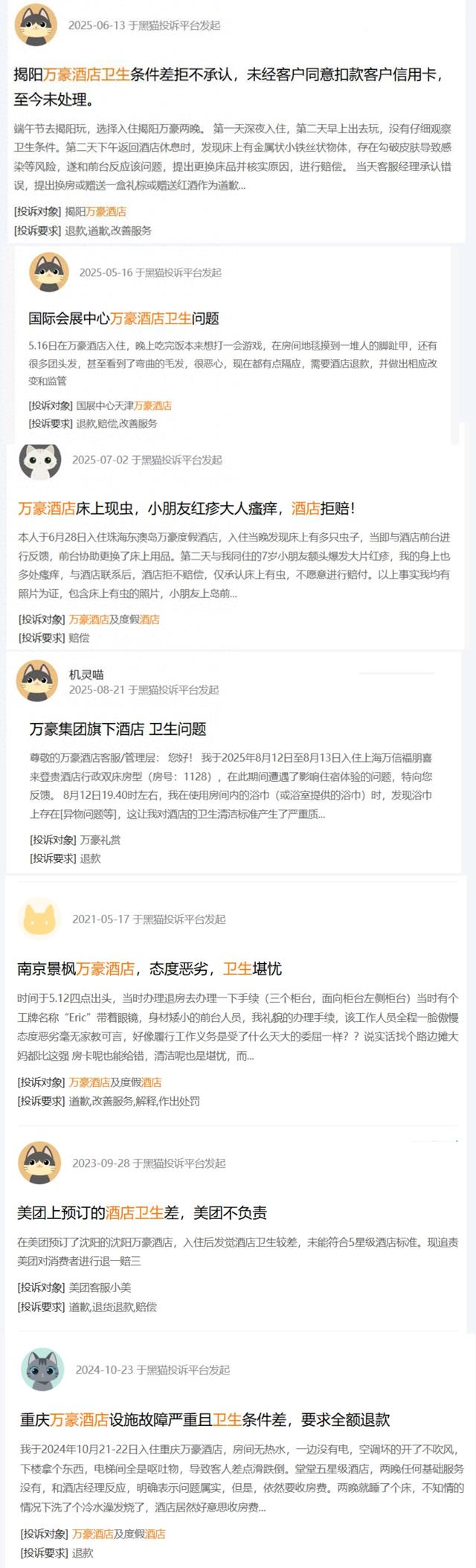
万豪旗下酒店床上虫子乱爬,高星酒店正滑向信任深渊
Guan Cha Zhe Wang· 2025-10-19 10:11
Core Points - Recent hygiene issues at Marriott hotels have raised public concern, particularly after a consumer reported finding live insects in multiple rooms at the Shanghai Xujiahui Marriott Hotel during the National Day holiday [1][2] - The incident has led to widespread criticism of the hygiene management capabilities of Marriott hotels, with many consumers expressing distrust in hotel cleanliness standards [1][2] - Complaints regarding hygiene in high-end hotels have been increasingly common, with reports of unclean linens, reused toiletries, and other sanitation failures [2][11] Company Summary - The Shanghai Xujiahui Marriott Hotel, part of the Marriott International Group, recently faced significant backlash due to reports of live insects in guest rooms, which has raised questions about its hygiene management practices [1][11] - The hotel, which opened recently, attributed the issue to new furnishings and insufficient ventilation, but this explanation has been met with skepticism from the public [2][11] - The hotel has received over 1,100 complaints related to hygiene issues, indicating a broader problem within the Marriott brand regarding cleanliness and guest safety [10][11] Industry Summary - The hotel industry is experiencing a crisis of trust among consumers, particularly in the high-end segment, where hygiene is a critical component of service quality [11][12] - Increased competition and cost-cutting measures have led some hotels to reduce investments in hygiene management, which can severely impact brand reputation and customer satisfaction [12][13] - Experts emphasize the need for hotels to prioritize guest health and safety, suggesting that failure to do so could result in significant damage to brand value and market position [11][12][13]

Marriott International Stock: Not In The Buying Zone Yet (NASDAQ:MAR)
Seeking Alpha· 2025-10-17 00:27
Core Insights - The article emphasizes the importance of a comprehensive and in-depth analysis of financial statements for mega and large-cap companies to assess their investment attractiveness [1]. Group 1: Investment Strategy - The primary investment strategy involves regularly purchasing shares with a portion of income intended for long-term holding [1]. - The analysis model used is a combination of quantitative and fundamental analysis, which allows for objective assessments of public businesses [1]. Group 2: Focus Areas - The analysis specifically excludes banks, insurance companies, and REITs, focusing instead on large and well-known companies [1]. - The analyst aims to provide private investors with an independent view based on facts and figures, enhancing their ability to make informed decisions [1].
Marriott International: Not In The Buying Zone Yet
Seeking Alpha· 2025-10-17 00:27
Core Insights - The article discusses the author's investment philosophy, focusing on a conservative approach to investing in US equities since 2018, utilizing a model that combines quantitative and fundamental analysis to evaluate companies [1] Group 1: Investment Strategy - The main investment strategy involves regularly purchasing shares with a portion of income intended for long-term holding [1] - The author emphasizes a comprehensive and in-depth analysis of financial statements, particularly for mega and large-cap companies, updating insights quarterly [1] Group 2: Analytical Approach - The evaluation model allows for an objective assessment of public businesses, excluding banks, insurance companies, and REITs [1] - The goal is to provide private investors with an independent view of large and well-known companies based on factual data [1]
What to Expect From Marriott International's Q3 2025 Earnings Report
Yahoo Finance· 2025-10-16 15:46
Core Insights - Marriott International, Inc. has a market capitalization of $72.3 billion and operates a diverse portfolio of hotel brands across various price and service levels [1] - The company is expected to announce its fiscal Q3 2025 results on November 4, with analysts predicting an adjusted EPS of $2.38, a 5.3% increase from the previous year [2] - For fiscal 2025, analysts forecast an adjusted EPS of $10.01, representing a 7.3% rise from fiscal 2024, with further growth anticipated to $11.41 in fiscal 2026 [3] Financial Performance - In Q2 2025, Marriott reported an adjusted EPS of $2.65, slightly exceeding Wall Street estimates, with revenue reaching $6.7 billion, driven by strong performance in the upscale and luxury segments [5] - Room revenue in U.S. and Canada luxury properties grew by 4.1%, which helped offset a 1.5% decline in select-service brands [5] Stock Performance and Analyst Ratings - Over the past 52 weeks, shares of Marriott have risen marginally, underperforming compared to the S&P 500 Index's 14.6% increase and the Consumer Discretionary Select Sector SPDR Fund's 18.2% return [4] - Analysts maintain a cautiously optimistic view on MAR stock, with a consensus "Moderate Buy" rating; the average price target is $286.88, indicating a potential upside of 8.8% from current levels [6]
万豪旗下酒店床上出现活虫,连续更换5间客房仍有虫爬行,集团客服回应
Xin Jing Bao· 2025-10-15 09:04
Group 1 - The Shanghai Xujiahui Marriott Fairfield Hotel recently faced complaints from consumers about bed bugs, leading to the closure of affected rooms and emergency pest control measures [1][2] - The hotel, which opened in September 2023, has 170 rooms with average daily rates ranging from 700 to 900 yuan [1] - Marriott International's customer service stated that the hotel is investigating the issue and will provide further updates [1][2] Group 2 - The Marriott Fairfield brand, a mid-to-high-end service brand under Marriott International, has rapidly expanded in China, with over 150 projects currently open or under construction [2] - The brand's new hotel signings in the first seven months of 2025 increased by 75% year-on-year [2] - The hotel industry is facing challenges from high operational costs and intense competition, leading to concerns about hygiene management as costs are cut [2] Group 3 - As of August 2025, Marriott International operates 622 hotels in China, covering over 120 cities, but its financial performance has not improved correspondingly [3] - The revenue per available room (RevPAR) in the Greater China region decreased by 1% to $73.19 in the first half of 2025, while the average daily rate (ADR) fell by 1.7% to $112.36 [3] - Despite a slight increase in occupancy rate by 0.5 percentage points to 65.1%, overall revenue generation remains weak, indicating a trend of "trading price for volume" [3]
上海万豪万枫酒店被投诉“连换五次房均有虫”!店方称正处理
Nan Fang Du Shi Bao· 2025-10-14 14:50
Group 1 - A guest reported finding live bugs in multiple rooms at the Shanghai Xujiahui Marriott Hotel during the National Day holiday, expressing dissatisfaction with the hotel's hygiene and handling of the situation [1][2] - The hotel confirmed the issue and stated that a dedicated team is addressing the matter, while Marriott International's customer service indicated that hotel staff are currently managing the situation [1][2] - The hotel, which opened in 2025, is a high-end establishment with room rates typically ranging from 700 to 900 yuan [3] Group 2 - The guest experienced allergic reactions and was not offered an apology upon checkout, only receiving a full refund for the night [2] - The guest has filed a complaint with the local health authority, which has promised to investigate the hotel's hygiene conditions [2] - The hotel suggested that guests inspect the room before confirming their booking to ensure it meets their expectations [2]
Monomoy, Axonic partner to convert Atlanta hotel to Marriott brand
Yahoo Finance· 2025-10-14 11:07
Core Insights - Monomoy Property Ventures and Axonic Capital have partnered to acquire a 462-key hotel and convention center in Atlanta, Georgia, with plans for a full-scale renovation and rebranding as a Marriott property [1][2] - The acquisition is supported by a $67.5 million loan arranged by University Place Asset Management for the renovation [2] - The renovation will modernize the hotel to meet Marriott's operational standards, including updates to guestrooms, public facilities, and back-of-house systems [2][3] Group 1 - The property will be rebranded as Marriott Atlanta, featuring new meeting spaces, an "M-Club" lounge, and dining options, and will join the Marriott Bonvoy loyalty program [3] - Monomoy's founder emphasized the alignment of this project with the company's strategy of acquiring high-quality real estate in growing markets with repositioning potential [3][4] - The renovation and conversion to Marriott are expected to enhance the property's market fit for travelers in Atlanta, aiming for attractive outcomes for the partnership [4] Group 2 - Schulte Hospitality Group will manage the property post-renovation, with a focus on elevating performance and long-term ROI [5] - Construction is set to begin after the 2026 FIFA World Cup, with an anticipated reopening in late 2027, coinciding with Super Bowl LXII in Atlanta [5]