Morgan Stanley(MS)

Search documents
人均年薪百万+!深扒美国顶尖投行真实薪资待遇!
Sou Hu Cai Jing· 2025-09-30 13:14
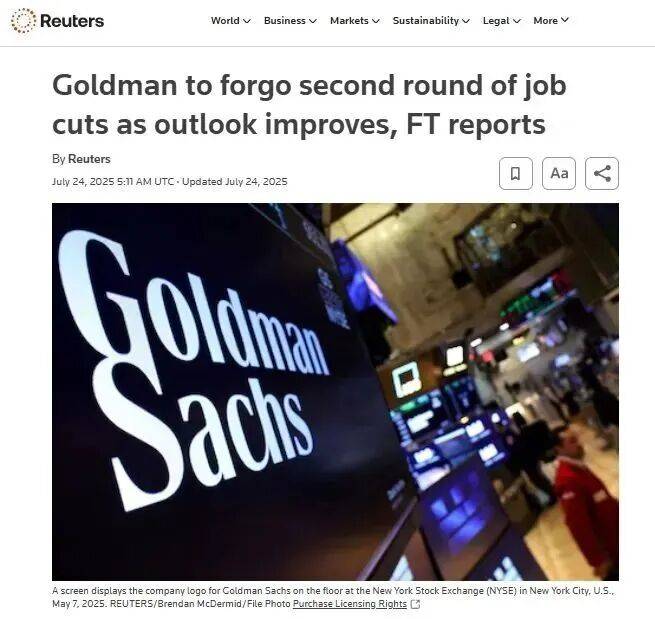
在全球经济形势下行,超多行业裁员减薪的大浪潮下,依旧有一个行业顶住压力,不仅有企业官宣取消裁员,甚至还要给员工们加奖金! 关注投行圈的留学生们就能发现,近期由于美股/港股迎来IPO热潮,高盛官宣取消裁员计划,各大企业今年的奖金,有希望继续涨涨涨! 金融行业作为高薪领域的代表,一直是留学生群体首选的发展道路,那么真实的金融圈薪资待遇到底怎么样? Goldman Sachs 高盛是全球领先的投资银行与金融服务公司,其业务涵盖投资银行、证券交易、资产管理及直接投资等领域。今年上半年,高盛的业绩成绩单也是好到直 接官宣取消裁员。 2024年高盛伦敦办公室共有542名MRTs(含投行及其他部门),平均固定薪酬:69.7万美元;平均奖金金额:96.8万美元,增幅39%;平均总薪酬:170万 美元,增幅5.7%。 奖金构成分析:18%以现金形式发放(无递延部分),82%以股票形式支付(其中79%为递延股票)。 薪酬超百万欧元员工的分布情况: | Pay Band | Earners in 2024 | Earners in 2023 | Earners in 2022 | | --- | --- | --- | --- | ...


中国观察-刺激政策与市场展望-Morgan Stanley Global Macro Forum-China Watch – What to Expect for Stimulus and Markets
2025-09-30 02:22
Summary of Morgan Stanley Global Macro Forum - China Watch Industry Overview - **Focus**: The report centers on the Chinese economy and its implications for various markets, particularly in the context of potential stimulus measures and macroeconomic trends. Key Points Economic Outlook - **Real GDP Growth**: Projected to slow to **4.5%** year-on-year in the second half of 2025, with persistent deflationary pressures [6][64] - **Policy Adjustments**: Anticipation of modest stimulus measures ranging from **RMB 0.5 trillion to 1 trillion** in early Q4 2025, aimed at infrastructure and consumption [64] Policy and Structural Reforms - **Fourth Plenary Session**: Expected discussions on the 15th Five-Year Plan (FYP) will provide insights into structural reforms, focusing on social welfare reform as a key policy lever [8][9] Equity Market Insights - **MSCI China Performance**: Strong returns in 2024 and year-to-date 2025 attributed to earnings growth and P/E re-rating, with MSCI China trading at discounts compared to other major global equity markets [12][15] - **Earnings Consistency**: Offshore market has shown in-line quarterly earnings results for three consecutive quarters [15] Currency and Credit Market Dynamics - **RMB Appreciation**: Mild appreciation of the RMB against the USD expected through 2026, influenced by foreign investor behavior and local market dynamics [26][64] - **China USD Credit Market**: Tight credit spreads supported by strong demand and negative net supply since 2022, with expectations for increased Dim Sum bond supply driven by foreign issuers [41][44] Commodities Market - **Metals Demand**: Strong year-to-date demand and exports for metals, with precious metals leading the performance, although some indicators show signs of slowing [49][54][64] - **Anti-Involution Policy Impact**: The policy has provided support for raw materials and processing fees, contributing to the overall demand in the commodities sector [54][64] Broader Market Implications - **Asia Rates and FX**: Limited spillover effects from China to the broader Asia region, with local dynamics and UST movements being more significant for local yields [34][64] - **Investor Sentiment**: Improved sentiment towards quality large-cap stocks and private firms, indicating a potential shift in investment strategies [64] Additional Insights - **Gradual RMB Appreciation**: Signals indicate a stable FX conversion for exporters, with no significant further rally expected in the absence of external pressures [29][64] - **Demand Indicators**: Some demand indicators for commodities are showing signs of overstretching, suggesting a need for cautious positioning [59][64] This summary encapsulates the critical insights from the Morgan Stanley Global Macro Forum regarding the Chinese economy, its equity markets, currency dynamics, and commodities, providing a comprehensive overview for investors and stakeholders.
亚洲经济-亚洲面临青年失业率上升的挑战-Asia Economics-The Viewpoint Asia Faces Rising Youth Unemployment Challenge
2025-09-30 02:22
Summary of Key Points from the Conference Call Industry Focus - **Industry**: Youth Unemployment in Asia - **Countries Highlighted**: China, India, Indonesia Core Insights and Arguments 1. **High Youth Unemployment Rates**: Asia's youth unemployment rates are significantly higher than headline unemployment rates, with ranges from 4% to 18% compared to 2% to 7% for overall unemployment [5][6][13] 2. **Specific Rates**: As of August 2025, youth unemployment rates are reported at 16.5% in China, 17.6% in India, and 17.3% in Indonesia [5][19][60] 3. **Cyclical and Structural Challenges**: Slowing economic growth and the impacts of AI and automation are identified as both cyclical and structural challenges contributing to rising youth unemployment [5][29][74] 4. **Need for Policy Reforms**: Policymakers are urged to implement reforms to increase investment ratios in India and Indonesia and address labor mismatches in China to mitigate unemployment risks [5][74] 5. **Social Stability Risks**: If social stability risks arise, redistributive efforts may be necessary to manage the situation [5][74] Additional Important Content 1. **Worsening Labor Market Dynamics**: Despite stable headline unemployment rates, underlying labor market conditions are deteriorating, particularly in China where entry-level wages are declining [7][29] 2. **Underemployment Issues**: In India, significant underemployment exists, with a notable increase in primary sector employment despite its low contribution to GDP [38][48] 3. **Investment Trends**: Indonesia's investment-to-GDP ratio has decreased from 32% pre-COVID to 29%, indicating a lack of investment that is impeding job creation [61][72] 4. **Future Labor Market Outlook**: The labor market outlook remains weak across China, India, and Indonesia, with anticipated slowdowns in exports and domestic demand affecting job creation [73][74] 5. **Demographic Pressures**: Indonesia is expected to add 12.7 million to its working-age population over the next decade, exacerbating the need for job creation [60][70] This summary encapsulates the critical points discussed in the conference call regarding youth unemployment in Asia, focusing on the challenges faced by China, India, and Indonesia, and the necessary policy responses to address these issues.
Morgan Stanley's Ben Huneke: Asset owners are moving more capital into private markets
Youtube· 2025-09-29 19:57
Market Overview - The current market environment is characterized by a significant allocation of 70% of investments to the US, raising questions about whether to diversify into global markets due to the recent performance of the dollar [2][3] - The depreciation of the US dollar against other currencies is seen as an underreported story, influencing global investment strategies [4][5] Investment Strategies - Investors are considering reallocating funds to markets such as Japan, China, India, and Europe as a response to the dollar's weakness, although this does not imply a complete withdrawal from US investments [6] - The valuation of international markets appears more attractive due to currency movements, prompting interest in opportunities outside the US [7][8] Market Concentration - The US market is experiencing unprecedented concentration, with companies like Nvidia and Microsoft having market capitalizations larger than entire markets of other countries, except Japan [7][8] - The concentration of gains in the public markets among a few names is driving interest in private markets from both institutional and retail clients [9]
Final Trades: Leidos Holdings, Charles Schwab, Morgan Stanley and the ETHA
CNBC Television· 2025-09-29 17:34
Brand, you have a final trade. Let's talk about it. >> Yeah, ETHA, uh, it's down about 15% from its August highs. It's right at support from its 2020 24 highs.So, I think it's a good setup for Q4 risk on. >> Where are you on Bitcoin Weiss. What what do you see.>> I'm there. I'm there. I I you know, I'm not surprised by it declining after the big runup.I think it'll reassert that. >> You're you're there through what again. >> IBIT. >> IBIT.Okay. That's what I thought. What's uh well you're also in Lidos and ...


JEF or MS: Which Investment Banking Stock Offers Better Upside Now?
ZACKS· 2025-09-29 15:16
Core Insights - Investment banking is pivotal in global capital flows, with Morgan Stanley and Jefferies Financial Group representing two distinct operational models [1] Group 1: Morgan Stanley - Morgan Stanley's investment banking revenues increased by 36% to $6.71 billion last year, following a decline in 2022 and 2023 [2][9] - The company's investment banking performance was modest in the first half of 2025, with revenues rising only 1% year-over-year, but there is cautious optimism for the remainder of the year due to a stable M&A pipeline [3] - The trading business has performed well, benefiting from market volatility and client activity, which is expected to continue [4] - Wealth and asset management operations contributed over 55% to total net revenues in 2024, up from 26% in 2010, with total client assets reaching $8.2 trillion [5] Group 2: Jefferies Financial Group - Jefferies' investment banking fees surged by 52% to $3.31 billion in fiscal 2024, following declines in the previous two years [6] - Despite a decline in investment banking revenues in the first half of fiscal 2025, clarity on tariff plans is expected to boost deal-making activities [7] - Strategic partnerships, including a stake increase from Sumitomo Mitsui Financial Group, are anticipated to enhance Jefferies' growth prospects [8] - Jefferies' investment banking fees are expected to improve with potential rate cuts, and its asset management segment is projected to grow as macroeconomic conditions stabilize [10] Group 3: Performance and Valuation Comparison - Morgan Stanley shares have risen by 27.4% in 2025, while Jefferies shares have decreased by 14.9% [11] - Jefferies is trading at a forward P/E of 16.67X, making it less expensive compared to Morgan Stanley's 17.03X [14] - Morgan Stanley's return on equity (ROE) stands at 15.20%, significantly higher than Jefferies' 6.59% [15] Group 4: Earnings Estimates - Analysts project Morgan Stanley's revenues to grow by 8.6% in 2025 and 4.4% in 2026, with earnings growth estimates of 11.5% and 8.2% respectively [18] - Jefferies is expected to see a marginal revenue increase in 2025, but a significant jump of 16.6% in 2026, with earnings anticipated to rise by 70.8% [20] Group 5: Investment Outlook - Jefferies is viewed as a more concentrated investment banking play with growth potential bolstered by strategic partnerships and a mid-market focus [22] - The near-term risk-reward appears more favorable for Jefferies, which holds a Zacks Rank 2 (Buy), compared to Morgan Stanley's Zacks Rank 3 (Hold) [24]

As Morgan Stanley Moves to Offer Crypto Trading, Should You Buy, Hold, or Sell MS Stock?
Yahoo Finance· 2025-09-29 15:09
Shares of the investment banking giant have been on a tear, up 54% over the past 52 weeks and 39% over the past six months. MS stock hit a fresh all-time high of $163.93 on Sept. 23, fueled by excitement over its E*Trade crypto initiatives.What sets Morgan Stanley apart is its disciplined approach to risk and its ability to ride market cycles with resilience. Diversified revenue streams and a strong brand reputation have made it a go-to for clients seeking stability and expertise. Over nearly a century, the ...
亚洲经济: 与美国投资者的讨论要点-Asia Economics_ The Viewpoint_ What we debated with US investors
2025-09-28 14:57
Summary of Key Points from the Conference Call Industry Overview - **Industry**: Asia Pacific Economics - **Key Focus**: Discussions with US investors regarding the economic outlook for Asia, particularly China, India, and Japan Core Insights 1. **Business Cycle Outlook for Asia**: - Investors are generally optimistic about growth, particularly equity investors compared to fixed income investors who anticipate a modest slowdown. - There is a strong IT capital expenditure in the US, which is expected to support Asia's exports [6][5][5] 2. **China's Macro vs. Market Divergence**: - Investors recognize the weakness in China's macroeconomic landscape but expect markets to diverge from macro trends. - The anti-involution policy is seen as insufficient to address deflationary pressures [22][22][5] 3. **India's Domestic Demand Recovery**: - Investor sentiment is bearish on India due to recent deceleration in corporate revenue and profit growth. - However, a recovery is anticipated from Q4 2025 driven by fiscal and monetary easing measures [26][27][28] 4. **Japan's Policy Rate Path**: - Most investors expect the Bank of Japan (BoJ) to hike rates sooner rather than later, contrary to the base case which does not foresee rate hikes even in 2026. - The current inflation dynamics are largely influenced by supply factors rather than demand [29][30][32] Additional Important Insights 1. **Impact of Tariffs**: - The weighted average tariff on imports from Asia has risen to 25%, significantly impacting growth expectations. - The US-Korea trade deal remains unresolved, with auto tariffs still at 27.5% [7][5][5] 2. **Korea's Trade Cycle**: - Recent data indicates a slowdown in Korea's exports, with daily exports contracting by 10.6% after adjusting for working days, highlighting broad-based weakness [8][8][8] 3. **Rate Cuts in Asia**: - More rate cuts are expected across Asian economies, particularly in India, Korea, Indonesia, and Taiwan, as growth and inflation pressures persist [16][19][19] 4. **China's Deflationary Pressures**: - For a sustainable exit from deflation, significant shifts in the growth model are necessary, including reducing excess capacity and boosting domestic consumption [23][24][24] 5. **Investor Focus on Micro Themes**: - Investors are increasingly interested in micro themes such as emerging frontiers and sectors benefiting from anti-involution policies, rather than macroeconomic recovery [25][25][25] 6. **US-India Trade Relations**: - Ongoing trade tensions pose risks to India's growth outlook, particularly concerning services exports which constitute a significant portion of GDP [28][28][28] 7. **Japan's Corporate Profit Outlook**: - The slowdown in global trade is expected to adversely affect corporate profits, especially in the manufacturing sector [34][34][34] This summary encapsulates the key discussions and insights from the conference call, providing a comprehensive overview of the current economic landscape in Asia and the sentiments of investors regarding future growth and risks.
How Morgan Stanley (MS) Stands Out in the Bank Dividend Stock Landscape
Yahoo Finance· 2025-09-28 01:28
Morgan Stanley (NYSE:MS) is included among the 11 Best Bank Dividend Stocks to Buy. How Morgan Stanley (MS) Stands Out in the Bank Dividend Stock Landscape Photo by Annie Spratt on Unsplash Morgan Stanley (NYSE:MS) is a global investment bank with operations in more than 40 countries and a workforce exceeding 80,000 employees. Its operations are divided into three main segments: institutional securities, wealth management, and investment management. Morgan Stanley (NYSE:MS) was originally part of JPMor ...
'There's a lot at risk' if government shuts down, says Morgan Stanley's Monica Guerra
CNBC Television· 2025-09-26 20:45
Now for more on what Wall Street should expect from a possible government shutdown, let's bring in Monica Gara. She is head of US policy at Morgan Stanley Wealth Management. Monica, Democrats are trying to make the shutdown potentially about healthcare relitigating the president's bill from the summer, literally.Who gets blamed for the shutdown, you think. And if government job cuts come along with it, who gets blamed for that. Does that matter for for the markets.I don't think that piece matters for market ...