
Morgan Stanley(MS)

Search documents
摩根士丹利:黄金对美元霸权的挑战“看不到尽头”
Xin Hua Cai Jing· 2026-01-22 01:18
Core Insights - Morgan Stanley indicates that the role of the US dollar in the global system is gradually being weakened, but credible alternative currencies remain limited, making gold the biggest challenger to the dollar [1] Group 1: Dollar's Declining Influence - The international influence of the US dollar has declined across multiple indicators, including its share in central bank foreign exchange reserves and its usage in corporate and emerging market sovereign issuances [1] - Despite the decline, the dollar still holds the largest share in global reserves [1] Group 2: Gold's Rising Position - When considering gold, the situation changes significantly; gold's share in central bank holdings has increased from approximately 14% to between 25% and 28%, with this upward trend showing "no signs of slowing down" [1] - Risk premiums and hedging behaviors will continue to exert pressure on the dollar while supporting gold demand [1] Group 3: Policy Factors - The policy factors driving "de-dollarization" are currently in a state of "neutral to slightly accelerating," and the evolution of these policies in the short term will determine how far the de-dollarization trend will go [1]

Mortgage Rates Could Dip Below 6% in 2026—But the Window May Be Brief
Investopedia· 2026-01-22 01:03
Core Insights - Mortgage rates are decreasing, with the average 30-year fixed mortgage rate at 6.06% as of January 15, down from 6.97% a year ago, potentially saving buyers significant amounts over the life of a loan [2][4] - Forecasts suggest that mortgage rates may dip into the high- or mid-5% range around mid-2026 before rising again due to changing economic conditions and recovering housing demand [3][5][10] Mortgage Rate Trends - Many analysts expect mortgage rates to remain in the lower 6% range through 2026, with some predicting temporary dips to between 5.50% and 5.75% [3][5][7] - Curinos anticipates a similar pattern, with rates falling in the second quarter of 2026 before increasing again [6][10] - Fannie Mae had previously projected rates to fall to 5.9% by year-end but has since revised its outlook slightly higher [8] Economic Influences - A slowing economy and cooling inflation are expected to contribute to lower mortgage rates later this year, even if the Federal Reserve is cautious with rate cuts [9][12] - Investor behavior, particularly a shift towards safe-haven assets like U.S. Treasurys, is seen as a key driver for lower mortgage rates, potentially bringing the 10-year Treasury yield down to around 3.75% by mid-2026 [10][11] Housing Market Implications - A dip in mortgage rates below 6% may be necessary to stimulate housing activity, which is crucial for consumer spending and job growth [13][14] - With 80% of first-lien mortgage holders having rates below 6%, a further decline in rates could support a growing mortgage market [14] Future Projections - Most experts believe that any decline in mortgage rates will be temporary, with expectations that rates will return to around 6% by the end of 2026 [15][16] - Sustained progress on inflation is necessary for rates to remain below 6% for an extended period, as any unexpected inflation increase could quickly push rates higher [17][18]


Leaders await ‘significant’ revenue boost from AI by 2030
Yahoo Finance· 2026-01-21 15:34
Group 1 - AI's return on investment remains uncertain for business executives, with only 24% able to identify revenue sources from AI, despite expectations for significant contributions by 2030 [3][8] - Global AI spending is projected to reach $2.52 trillion by 2026, reflecting a 44% year-over-year increase, with 47% of AI investments currently aimed at productivity and efficiency [5] - The financial services sector is heavily investing in AI, with major banks like Bank of America and Goldman Sachs anticipating future efficiency gains, despite acknowledging potential initial challenges [6] Group 2 - Executives expect AI to enhance productivity by 42% over the next four years, with two-thirds anticipating most gains by 2030 [7] - Nearly 80% of executives believe that 2030 will mark a significant increase in AI's contribution to enterprise revenue, compared to 40% who report current revenue boosts from AI [8] - AI investment as a percentage of revenue is expected to more than double in the next four years, although 68% of executives express concerns about integration issues potentially hindering AI efforts [8]

US policy factors 'critical' to extent of de-dollarisation shift, Morgan Stanley says
Yahoo Finance· 2026-01-21 12:57
Group 1 - The core viewpoint is that U.S. President Trump's policies regarding debt, trade, sanctions, and security will significantly influence the dollar's status in a transitioning multipolar world [1][2] - Morgan Stanley indicates that the dollar's international role has been gradually declining over the past 25 years, with gold emerging as a major challenger, currently valued at record highs [3] - For the first time since 1996, foreign central banks hold approximately $4 trillion in gold, surpassing the $3.9 trillion held in U.S. Treasuries [3] Group 2 - Current concerns affecting the dollar include U.S. debt sustainability, pressure on the Federal Reserve, and the independence of key institutions [4] - Elevated trade uncertainty and Trump's tariff strategies are contributing to the geopolitical tensions that impact the dollar [4] - Morgan Stanley notes that alliances can increase reserves of the leading currency by about 30 percentage points, suggesting that a NATO breakup could negatively affect the dollar [5]
BioNxt Reports Final Preclinical Results Demonstrating Approximately 40% Higher Cladribine Delivery for the Treatment Multiple Sclerosis (MS)
Accessnewswire· 2026-01-21 08:05
Core Insights - BioNxt Solutions Inc. has reported final results from a preclinical pig study indicating that its proprietary needle-free, swallow-free sublingual oral dissolvable film (ODF) formulation of cladribine for Multiple Sclerosis (MS) shows significantly higher systemic drug delivery compared to conventional oral tablet formulations [1] Group 1: Product Development - The study demonstrates that reformulating cladribine as a sublingual oral dissolvable film can materially improve systemic drug delivery compared to conventional oral tablet dosing [1] - The conventional oral tablet formulation of cladribine, such as those used in Mavenclad®, has reported annual global sales exceeding USD 1.2 billion with sustained double-digit growth [1] Group 2: Market Implications - The results represent an important development milestone for BioNxt, highlighting the potential for enhanced therapeutic efficacy in the treatment of Multiple Sclerosis [1]
美国利率策略 - 可赎回供给为熊陡曲线打开空间-US Rates Strategy-Callable Supply Opens the Door to Bear Steepeners
2026-01-21 02:58
Summary of Key Points from the Conference Call Industry Overview - The conference call focuses on the callable bond market in North America, specifically the surge in callable issuance in January 2026, which is noted as one of the most active months in years [6][10]. Core Insights and Arguments - **Callable Issuance Surge**: Callable issuance reached $37.1 billion by January 16, 2026, with $19.0 billion called, indicating strong market activity. Non-agency issuers drove net issuance, totaling $11.1 billion, while agencies typically issue larger notional amounts [10][11]. - **Volatility Dislocations**: The concentrated issuance created volatility dislocations across the market, particularly affecting the volatility surface [6][9]. - **Restructuring Recommendations**: The previous bull steepener trade is recommended to be unwound and restructured into a 1-year 3s30s bear steepener, which is expected to have a better carry profile [6][28]. - **Exit from Receiver Spread**: The recommendation includes exiting the 3m10y receiver spread trade due to the curve bear-steepening by 8 basis points, which has rendered the original trade out of the money [28][29]. Additional Important Insights - **Vega Supply**: The vega supply from Bermudan callable issuance reached approximately $3.5 million, close to the highest level in three years, with supranational, financial, and agency issuers each accounting for about one-third of this supply [16][17]. - **Market Dynamics**: The strong activity from supranational issuers is attributed to demand from Chinese banks seeking high-carry bonds ahead of the Chinese New Year [17]. - **Agency Issuance Outlook**: There is a potential risk of increased issuance from Fannie Mae and Freddie Mac following a government announcement regarding mortgage purchases, which could exert downward pressure on top-left volatility [18]. - **Trade Ideas**: The call outlines several trade ideas, including entering a conditional bear steepener to maintain steepening exposure in a positive carry format, and the preference for low strikes to improve entry levels [31][32]. This summary encapsulates the key points discussed in the conference call, highlighting the current state of the callable bond market, strategic recommendations, and potential risks and opportunities for investors.
美国股债汇三杀,纳指跌超2%,芯片股、中概股普跌,晶科能源跌超12%,黄金白银再创新高
2 1 Shi Ji Jing Ji Bao Dao· 2026-01-20 23:15
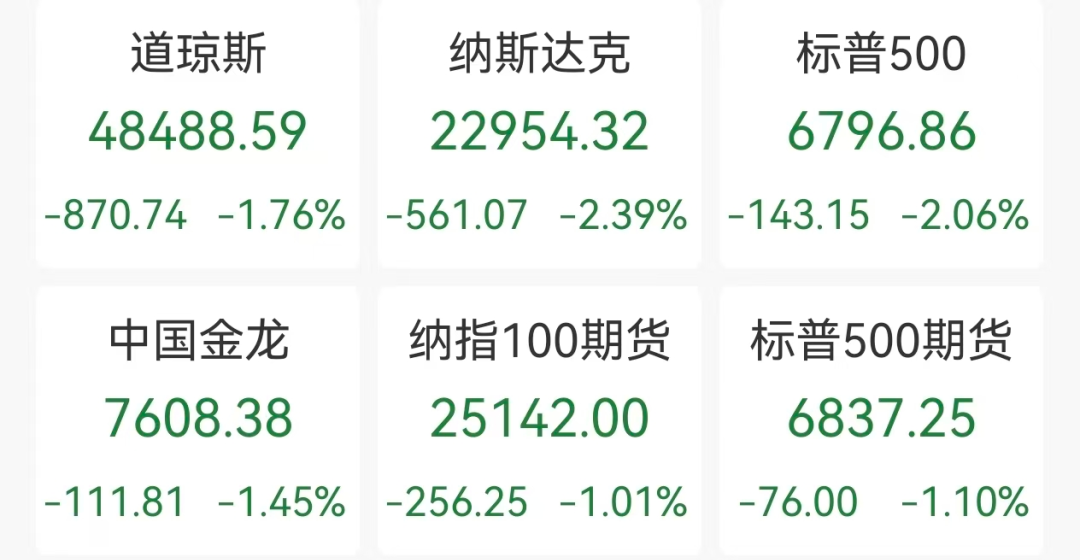
Market Overview - US stock indices experienced a significant decline, with the Dow Jones falling by 870 points (1.76%), the S&P 500 down by 143.15 points (2.06%), and the Nasdaq dropping by 561.07 points (2.39%) [1] - The Chicago Board Options Exchange Volatility Index (VIX), known as Wall Street's "fear index," surged above 20, reaching recent highs [1] Technology Sector - Major tech stocks saw substantial losses, with Nvidia and Tesla both dropping over 4%, while Apple and Amazon fell more than 3% [2][3] - Nvidia's stock price was reported at $178.07, down 4.38%, and Tesla at $419.25, down 4.17% [3] Streaming and Media - Netflix's post-market decline expanded to nearly 5% due to disappointing first-quarter earnings outlook and adjustments to its acquisition proposal for Warner Bros. assets to an all-cash offer totaling $82.7 billion [4] Semiconductor Industry - The semiconductor sector faced widespread declines, with Broadcom and Skyworks Solutions dropping over 5%, while TSMC fell more than 4% [4] Banking Sector - Bank stocks also fell across the board, with Citigroup down over 4% and JPMorgan and Morgan Stanley both declining more than 3% [4] Chinese Stocks - Chinese stocks mostly declined, with JinkoSolar down 12.5% and CenturyLink down over 10% [4][5] Bond Market - US Treasury yields rose to a four-month high, while the dollar index fell by 0.41%, marking its worst two-day performance in about a month [6] Precious Metals - Gold and silver prices reached new highs, with spot gold exceeding $4,763 per ounce and silver surpassing $94 per ounce [8][9] Cryptocurrency Market - The cryptocurrency market experienced a significant downturn, with Bitcoin dropping below $90,000 and Ethereum falling below $3,000, affecting approximately 163,000 traders [10][11]


Morgan Stanley Snaps Up $110 Million Bay Area Factory - Morgan Stanley (NYSE:MS)
Benzinga· 2026-01-20 19:32
Core Insights - Morgan Stanley announced a $110 million acquisition of an advanced manufacturing property in Fremont, California, through its investment management arm [1] - The acquisition aligns with Morgan Stanley Real Estate Investing's strategy of focusing on high-quality industrial and innovation-related real estate [2] Acquisition Details - The property spans approximately 290,000 square feet and has a long-term net lease to Western Digital, a leader in data storage [1][2] - The site's power capacity is higher than that of standard industrial properties in the region, making it appealing to technology and manufacturing tenants [2] Portfolio Expansion - With this acquisition, Morgan Stanley Real Estate Investing has acquired about $1.5 billion in U.S. industrial assets in 2025, expanding its U.S. industrial portfolio to over 75 million square feet [3] - The head of U.S. investments at MSREI expressed confidence in the manufacturing ecosystem of the region, citing constrained supply and durable demand for advanced R&D and manufacturing facilities [3] Financial Performance - Morgan Stanley reported a revenue of $17.89 billion for the recent quarter, reflecting a 10% year-over-year increase and surpassing the consensus estimate of $17.77 billion [4] - The firm's expense efficiency ratio improved to 68% in 2025 from 71% a year ago, indicating operational leverage while continuing to invest in businesses [4] Market Position - The CFO highlighted that all investments are performing well, with share gains in advisory and debt capital markets, particularly in data centers where hyperscalers seek access to capital markets [5] - Morgan Stanley shares were reported to be down 3.45% at $182.57 at the time of publication [5]

摩根士丹利:特朗普关税风险有限集中
Xin Lang Cai Jing· 2026-01-20 15:52
摩根士丹利(MS)表示,与格陵兰争端相关的美国拟议关税对欧股构成的是个股特定风险而非系统性 风险,同时国防类股可能因支出增加而受益。 责任编辑:张俊 SF065 摩根士丹利(MS)表示,与格陵兰争端相关的美国拟议关税对欧股构成的是个股特定风险而非系统性 风险,同时国防类股可能因支出增加而受益。 责任编辑:张俊 SF065 ...
How Greenland could turn into a Big Tech problem, according to Morgan Stanley’s Mike Wilson
Yahoo Finance· 2026-01-20 14:38
Core Viewpoint - The ongoing U.S.-EU tensions over Greenland may negatively impact Big Tech stocks, with Wall Street showing readiness to sell stocks amid uncertainty [1][6]. Group 1: Market Reactions - Citigroup has downgraded European equities for the first time in a year, citing potential earnings fallout from the U.S.-EU spat [2]. - Morgan Stanley's chief U.S. equity strategist, Mike Wilson, anticipates a contained direct cost impact on major U.S. indices from new tariff threats, but smaller sectors like autos and healthcare are at higher risk [3][4]. Group 2: Potential Risks - Wilson expresses concern that the EU may activate its 'anti-coercion' tool, which could significantly impact U.S. mega-cap companies, particularly in the tech sector [4][7]. - The Anti-Coercion Instrument could lead to a range of policy tools beyond tariffs, including investment restrictions and taxation on U.S. digital services [5]. Group 3: Market Sentiment - Nasdaq-100 futures are reflecting concerns about potential losses for Big Tech, especially with earnings reports approaching [6]. - Analysts suggest that a market slump could occur if U.S.-Europe tensions escalate beyond tariffs to more severe confrontations, such as limiting market access for Big Tech [7].
