Novo Nordisk(NVO)

Search documents
This Beaten-Down Stock Just Jumped By 8%. Time to Buy?
Yahoo Finance· 2025-12-29 14:05
Core Insights - Novo Nordisk has faced significant challenges over the past 18 months, including clinical setbacks, disappointing financial results, and a loss of market share in its key therapeutic area, leading to a notable decline in stock price [1] - Recent regulatory approval for an oral version of Wegovy, the first oral GLP-1 approved for weight management, has positively impacted Novo Nordisk's share price, increasing it by as much as 8% in one day [1][3] Group 1: Product Developments - Novo Nordisk primarily generates revenue from GLP-1 products, including Wegovy, which is used for diabetes treatment and weight management [2] - The newly approved oral Wegovy is expected to attract more patients by eliminating the need for injections, making it easier and cheaper to manufacture at scale [4] - The approval of oral Wegovy provides Novo Nordisk with a first-mover advantage in the oral weight loss market, potentially helping the company regain market share lost to competitors [5] Group 2: Competitive Landscape - Eli Lilly, a major competitor, is also advancing in the weight loss market with its application for orforglipron, a weight loss pill that has shown promising results in clinical trials [7] - The competitive dynamics in the weight management market are intensifying, with both companies vying for a larger share of the growing demand for weight loss therapies [6][7]

【报告】医药生物行业定期报告:从供需看,中国创新药能从海外分成多少钱?(附下载)
Xin Lang Cai Jing· 2025-12-29 13:40
Group 1: Market Overview - The CITIC Pharmaceutical Index increased by 1.2% during the week of June 3-6, 2025, outperforming the CSI 300 Index by 0.3 percentage points, ranking 16th among CITIC's primary industry classifications [1] - Year-to-date, the CITIC Pharmaceutical and Biotechnology Index has risen by 8.3%, surpassing the CSI 300 Index by 9.9 percentage points, ranking 5th among CITIC's industry classifications [1] - The top five performing stocks for the week included Yiming Pharmaceutical (+33.09%), Wanbangde (+32.59%), Anglikang (+30.28%), Xinnowei (+21.36%), and Haichen Pharmaceutical (+20.93%) [1] Group 2: Patent Cliff and Market Opportunities - By 2037, 27 blockbuster drugs with projected sales exceeding $4 billion in 2024 will face patent expiration, creating a market opportunity of over $240 billion for new entrants [2][12] - China is positioned as a core player in global innovative drug supply, leveraging its technological platforms and research efficiency, with the highest number of clinical pipelines in cell therapy, ADC, and bispecific antibodies [2][21] - The projected revenue from licensing agreements for Chinese projects from 2020 to 2025 is estimated to generate approximately $8.2 billion in net profit, translating to a potential market capitalization increase of $81.7 billion based on a 10x PE ratio [2] Group 3: Investment Recommendations - Focus on authorized blockbuster products with overseas clinical progress, including companies like Kangfang Biotech, Kelun Biotech, and Sanofi [2] - Potentially significant products for licensing out include Innovent Biologics, CSPC Pharmaceutical Group, and Zai Lab [2] - Companies with approved products showing strong commercialization performance include BeiGene, Kingsoft Biotech, and Hutchison China MediTech [2] Group 4: Mid to Long-term Investment Strategy - The investment strategy emphasizes three main lines: innovation, recovery, and policy support [4] - The innovation line focuses on biopharmaceuticals with competitive advantages in international markets and companies with second growth curves in pharmaceuticals [4] - The recovery line anticipates a rebound in medical device tenders and consumer healthcare, while the policy line supports high-dividend companies and encourages mergers and acquisitions [4]




Novo cuts Wegovy prices in some Chinese provinces, local media reports
Reuters· 2025-12-29 12:51
Core Viewpoint - Danish drugmaker Novo Nordisk has significantly reduced the prices of its obesity drug Wegovy in certain provinces of China, nearly halving the costs [1] Company Summary - Novo Nordisk has implemented a price reduction strategy for Wegovy, targeting specific regions in China to enhance accessibility [1]
AI算力、脑机接口与商业航天催化科技主线
Xin Lang Cai Jing· 2025-12-29 11:20
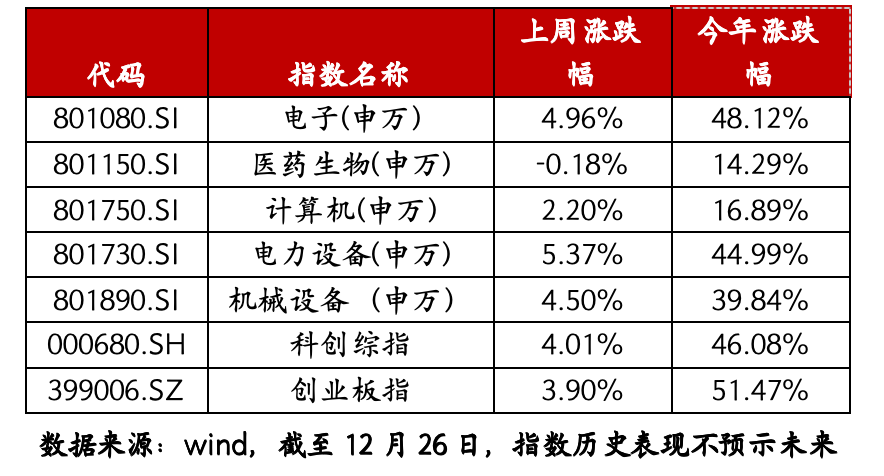
Group 1: Technology Sector Overview - The technology sector, including the Sci-Tech and ChiNext boards, has started to rebound, with only the pharmaceutical and biological industry experiencing a slight decline of 0.18% last week, while other industries showed good rebound gains [1] - The electronic index (801080.SI) increased by 4.96% last week and has risen by 48.12% this year, indicating strong performance in the electronic sector [2] - The computer index (801750.SI) rose by 2.20% last week and has increased by 16.89% year-to-date, reflecting positive momentum in the computer industry [2] Group 2: Sci-Tech Index Overview - The Sci-Tech 100 index, Sci-Tech Composite index, and ChiNext index all experienced upward movement last week, with significant recovery since September 26, 2024, after a general decline from the 2021-2022 peak [3] - As of December 26, 2024, the Sci-Tech 100 index has risen by 43.03%, the Sci-Tech Composite index by 57.62%, and the ChiNext index by 77.00% [3] Group 3: Market Insights - NVIDIA has reached a technology licensing agreement with Groq for $20 billion, acquiring all assets and technology licenses, which will enhance NVIDIA's product capabilities and market expansion [5] - DDR5 memory prices are expected to rise by 45% by the end of 2026 due to shifts in production capacity towards AI-related high-bandwidth memory, impacting major PC manufacturers' product release schedules [7] - Novo Nordisk's oral semaglutide has been approved in the U.S. for weight management, marking a significant advancement in the pharmaceutical sector [8] - The National Medical Products Administration has included implantable brain-machine interface devices in its priority approval list, indicating policy support for this emerging technology [8] Group 4: Power Equipment Sector - The price of polysilicon has increased, with the average transaction price rising to 53,900 yuan per ton, up 1.32% week-on-week, providing support for price stabilization across downstream segments [10] - Several lithium iron phosphate manufacturers announced production line maintenance, which is expected to reduce output and strengthen pricing power in the industry [11] Group 5: Mechanical Equipment Sector - A humanoid robot made its debut at the 15th National Games, showcasing advanced capabilities in award presentation, marking a milestone in the integration of technology and sports [12] - UBTECH's Walker S2 humanoid robot has entered mass production, with hundreds of units delivered for use in automotive manufacturing and smart logistics, indicating a shift from prototype to production [12] Group 6: Investment Recommendations - The overall trend for the Sci-Tech Composite index, Sci-Tech 100 index, and ChiNext index is positive, suggesting a favorable outlook for related industries in the medium to long term [13]

The Weight Loss Drug Competition Is Heating Up: These 2 Industry Leaders Just Filed Competing Drugs with the FDA.
The Motley Fool· 2025-12-29 09:23
Core Insights - The weight loss market is currently dominated by two brands: Wegovy from Novo Nordisk and Zepbound from Eli Lilly, with both companies poised for further growth through new approvals [2][11] Novo Nordisk - Novo Nordisk's semaglutide, the active ingredient in Wegovy, mimics GLP-1 hormones, aiding in insulin regulation and satiety [4] - The company is seeking approval for CagriSema, a dual agonist that has shown better performance than semaglutide in clinical trials, potentially becoming a new growth driver [5] - Despite a competitive mean weight loss of 22.7% reported for CagriSema, it did not meet the company's expectations of 25% in phase 3 studies [11] - Novo Nordisk's market value has decreased by more than half over the past two years, but its pipeline may still capitalize on the expanding weight loss market [12] Eli Lilly - Eli Lilly's Zepbound is gaining market share, and the company has reported positive phase 3 results for orforglipron, a next-generation anti-obesity medication [11] - Orforglipron is a daily oral pill, making it easier for patients compared to weekly injections of Wegovy and Zepbound, which could enhance its market appeal [7][8] - The approval process for orforglipron may be expedited due to its receipt of a National Priority Voucher, potentially allowing for a quicker market entry [8] - Eli Lilly's retatrutide has demonstrated a mean weight loss of 28.7% in phase 3 studies, indicating a strong competitive position in the market [12]

跨国药企迎战略重构
2 1 Shi Ji Jing Ji Bao Dao· 2025-12-29 08:11
Core Insights - The pharmaceutical industry is experiencing significant performance divergence among major multinational companies in 2025, with some companies thriving while others face substantial challenges [1][2][3][4]. Financial Performance - Novo Nordisk reported Q3 2025 revenues of 74.976 billion Danish Krone (approximately $11.276 billion), a year-on-year increase of 11%, with total revenues for the first three quarters reaching 229.92 billion Danish Krone (approximately $34.58 billion), up 15% [1]. - Key products such as Ozempic, Rybelsus, and Wegovy contributed significantly to Novo Nordisk's revenue, with Wegovy showing a remarkable growth of 54% [1]. - Merck's pharmaceutical revenue for the first three quarters of 2025 was $43.299 billion, with a 68% decline in revenue from China, dropping to $1.452 billion [2]. - Eli Lilly achieved a remarkable turnaround with Q3 revenues of $17.6 billion, a 54% increase year-on-year, driven by the success of its GLP-1 drug [3]. - Pfizer was the only company in the top 10 to experience a decline in both revenue and profit, with Q3 revenues of $16.654 billion, down 6% year-on-year [4]. Strategic Adjustments - Major pharmaceutical companies are actively seeking solutions to address strategic challenges, including layoffs and business divestitures, with 190 layoffs reported in the first three quarters of 2025 [2][9]. - Companies like Merck and Novo Nordisk are implementing significant cost-cutting measures, with Merck aiming to save $3 billion by 2027 and Novo Nordisk planning to cut approximately 9,000 jobs [2][9]. - The trend of divesting mature assets is becoming common, with companies opting to sell off non-core or underperforming business units to focus on innovation [7][9]. Market Dynamics - The Chinese market is no longer a guaranteed success for multinational pharmaceutical companies, with significant performance disparities emerging [5][12]. - The ongoing "patent cliff" is a critical concern, with many companies facing over 20% of their revenue at risk due to expiring patents [5]. - The competitive landscape is shifting, with local investment firms increasingly acquiring mature products from multinational companies, allowing for more localized management and decision-making [8][9]. Future Outlook - The future of multinational pharmaceutical companies will depend on their ability to innovate rapidly, adapt to local market policies, and manage patent expirations effectively [12][14]. - Companies that can successfully transition to innovation-driven models and integrate into China's biopharmaceutical ecosystem are likely to thrive [12][14]. - The restructuring of global pharmaceutical companies is creating both challenges and opportunities for local firms, as they may benefit from the divestiture of mature products and increased collaboration on early-stage innovations [14].


跨国药企迎战略重构|记“医”2025
2 1 Shi Ji Jing Ji Bao Dao· 2025-12-29 08:06
Core Insights - The pharmaceutical industry is experiencing significant performance divergence among major multinational companies in 2025, with some achieving remarkable growth while others face substantial declines [1][4][6]. Financial Performance - Novo Nordisk reported Q3 2025 revenues of 74.976 billion Danish Krone (approximately $11.276 billion), a year-on-year increase of 11%, with total revenues for the first three quarters reaching 229.92 billion Danish Krone (approximately $34.58 billion), up 15% [1]. - Merck's pharmaceutical business revenue for the first three quarters of 2025 was $43.299 billion, with a 68% year-on-year decline in revenue from China, dropping to $1.452 billion [2]. - Eli Lilly achieved a Q3 2025 revenue of $17.6 billion, a 54% increase from $11.439 billion in the same period last year, with total revenues for the first three quarters reaching $45.887 billion, up 46% [3]. - Pfizer's Q3 2025 total revenue was $16.654 billion, a 6% decrease from $17.702 billion year-on-year, with a 55% drop in revenue from its COVID-19 oral drug Paxlovid [4]. Strategic Adjustments - Major pharmaceutical companies are actively seeking solutions to address strategic challenges, including layoffs and business divestitures, with 190 layoffs reported in the biopharmaceutical sector in the first three quarters of 2025 [2][9]. - Companies like Merck and Novo Nordisk are implementing significant cost-cutting measures, with Merck aiming to save $3 billion by 2027 and Novo Nordisk targeting an annual cost saving of 8 billion Danish Krone [9]. - The trend of divesting mature assets is becoming common, with investment firms stepping in as buyers, indicating a shift in the operational landscape of the pharmaceutical industry in China [7][8]. Market Dynamics - The Chinese market is no longer a guaranteed profit zone for multinational pharmaceutical companies, with significant performance disparities emerging among leading firms [5][12]. - The ongoing "patent cliff" is a critical concern, with many companies facing over 20% revenue exposure to patent expirations in the next three years, impacting their financial stability [4][5]. - The competition in the pharmaceutical sector is intensifying, necessitating companies to adapt quickly to local market policies and innovate their product pipelines to maintain growth [6][12]. Future Outlook - The future of multinational pharmaceutical companies will heavily rely on their innovation capabilities, local market strategies, and management of patent expirations [12][15]. - Companies that successfully transition to innovation-driven models and establish strong positions in emerging therapeutic areas are likely to thrive, while those unable to adapt may face ongoing growth pressures [12][15]. - The restructuring of global pharmaceutical strategies is expected to accelerate, focusing on both downsizing and investing in innovative fields, such as gene and cell therapies [9][10].
GLP-1药品大幅降价:替尔泊肽低至2折,预售订单激增10倍
Nan Fang Du Shi Bao· 2025-12-29 06:27
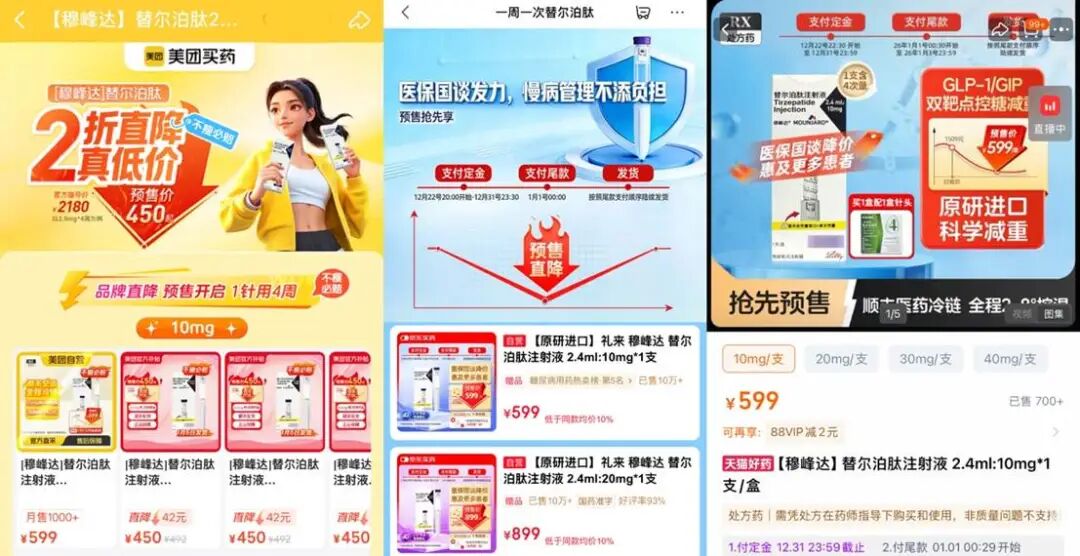
Core Insights - Eli Lilly's weight loss drug Tirzepatide has launched a significant price reduction on the Meituan platform, with prices dropping to around 20% of their initial levels, leading to a more than tenfold increase in order volume [1][4] - The Chinese GLP-1 weight loss market is entering a new phase of competition characterized by "price for volume" strategies, influenced by factors such as Tirzepatide's inclusion in the national medical insurance directory and the impending patent expiration of Semaglutide [5][7] Pricing and Sales Dynamics - Tirzepatide's prices on Meituan for various specifications are set at 450 yuan, 750 yuan, 1050 yuan, and 1320 yuan, which are approximately 20% of the prices at the beginning of the year [2] - Other e-commerce platforms have slightly higher prices for the same specifications, indicating a competitive pricing landscape [4] - The price drop has stimulated consumer demand significantly, with order volumes on Meituan increasing over tenfold following the price reduction [4] Market Competition and Trends - The GLP-1 market is experiencing intense competition, with Tirzepatide contributing significantly to Eli Lilly's revenue, accounting for half of its total sales in the first three quarters of the year [5] - Novo Nordisk's Semaglutide has also seen price reductions, with its 1.5ml injection priced around 220 yuan, down approximately 70% from the mid-year price [4] - The market is expected to see a surge in competition as Semaglutide's core patent expires in March 2024, leading to an influx of generic drugs [7] Consumer Behavior and Online Market - The online channel has become a crucial battleground for GLP-1 drugs, with over 80% of users actively seeking information about weight management products online [7][8] - Female users dominate the online purchasing demographic, with women making up about three times the number of male users in the weight loss sector [8] - Platforms like Meituan are enhancing user experience by integrating services such as patient education and cold chain logistics for drug delivery, addressing the specific needs of GLP-1 medication [8] Future Outlook - The GLP-1 market is projected to exceed 30 billion yuan by 2030, with online medical channels expected to capture over 50% of this market share [7] - The Chinese government's initiatives, such as the "Weight Management Year" starting in 2024, aim to address the rising obesity rates, further driving the demand for GLP-1 drugs [8]
医药行业周报:本周申万医药生物指数下跌0.2%,关注对外授权及新品上市-20251229
Shenwan Hongyuan Securities· 2025-12-29 03:42
Investment Rating - The report indicates a cautious outlook on the pharmaceutical industry, with the overall investment rating reflecting a mixed performance in the sector [2][3]. Core Insights - The Shenwan Pharmaceutical and Biological Index decreased by 0.2% this week, while the Shanghai Composite Index rose by 1.88%, ranking the pharmaceutical index 25th among 31 Shenwan sub-industries [2][3]. - The current valuation of the pharmaceutical sector stands at 29.2 times earnings, placing it 10th among 31 Shenwan primary industries [5]. - Recent collaborations in the industry include significant licensing agreements, such as the partnership between JAKOS and AstraZeneca for the Pan-KRAS inhibitor, which could yield up to $20.15 billion in potential payments [11]. - The report highlights the ongoing challenges in the industry, including a decline in the number of retail pharmacies, which has seen a net reduction of over 8,800 stores in the last quarter alone [16]. Market Performance - The pharmaceutical sector's performance this week showed a decline of 0.2%, with various sub-sectors experiencing mixed results, such as raw materials (+2.0%) and hospitals (-2.8%) [2][5]. - The report notes that the pharmaceutical index's performance is lagging compared to other sectors, indicating a need for strategic adjustments [3][5]. Recent Developments - The sixth batch of national procurement for medical consumables has been officially launched, which may impact pricing and availability in the market [14]. - Several innovative drugs and medical devices have received approval for market entry, including Novo Nordisk's oral semaglutide, marking a significant advancement in obesity treatment [19][21]. - The report also mentions the IPO applications of several companies, including Xinnowei and Frontera, indicating a trend of new entrants seeking capital in the pharmaceutical sector [26][29].


速递|中国首款周制生长激素落地!诺和诺德生长激素获批上市
GLP1减重宝典· 2025-12-28 15:17
Core Viewpoint - The article discusses the approval and clinical efficacy of the long-acting growth hormone injection, Pasi Growth Hormone, developed by Novo Nordisk, which is now available in China for treating growth hormone deficiency in children aged 2.5 years and older [4][6]. Group 1: Product Approval and Details - Pasi Growth Hormone injection received approval from the National Medical Products Administration in China on December 22, 2025, with the approval number SJ20250030 [6]. - The product is a long-acting growth hormone analog that has been optimized to extend its half-life, allowing for weekly administration [4][6]. - It was first approved by the FDA in the United States in August 2020 for adult growth hormone deficiency and expanded its indications in April 2023 to include both children and adults [4]. Group 2: Clinical Efficacy - The efficacy of Pasi Growth Hormone has been validated in multiple global Phase III clinical studies, including the REAL4 study, which confirmed its safety and efficacy in an international population [8]. - In the REAL6 study conducted in China, 110 previously untreated children were randomized to receive either Pasi Growth Hormone or a daily regimen of recombinant human growth hormone. The results showed that the average height growth rate in the Pasi group was 11.0 cm/year, comparable to the daily regimen group [8]. - The overall safety profile of Pasi Growth Hormone was consistent with previous growth hormone formulations, with an injection site reaction rate of only 2.7% and no reported injection site pain during the 52-week treatment period, indicating a lower treatment burden and good drug tolerance [8].