Novo Nordisk(NVO)

Search documents
【早报】北京发放首批L3级高速公路自动驾驶车辆专用号牌;中芯国际对部分产能实施涨价
财联社· 2025-12-23 23:09
Macro News - Xi Jinping emphasized the importance of central enterprises in supporting national strategies and enhancing core competitiveness, urging them to focus on their main responsibilities and optimize the layout of state-owned economy [4] - The meeting of central enterprise leaders highlighted the need for strong support in major infrastructure construction and the promotion of new infrastructure development [4] Industry News - Shenzhen banks have raised the minimum interest rate for business loans secured by real estate to 2.35% annually, up from a previous low of 2.2% [8] - The first batch of L3-level highway autonomous vehicle special license plates has been issued in Beijing, allowing conditional autonomous driving on specific highways [9] - The sixth round of national high-value medical consumables procurement has started, introducing a price anchor concept to balance price reductions and prevent malicious underpricing [9] Company News - SMIC has implemented a price increase of approximately 10% on certain production capacities [10] - Oriental Yuhong reported that its wholly-owned subsidiary in the U.S. was allegedly a victim of telecom fraud, with an involved amount of approximately 12.118 million yuan [10] - Aiko Cyber announced it won the bid for the BEST and HL-3 nuclear fusion power project [11] - Zhenyu Technology plans to raise no more than 1.88 billion yuan for lithium battery precision structural component expansion projects [11] Global Market - U.S. stock indices collectively rose, with the S&P 500 index reaching a new closing high [12] - International gold and silver prices hit historical highs, with COMEX gold futures rising by 1.02% to $4,515 per ounce and silver futures up by 4.44% to $71.61 per ounce [14]





Launch of Wegovy pill is core to Novo Nordisk's growth, says Guggenheim's Seamus Fernandez
Youtube· 2025-12-23 23:06
Core Insights - Novo Nordisk is entering the oral GLP-1 market with its new pill, which may provide an opportunity to gain market share despite not dramatically changing the competitive landscape [2][3] - The success of Novo's pill will depend on its manufacturing capabilities and the ability to meet demand, as the active ingredient requires significantly more quantity compared to injectables [4][5][6] - Consumer preferences will be tested in 2026, determining whether they favor the convenience of a pill over the effectiveness of injectables [7][8][9] Manufacturing and Supply - Novo has begun manufacturing the active ingredient for its pill in North Carolina, but there are concerns about its ability to meet demand due to the complexity of the molecule [4][5] - The pill formulation requires approximately 70 times more of the active ingredient to be effective compared to injectable forms, which poses additional manufacturing challenges [6] Market Dynamics - The introduction of Novo's pill and Eli Lilly's upcoming orforglipron will create a competitive environment where consumer preferences will play a crucial role [3][7] - Eli Lilly has demonstrated effective marketing strategies with its own products, which may influence consumer choices in the market [8][9]


Stock Market Today, Dec. 23: U.S. Stocks Hold Near Records on Narrow Tech-Led Gains
Yahoo Finance· 2025-12-23 22:41
Market Performance - The S&P 500 rose 0.46% to 6,909.79, the Nasdaq Composite gained 0.57% to 23,561.84, and the Dow Jones Industrial Average edged up 0.16% to 48,442.41 in quiet holiday trading [1][2]. Company Developments - Novo Nordisk advanced on FDA approval of its Wegovy pill, boosting healthcare sentiment [2]. - ServiceNow slid nearly 3% after announcing a $7.75 billion acquisition of cybersecurity firm Armis, impacting large-cap software within the Nasdaq [2]. Economic Indicators - Third-quarter GDP growth of 4.3% indicates firm economic momentum, supporting risk appetite as markets remain near record levels [3]. - Resilient growth allows the Federal Reserve to maintain a patient stance on rate cuts, with forecasts extending into 2026 [3]. Sector Trends - Mega-cap technology and AI stocks are primary drivers of index performance, which can elevate indexes while masking thinner participation [4]. - The strength in healthcare following Novo Nordisk's approval reflects investor interest in businesses with predictable demand amid ongoing questions about rates and growth [4]. Market Mechanics - Holiday trading schedules are thinning volume, making price action more susceptible to positioning, thus daily moves may be less reliable [5]. - Investors are likely to overlook short-term fluctuations until markets fully reopen, when upcoming economic data and early-year earnings guidance will provide clearer insights [5].

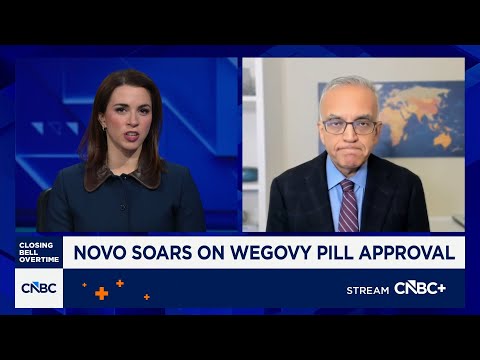
Dr. Ashish Jha talks Novo Nordisk getting approval for Wegovy pill
CNBC Television· 2025-12-23 21:52
Joining me now is Dr. . Ashish Ja. He is the outgoing dean of the school of public health at Brown University and the former White House CO 19 response coordinator.Uh doctor, thank you for joining us today. So what do you see just if we can take a step back here is the total addressable market for a pill of GLP1 how big ultimately do you think this could be. >> Yeah.So first of all, thanks for having me back. I think this is a big deal and let me explain why. I mean more than 100 million Americans have obes ...
Dr. Ashish Jha talks Novo Nordisk getting approval for Wegovy pill
Youtube· 2025-12-23 21:52
Core Insights - The total addressable market for GLP-1 pills is significant, with over 100 million Americans affected by obesity, indicating a large potential user base for these medications [2][3] - The transition from injectable to oral forms of GLP-1 drugs is expected to increase accessibility and adoption among patients who dislike injections, potentially leading to a higher uptake of these treatments [2][3] Market Dynamics - Novo Nordisk is currently leading the market with its GLP-1 drug, while Eli Lilly is expected to follow closely behind, likely launching its product a few months later [3][4] - The competitive landscape is characterized by a rush to enroll patients before Eli Lilly's product becomes available, as established users may be reluctant to switch medications once they start seeing results [4] Efficacy and Health Impact - Both Novo Nordisk and Eli Lilly's drugs are anticipated to be effective in promoting weight loss and improving related health conditions, with Eli Lilly's product potentially offering slightly better results [5] - A significant increase in the number of users, particularly among those who avoid injections, could lead to improved health outcomes and potentially lower healthcare costs in the long term, despite initial higher expenses associated with these drugs [5][7] Long-term Outlook - The initial phase may see increased healthcare costs due to the high price of these medications, but the long-term health benefits could lead to improved longevity and overall health for the population [6][7] - The focus of these drugs is primarily on health improvement rather than cost reduction, emphasizing the importance of enhancing quality of life and longevity for users [8]

Stock Market Today, Dec. 23: Novo Nordisk Surges After FDA Approves Oral Wegovy Weight Loss Pill
The Motley Fool· 2025-12-23 21:42
Core Insights - The FDA's approval of Novo Nordisk's oral Wegovy weight-loss pill is a significant development that enhances the company's competitive position in the obesity treatment market [3][5] - Novo Nordisk's stock experienced a notable increase of 7.30%, closing at $51.61, following the approval announcement, indicating strong investor confidence [2][5] - The oral Wegovy pill demonstrated an average weight loss of 17% over 64 weeks, which may drive strong sales due to the convenience of not requiring injections [6] Company Performance - Novo Nordisk's market capitalization stands at $162 billion, with a gross margin of 81.93% and a dividend yield of 3.59% [2] - The trading volume for Novo Nordisk reached 65 million shares, significantly above its three-month average of 16 million shares, reflecting heightened investor interest [2] Market Impact - The approval of Wegovy is expected to influence healthcare stocks broadly, with investors monitoring demand in U.S. self-pay channels [3][5] - Competitors in the obesity treatment space are being closely watched, as other oral weight loss drugs may enter the market soon, potentially affecting Novo Nordisk's market share [6]

Stock market today: S&P 500 notches latest 2025 record as Wall Street's winning streak reaches 4
Yahoo Finance· 2025-12-23 21:03
Market Performance - US stocks experienced an upward trend, with the S&P 500 reaching a record close of 6,909.79, marking a 0.5% increase [2] - The Nasdaq Composite rose by 0.6%, while the Dow Jones Industrial Average gained approximately 0.2%, extending gains for four consecutive sessions [2] Economic Data - The third quarter GDP data revealed a surprising growth of 4.3% annualized rate, significantly exceeding the expected 3.3%, indicating ongoing economic resilience [3] - Consumer spending remained robust over the summer, contributing to the positive economic outlook [3] Interest Rate Expectations - Following the GDP release, traders reduced their expectations for a rate cut in January, with over 85% odds now pricing in the Federal Reserve maintaining current rates, an increase from 80% the previous day [4] - Despite this, a majority of bets still anticipate two rate cuts by the end of next year [4] Corporate Developments - Novo Nordisk's US-listed stock surged after receiving official approval to market its Wegovy weight-loss pill, highlighting positive corporate news amid broader market trends [5]
诺和诺德周二尾盘大涨7.1%
Xin Lang Cai Jing· 2025-12-23 20:21
Group 1 - The core point of the article is that Novo Nordisk (NVO) experienced a significant stock increase of 7.1% following the FDA approval of its weight loss drug Wegovy, which enhances the outlook for the weight loss market [1][2]. Group 2 - The FDA approval of Wegovy is a pivotal event for Novo Nordisk, indicating potential growth opportunities in the weight loss sector [1][2].
Novo Nordisk is still worried about revenue growth next year despite obesity pill: BMO's Seigerman
Youtube· 2025-12-23 20:04
Core Viewpoint - The healthcare sector has shown resilience despite challenges, with optimism returning in the latter half of the year, particularly in the biopharmaceutical segment, which is experiencing one of its best performances in a decade [2][3]. Company Analysis - Novo Nordisk is facing a competitive landscape in the obesity treatment market, particularly against Eli Lilly, which has been rated more favorably by analysts [4]. - The new WGOI pill from Novo is noted for its higher concentration of active pharmaceutical ingredient (API), which is 25 milligrams compared to the 2.4 milligrams in Lilly's shot, suggesting a potential for greater weight loss [5][7]. - Concerns exist regarding revenue growth for Novo in the upcoming year, as the market is cautious about the company's ability to maintain its competitive edge [5][7]. - The convenience of the WGOI pill, which requires taking it first thing in the morning, may present challenges compared to Lilly's orphagon pill that does not have food effect issues [6]. Industry Landscape - The obesity treatment market is substantial, with over 140 million obese individuals in the U.S., indicating significant room for growth for both Novo and Lilly [10]. - The introduction of longer-acting competitors, such as Pfizer, could further impact market dynamics and competition in the obesity treatment space [11].

FDA approves Novo Nordisk weight-loss pill. Here's what to know
Fastcompany· 2025-12-23 19:51
Core Insights - The U.S. FDA approved Novo Nordisk's weight-loss pill, Wegovy, which contains 25 mg of semaglutide, enhancing its competitive position against Eli Lilly [1][2] - The approval is expected to revitalize Novo's sales after a challenging year marked by declining shares and profit warnings [2] - The oral semaglutide pill is aimed at adults with obesity or overweight and related health conditions, potentially tapping into a market projected to reach $150 billion annually by the next decade [3] Company Strategy - Novo is leveraging its first-to-market advantage with the oral pill to regain market share in the U.S., where it has faced competition from Lilly [4] - The company has been preparing for the launch by building up supplies of the pill in North Carolina [5] - Novo's pricing strategy includes a starter dose priced at $149 per month for Medicare and Medicaid, with a recent reduction in the cash price for Wegovy from $499 to $349 [9] Market Dynamics - Approximately 40% of American adults are classified as obese, with around 12% currently using GLP-1 drugs [5] - Analysts predict that oral pills could capture about 20% of the weight-loss market by 2030, appealing to patients who prefer less invasive treatment options [6] - The approval of the oral pill may lead to increased patient uptake, as it addresses injection hesitancy and offers convenience [6][8] Competitive Landscape - Novo's injectable semaglutide initially struggled to meet demand, allowing Lilly to gain an edge with its Zepbound product [6] - Lilly's next-generation weight-loss pill, orforglipron, is expected to be approved soon, intensifying competition in the market [4] - The oral semaglutide requires specific administration guidelines, which may affect its adoption compared to Lilly's pill that has fewer restrictions [11]