
Wells Fargo(WFC)

Search documents
Do Branch Renovations Anchor Wells Fargo's Growth Strategy?
ZACKS· 2025-12-16 17:06
Key Takeaways At a conference, WFC said branch renovations are central to growth, leveraging its 4,100-branch network.WFC's wider reach enables community-style access and branch-led product growth, with credit cards a focus.WFC expects over half its branches to be refreshed by 2025, with renovations in major cities slated for 2026.At the Goldman Sachs 2025 U.S. Financial Services Conference on Dec. 9, Wells Fargo & Company (WFC) said that its branch renovation program is a key lever for future growth. CEO C ...



富国银行:预期流动性将上升,美股回调将创造买入机会
Ge Long Hui A P P· 2025-12-16 13:57
格隆汇12月16日|富国银行指出,目前流动性条件紧张,但美联储预计将扩大其资产负债表的举措可能 会在2026年上半年推动这一环境出现"急剧逆转"。包括Ohsung Kwon和John Glascock在内的富国银行分 析师认为,在预期的流动性上升期间,股市回调将成为投资者的买入机会。过去流动性紧张导致防御性 股票(盈利似乎受经济起伏影响较小的股票)表现优于更具投机性的成长板块。 ...
26 people who will change banking in 2026
American Banker· 2025-12-16 11:00
Group 1: Home BancShares and M&A Activity - Home BancShares announced plans to acquire Mountain Commerce Bancorp, valued at $1.8 billion, marking its return to the M&A arena after nearly four years [4][5] - CEO John Allison expressed openness to additional deals, indicating a strong capital position with a "war chest of capital" [5] - The previous acquisition of Happy State Bank was initially seen as successful but led to a legal battle due to employee departures, which has since been resolved [6][8][9] Group 2: OpenAI and Generative AI in Banking - OpenAI's CEO Sam Altman is focusing on the banking sector, hiring former employees from major banks to develop AI tools aimed at replacing entry-level investment banking tasks [12][13] - The project, codenamed Mercury, aims to enhance efficiency in transaction types, posing potential risks to anti-fraud measures in the banking industry [11][14] Group 3: Coinbase and Partnerships - Coinbase, the largest U.S. cryptocurrency exchange, is expanding its services through partnerships with major banks like JPMorganChase and PNC, facilitating easier crypto transactions for their clients [16][18] - The company aims to become a comprehensive trading platform, potentially allowing trades of various asset types, including loans and real estate [19][20] Group 4: Regulatory Changes and Leadership - Scott Bessent, the Treasury Secretary, is advocating for a deregulatory agenda, focusing on reducing compliance burdens for community banks and altering supervisory practices [23][24] - Michelle Bowman, Vice Chair for Supervision at the Federal Reserve, is implementing a deregulatory shift, modifying how banks are examined and potentially changing oversight tools [26][28] Group 5: Capital One and Discover Acquisition - Capital One's acquisition of Discover Financial Services is seen as a long-term bet to enhance its payments network, with shares up approximately 40% since regulatory approval [46][47] - The integration process is expected to be complex, with potential short-term impacts on loan growth as the company adjusts Discover's portfolio [48][49] Group 6: Citi's Transformation Under Jane Fraser - Citi, under CEO Jane Fraser, is undergoing significant transformation, focusing on profitability and operational efficiency, with a target return on tangible common equity of 10%-11% for 2026 [52][54] - Fraser's leadership has led to improved financial results and a restructuring of the bank's operations, positioning Citi as a more competitive entity [53][55] Group 7: Stripe and AI Innovations - Stripe, co-founded by the Collison brothers, is leveraging AI and digital assets to enhance its payment solutions, including a partnership with OpenAI for Instant Checkout in ChatGPT [34][36] - The company's valuation has rebounded to over $90 billion, with processing volumes reaching $1.4 trillion, indicating strong market confidence [36] Group 8: Wells Fargo's Strategic Focus - Wells Fargo, led by CEO Charlie Scharf, is aiming to grow its credit card and investment banking businesses, with credit card revenue up 8% year-over-year [108][110] - The bank is positioning itself to compete more effectively with larger institutions, potentially resembling JPMorgan's business model by the end of 2026 [111] Group 9: Regulatory Environment and Political Influence - The current political landscape, influenced by President Trump and key figures like Congressman French Hill, is shaping banking regulations, including stablecoin legislation and deregulatory efforts [72][116] - The FDIC, under acting chair Travis Hill, is expected to continue a trend of lighter supervision, focusing on risk-based regulatory approaches [75][77]



How AI Is Impacting Productivity at JPM, BAC, C & Others
ZACKS· 2025-12-15 13:46
Core Insights - Artificial intelligence (AI) is recognized as the most significant technological disruption since the Internet, fundamentally altering work, creativity, and decision-making processes [1] - Major U.S. banks, including JPMorgan, Citigroup, Bank of America, and Wells Fargo, are investing billions in AI to enhance productivity and adapt to evolving client needs [1] AI Integration in Banking - AI is moving from pilot projects to being integrated into daily banking operations, viewed as a productivity and headcount lever by executives [2] - Banks are leveraging AI as a force multiplier to improve operational efficiency, accelerate software development, and enhance client service, leading to higher output per employee [3] JPMorgan's AI Initiatives - JPMorgan has reported a productivity increase from approximately 3% to 6% due to AI, with operations specialists seeing potential productivity gains of 40% to 50% as tasks become more automated [4] - The bank maintains a substantial technology budget of around $18 billion annually, with a $2 billion investment in AI aimed at achieving measurable returns on investment [5] Citigroup's AI Strategy - Citigroup is scaling internal generative AI tools to enhance developer productivity, freeing up about 100,000 developer hours weekly, with 180,000 employees accessing these tools [6] - The bank has an annual technology budget of approximately $12 billion, indicating strong organizational support for AI integration across functions [7] Bank of America's AI Spending - Bank of America has committed $4 billion of its roughly $13 billion technology budget to AI, linking this investment to tangible productivity improvements in both frontline and tech teams [8] - The bank's AI initiatives, including the virtual assistant Erica, are designed to handle high-volume service interactions, allowing human employees to focus on more complex tasks [9] Wells Fargo and PNC Financial's Approach - Wells Fargo and PNC Financial are also focusing on AI to enhance efficiency, with Wells Fargo indicating a potential decline in headcount as a result of automation [10] - PNC Financial's CEO has suggested that AI will accelerate existing automation efforts, potentially stabilizing headcount while scaling the business over the next decade [12] Overall Efficiency Gains from AI - The transition to AI-driven productivity is expected to yield sustainable expense leverage, with early evidence showing improvements in operations, software development, and client support [13] - The long-term success of AI integration will depend on the ability to embed it into everyday decisions and workflows while maintaining regulatory compliance [14]


Wells Fargo Stock Just Hit an All-Time High. Here Are 2 Tailwinds Behind the Banking Giant.
The Motley Fool· 2025-12-13 20:02
Core Viewpoint - Wells Fargo has successfully overcome regulatory challenges and is now positioned for growth, with stock trading at an all-time high and the removal of asset caps and consent orders [1][2]. Group 1: Regulatory Changes and Management Actions - The asset cap imposed by the Federal Reserve has been lifted, allowing Wells Fargo to pursue growth strategies [2]. - CEO Charlie Scharf has implemented a new regulatory infrastructure, sold non-core businesses, reduced expenses, and focused on capital-light operations like investment banking and credit card lending [2]. Group 2: Financial Performance and Targets - Wells Fargo achieved a 15% return on tangible common equity (ROTCE) year to date, with a goal to reach 17% to 18% ROTCE in the medium term, aligning with top industry performers [5]. - The bank's common equity tier 1 (CET1) capital requirement decreased from 9.7% in 2024 to 8.5% in the current year, potentially resulting in billions in excess capital [8]. Group 3: Capital Management and Future Outlook - As of the end of Q3, Wells Fargo's CET1 ratio stood at 11%, with plans to reduce it to the 10% to 10.5% range, which may lead to increased dividends and share repurchases [9]. - The favorable regulatory environment and excess capital position the banking sector well for the future, particularly heading into 2026 [10].

Jim Cramer Says He Likes “Wells Fargo Now That Its Asset Cap Has Been Lifted”
Yahoo Finance· 2025-12-13 16:17
Group 1 - Wells Fargo & Company (NYSE:WFC) has seen a spike in its stock price following the Federal Reserve's rate cut, indicating a positive market reaction [1] - The company's valuation is shifting from net interest income to a focus on lending capacity, as demand for loans is expected to increase [1] - The lifting of Wells Fargo's asset cap is viewed positively, enhancing its potential for growth in the banking sector [1] Group 2 - Wells Fargo provides a range of financial services, including banking, lending, investment, and wealth management solutions [2]
X @Bitcoin
Bitcoin· 2025-12-12 22:53
RT Consumers' Research (@ConsumersFirst)BREAKING: The U.S. Comptroller of the Currency has found conclusive proof that 9 large financial institutions actively engaged in debanking.The financial institutions named are:- @JPMorgan- @BankofAmerica- @Citi- @WellsFargo- @USBank- @CapitalOne- @PNCBank- @TDBank_US- @BMOhttps://t.co/VOyOGjbsJC ...

重返增长轨道:富国银行(WFC.US)扩招加码投行,并购排名首次跻身前十
智通财经网· 2025-12-12 13:29
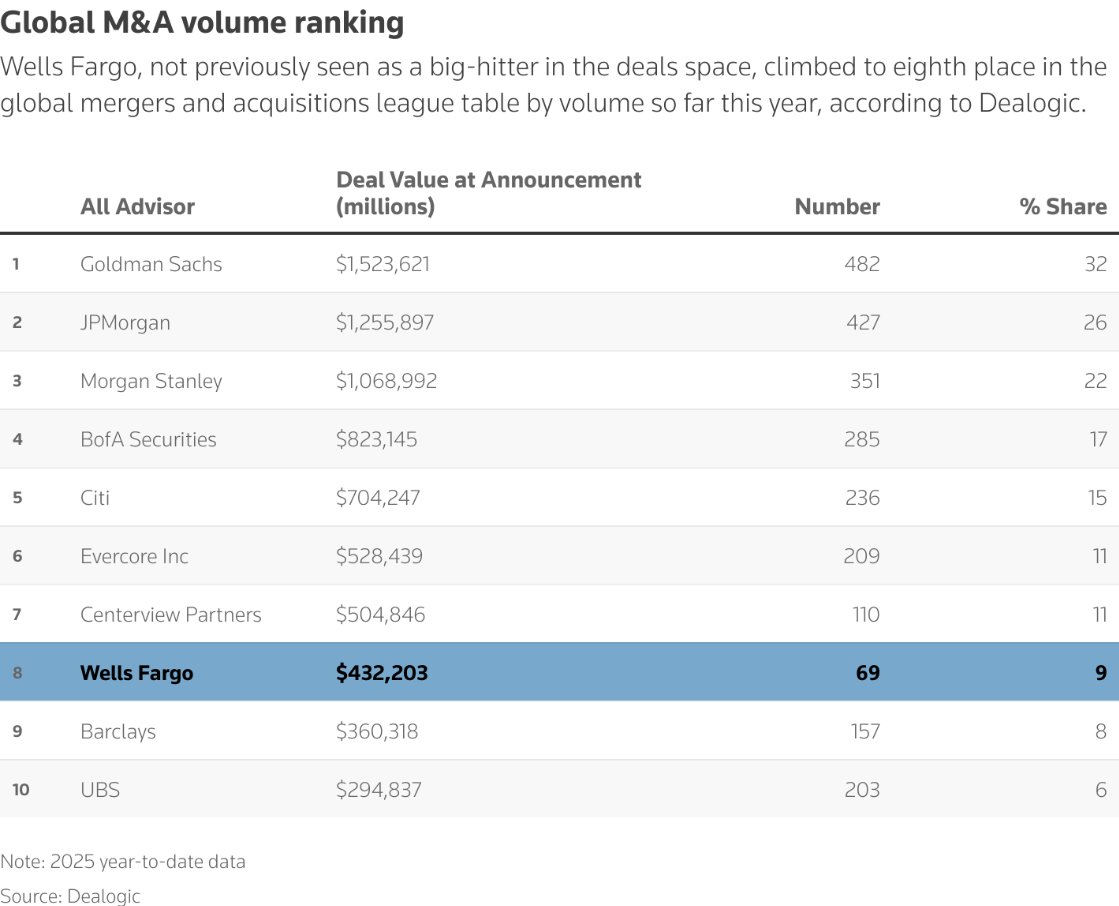
Core Viewpoint - Wells Fargo (WFC.US), the fourth-largest bank in the U.S., is planning to expand its investment banking operations significantly, having already improved its ranking in the mergers and acquisitions (M&A) sector due to recent hiring and market share efforts [1][4]. Group 1: Investment Banking Expansion - Wells Fargo has seen a notable rise in its M&A ranking, moving to eighth place globally in terms of transaction volume as of this year, up from 17th place in 2024 [1][2]. - This marks the first time Wells Fargo has entered the top ten of the M&A rankings since Dealogic began collecting data in 1995, indicating a significant shift in its market position [3]. - The bank's CEO, Charlie Scharf, aims to position Wells Fargo among the top five investment banks globally, with the current ranking being eighth in the world and sixth in the U.S. by revenue [5][6]. Group 2: Market Conditions and Strategic Moves - The optimistic outlook among Wall Street executives regarding transaction prospects is supported by the resilience of the U.S. economy, which benefits Wells Fargo's investment banking ambitions [1][3]. - The lifting of a seven-year punitive asset cap by regulators has allowed Wells Fargo to pursue larger domestic business mandates, enhancing its competitive edge against smaller boutique firms [5][6]. - The bank's investment banking division has been actively recruiting, with over 125 managing directors hired since 2019, indicating a commitment to strengthening its market presence [8]. Group 3: Recent Transactions and Revenue Potential - Wells Fargo has participated in high-profile M&A transactions, including advising Netflix on a $72 billion acquisition of Warner Bros. Discovery, which is expected to yield $37 million in advisory fees [4]. - The bank is also advising Union Pacific on an $85 billion acquisition of Norfolk Southern, with anticipated revenue of $52.5 million from this deal [5]. - The bank's advisory fee income has been on the rise, although it still ranks 20th in M&A transaction revenue [5].
Here’s What Boosted Wells Fargo (WFC)
Yahoo Finance· 2025-12-12 12:55
Mairs & Power, an investment advisor, released the third-quarter 2025 investor letter for the “Mairs & Power Balanced Fund.” A copy of the letter can be downloaded here. As we move into 2025, the market’s concentration persists, with a few dominant mega-cap stocks tied to artificial intelligence (AI) driving most of the favorable outcomes. The fund returned 6.47% in the first nine months of 2025. The fund underperformed the benchmark composite indexes (60% S&P 500 Total Return Index and 40% Bloomberg U.S. G ...
Nike: Navigating Revenue and Margin Headwinds Ahead of Critical Q2 Earnings
Investing· 2025-12-12 12:22
Core Insights - The article provides a comprehensive market analysis of Nike Inc., highlighting its performance and strategic positioning in the athletic apparel and footwear industry [1] Group 1: Company Performance - Nike Inc. has shown a significant increase in revenue, reporting a growth of 10% year-over-year, reaching $51.2 billion [1] - The company's net income also saw a rise, with a reported increase of 15%, totaling $5.7 billion [1] - Direct-to-consumer sales have surged, accounting for 40% of total revenue, reflecting a shift in consumer purchasing behavior [1] Group 2: Market Positioning - Nike maintains a strong market share, estimated at 27% in the global athletic footwear market, positioning it as a leader in the industry [1] - The company continues to invest in innovation and sustainability, with a commitment to reducing carbon emissions by 30% by 2030 [1] - Nike's brand value is estimated at $34 billion, making it one of the most valuable brands in the sports sector [1] Group 3: Competitive Landscape - The competitive landscape includes major players such as Adidas and Puma, which are also focusing on sustainability and direct-to-consumer strategies [1] - Nike's marketing strategies, including collaborations with high-profile athletes and influencers, have strengthened its brand presence and consumer loyalty [1] - The company faces challenges from emerging brands that are gaining traction among younger consumers, necessitating continuous innovation [1]

