Yum!(YUM)

Search documents
为什么在高铁、机场,肯德基涨价,星巴克不涨价?
3 6 Ke· 2026-02-25 02:35
春运期间,高铁站与机场往往成为密度最高的商业空间之一。有限的空间承载着巨量的人流,消费行为被压缩在短暂停留之中,交易效率与渠道话语权被 极大放大。在这样的场景里,价格上浮几乎成为一种默认规则。从矿泉水到简餐,从便利商品到服务收费,消费者对此并不会感到意外。 原因也很直接,交通枢纽属于典型强势渠道,租金远高于普通商场,许多场地还叠加营业额抽成、运营规范成本与物流限制。这些成本终究要被转移到终 端价格之中。对大多数品牌而言,进入这样的渠道,本身就意味着接受一套新的定价逻辑。 价格策略的第一约束,来自成本结构。交通枢纽环境并不会改变品牌定位,却会显著放大成本压力。当渠道成本上升时,企业能否吸收这部分压力,取决 于产品本身的利润厚度与商业模型。 肯德基是标准化大众快餐。在它的成本模型里,生鲜食材、庞大且复杂的冷链物流,以及后厨高强度的标准化人工操作,占据了极高的硬性成本。 这种重资产、重供应链的模式,决定了它在常规市区的核心盈利法宝是薄利多销,必须依靠极高的客流周转率来摊薄固定支出。 但真正耐人寻味的差异在于,即便处在同一空间,不同品牌的反应却并不一致。肯德基的产品价格往往明显高于市区门店,而星巴克却大体维持全国统一 ...


KFC® Brings Back the Fan-Favorite Twister* and Launches New $20 Customizable Bucket**
Prnewswire· 2026-02-24 17:04
A nostalgic classic returns for a limited time, alongside a new option to bring everyone to the table PLANO, Texas, Feb. 24, 2026 /PRNewswire/ -- KFC® is expanding how guests can order across occasions with the return of the Twister and the debut of the $20 Build a Bucket, a new bundle designed for sharing and variety. Together, the two offerings make it easier to enjoy KFC whether you're grabbing something for yourself or feeding a crowd. ...

Yum!(YUM) - 2025 Q4 - Annual Report
2026-02-20 21:54
Business Operations - YUM operates over 63,000 restaurants across 155 countries, with system sales totaling $68.295 billion in 2025[18] - Approximately 97% of YUM's restaurant units are operated by independent franchisees, with 40% of franchised units in mainland China operating under master franchise agreements[29] - The company has a Master License Agreement with Yum China, its largest franchisee, which is crucial for its operations in mainland China[65] - The company has approximately 61,000 franchise restaurants globally, employing over 1 million people, creating numerous part-time, entry-level opportunities[50] - YUM's KFC division has 33,897 units, with 99% operated by franchisees, while the Habit Burger & Grill division has 384 units, with only 22% franchised[18] - The company does not consider its operations to be seasonal, indicating stable performance throughout the year[43] Financial Performance - System sales growth for 2025 was reported at +4%, with same-store sales growth of +3%[194] - Company sales reached $2,945 million in 2025, a 15% increase from $2,552 million in 2024[196] - Net income for 2025 was $1,559 million, reflecting a 5% increase compared to $1,486 million in 2024[196] - Diluted EPS for 2025 was $5.55, up 6% from $5.22 in 2024[196] - Franchise sales increased to $65,350 million in 2025, compared to $62,914 million in 2024, marking a growth of 3.4%[198] - Core operating profit for 2025 was $2,684 million, compared to $2,572 million in 2024, indicating a growth of 4.4%[201] Strategic Initiatives - The company is reviewing strategic options for the Pizza Hut brand, aiming to complete this review in 2026[17] - The company emphasizes a strategy focused on customer needs, franchisee performance, and leveraging technology for growth[27] - The company has initiated a process to explore strategic options for the Pizza Hut brand to maximize long-term value creation, with no assurance of a successful transaction outcome[72] - Significant expenses are expected in connection with the strategic review of Pizza Hut, which may divert management's attention and disrupt business operations[74] Technology and Digital Sales - Digital sales approached $40 billion in 2025, accounting for nearly 60% of overall system sales[36] - The Byte by Yum! platform was introduced in 2025, enhancing operational efficiency and customer experience through AI-driven solutions[35] - The company is investing significantly in digital and technology capabilities, including AI, but faces risks related to the rapidly evolving legal and regulatory landscape[95] - There is an increasing dependence on digital commerce and delivery platforms, and any failure to effectively implement these initiatives could adversely affect sales growth[96] Risks and Challenges - The company faces risks related to food safety and potential catastrophic events, which could disrupt operations and affect growth prospects[56][57] - The company may face significant tax liabilities related to the Yum China spin-off if the IRS challenges the tax-free status of the transaction[129][130] - The company faces significant foreign currency risks, particularly with fluctuations in the value of the U.S. dollar against currencies like the Chinese Renminbi, which could adversely affect reported earnings[82] - Cybersecurity incidents pose a risk to the company's financial results and growth prospects, with a ransomware attack in January 2023 impacting certain IT systems and resulting in the closure of fewer than 300 restaurants for one day[86] - The company faces challenges due to labor shortages and increased labor costs, which may adversely affect operations and growth prospects[110] Market Environment - The retail food industry is highly competitive, with various types of competitors, and the company does not constitute a significant portion of the industry in terms of system units or sales[44] - The company’s growth may be impacted by franchisee financial distress, which could hinder new unit development and operational profitability[61][69] - The company is subject to evolving ESG expectations, which may increase compliance costs and management focus, potentially impacting financial results[119] Employee Engagement and Culture - The company is focused on building a culture of engagement and opportunity among employees, which is integral to its growth strategy[51][54] - As of December 31, 2025, the company employed approximately 49,000 persons, with about 90% working in restaurants, and 80% of U.S. restaurant general managers promoted from within[49][50] Legal and Regulatory Compliance - The company is subject to numerous global data privacy laws, including the E.U.'s GDPR, which impose strict requirements and significant penalties for noncompliance[90] - Compliance with Payment Card Industry Data Security Standards is critical; failure to do so could result in civil liability and increased costs[89] - Legal and regulatory complexities, including labor laws and health regulations, may adversely affect business operations and growth prospects[123] Capital Structure and Shareholder Returns - As of December 31, 2025, the company's total outstanding short-term borrowings and long-term debt was approximately $12.0 billion[137] - The Company declared and paid four cash dividends of $0.71 per share in 2025, with a new dividend of $0.75 per share declared for March 6, 2026[171] - The Company has remaining capacity to repurchase up to $1.1 billion of Common Stock under the authorized $2.0 billion share repurchase program[172]
万店巨头再打9.9元价格战,“中国版肯德基”杀入红海市场
创业邦· 2026-02-18 01:08
Core Viewpoint - The introduction of the "9.9 yuan" coffee monthly card by Wallace, a fast-food brand, is a strategic move to attract customers and increase sales frequency, amidst ongoing price wars in the coffee market [6][10]. Group 1: Company Overview - Wallace, founded in 2001, is known for its low-priced Western fast food, primarily targeting lower-tier cities in China, and has over 19,000 stores, making it a significant player in the market [4][8]. - The company has faced challenges, including food safety issues and a low profit margin of 2.88% in 2024, prompting a strategic shift to improve operational efficiency [10]. Group 2: Market Context - The coffee market has seen intense competition, with brands like Luckin and Kudi previously engaging in aggressive pricing strategies, leading to a "coffee war" that has influenced consumer expectations [6][19]. - The introduction of low-priced coffee options by fast-food chains is part of a broader trend to enhance customer experience and increase average transaction values [6][19]. Group 3: Strategic Implications - Wallace's "9.9 yuan" coffee monthly card aims to leverage low pricing as a means to drive traffic to its core fast-food offerings, similar to strategies employed by McDonald's and KFC [16][19]. - However, the sustainability of such low-price strategies is questioned, as they may lead to low customer loyalty and potential harm to brand value in the long term [19].



餐饮茶饮集体涨价,为啥大家都放弃了低价策略?
Bei Jing Ri Bao Ke Hu Duan· 2026-02-17 07:46
Group 1 - The core point of the article is the collective price increase in the restaurant and beverage market, which marks a shift from the previously dominant low-price strategy [1][3] - Major brands like KFC and McDonald's have recently raised prices, with KFC adjusting delivery prices by an average of 0.8 yuan while keeping dine-in prices unchanged [1][2] - Other brands such as Nayuki, Luckin Coffee, and others are also increasing prices, typically by 1-2 yuan, to balance costs and profits [1][2] Group 2 - The abandonment of low-price strategies is attributed to rising operational costs, particularly in raw materials, with fresh fruit prices increasing by 4.4% as of December 2025 [5][7] - The competitive landscape in the restaurant and beverage market has intensified, with new brands emerging and consumer demand shifting towards quality and experience, necessitating increased investment in product innovation [7][8] - Price increases are seen as a necessary response to cost pressures and market competition, but companies must also focus on establishing sustainable profit models rather than relying solely on price wars [8][10] Group 3 - The risk of collective price increases lies in potential strategic disagreements among leading companies, which could lead to market disruption if a major player opts to maintain lower prices [10] - If a brand like Mixue Ice City maintains low prices while others raise theirs, it could attract consumers away from mid-tier brands, creating a market divide [10]

Do Wall Street Analysts Like Yum! Brands Stock?
Yahoo Finance· 2026-02-16 10:15
Core Insights - Yum! Brands, Inc. has a market capitalization of $44.6 billion and operates over 55,000 restaurants globally under brands like KFC, Pizza Hut, Taco Bell, and The Habit Burger Grill [1] Financial Performance - In Q4 of fiscal 2025, Yum! reported a revenue increase of 6% year-over-year to $2.51 billion, with global same-store sales up 3% and system sales increasing by 5% [4] - Adjusted EPS for the quarter was $1.73, reflecting an 8% year-over-year growth, but slightly below analyst expectations [4] Stock Performance - Yum! shares have gained 8%, underperforming the S&P 500 Index, which has risen nearly 11.8% [2] - Year-to-date, Yum!'s stock rose 6.1%, contrasting with a slight decline in the S&P 500 [2] Analyst Ratings and Expectations - Analysts project Yum!'s EPS to grow by 9.4% to $6.07 for the fiscal year ending December 2026 [5] - The consensus rating among 28 analysts is a "Moderate Buy," with 11 "Strong Buy" ratings and 17 "Holds" [5] - Evercore ISI analyst raised the price target for Yum! to $190, indicating confidence in the stock's potential [7]
McDonald’s vs. Yum! Brands: Which Wins the Battle for India as US Growth Slows?
Yahoo Finance· 2026-02-11 13:15
Quick Read McDonald’s (MCD) and Yum Brands (YUM) face double-digit traffic declines from lower-income U.S. consumers in Q3. KFC dominates India with 600+ locations and unified franchise structure. McDonald’s operates 500 stores split between two partners. Yum’s Taco Bell U.S. same-store sales grew 7% in Q3. McDonald’s U.S. comparable sales rose just 2.4%. A recent study identified one single habit that doubled Americans’ retirement savings and moved retirement from dream, to reality. Read more here ...
McDonald's vs. Yum! Brands: Which Wins the Battle for India as US Growth Slows?
247Wallst· 2026-02-11 13:15
Core Insights - McDonald's and Yum! Brands are facing significant challenges in the U.S. market, with both companies experiencing double-digit traffic declines among lower-income consumers in Q3 2025. This trend has persisted for nearly two years, driven by rising labor costs, consumer resistance to pricing, market saturation, and competition in value menus [1] - India presents a substantial growth opportunity for both companies, with a population of 1.4 billion, a median age of 29, and a rapidly expanding middle class projected to reach 600 million by 2030. The underpenetration of Western QSR brands in India further enhances this potential [1] Company Strategies and Market Position - Yum! Brands has a structural advantage in India, with KFC being the largest Western QSR by store count, operating over 600 locations. The brand's chicken-forward menu requires minimal cultural adaptation, unlike McDonald's, which has pivoted to vegetarian offerings to accommodate local dietary preferences [1] - McDonald's operates over 500 locations in India, split between two franchise partners, leading to a fragmented operational structure. This contrasts with Yum's unified partnership with Devyani International, which is India's largest QSR franchisee [1] - Yum! Brands' multi-brand portfolio, including Taco Bell and Pizza Hut, allows for risk diversification and has shown stronger performance in emerging markets compared to McDonald's [1] Financial Performance - In Q3 2025, McDonald's U.S. comparable sales grew by only 2.4%, while Yum! Brands reported a 7% increase in same-store sales for Taco Bell and a 2% increase for KFC. Yum's digital sales reached a record $10 billion, indicating strong platform performance [1] - Yum! Brands derives a higher percentage of revenue from emerging markets, with India being a top-five global market for KFC. This positions Yum favorably for growth in India, while McDonald's faces challenges in the U.S. market [1] - Over the past year, Yum! Brands' stock return was 7.22%, outperforming McDonald's return of 5.69%, reflecting the differing market dynamics and growth strategies of the two companies [1]
火锅+汉堡邪修出圈!好人家联动肯德基共创春节营销新范式
Zhong Guo Shi Pin Wang· 2026-02-11 04:11
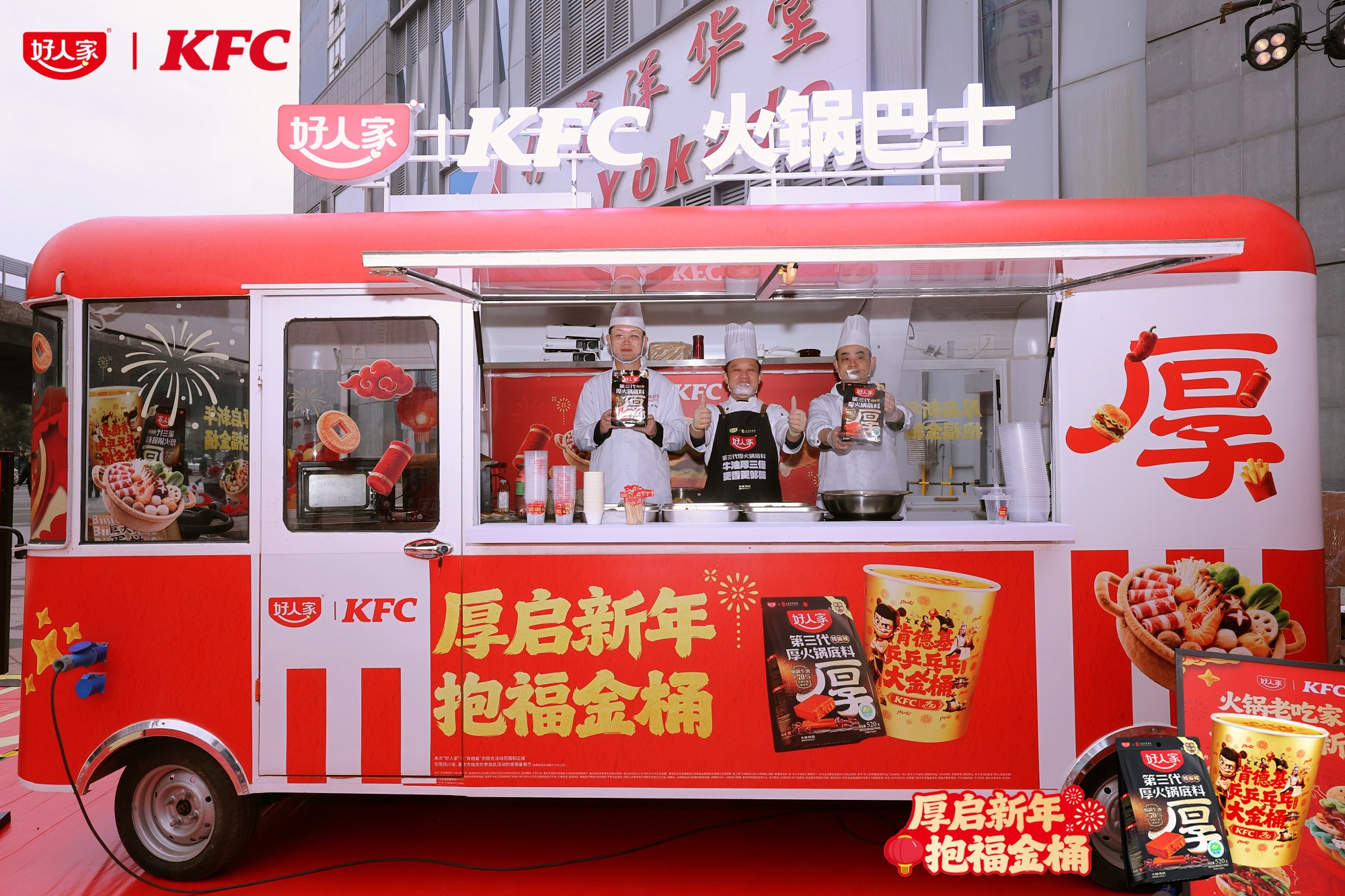
Core Viewpoint - The collaboration between KFC and the seasoning brand Haorenjia has successfully created a unique fusion of fast food and traditional hot pot flavors, attracting significant consumer interest during the Chinese New Year period [1][5][13]. Group 1: Event Highlights - The event featured innovative food items such as the "Ears of Folded Root Burger" and "Shrimp Slipper Spicy Egg Tart," which combined traditional hot pot ingredients with fast food offerings, generating excitement among consumers [1][5]. - A giant burger, measuring 15cm in diameter and filled with various hot pot ingredients, became a social media sensation, driving foot traffic to the KFC store [1][5]. - The event atmosphere was enhanced by interactive games and themed decorations, creating a festive environment that resonated with the Chinese New Year spirit [5][9]. Group 2: Brand Collaboration - The partnership between KFC and Haorenjia is characterized by a deep understanding of local consumer preferences, allowing for a creative and culturally relevant dining experience [13][15]. - The collaboration aims to break traditional market competition by merging fast food with hot pot, appealing to younger demographics and enhancing brand visibility [13][15]. - A new customized product is set to launch in 2026, indicating a long-term commitment to innovation and collaboration between the two brands [15]. Group 3: Consumer Engagement - The event attracted over 30,000 visitors in a single day at the themed store, with a total of over 90,000 people engaged through various promotional activities [9]. - The campaign's success is reflected in the viral social media discussions surrounding the collaboration, indicating strong consumer interest and engagement [5][9]. - The initiative has effectively positioned Haorenjia's hot pot base as a staple in more households during the festive season, enhancing brand penetration [9].
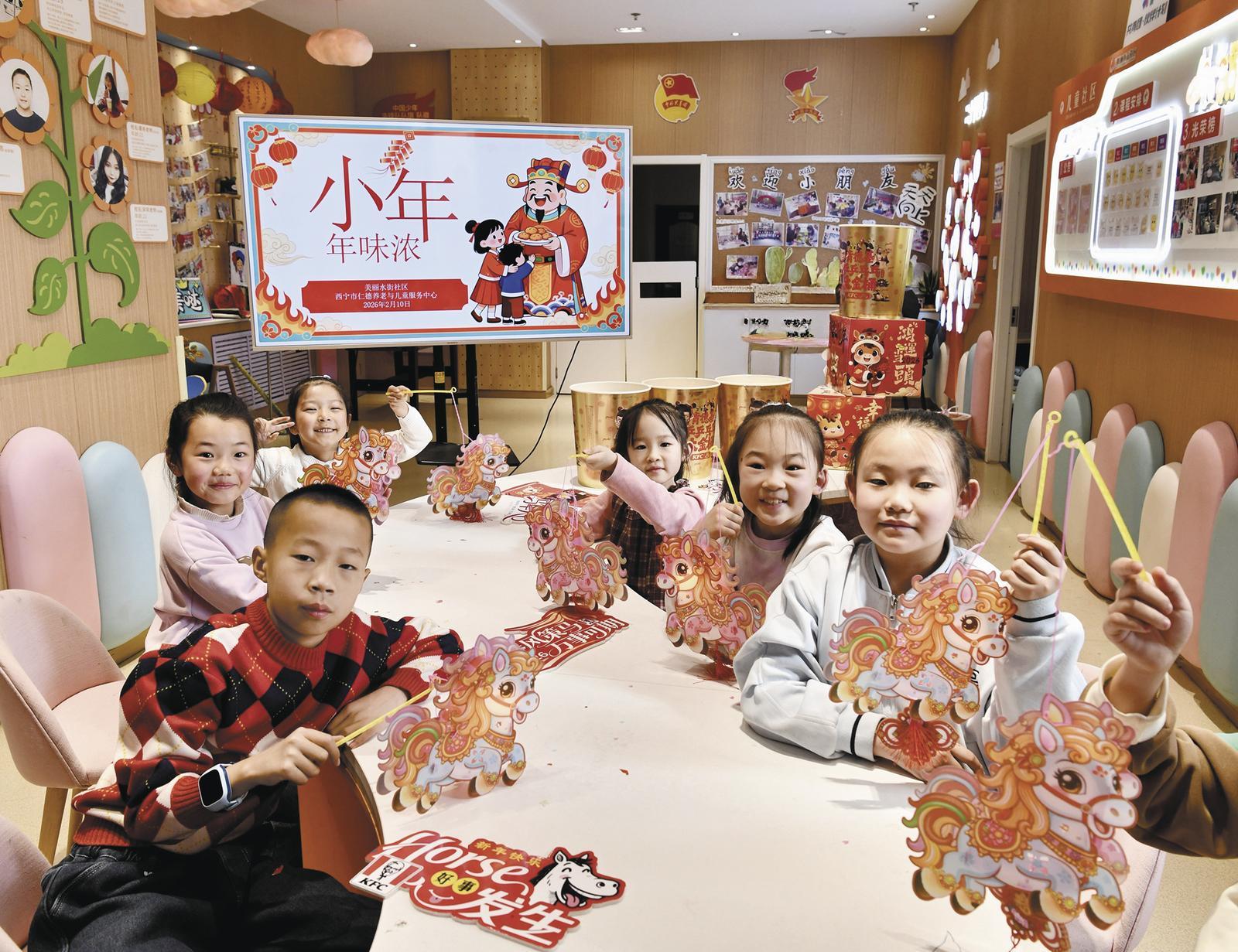
感受浓浓年味 乐享幸福生活
Xin Lang Cai Jing· 2026-02-10 20:04
Group 1 - The community in Xining's Chengbei District collaborated with KFC to host a "New Year Initiation: Small Year Folk Customs Classroom" event, engaging children in traditional customs and New Year etiquette [1] - The event included hands-on activities such as lantern making and sharing food, culminating in children writing down their New Year wishes and growth goals [1] Group 2 - The Delingha City in Haixi Mongolian and Tibetan Autonomous Prefecture held a "Tree of Life Market" themed "Fireworks in Kelukor, the Most Human Flavor," featuring fresh fruits and local snacks, alongside cultural activities like free Spring Festival couplet writing [2] - The event aimed to leverage the popularity of the TV series "Tree of Life" to attract consumer interest and boost local economic development, allowing attendees to experience the festive atmosphere while shopping for New Year goods [2] Group 3 - The Women's Federation of Xining organized community volunteers to provide services such as cleaning and cooking for over 50 underprivileged families, delivering warmth and care during the festive season [4] - The initiative reflects the commitment of volunteers to bring comfort and support to the community, enhancing the sense of care from the government and the joy of the New Year [4]