
白云山

Search documents
广州为国企民企搭建资源对接平台促双方发展
Sou Hu Cai Jing· 2026-01-30 09:02
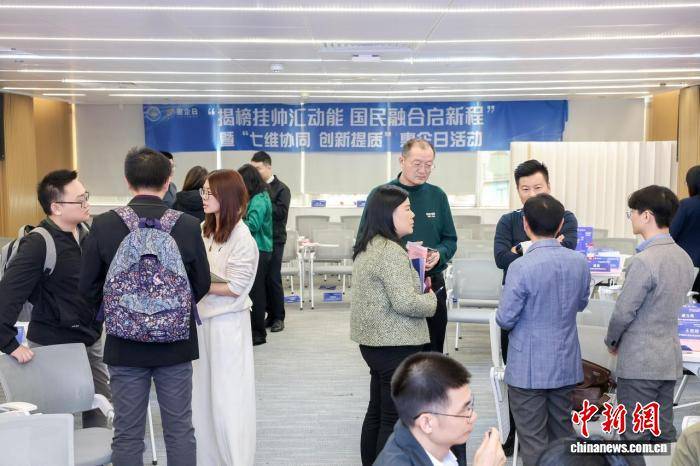
Group 1 - The event "Unveiling the Banner and Leading the Energy, National Integration Starts a New Journey" was co-hosted by the Guangzhou Federation of Industry and Commerce and the Guangzhou State-owned Assets Supervision and Administration Commission, aimed at creating an efficient platform for cooperation between state-owned enterprises (SOEs) and private enterprises (PEs) [1][4] - The event focused on 12 "unveiling" demand projects from 10 key SOEs, aligning with the cooperation intentions of PEs, facilitating close communication between supply and demand sides [3][4] - Five key SOEs, including Guangzhou Pharmaceutical Group and Guangzhou Construction Group, presented specific demands in fields such as biomedicine, high-end equipment manufacturing, and artificial intelligence, while the remaining SOEs engaged in precise matching through on-site discussions [3][4] Group 2 - The private enterprise roadshow highlighted innovative companies like Guangzhou Lido Robot Intelligent Technology Group and Guangdong Yushun Digital Technology, showcasing their customized solutions and technical capabilities in niche areas [3] - Guangzhou Lido Robot presented its self-developed vacuum negative pressure climbing robot, emphasizing safety performance improvements and cost control solutions for high-rise building construction [3] - Guangdong Yushun Digital Technology focused on digital transformation needs of SOEs, offering comprehensive digital solutions and AI technology applications, which received broad recognition from SOE representatives [3][4] Group 3 - The event facilitated in-depth discussions between SOE and PE representatives, fostering a consensus on cooperation and creating a direct and efficient communication platform [4] - The organizers plan to establish a long-term mechanism for "demand release - precise matching - project implementation - follow-up service" to ensure continuous and effective cooperation between SOEs and PEs [4]


2025年中国中成药产量为181.4万吨 累计下降7.7%
Chan Ye Xin Xi Wang· 2026-01-29 03:50
知前沿,问智研。智研咨询是中国一流产业咨询机构,十数年持续深耕产业研究领域,提供深度产业研 究报告、商业计划书、可行性研究报告及定制服务等一站式产业咨询服务。专业的角度、品质化的服 务、敏锐的市场洞察力,专注于提供完善的产业解决方案,为您的投资决策赋能。 2020-2025年中国中成药产量统计图 数据来源:国家统计局,智研咨询整理 上市企业:云南白药(000538),同仁堂(600085),片仔癀(600436),白云山(600332),太极集团 (600129),东阿阿胶(000423),九芝堂(000989),贵州百灵(002424),葵花药业(002737),吉林敖 东(000623) 相关报告:智研咨询发布的《2026-2032年中国中成药行业发展形势分析及产业前景规划报告》 根据国家统计局数据显示:2025年12月中国中成药产量为19.4万吨,同比增长2.1%;2025年中国中成药 累计产量为181.4万吨,累计下降7.7%。 ...

中成药即将告别“尚不明确”
Ke Ji Ri Bao· 2026-01-29 02:17
Core Viewpoint - The implementation of the new regulation by the National Medical Products Administration (NMPA) will phase out traditional Chinese medicine (TCM) products with ambiguous safety information, marking a significant shift towards quality over quantity in the TCM industry [1][4]. Group 1: Regulation Impact - The new regulation, referred to as the "life and death clause" for TCM, will take effect on July 1, 2026, and will disallow re-registration of TCM products that have any safety information marked as "unclear" after a three-year grace period [1][4]. - Over 70% of the approximately 57,000 approved TCM products currently have safety information issues, which will lead to a significant reduction in market products, estimated at 30%-40% [2][4]. Group 2: Consumer Safety - Existing TCM products, such as Ban Lan Gen and Lianhua Qingwen, will not be directly affected by the new regulation, allowing consumers to continue using them [3]. - Companies are proactively investing in post-marketing safety evaluations to ensure compliance with the new standards before the deadline [3]. Group 3: Industry Transformation - The regulation signifies a transition for the TCM industry from a focus on quantity to prioritizing quality, with an expected 20%-30% of TCM approvals likely to exit the market in the next 3-5 years [4]. - The cost of compliance for companies may increase due to the need for safety evaluations, but this is not expected to lead to widespread price hikes for TCM products [5][6]. Group 4: Market Dynamics - The market concentration is expected to increase as low-market-share products exit, allowing leading companies to fill the gap with quality products [6]. - The NMPA has established communication mechanisms to support companies in their research efforts and expedite the review process for critical products [6].
超4万批文面临出清考验 中药即将告别“尚不明确〞
Zhong Guo Jing Ji Wang· 2026-01-29 00:58
Core Viewpoint - The new regulation from the National Medical Products Administration (NMPA) will eliminate ambiguous safety information in traditional Chinese medicine (TCM) product labels, significantly impacting over 70% of existing TCM approvals by 2026 [1][2]. Group 1: Background and Current Situation - The regulation, referred to as the "life and death clause" for TCM, will take effect on July 1, 2026, and aims to address the lack of safety information in TCM product labels [1]. - Currently, there are approximately 57,000 approved TCM products in China, with over 40,000 labels indicating "unclear" safety information in categories such as contraindications and adverse reactions [2]. Group 2: Impact on TCM Products - The regulation is expected to reduce the number of marketable TCM products by 30%-40%, primarily affecting those with unclear clinical value and high safety risks [2]. - Existing products on the market, such as Ban Lan Gen and Lianhua Qingwen, will not be directly affected and can continue to be used by consumers [3]. Group 3: Industry Transformation - The regulation signifies a shift in the TCM industry from quantity expansion to quality prioritization, addressing issues of low clinical value and redundancy among TCM products [4]. - An estimated 20%-30% of TCM approvals may exit the market in the next 3-5 years due to the new registration requirements [4]. Group 4: Cost Implications for Companies - Companies will face increased research costs to comply with the new safety evaluation requirements, which can range from hundreds of thousands to millions of yuan per product [6]. - Despite the increased costs, experts believe that this will not lead to a significant rise in TCM prices due to market competition and the potential for cost dilution through scale production [7]. Group 5: Long-term Industry Outlook - The regulation is seen as a necessary step for the modernization of TCM, aligning with international practices for drug safety information [7]. - The NMPA has established communication mechanisms and support channels to assist companies in meeting the new requirements, particularly for urgently needed products [7].
热点回应丨超4万批文面临出清考验 中药即将告别“尚不明确〞
Ke Ji Ri Bao· 2026-01-28 15:06
Core Viewpoint - The new regulation from the National Medical Products Administration (NMPA) will eliminate ambiguous safety information in traditional Chinese medicine (TCM) product labels, significantly impacting over 70% of existing TCM approvals by 2026 [1][2]. Group 1: Background and Purpose of the Regulation - The regulation aims to address the safety information gaps in TCM product labels, promoting high-quality development in the TCM industry [2]. - Approximately 57,000 TCM approvals exist in China, with over 40,000 labels indicating "not clear" for contraindications, adverse reactions, or precautions [2]. - The regulation will primarily affect TCM products with unclear clinical value and high safety risks, as well as traditional formulations lacking modern research data [2]. Group 2: Impact on Existing Products - Current TCM products in circulation, such as Ban Lan Gen and Lianhua Qingwen, will not be directly affected, allowing consumers to continue using them [3]. - The regulation applies to the re-registration process, meaning existing stock can still be sold legally [3]. - Leading companies like Yiling Pharmaceutical and Baiyunshan Pharmaceutical Group are proactively investing in post-market safety evaluations to meet the new standards [3]. Group 3: Industry Transformation - The regulation signifies a shift in the TCM industry from quantity expansion to quality prioritization, addressing issues of low clinical value and redundancy among TCM products [4]. - An estimated 20%-30% of TCM approvals may exit the market in the next 3-5 years due to the new standards [4]. Group 4: Cost Implications for Companies - Companies may face increased research costs for safety evaluations, typically ranging from hundreds of thousands to millions of yuan per product [6]. - However, this is not expected to lead to significant price increases for TCM products due to market competition and the potential for cost dilution through scale production [6]. - The top 100 TCM products account for over 60% of the market share, indicating that leading companies with solid research foundations can manage the costs effectively [6]. Group 5: Support Mechanisms - National and provincial drug regulatory authorities have established communication mechanisms and green channels to support companies in conducting necessary research and expedite the review of supplementary applications for urgently needed products [7].
白云山(00874.HK)获LSV Asset Management增持11.8万股
Ge Long Hui· 2026-01-28 13:05
Group 1 - LSV Asset Management increased its stake in Guangzhou Baiyunshan Pharmaceutical Holdings Company Limited (00874.HK) by purchasing 118,000 shares at an average price of HKD 18.7863 per share, totaling approximately HKD 2.2168 million [1] - Following the acquisition, LSV Asset Management's total shareholding rose to 13.2692 million shares, increasing its ownership percentage from 5.98% to 6.03% [1]

粤两会聚焦生物医药 全链条施策培育新质生产力
Zhong Guo Xin Wen Wang· 2026-01-28 08:50
Core Insights - Guangdong is intensifying its focus on the biopharmaceutical industry, leveraging policy benefits and innovation, but still faces deep-seated bottlenecks in R&D, commercialization, market access, and internationalization [1] Group 1: Innovation Mechanisms - The biopharmaceutical R&D process is characterized by high investment, long cycles, and significant risks, necessitating a more inclusive and precise innovation mechanism [1] - A typical original drug takes an average of 12 years from compound selection to market, with R&D costs exceeding $2 billion and a clinical trial failure rate of 90%, highlighting the need for a fault-tolerant mechanism [1] - Establishing a fault-tolerant mechanism could effectively encourage pharmaceutical companies to explore and innovate while maintaining stable growth [1] Group 2: Financial Support and Risk Compensation - A proposal for a provincial biopharmaceutical innovation risk compensation fund aims to provide subsidies for failed R&D projects and support companies purchasing clinical trial insurance [2] - Encouragement for banks to offer credit support to companies with fault-tolerant records and to pilot asset securitization for fault-tolerant projects in Guangzhou and Shenzhen [2] Group 3: Technology and Industry Integration - Emphasis on creating a source of original innovation by leveraging national laboratories and addressing major disease prevention and core technology needs [2] - Increased support for AI-driven innovative drug projects and precise funding for the discovery of original drugs to enhance the global competitiveness of Guangdong's pharmaceutical companies [2] Group 4: Market Access and Internationalization - The importance of market access and internationalization for high-quality industry development is highlighted, with suggestions to utilize the Guangdong-Hong Kong-Macao Greater Bay Area to enhance internationalization levels of pharmaceutical companies [2] - Recommendations to establish a GLP platform recognized internationally to support local pharmaceutical companies in Hong Kong and Macao [2] Group 5: Regulatory and Legal Framework - Proposal to include the Hengqin Guangdong-Macao Deep Cooperation Zone in the "Healthy China" pilot area, allowing for the use of drugs and medical devices already approved in Hong Kong and Macao [3] - Suggestions for establishing a collaborative mechanism for international trademark disputes, integrating resources from various departments to support companies in legal matters [3]
2025GDP十强预测实锤!京沪破5万亿断层领跑,苏州紧追广州,增速之王是它?
Sou Hu Cai Jing· 2026-01-28 08:15
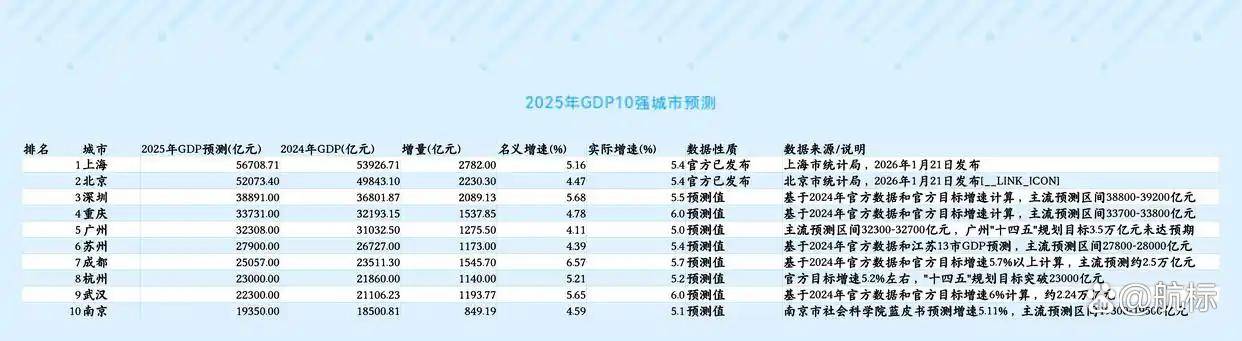
Core Insights - The competition landscape for China's urban GDP in 2025 has become clearer with the release of data, revealing the top ten cities in terms of GDP rankings [1] Group 1: Top Cities and GDP Predictions - Shanghai ranks first with a GDP of 56,708.71 billion yuan, showing a nominal growth rate of 5.16% and a real growth rate of 5.4%, driven by advancements in hard technology and a strong port trade [2][4] - Beijing follows with a GDP of 52,073.40 billion yuan, achieving a nominal growth of 4.47% and a real growth of 5.4%, supported by significant R&D investment and a thriving financial sector [4] - Shenzhen ranks third with a GDP of 38,891 billion yuan, boasting the highest nominal growth rate of 5.68%, fueled by a robust private sector and innovation in electric vehicles [6] Group 2: Mid-Tier Cities and Their Growth Strategies - Chongqing holds the fourth position with a GDP of 33,731 billion yuan and a real growth rate of 5.1%, benefiting from a comprehensive industrial system and increased freight activity [8] - Guangzhou, in fifth place with a GDP of 32,308 billion yuan, is focusing on transforming its economy towards technology and manufacturing, but faces competition from Shenzhen and Chongqing [8] - Suzhou, ranked sixth with a GDP of 27,900 billion yuan, has a growth rate of 5.5%, driven by high-tech industries, although it needs to enhance its service sector [10] Group 3: Emerging Cities and Economic Contributions - Chengdu, with a GDP of 25,057 billion yuan and a growth rate of 6.57%, is seeing significant contributions from the consumer sector and high-tech industries [10] - Hangzhou's GDP reached 23,000 billion yuan, with a focus on digital economy, but it faces challenges in industrial strength [11] - Wuhan, with a GDP of 22,300 billion yuan and a growth rate of 6.0%, is rapidly advancing in the electric vehicle sector and optical electronics [11] Group 4: Overall Trends and Future Outlook - The competition among cities is intensifying, with a clear shift towards innovation and manufacturing as key growth drivers [11] - The dominance of Beijing and Shanghai is expected to remain stable in the short term, while cities like Suzhou and Chengdu are positioned for potential upward mobility [11]
空中看广州!广州塔、白云山等地标将设垂直起降点
Zhong Guo Xin Wen Wang· 2026-01-28 06:46
Group 1 - Guangzhou aims to develop the low-altitude economy by establishing vertical take-off and landing points at iconic locations such as the Canton Tower and Baiyun Mountain, promoting the "Aerial View Guangzhou" product to enhance urban life and economic development [1] - The city plans to create a comprehensive airspace system that includes applications for air transportation, low-altitude logistics, cultural tourism experiences, and emergency rescue, focusing on iterative upgrades and regular commercial operations [1] - Artificial intelligence and low-altitude economy are recognized as strategic emerging industries in China's national layout and are included in Guangzhou's "12218" modernization industrial system [1] Group 2 - Guangzhou will implement the "AI+" initiative to cultivate "AI + industry" solution companies and establish a comprehensive AI space platform, including empowerment centers and high-value parks [2] - The city plans to launch a series of major platforms, such as the aerospace intelligent manufacturing base and the low-altitude comprehensive hub project in the Guangdong-Hong Kong-Macao Greater Bay Area, to promote industrial clustering and development [2] - Investment funds for the AI and aerospace industries have been established to enhance the effectiveness of investment across the entire lifecycle and industry system, creating a multi-level investment fund matrix [2] Group 3 - New local regulations will be introduced to promote the development of artificial intelligence and low-altitude economy, providing targeted support for enterprises at different scales and development stages in areas such as project layout, scene opening, talent introduction, financing support, and market expansion [3]
广州市市长孙志洋:广州塔、白云山将设eVTOL垂直起降点
Xin Lang Cai Jing· 2026-01-28 05:47
Core Viewpoint - Guangzhou is set to introduce local regulations to promote artificial intelligence and low-altitude economy, along with various supportive policies for enterprises at different stages of development [1] Group 1: Policy Initiatives - The city will implement regulations for artificial intelligence development and low-altitude economy [1] - A series of policies will be introduced, including AI + industry application plans and low-altitude flight infrastructure planning [1] - Support will be categorized based on enterprise size and development stage, focusing on project layout, scenario opening, talent introduction, financing support, and market expansion [1] Group 2: Infrastructure Development - Guangzhou aims to accelerate the construction of major platforms such as the Guangdong-Hong Kong-Macao Greater Bay Area Aerospace Manufacturing Base and Huangpu Aerospace Manufacturing Equipment Park [1] - The city will promote the development of a comprehensive low-altitude hub project in the Greater Bay Area [1] - Plans include building a world-class low-altitude industrial ecosystem that integrates flight testing, promotion, manufacturing, and certification [1] Group 3: Application Scenarios - The city will develop a comprehensive unmanned system for all-space scenarios, enhancing applications in air traffic, low-altitude logistics, cultural tourism experiences, and emergency rescue [1] - Focus will be on the commercialization of eVTOL business models, creating clusters such as flight camps [1] - Iconic locations like Guangzhou Tower and Baiyun Mountain will feature vertical take-off and landing points, launching products like "Aerial View of Guangzhou" to integrate low-altitude economy into daily life and economic development [1]