陶氏公司

Search documents
美国半导体技术霸权的底层支撑与中国突围
是说芯语· 2026-01-03 00:52
Core Viewpoint - The article discusses the absolute monopoly of the United States in the semiconductor industry, highlighting the dominance in core technologies such as design tools, high-end IP cores, advanced architectures, key manufacturing equipment, and testing instruments. This monopoly creates significant barriers to entry and establishes a comprehensive technological hegemony that is difficult to challenge globally, while also leaving room for diversification and breakthroughs in specific fields, particularly in China's domestic semiconductor industry [1]. Group 1: Chip Design Tools (EDA) - The monopoly is held by Synopsys, Cadence, and Siemens EDA, which together account for over 95% of the global market share, providing a comprehensive toolchain for chip design [3]. - These tools are essential for advanced process nodes of 7nm and below, featuring capabilities such as lithography simulation and yield optimization, making them critical infrastructure for chip development [3]. - The high density of patent barriers and deep collaboration with leading foundries like TSMC and Samsung create strong user ecosystem stickiness, making it difficult for latecomers to replace these tools [3]. Group 2: High-Performance IP Cores and Architectures - The monopoly is dominated by X86 architecture (Intel, AMD), GPU architecture (NVIDIA, AMD), and AI acceleration IP (NVIDIA, Xilinx), with ARM's technology also heavily influenced by U.S. regulations [6]. - The X86 architecture leads in high-performance computing, while NVIDIA's CUDA architecture defines global AI computing standards, creating dual barriers of performance and ecosystem [6]. - Global chip design companies are highly dependent on U.S. IP, and the U.S. can restrict access to these IPs through licensing, directly impacting the design capabilities of other nations [6]. Group 3: Key Manufacturing Equipment - The monopoly is held by U.S. companies like Applied Materials, Lam Research, and KLA, which lead in critical equipment for etching, film deposition, and process inspection [9]. - These companies provide essential technologies for advanced processes, with high barriers to entry due to long R&D cycles and significant capital investment [9]. - The dependency of global foundries like TSMC and Samsung on U.S. equipment means that U.S. export controls can directly affect the expansion and technological upgrades of advanced manufacturing capacities [9]. Group 4: High-End Chip Design and Architecture Innovation - U.S. companies like NVIDIA, Qualcomm, AMD, and Apple dominate the global technology direction in AI chips, mobile terminal chips, and high-performance computing chips [12]. - Continuous high R&D investment (approximately 17.7% of semiconductor industry revenue) and strong ecosystem integration capabilities allow these companies to maintain significant advantages [12]. - The U.S. leads in defining the demand and technological evolution of high-end chips, influencing the global semiconductor supply chain [12]. Group 5: Semiconductor Testing and Packaging Technologies - The monopoly is held by U.S. companies like Teradyne and Cohu, which dominate the high-end chip testing equipment market [15]. - These companies provide comprehensive testing solutions that meet the high precision requirements of advanced process nodes [15]. - The global chip production's yield control and quality assurance are highly reliant on U.S. testing equipment, and export restrictions can impact production efficiency and quality stability [15]. Group 6: Core Materials Technology - U.S. companies like Dow Chemical, DuPont, and GlobalFoundries dominate the market for critical semiconductor materials such as photoresists and electronic specialty gases [18]. - The high purity and stability requirements for semiconductor materials create significant barriers for new entrants [18]. - Advanced process chip manufacturing relies over 80% on U.S. core materials, and U.S. export controls can directly affect global production capacities [18]. Group 7: Semiconductor Software and Ecosystem - U.S. companies like Microsoft, Google, and NVIDIA dominate the software ecosystem that supports chip applications [21]. - The NVIDIA CUDA ecosystem monopolizes AI training and inference software, with over 90% of AI developers using the CUDA platform [21]. - The strong network effects of these ecosystems create significant barriers for new entrants, making it difficult for other countries to commercialize breakthroughs in high-performance chip development [21]. Group 8: Industry Standard Setting Authority - The U.S. leads international standard organizations like IEEE and JEDEC, controlling the core industry standards for chip interfaces and performance specifications [24]. - The binding of industry standards with technology patents creates dual barriers that are difficult for non-U.S. companies to overcome [24]. - The U.S. can guide global semiconductor technology development through standard-setting, impacting the innovation paths of non-U.S. enterprises [24]. Group 9: High-End Semiconductor Products and Solutions - U.S. companies like NVIDIA, Intel, Qualcomm, and Micron hold a dominant share in the global high-end semiconductor product market [27]. - These companies have established significant performance advantages through long-term technological accumulation and deep integration with downstream manufacturers [27]. - The global technology industry is highly dependent on U.S. semiconductor products, and U.S. export controls can directly influence the development of global technology sectors [27].



Dogs Of The Dow: 10 High-Yield Stocks With Dividends Up To 6.8% - Including Several Warren Buffett Favorites
Benzinga· 2026-01-02 22:06
Core Viewpoint - The Dow Jones Industrial Average reached record highs in 2025, with many components showing positive performance, and it continues to be a significant source of high-yielding blue-chip stocks as it heads into 2026 [1]. Group 1: Dividend Stocks Overview - Of the 30 components in the Dow Jones Industrial Average, 28 currently pay dividends, making it a viable option for investors seeking dividend stocks [2]. - The average dividend yield of the top 10 payers in the index is 3.3% at the start of 2026 [4]. - The overall average dividend yield of the Dow Jones Industrial Average is approximately 1.9% at the start of 2026, down from 2% at the start of 2025 [9]. Group 2: High-Yielding Stocks - The highest-yielding stocks in the Dow include Verizon (6.8% yield), Chevron (4.5% yield), and Merck (3.2% yield), with varying stock performances in 2025 [7]. - Notably, four of the highest-yielding stocks were down in 2025, while six were up, indicating mixed performance among top yielders [5]. - Companies like UnitedHealth, Nike, and Procter & Gamble rank among the highest yielding but also appeared in the list of the worst-performing stocks in 2025 [5]. Group 3: Recent Changes in the Index - The Dow Jones Industrial Average has seen changes in its components, including the addition of Amazon in February 2024 and NVIDIA and Sherwin-Williams in November 2024 [6]. - Amazon and Boeing are the only stocks in the index that do not pay dividends, while NVIDIA has the lowest yield among dividend-paying stocks [8].



Dow Jones 2025 Scorecard: Caterpillar, Nvidia Help Index Hit All-Time Highs – Top 5 Winners & Losers
Benzinga· 2026-01-02 21:17
Core Insights - The Dow Jones Industrial Average reached new all-time records in 2025, with President Donald Trump celebrating this achievement [1] Group 1: 2025 Performance Overview - In 2025, 23 out of 30 Dow Jones Industrial component stocks experienced gains, while 7 declined, marking an improvement compared to previous years where 18 stocks were up in 2024 and 19 in 2023 [2] - The overall performance of the Dow Jones Industrial Average was an increase of approximately 13% for the full year [3] Group 2: Top Gainers and Losers - The top five gainers in 2025 included: 1. Caterpillar: +59.5% 2. Goldman Sachs: +55.8% 3. Johnson & Johnson: +43.5% 4. NVIDIA: +40.2% 5. IBM: +39.1% [6] - The top five losers in 2025 included: 1. UnitedHealth Group: -35.0% 2. Salesforce: -20.4% 3. Nike: -19.1% 4. Procter & Gamble: -13.8% 5. Honeywell: -12.7% [6] Group 3: New Additions to the Index - Nvidia replaced Intel in the Dow Jones Industrial Average in November 2024, with Intel outperforming Nvidia in 2025, gaining over 90% [4] - Sherwin-Williams replaced Dow Inc. in November 2024, with Sherwin-Williams down 1.3% over the past year, while Dow stock fell more than 30% [5] - Amazon replaced Walgreens Boots Alliance, with Amazon shares up 4.8% in 2025 [6]



中国聚偏二氯乙烯(PVDC)行业销售投资及运作模式探讨报告2026-2032年
Sou Hu Cai Jing· 2025-12-31 02:02
Group 1 - The report discusses the sales investment and operational models of the polyvinylidene chloride (PVDC) industry in China from 2026 to 2032, highlighting market trends and forecasts [1][3] - It categorizes PVDC products into different types and applications, analyzing growth trends from 2021 to 2031 [3][4] - The report provides an overview of the current state of the PVDC industry, including development characteristics and influencing factors [4][6] Group 2 - Global supply and demand dynamics for PVDC are examined, with forecasts for production capacity, output, and utilization rates from 2021 to 2031 [4][5] - The report details the revenue and sales volume trends for PVDC in both global and Chinese markets, including market share analysis [5][6] - It analyzes the competitive landscape of the PVDC industry, identifying key players and their market shares [5][6] Group 3 - The report includes a detailed analysis of different product types and applications of PVDC, with projections for sales and revenue from 2021 to 2031 [6][10] - It discusses the industry development environment, including driving factors and policy analysis relevant to the PVDC sector in China [6][7] - The supply chain of the PVDC industry is outlined, covering procurement and production models [7][8]

What to Expect From Dow's Q4 2025 Earnings Report
Yahoo Finance· 2025-12-30 14:11
Company Overview - Dow Inc. has a market cap of $16.6 billion and operates as a global materials science company, providing innovative solutions across packaging, infrastructure, mobility, and consumer markets [1] - The company operates through three segments: Packaging & Specialty Plastics, Industrial Intermediates & Infrastructure, and Performance Materials & Coatings, offering a diverse portfolio of plastics, chemicals, coatings, and specialty materials [1] Financial Performance - Dow is set to announce its fiscal Q4 2025 results on January 29, with analysts expecting an adjusted loss of $0.45 per share [2] - For fiscal 2025, analysts project an adjusted loss of $1.03 per share, a significant decline from an adjusted EPS of $1.71 in fiscal 2024, but a rebound is anticipated in fiscal 2026 with an estimated 81.6% year-over-year improvement, narrowing the adjusted loss to $0.19 per share [3] Stock Performance - Over the past 52 weeks, Dow's stock has dropped 41.7%, underperforming the S&P 500 Index, which increased by 16.9%, and the State Street Materials Select Sector SPDR ETF, which rose by 7.7% [4] - Despite reporting weaker-than-expected Q3 2025 revenue of $9.97 billion, Dow's shares surged nearly 13% on October 23 due to a smaller-than-expected adjusted loss of $0.19 per share, attributed to strong cost discipline and higher volumes from new assets [5] Analyst Ratings - The consensus view among analysts on Dow stock is cautious, with an overall "Hold" rating; of the 20 analysts covering the stock, two recommend a "Strong Buy," 17 give a "Hold," and one has a "Strong Sell" [6] - The average analyst price target for Dow is $26.83, indicating a potential upside of 14.9% from current levels [6]

下游迭代加速:汽车、包装与家电需求变化重塑机铰式注塑机结构性机会
QYResearch· 2025-12-30 09:59
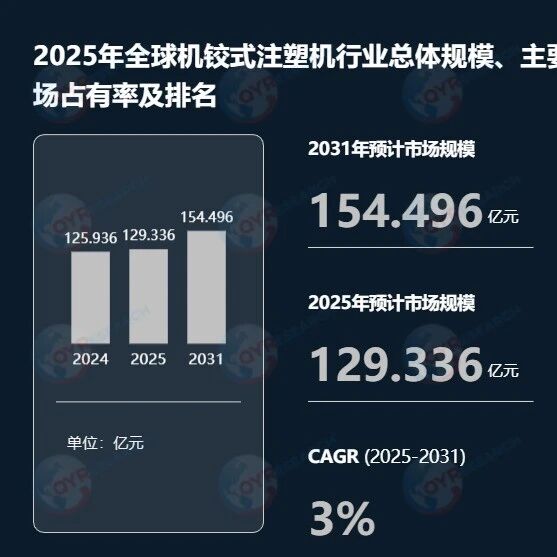
Core Viewpoint - The toggle-type injection molding machine is gaining traction due to its mechanical advantages over traditional hydraulic machines, including energy efficiency, reduced mold deformation, and faster cycle times, making it suitable for high-demand production environments [2][3]. Market Overview - The global market for toggle-type injection molding machines is projected to reach USD 1.902 billion in 2024, with a compound annual growth rate (CAGR) of 3% [3]. - Key manufacturers in the industry include Engel, Supermac Machinery, UBE Machinery Corporation, and others, focusing on various applications across automotive, packaging, medical, and industrial sectors [4]. Supply Chain Dynamics - The upstream supply chain consists of resin materials (e.g., PP, PE, ABS, PC) and essential components like steel, hydraulic oils, and servo motors, with suppliers such as BASF and Baowu Steel [6]. - The downstream applications span across automotive, home appliances, consumer electronics, and medical devices, with major clients including Toyota, Haier, and Foxconn [6]. Driving Factors - The demand for toggle-type injection molding machines is driven by the need for lightweight automotive components, rapid product iterations in consumer electronics, and the push for energy-efficient manufacturing processes [7]. - The transition from traditional hydraulic systems to servo-driven and automated solutions is enhancing production efficiency and stability [7]. Barriers to Entry - High capital expenditure and total cost of ownership (TCO) pressures, along with the need for precise assembly and maintenance capabilities, pose significant challenges for new entrants in the market [8]. - The complexity of the machinery and the requirement for a robust service network make it difficult for newcomers to compete effectively [10]. Industry Development Opportunities - Opportunities for growth are centered around enhancing energy efficiency, integrating automation, and expanding processing capabilities [9]. - The increasing demand for advanced materials and specialized applications in automotive and packaging sectors is expected to drive the adoption of high-end toggle machines [9]. Competitive Landscape - The competitive landscape is characterized by the need for system engineering capabilities, reliability validation, and a strong service network to meet customer expectations [10]. - Established players with a proven track record in quality and service are likely to maintain a competitive edge in the market [10].
商务部最新反倾销公告发布,涉及陶氏化学、阿朗新科、埃克森美孚、乐天等
DT新材料· 2025-12-29 16:05
Core Viewpoint - The article discusses the upcoming 2026 Future Industry New Materials Expo, focusing on the demand for lightweight, high-strength, and sustainable materials across various industries such as robotics, automotive, drones, data centers, aerospace, AI, and new energy sources [1][5]. Summary by Sections Anti-Dumping Measures - The Ministry of Commerce announced a review of anti-dumping measures on imports of ethylene-propylene rubber from the US, South Korea, and the EU, effective from December 20, 2025 [1]. - During the review period from July 1, 2024, to June 30, 2025, the same anti-dumping tax rates will continue to apply as per the 2020 announcement [2]. Anti-Dumping Tax Rates - The anti-dumping tax rates for various companies are as follows: - US companies: 222.0% for Dow Chemical, 214.9% for ExxonMobil, and 219.8% for both Arlanxeo US and other US companies [3]. - South Korean companies: 12.5% for Kumho Polychem, 21.1% for Lotte Chemical, and 24.5% for other South Korean companies [3]. - EU companies: 18.1% for Arlanxeo Netherlands, 14.7% for ExxonMobil Chemical France, and 31.7% for other EU companies [3]. Exhibition Details - The expo will feature six major exhibition areas, including a focus on lightweight, high-strength, and sustainable materials, highlighting innovations in carbon fiber, polymers, and modified plastics [1][4]. - Over 800 enterprises are expected to participate, showcasing advancements in new materials and technologies [5]. Industry Focus Areas - Key areas of focus at the expo include: - Robotics, smart vehicles, AI consumer electronics - Low-altitude aircraft, aerospace, deep-sea technology, rail transportation components - Quantum technology, 6G, brain-computer interfaces, computing power center server components - New energy equipment components, high-performance fibers and composite materials, and low-carbon sustainable materials [6].

My 2026 Market Outlook: Momentum Is Out, Selectivity Is In
Seeking Alpha· 2025-12-29 12:00
Core Insights - Investors achieved positive returns in 2025, with all three major indexes continuing to rally despite negative catalysts such as higher costs [1] Group 1: Market Performance - The major indexes have shown resilience and growth throughout the year, indicating a strong market performance [1] Group 2: Sector Focus - The analysis emphasizes the importance of timely and quick analysis of earnings and macro-related events, particularly in the retail and real estate sectors [1]



智者勇进 接续奋进新江苏|物质文明与精神文明协调发展,探寻县域现代化的“张家港坐标”
Yang Zi Wan Bao Wang· 2025-12-25 03:15
Core Viewpoint - Zhangjiagang is showcasing a modern county-level development model, integrating advanced manufacturing, cultural enrichment, and community service to achieve high-quality growth [1] Group 1: Industrial Development - Shagang Group has been recognized as a "national manufacturing single champion" due to its advanced ultra-thin strip production line, which reduces fuel consumption by 95%, water usage by 80%, and carbon emissions per ton of steel to just 25% of traditional processes [3] - The metallurgical new materials industry in Zhangjiagang, led by Shagang Group and Yongzhuo Holdings, has over 200 large-scale enterprises, projected to achieve an output value exceeding 220 billion yuan in 2024 [6] - The city is focusing on emerging sectors such as semiconductors, hydrogen energy, biomedicine, and artificial intelligence, aiming to build a modern industrial system with multiple billion-level innovation clusters [7] Group 2: Government Support and Business Environment - Zhangjiagang's government has implemented efficient services and parallel approvals, exemplified by the rapid progress of Dazhu Laser's East China regional headquarters project, achieving "nine certificates in one go" [8] - The city has been recognized for its innovative business environment, which has attracted over 120 foreign R&D centers and 20 headquarters, with significant investments from global giants like Dow Chemical [9] - A proactive investment attraction mechanism has been established, leading to 777 enterprise inspections and 87 project signings, attracting nearly 8 billion yuan in investments within a year [10] Group 3: Community and Social Development - Zhangjiagang has developed a "warm heart station" network for urban delivery workers, providing support and training, which fosters community engagement and volunteerism [11] - The city has been awarded the title of "civilized city" for seven consecutive years, reflecting its commitment to enhancing the quality of life through urban renewal and community services [12] - In 2024, the total assets of village collectives in the city are expected to reach 35.2 billion yuan, with an average operating income of 18.03 million yuan per village, indicating a strong foundation for shared prosperity [12]

Christmas Cheer Could Be in Store for the S&P 500 Index
Schaeffers Investment Research· 2025-12-23 17:52
Market Overview - The Dow Jones Industrial Average (DJI) and S&P 500 Index (SPX) experienced three consecutive losses due to a mix of Big Tech volatility and economic data, with Oracle's AI-triggered drawdown and Micron Technology's earnings impacting the market [1] - Despite the losses, the Nasdaq Composite (IXIC) and SPX managed to achieve weekly gains [1] Upcoming Economic Reports - A few delayed economic reports, including third-quarter gross domestic product (GDP) data, are expected to be released next week [2] - Historical data suggests that the Friday after Christmas often yields positive returns, indicating a potentially impressive week ahead [2] Historical Performance Data - Since 1950, the SPX has averaged a weekly return of 0.55% during Christmas week, with positive returns occurring almost 70% of the time [3][4] - This year, Christmas falls on a Thursday, a scenario that has occurred only nine times since 1950, with the following Friday averaging a return rate of 0.46% [3][5] Underperforming Stocks - CME Group (CME) is identified as the worst performer during Christmas week, failing to beat SPX returns for at least a decade, with an average return of -0.99% [7][8] - Old Dominion (ODFL) is the only other stock that has not succeeded in beating the SPX during Christmas week in the last 10 years [7] CME Group Analysis - CME Group's stock has struggled, showing a 16% increase in 2025 but a 4% decline in December [8] - The stock has not maintained breakouts above $280, and the 10-week moving average is adding pressure [8] - There is potential for downgrades as eight brokerages currently have a "buy" or better rating, which could lead to further headwinds if bullish sentiment declines [9] Options Trading Strategy - Current options trading conditions for CME Group may present an opportunity, as its Schaeffer's Volatility Index (SVI) of 18% is higher than just 14% of readings from the last year [10] - The Schaeffer's Volatility Scorecard (SVS) indicates that CME has consistently realized lower volatility than its options have priced in, suggesting a premium-selling strategy could be advantageous for options traders [10]