
智谱

Search documents
腾讯,最牛IPO捕手
投资界· 2026-02-02 07:08
Core Viewpoint - The article highlights Tencent's significant role in recent IPOs, marking a transition from the internet era to the AI era, with Tencent heavily investing in AI-related companies and exiting previous investments in traditional internet firms [2][10][12]. Group 1: Recent IPOs and Tencent's Involvement - Tencent has been a major shareholder in several recent IPOs, including MiniMax and Zhizhu, with MiniMax's market value exceeding 1,500 billion HKD and Zhizhu surpassing 1,000 billion HKD [2][3]. - Tencent's investment in Zhizhu during its B4 financing round amounted to 200 million, and it has also invested in MiniMax, resulting in substantial returns [4]. - Longxin Technology, another company backed by Tencent, is expected to raise 29.5 billion and is projected to reach a market value of over 1 trillion post-IPO [5][6]. Group 2: Tencent's Strategic Investments - Tencent holds a significant stake of 19.9493% in Suiruan Technology, making it the largest shareholder, and the company generates over 70% of its revenue from Tencent [6]. - In the case of Yunbao Intelligent, Tencent has increased its stake to 22.5351%, surpassing the founder's share [7]. - Tencent has also been a cornerstone investor in various upcoming IPOs, including Mingming and Dongpeng Beverage, showcasing its strategy of supporting multiple companies in the consumer sector [8][9]. Group 3: Transition to AI and Future Outlook - The article notes a parallel between Tencent and Alibaba, both of which are pivoting towards AI investments, with Alibaba also being a significant shareholder in companies like Zhizhu and MiniMax [10][11]. - Tencent's leadership has emphasized the importance of AI, with plans to focus investments in AI, hard technology, and healthcare sectors, indicating a strategic shift in their investment approach [12].



头部大模型厂商基本面更新与推荐
2026-02-02 02:22
Summary of Key Points from Conference Call Records Industry Overview - The large model industry has transitioned from the Chat paradigm to the Agent paradigm, with leading companies focusing on building native Agent capabilities rather than merely pursuing parameter scale [1][5] - Major internet companies are intensifying competition for AI super entry points, with Alibaba, ByteDance, and Tencent implementing various strategies to capture high-frequency traffic [1][8] Core Companies and Their Strategies Zhiyu (智谱) - Zhiyu has developed a full-stack large model technology and open-source strategy to build an industry ecosystem, with expected revenue reaching 700-800 million RMB by 2025, but it will not achieve profitability due to high R&D and delivery costs [3][12] - The company launched the AutoGLM model, which integrates deep research and operational capabilities, and updated its GLM 4 Air base model with 320 billion parameters, achieving performance comparable to Deepseek 1 with an 8x speed improvement [2][19] Minimax - Minimax has released its second-generation agent product, MiniMax Agent 2, which transforms the interaction logic from human adaptation to agent adaptation, enhancing its competitive edge [2][4] - The company is expected to achieve revenue close to 300 million RMB by 2025 and approximately 230 million USD by 2026, with a strong focus on C-end subscriptions and application in overseas markets [3][19] Kimi - Kimi has launched the Kimi 2.5 multimodal model, which can utilize up to 100 specialized agents to perform tasks in parallel, significantly lowering the AI interaction threshold [5][6] Deepseek - Deepseek focuses on niche technological breakthroughs, particularly in OCR and visual processing, to differentiate itself in the market [6][7] Competitive Landscape - The competition among leading large model companies is becoming increasingly differentiated, with a focus on high-level reasoning capabilities, native multimodality, and collaborative execution of complex tasks [3][6][14] - Companies are moving beyond pure technical competition to consider technology, product, ecosystem, and implementation capabilities [7][15] Market Trends and Predictions - By 2028, it is expected that 60% of systems will support multi-vendor interoperability, transitioning from single-platform to agent internet systems, although cost and user experience remain constraints [10] - The market for MaaS (Model as a Service) is projected to reach a penetration rate of 70% in China by 2030, with companies like Zhiyu leveraging their API and cloud services to adjust their revenue structure [19] Challenges and Opportunities - Independent large model companies like Zhiyu and Minimax face challenges in achieving a leading position in high-level reasoning and multimodal engineering, requiring significant R&D investment and rapid product iteration [15][16] - The competition for entry points among major internet companies poses a risk of winner-takes-all scenarios, particularly if they establish one or two super entry points by 2026-2027 [15][16] Financial Performance - Minimax's performance is driven by C-end subscriptions and application fees, with a significant increase in active users and ARPU from 6 USD to 15 USD [19][20] - Zhiyu is the largest large model startup in China by revenue, with a focus on local deployment and cloud business as growth engines, while also expanding into international markets to mitigate domestic pricing wars and policy risks [20]
港股AI大模型概念股表现亮眼 MINIMAX-WP(00100.HK)涨15%
Mei Ri Jing Ji Xin Wen· 2026-02-02 02:00
每经AI快讯,AI大模型概念股表现亮眼。截至发稿,MINIMAX-WP(00100.HK)涨15.22%,报545港元; 智谱(02513.HK)涨6.1%,报240港元。 ...
AI大模型概念股表现亮眼 MINIMAX-WP暴涨15% 智谱涨近7%
Zhi Tong Cai Jing· 2026-02-02 01:53
Core Viewpoint - AI large model concept stocks have shown strong performance, with MINIMAX-WP rising by 15.22% to 545 HKD and Zhiyuan increasing by 6.1% to 240 HKD [1] Group 1: Company Developments - MiniMax has launched desktop and "expert agents," creating a closed loop between agents and local work environments [1] - The AI Agent sector is experiencing a "toolization" explosion, with the release of Kimi2.5 by Moon's Dark Side, which achieves advanced office automation through agent clusters [1] - The open-source project Clawdbot has gained attention for enabling personal AI assistants to run on local Macs or servers [1] Group 2: Market Trends - Guangfa Securities has noted that as the commercial value of AI-assisted programming tools for enhancing R&D efficiency and optimizing business processes becomes recognized, enterprise users are likely to increase their willingness to pay for software development, data analysis, and business process automation scenarios [1] - Domestic AI large models are expected to benefit from this trend, achieving better commercialization [1]
港股异动 | AI大模型概念股表现亮眼 MINIMAX-WP(00100)暴涨15% 智谱(02513)涨近7%
智通财经网· 2026-02-02 01:51
Group 1 - The core viewpoint of the article highlights the strong performance of AI large model concept stocks, with MINIMAX-WP rising by 15.22% to 545 HKD and Zhiyu (智谱) increasing by 6.1% to 240 HKD [1] - MiniMax has launched desktop and "expert agents," creating a closed loop between agents and local work environments, indicating advancements in AI technology [1] - The AI Agent sector is experiencing a "toolization" explosion, with the release of Kimi 2.5 enabling high-level office automation through agent clusters [1] Group 2 - The open-source project Clawdbot has gained attention for enabling personal AI assistants to run on local Macs or servers, showcasing the growing interest in AI tools [1] - Guangfa Securities has noted that as the commercial value of AI-assisted programming tools becomes recognized, enterprise users are likely to increase their willingness to pay for software development, data analysis, and business process automation [1] - Domestic AI large models are expected to benefit from this trend, achieving better commercialization outcomes [1]
DeepSeek之后,智源大模型登Nature:事关“世界模型”统治路线
3 6 Ke· 2026-02-02 00:22
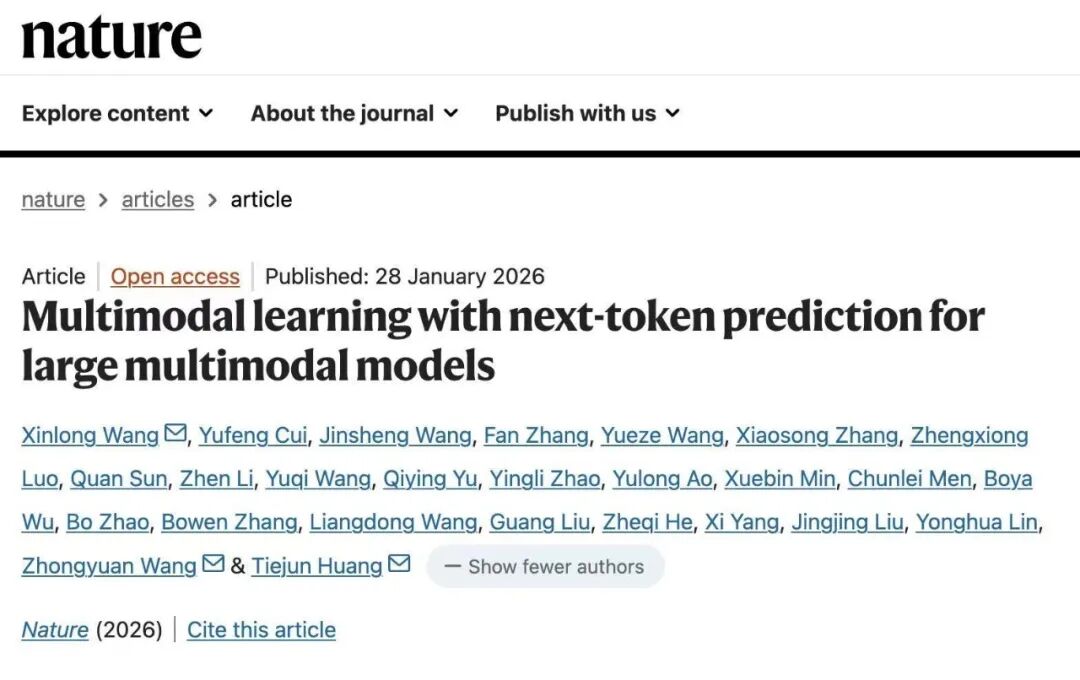
Core Insights - The core achievement of the "Wujie·Emu" multimodal model is its publication in Nature, marking it as the second Chinese large model team to achieve this milestone, and the first paper focused on multimodal models from China [1][3]. Group 1: Model Performance and Capabilities - Emu3 demonstrates unified learning across text, image, and video modalities, achieving performance comparable to specialized models in generation and perception tasks [3][10]. - In image generation, Emu3 scored 70.0, outperforming SD-1.5 (59.3) and SDXL (66.9) [4]. - For video generation, Emu3 achieved a score of 81.0 on VBench, surpassing Open-Sora 1.2 [4]. - In visual language understanding, Emu3 scored 62.1, slightly higher than LLaVA-1.6 (61.8) [4]. Group 2: Technical Innovations and Development - Emu3 is based on a simple architecture that relies solely on the "next-token prediction" method, which is seen as having strong scalability potential [4][10]. - The model was developed by a dedicated team of 50, focusing on a unified approach to multimodal learning, which simplifies the complexity of model development [10][12]. - Emu3's architecture integrates visual and textual data into a single representation space, allowing for efficient training on multimodal sequences [10][12]. Group 3: Industry Impact and Future Prospects - Since its release, Emu3 has significantly influenced the multimodal field and has been widely recognized and applied in the industry [13]. - The model's performance has positioned it as a competitive alternative to leading diffusion models and has opened new pathways for the development of physical AI and embodied intelligence [6][34]. - The upcoming Emu3.5 is expected to further enhance capabilities, including understanding long sequences and simulating exploration in virtual environments [6][34]. Group 4: Research and Development Background - The development of Emu3 began in February 2024, amidst a reassessment of the paths for large model development, particularly in the context of the success of models like GPT-4 [8][10]. - The research team faced significant technical challenges, including the need to create a new language system aligned with human language for visual data [12][40]. - The commitment to a unified multimodal approach reflects a belief that achieving AGI requires models that can understand and interact with the physical world [12][40].

国产大模型密集上新工程化闯关还有三道坎
Mei Ri Jing Ji Xin Wen· 2026-02-01 13:08
Core Insights - Recent updates from multiple domestic large model manufacturers indicate a shift from merely competing on parameters and dialogue performance to a deeper focus on engineering and system-level capabilities [1] - The transition aims to enable large models to evolve from "research achievements" to "industrial products," allowing non-AI professional teams to utilize these models in a stable, secure, and cost-effective manner [1] Group 1: Challenges in Engineering Large Models - The first challenge is balancing cost and efficiency, as high-parameter models incur significant training and inference costs, creating financial pressure for most enterprises [2] - The second challenge involves meeting industrial-grade requirements for stability and interpretability, as current models still exhibit issues like "hallucinations" and output variability, which can pose risks in critical applications [2] - The third challenge is integrating large models with existing systems, which requires complex API integration, data format conversion, and workflow restructuring [2] Group 2: Solutions and Strategic Directions - Breakthroughs in these challenges are difficult, necessitating a shift from pursuing extreme parameters to optimizing computational efficiency, making models more accessible and usable for enterprises [3] - Companies should focus on providing comprehensive services and solutions rather than just models, enhancing reliability and interpretability through techniques like prompt engineering and retrieval-augmented generation [3] - Successfully navigating these engineering challenges will allow domestic large models to transition from frequent updates to deeper, more sustainable usage, ultimately creating significant industrial value and market returns [3]
每经热评丨国产大模型密集上新工程化闯关还有三道坎
Xin Lang Cai Jing· 2026-02-01 13:07
Core Insights - Recent updates from multiple domestic large model manufacturers indicate a shift from merely competing on parameters and dialogue performance to a deeper focus on engineering and system-level capabilities [1] - The transition aims to enable large models to evolve from "research achievements" to "industrial products," allowing non-AI professional teams to utilize these models in a stable, secure, and cost-effective manner [1] Group 1: Challenges in Engineering Large Models - The first challenge is balancing cost and efficiency, as high-parameter models incur significant training and inference costs, creating financial pressure for most enterprises [2] - The second challenge involves meeting industrial-grade requirements for stability and interpretability, as current models still exhibit issues like "hallucinations" and output variability, which can pose risks in critical applications [2] - The third challenge is integrating large models with existing systems, which requires complex API integration, data format conversion, and workflow restructuring [2] Group 2: Pathways to Overcoming Challenges - Breakthroughs in these challenges are technically demanding, necessitating a shift from "pursuing extreme parameters" to "optimizing unit computational efficiency" to make models more accessible and usable for enterprises [3] - Clients are not purchasing technical parameters but rather the stable capabilities to solve problems, indicating a need to transition from merely providing models to offering comprehensive services and solutions [3] - Implementing techniques like prompt engineering and retrieval-augmented generation can help build safeguards for key application scenarios, enhancing reliability and interpretability of results [3]
热评丨国产大模型密集上新工程化闯关还有三道坎
Mei Ri Jing Ji Xin Wen· 2026-02-01 13:06
Core Insights - Domestic large model manufacturers are advancing their models, moving beyond mere parameter competition to focus on engineering and system-level capabilities [1] - The recent launch of various models, such as Qwen3-Max-Thinking by Alibaba and Music2.5 by MiniMax, has sparked significant interest in the AI sector, with MiniMax's stock rising over 20% [1] - The transition from "research achievements" to "industrial products" is crucial, enabling non-AI professional teams to utilize large models effectively and affordably [1] Group 1: Challenges in Engineering Large Models - The first challenge is balancing cost and efficiency, as high-parameter models incur significant training and inference costs, making it financially burdensome for most companies [2] - The second challenge involves meeting industrial-grade requirements for stability and interpretability, as current models may produce unreliable outputs in critical applications like finance and healthcare [2] - The third challenge is integrating large models with existing systems, which requires complex API integration and data format conversion, yet many models remain at a demonstration level without deep integration capabilities [2] Group 2: Path to Overcoming Challenges - Breakthroughs in these challenges are difficult, necessitating a shift from pursuing extreme parameters to optimizing computational efficiency, making models more accessible for enterprises [3] - Companies are increasingly seeking stable solutions rather than just technical specifications, prompting a shift from merely providing models to offering comprehensive services and solutions [3] - Implementing techniques like prompt engineering and retrieval-augmented generation can help mitigate issues like "hallucinations," enhancing reliability and interpretability of results [3]
营收预增超410%!“寒王”或大幅扭亏为盈
Zhong Guo Zheng Quan Bao - Zhong Zheng Wang· 2026-01-30 12:53
1月30日晚,寒武纪发布2025年业绩预告,公司预计2025年营业收入为60亿元至70亿元,与上年同期相 比增加48.26亿元到58.26亿元,同比增长410.87%至496.02%;归母净利润为18.5亿元到21.5亿元,同比 扭亏为盈;扣非后归母净利润为16亿元到19亿元。 2024年,寒武纪实现营业收入11.74亿元,归母净利润亏损4.52亿元,扣非后归母净利润亏损8.65亿元。 沐曦股份预计2025年实现营业收入16亿元至17亿元,同比增长115.32%至128.78%,预计2025年度归母 净利润将亏损6.5亿元至7.98亿元,与上年同期相比,亏损收窄43.36%至53.86%。 摩尔线程预计2025年实现营业收入14.5亿元至15.2亿元,同比增长230.70%—246.67%;归母净利润亏损 9.50亿元—10.60亿元,相较2024年亏损收窄幅度为34.50%至41.30%。 Wind数据显示,寒武纪在亏损多年(2017年—2024年连续八年亏损)后首次预计实现年度盈利,营收 规模也上了一个新台阶。2025年,寒武纪业务呈现出强劲增长势头。公司2025年第一季度实现单季度扭 亏,第二季度、第三 ...