DRAM存储芯片

Search documents
突发!存储巨头遭美国调查!
国芯网· 2026-03-27 15:26
Core Viewpoint - The article discusses the investigation initiated by the U.S. International Trade Commission (ITC) into NAND and DRAM memory chips, focusing on potential patent infringements by major companies such as Japan's Kioxia and South Korea's SK Hynix [2][4]. Group 1: Investigation Details - The investigation is based on a complaint filed by U.S. MonolithIC 3D on February 17, 2026, alleging violations of Section 337 of the Tariff Act of 1930 regarding the import and sale of certain NAND and DRAM memory chips [4]. - MonolithIC 3D is requesting the ITC to issue a limited exclusion order and a cease-and-desist order against the accused companies [4]. Group 2: ITC Process and Timeline - The ITC will determine the end date of the investigation within 45 days after the case is officially filed [6]. - Unless the U.S. Trade Representative vetoes the decision for policy reasons, any relief order issued by the ITC in Section 337 cases will take effect on the date of issuance and will be final 60 days after that date [6].

霍尔木兹海峡卡住的不只是“原油”,或许还有“芯片”
华尔街见闻· 2026-03-06 03:14
Core Viewpoint - The crisis in the Strait of Hormuz, triggered by the US-Iran conflict, is unexpectedly impacting the global technology supply chain through energy disruptions [1] Group 1: Impact on Chip Manufacturing - The Strait of Hormuz is crucial not only for global oil trade but also for the natural gas supply that supports chip manufacturing [2] - Over half of the world's DRAM and NAND storage chips are produced in South Korea, while about 70% of advanced logic chips are manufactured in Taiwan, both of which heavily rely on Qatari LNG [6][7] - The recent military actions have led to the shutdown of Qatar's Ras Laffan gas plant, which supplies about 20% of global LNG, causing significant market reactions [4] Group 2: Market Reactions and Vulnerabilities - The shutdown of the gas plant has resulted in severe sell-offs in Asian energy-related stock markets, with the South Korean KOSPI index dropping 12% in a single day, marking its largest daily decline in history [4][5] - The stock market volatility reflects the unusual vulnerability of these regions in the current crisis [5] Group 3: LNG Supply Concerns - South Korea's LNG reserves are critically low, sufficient for less than two months of import needs, raising concerns about power supply if disruptions continue [9] - The semiconductor manufacturing sector, which consumes significant electricity, faces direct production threats due to potential power shortages [10] - In contrast, the EU has a more substantial buffer with LNG reserves covering about one-third of its annual consumption [11] Group 4: Alternative Supply Strategies - The South Korean government is urgently seeking alternative LNG supplies, with the spot market still available but at significantly higher prices [12] - Australia and the US, as top LNG exporters, may take this opportunity to expand spot sales and capture market share [13]

存储超级周期驱动洁净室,关注商业航天新催化
Changjiang Securities· 2026-03-05 08:48
Investment Rating - The industry investment rating is "Positive" and maintained [9] Core Insights - The global semiconductor industry is experiencing a dual transformation driven by an "equipment investment supercycle" and a "surge in storage prices" [2][6] - Major players like TSMC and Micron are significantly expanding production, with capital increasingly directed towards HBM (High Bandwidth Memory) and advanced processes [2][6] - In the commercial aerospace sector, a technological breakthrough is anticipated, with the successful maiden flight of the Zhuque-3 rocket planned for December 2025, followed by recovery tests in Q2 2026 and reusable flight by Q4 2026, marking 2026 as a potential milestone for China's reusable rockets [2][6] Summary by Sections Semiconductor Equipment Market - According to SEMI, the global semiconductor manufacturing equipment market is expected to continue breaking records over the next three years, with total sales projected to reach $133 billion in 2025, a 13.7% year-on-year increase, and $145 billion in 2026, a 9.0% increase [13] - TSMC's capital expenditure for 2026 is estimated to be between $52 billion and $56 billion, a 27%-37% increase from $40.9 billion in 2025, while Micron's capital expenditure is expected to rise to approximately $20 billion, a 45% increase from $13.8 billion in 2025 [13] - The top eight global cloud service providers are projected to exceed $710 billion in capital expenditure in 2026, a staggering 61% year-on-year increase [13] Storage Price Trends - The price surge in storage has led major companies like Samsung, SK Hynix, and Micron to shift towards short-term contracts. In Q1 2026, global DRAM contract prices are expected to rise by 90%-95%, with NAND contract prices also seeing significant increases [13] - New contract frameworks are being implemented, moving from long-term fixed-price agreements to short-term or even monthly contracts, indicating a shift in market power towards suppliers [13] Domestic Competition and Expansion - Chinese storage giants Changxin and Changdong are accelerating production to promote domestic alternatives. Changxin is investing 180 billion yuan in a 12-inch wafer manufacturing base, while Changdong is investing 20.72 billion yuan in its third-phase project, expected to achieve mass production in the second half of 2026 [13] - Changdong is constructing a massive cleanroom exceeding 70,000 square meters, with a total investment of $24 billion, designed to support the production of hundreds of thousands of wafers monthly [13] Commercial Aerospace Developments - The Chinese commercial aerospace sector is transitioning from "experimental validation" to a new phase of "recovery and reuse." The Zhuque-3 rocket is set to conduct recovery tests in Q2 2026, with the potential for the first recovery and reuse flight in Q4 2026 [13] - The successful flight of the Long March 10A rocket in February 2026 has completed low-altitude demonstration tests and sea recovery, further advancing China's capabilities in commercial aerospace [13]
台积电营收创历史新高,T-glass供不应求
Huaxin Securities· 2026-03-03 08:26
Investment Rating - The investment rating for the semiconductor industry is maintained as "Recommended" [2] Core Insights - TSMC's revenue is projected to exceed NT$3.8 trillion (approximately RMB 850 billion) in 2025, marking a historical high. The company has received NT$151.422 billion in subsidies from various governments, enhancing its capacity and supply chain security [3] - The demand for T-glass is outpacing supply, which is becoming a critical factor limiting the production of AI hardware. Major companies like NVIDIA have pre-ordered T-glass capacity well in advance, leading to fierce competition among tech giants [4] - The report suggests focusing on companies such as SMIC, Hua Hong Semiconductor, China National Materials, and Honghe Technology for potential investment opportunities [5] Industry Dynamics - The semiconductor sector experienced an overall upward trend in stock prices during the week of February 23-27, with notable gains in the semiconductor materials sector, which rose by 7.47% [16] - The semiconductor index reached 8091.38 on February 27, reflecting a weekly increase of 2.19% [13] - The Philadelphia Semiconductor Index showed a fluctuating downward trend during the same week, indicating volatility in the market [28] Company Performance and Earnings Forecast - SMIC is rated as "Buy" with an estimated EPS of 0.46, 0.63, and 0.77 for 2024, 2025E, and 2026E respectively, with corresponding PE ratios of 250.00, 182.54, and 148.93 [7] - Other companies such as China National Materials and Honghe Technology have not been rated but have earnings forecasts available [7] Global Semiconductor Sales - Global semiconductor sales saw a significant increase in December 2025, reaching USD 78.88 billion, a year-on-year growth of 37.1%. China accounted for USD 21.29 billion of this total, representing 26.99% of the global market [39] Semiconductor Equipment Sales - The sales of semiconductor equipment in China reached USD 14.56 billion in Q3 2025, marking a year-on-year increase of 12.61% and a quarter-on-quarter increase of 28.17% [43] Market Trends - The report highlights that the demand for AI and 5G applications is driving the semiconductor market, with expectations of a gradual recovery in demand starting in 2024 [36]

日韩股市狂飙创历史新高!三星电子市值逼近万亿美元,存储芯片涨价周期引爆韩股狂欢
Jin Rong Jie· 2026-02-25 01:48
Market Performance - The Asia-Pacific stock market experienced a rally, with major indices in Japan and South Korea showing strong gains, continuing the rebound seen in US stocks [1] - The Nikkei 225 index in Japan reached a historic high of 58,000 points, with an intraday increase of approximately 1.2%, although the Tokyo Stock Exchange index lagged due to significant declines in bank stocks [1] - The KOSPI index in South Korea opened with a 1% increase, surpassing the 6,000-point mark for the first time, setting a new historical record [1] Company Highlights - Samsung Electronics saw its stock rise by about 1%, reaching a historical high with a market capitalization nearing $1 trillion. Several international institutions, including Morgan Stanley, Citigroup, and Macquarie, have raised their target prices, anticipating a strong cycle for DRAM and NAND storage chips that could last at least two years, with net profits expected to increase tenfold between 2025 and 2028 [1] - SK Hynix, another major player in the storage sector, also performed well, reaching a historical high with a current market value of approximately $480 billion and a slight increase of about 0.2% [1] Automotive Sector - The automotive sector in South Korea emerged as a highlight, with Kia Motors surging over 12% and Hyundai Motors increasing nearly 6%, positively impacting related industry stocks [1]
AI驱动DRAM与逻辑资本开支高增,芯片板块上行,芯片ETF(512760)盘中涨超1%
Mei Ri Jing Ji Xin Wen· 2026-02-13 05:14
Group 1 - The core viewpoint of the article highlights the significant increase in capital expenditure for DRAM and logic chips driven by strong AI server demand, leading to a bullish trend in the semiconductor sector [1] - DRAM-related equipment revenue is performing robustly, with a surge in HBM-related investments and substantial growth in general DRAM investments, resulting in a tightening market supply and demand [1] - The logic chip sector is advancing towards more sophisticated process nodes, with ongoing increases in related investments, while the demand for advanced packaging and chip testing is accelerating [1] Group 2 - The NAND flash memory sector is experiencing rising demand for eSSD in data centers, leading to increased factory utilization rates and gradually boosting new equipment investment needs [1] - The semiconductor ETF (512760) tracks the China Semiconductor Index (990001), which selects listed companies involved in semiconductor materials, equipment, design, manufacturing, packaging, or testing, reflecting the overall performance of the semiconductor industry [1] - The index has a high industry concentration, primarily focusing on the information technology sector [1]
AI热潮获益者 三星SK海力士总市值首次超越阿里腾讯
Feng Huang Wang· 2026-02-03 03:04
Core Viewpoint - The total market capitalization of Samsung Electronics and SK Hynix has surpassed that of Alibaba and Tencent, highlighting a shift in the investment landscape of the Asian tech sector driven by the AI investment boom [1][2]. Group 1: Market Capitalization - On February 3, the combined market value of Samsung and SK Hynix reached $1.11 trillion, slightly exceeding Alibaba and Tencent's $1.10 trillion [1]. - Samsung's stock price has increased by 34% this year, while SK Hynix has seen a rise of approximately 37% [1]. Group 2: Industry Dynamics - The growth of Samsung and SK Hynix is attributed to their deep investment in advanced high-bandwidth memory chips, which are essential for AI accelerators used by companies like NVIDIA [2]. - The current record shortage of DRAM and NAND storage chips has granted these Korean manufacturers unprecedented pricing power [2]. Group 3: Competitive Landscape - There are risks associated with the Korean chipmakers' reliance on the supply-demand cycle of storage chips, while Chinese internet giants may offer more long-term growth stability due to their advantages in application [2]. - Observers note that the vast potential in the AI sector allows investors to engage in thematic trading from various perspectives [2].


腾讯,最牛IPO捕手
投资界· 2026-02-02 07:08
Core Viewpoint - The article highlights Tencent's significant role in recent IPOs, marking a transition from the internet era to the AI era, with Tencent heavily investing in AI-related companies and exiting previous investments in traditional internet firms [2][10][12]. Group 1: Recent IPOs and Tencent's Involvement - Tencent has been a major shareholder in several recent IPOs, including MiniMax and Zhizhu, with MiniMax's market value exceeding 1,500 billion HKD and Zhizhu surpassing 1,000 billion HKD [2][3]. - Tencent's investment in Zhizhu during its B4 financing round amounted to 200 million, and it has also invested in MiniMax, resulting in substantial returns [4]. - Longxin Technology, another company backed by Tencent, is expected to raise 29.5 billion and is projected to reach a market value of over 1 trillion post-IPO [5][6]. Group 2: Tencent's Strategic Investments - Tencent holds a significant stake of 19.9493% in Suiruan Technology, making it the largest shareholder, and the company generates over 70% of its revenue from Tencent [6]. - In the case of Yunbao Intelligent, Tencent has increased its stake to 22.5351%, surpassing the founder's share [7]. - Tencent has also been a cornerstone investor in various upcoming IPOs, including Mingming and Dongpeng Beverage, showcasing its strategy of supporting multiple companies in the consumer sector [8][9]. Group 3: Transition to AI and Future Outlook - The article notes a parallel between Tencent and Alibaba, both of which are pivoting towards AI investments, with Alibaba also being a significant shareholder in companies like Zhizhu and MiniMax [10][11]. - Tencent's leadership has emphasized the importance of AI, with plans to focus investments in AI, hard technology, and healthcare sectors, indicating a strategic shift in their investment approach [12].


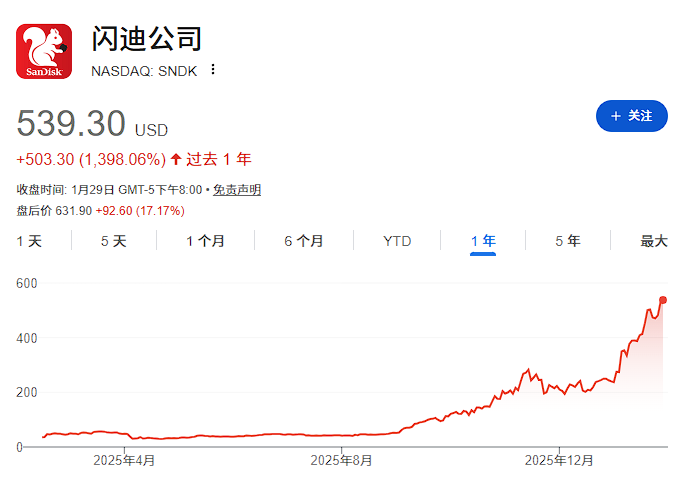
高盛快评闪迪季报:业绩超过了“本就很高”的预期
美股IPO· 2026-01-30 04:28
Core Viewpoint - Goldman Sachs states that SanDisk's performance not only surpassed market expectations but also significantly exceeded them, indicating a strong upturn in the NAND storage industry that could positively impact similar companies like Micron Technology [1][3][7]. Group 1: Q4 Performance - SanDisk reported Q4 revenue of $3.03 billion, which exceeded both Goldman Sachs' and market consensus expectations [4][15]. - The gross margin reached 51.1%, far surpassing Goldman Sachs' forecast of 43.0% and the market's expectation of 42.3% [4][15]. - The non-GAAP EPS was recorded at $6.20, which not only beat expectations but was nearly double the market's forecast of $3.55 [9][15]. Group 2: Q1 Guidance - For Q1, SanDisk provided a revenue guidance midpoint of $4.6 billion, which is 53.3% higher than market expectations [6][11]. - The gross margin guidance is projected to rise to 66.0%, significantly above Goldman Sachs' prediction of 44.0% and the market's expectation of 47.2% [6][12]. - The EPS guidance range is set between $12.00 and $14.00, with a midpoint of $13.00, which is 140% higher than the market's forecast of $5.42 and 273% above Goldman Sachs' own prediction of $3.48 [13][14]. Group 3: Industry Implications - The data suggests that the NAND storage industry may be entering a phase of unexpected prosperity, which could have a positive ripple effect on companies like Micron Technology [7][16]. - The significant increase in investor expectations is attributed to recent stock price surges, supply-demand tightness in the industry, and actions taken by Nvidia in the storage sector [16].
高盛快评闪迪季报:业绩超过了“本就很高”的预期
Hua Er Jie Jian Wen· 2026-01-30 03:58
Core Viewpoint - Goldman Sachs emphasizes that SanDisk has not only surpassed market expectations but has also delivered results that far exceed prior forecasts, indicating a strong performance in the NAND storage industry [1][4]. Group 1: Fourth Quarter Performance - SanDisk reported fourth-quarter revenue of $3.03 billion, exceeding both Goldman Sachs' prediction of $2.7 billion and the Wall Street consensus of $2.69 billion [7]. - The gross margin reached an impressive 51.1%, significantly higher than Goldman Sachs' forecast of 43.0% and Wall Street's expectation of 42.3% [7]. - The non-GAAP earnings per share (EPS) was recorded at $6.20, nearly double the market expectations, which were $3.66 from Goldman Sachs and $3.55 from Wall Street [7]. Group 2: First Quarter Guidance - For the first quarter, SanDisk provided a revenue midpoint guidance of $4.6 billion, which is 53.3% higher than market expectations [3][6]. - The gross margin guidance is projected to rise to 66.0%, surpassing Goldman Sachs' estimate of 44.0% and Wall Street's expectation of 47.2% [7]. - The EPS guidance range is set between $12.00 and $14.00, with a midpoint of $13.00, which is 140% higher than Wall Street's forecast of $5.42 and 273% above Goldman Sachs' prediction of $3.48 [6][7]. Group 3: Industry Implications - The strong performance and guidance from SanDisk suggest that the NAND storage industry may be entering a robust upcycle, which could positively impact similar companies like Micron Technology [3][6].