
宁波银行

Search documents
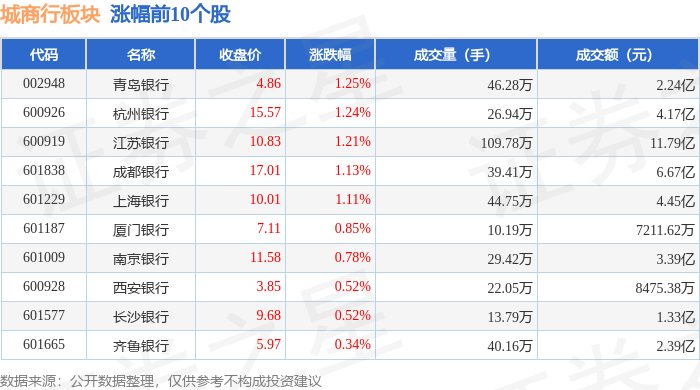
城商行板块11月27日涨0.69%,青岛银行领涨,主力资金净流入7276.85万元
Zheng Xing Xing Ye Ri Bao· 2025-11-27 09:07
Core Insights - The city commercial bank sector experienced a rise of 0.69% on November 27, with Qingdao Bank leading the gains [1] - The Shanghai Composite Index closed at 3875.26, up 0.29%, while the Shenzhen Component Index closed at 12875.19, down 0.25% [1] Stock Performance Summary - Qingdao Bank (002948) closed at 4.86, up 1.25% with a trading volume of 462,800 shares and a transaction value of 224 million [1] - Hangzhou Bank (600926) closed at 15.57, up 1.24% with a trading volume of 269,400 shares and a transaction value of 417 million [1] - Jiangsu Bank (616009) closed at 10.83, up 1.21% with a trading volume of 1,097,800 shares and a transaction value of 1.179 billion [1] - Chengdu Bank (601838) closed at 17.01, up 1.13% with a trading volume of 394,100 shares and a transaction value of 667 million [1] - Shanghai Bank (601229) closed at 10.01, up 1.11% with a trading volume of 447,500 shares and a transaction value of 445 million [1] - Xiamen Bank (601187) closed at 7.11, up 0.85% with a trading volume of 101,900 shares and a transaction value of 72.116 million [1] - Nanjing Bank (6000009) closed at 11.58, up 0.78% with a trading volume of 294,200 shares and a transaction value of 339 million [1] - Xi'an Bank (600928) closed at 3.85, up 0.52% with a trading volume of 220,500 shares and a transaction value of 84.754 million [1] - Changsha Bank (601577) closed at 9.68, up 0.52% with a trading volume of 137,900 shares and a transaction value of 133 million [1] - Qilu Bank (601665) closed at 5.97, up 0.34% with a trading volume of 401,600 shares and a transaction value of 239 million [1] Capital Flow Analysis - The city commercial bank sector saw a net inflow of 72.7685 million from institutional investors, while retail investors experienced a net inflow of 16.4028 million [2] - The sector faced a net outflow of 89.1713 million from speculative funds [2] Individual Stock Capital Flow - Jiangsu Bank (600919) had a net inflow of 75.1851 million from institutional investors, while it faced a net outflow of 38.3807 million from speculative funds [3] - Shanghai Bank (601229) saw a net inflow of 33.6962 million from institutional investors, with a net outflow of 37.6450 million from speculative funds [3] - Qilu Bank (601665) had a net inflow of 23.2129 million from institutional investors, while it faced a net outflow of 7.1943 million from speculative funds [3] - Chengdu Bank (601838) experienced a net inflow of 21.6104 million from institutional investors, with a significant net outflow of 68.9418 million from speculative funds [3] - Hangzhou Bank (600926) had a net inflow of 17.6667 million from institutional investors, while it faced a net outflow of 41.0399 million from speculative funds [3]



宁波银行(002142) - 2025年11月27日投资者关系活动记录表
2025-11-27 08:00
Group 1: Capital Growth and Financing - The company focuses on balancing dividends and endogenous capital growth to ensure a solid capital foundation for sustainable business development [2] - Endogenous capital is expected to create greater value for the company's development, with a commitment to enhancing performance and providing more returns to shareholders [2] Group 2: Loan Growth and Economic Support - The company has been actively supporting key sectors such as small and micro enterprises, manufacturing, and consumer spending, leading to steady growth in loan scale [2] - Future loan growth is anticipated to be maintained through the release of policy dividends aimed at expanding domestic demand and promoting consumption [2] Group 3: Advanced Capital Measurement - The company is researching and following the regulatory requirements for implementing advanced capital measurement methods as outlined by the National Financial Supervision Administration [2] - The company is closely monitoring regulatory dynamics and the progress of peers in applying for advanced measurement methods [2] Group 4: Investor Communication - The company ensured thorough communication with investors during the meeting, adhering to disclosure regulations and avoiding any leakage of undisclosed significant information [2]

证券代码:603816 证券简称:顾家家居 公告编号:2025-081
Zhong Guo Zheng Quan Bao - Zhong Zheng Wang· 2025-11-27 02:36
Core Viewpoint - The company has announced a series of guarantees for its wholly-owned subsidiaries to support their operational needs, involving a total credit limit of up to RMB 85 million and guarantees totaling up to RMB 84 million [3][4]. Group 1: Guarantee Overview - The company’s wholly-owned subsidiary, Gujia Ningbo, has signed a comprehensive credit agreement with China Everbright Bank for a credit limit of up to RMB 100 million, with a corresponding guarantee of the same amount [1]. - Another wholly-owned subsidiary, Zhejiang Kujia, has also signed a credit agreement with China Everbright Bank for a limit of up to RMB 50 million, with a guarantee of the same amount [2]. - The company has provided guarantees of RMB 50 million each for its subsidiaries Gujia Huanggang and Gujia Hebei through agreements with Ningbo Bank [2]. Group 2: Internal Decision-Making Process - The company’s board of directors approved a total credit limit of up to RMB 850 million and a guarantee limit of up to RMB 840 million for its subsidiaries during a meeting on April 27, 2025 [3]. - The board authorized management to handle specific guarantee transactions within the approved limits [3]. Group 3: Guarantee Agreements - The guarantees cover principal debts, interest, penalties, and various costs associated with debt recovery, with a guarantee period of three years for Gujia Ningbo and Zhejiang Kujia [6][8]. - The guarantees for Gujia Huanggang and Gujia Hebei have a guarantee period of two years [7][8]. Group 4: Necessity and Reasonableness of Guarantees - The guarantees are deemed necessary to support the operational needs of the subsidiaries and do not harm the interests of the company or minority shareholders [8]. - The company maintains effective control over the daily operations and significant matters of the subsidiaries, ensuring their good credit status [8]. Group 5: Cumulative Guarantee Situation - As of the announcement date, the total guarantees provided by the company amount to RMB 1.063 billion, representing 10.80% of the latest audited net assets attributable to the parent company [9]. - The company has no overdue guarantees and does not provide guarantees outside of its wholly-owned subsidiaries [9].

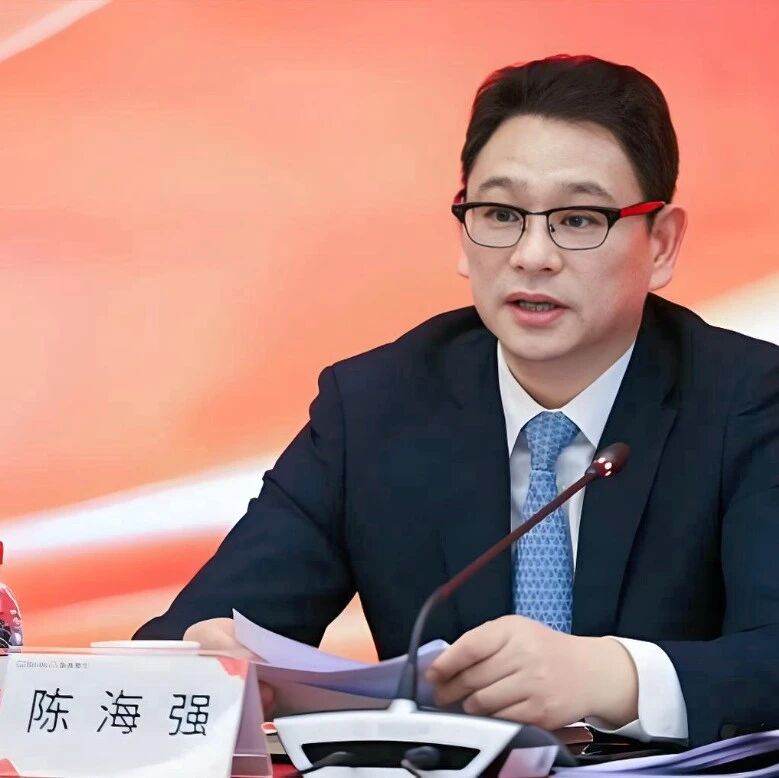
浙系银行“三国杀”:陈海强能否带领浙商银行重夺“一哥”地位?
凤凰网财经· 2025-11-26 12:56
Core Viewpoint - The article discusses the recent leadership changes at Zheshang Bank and highlights the challenges faced by the bank in comparison to its competitors, particularly Ningbo Bank and Hangzhou Bank, which have surpassed it in key financial metrics [3][5][7]. Group 1: Leadership Changes - On November 17, Zheshang Bank announced the nomination of Chen Haiqiang as the new chairman, marking the first internal promotion to this position in the bank's 21-year history [3]. - Chen Haiqiang has rapidly ascended through the ranks, moving from Chief Risk Officer to President and now to Chairman within a few months [3][5]. Group 2: Financial Performance Comparison - Zheshang Bank has fallen behind in several key financial indicators, including total assets, operating income, net profit attributable to shareholders, non-performing loan ratio, and provision coverage ratio, compared to Ningbo Bank and Hangzhou Bank [5][7]. - In 2019, Ningbo Bank's net profit was 137.14 billion yuan, while Zheshang Bank's was 129.25 billion yuan. By 2024, the gap had widened to 119.41 billion yuan, with a 107.77 billion yuan deficit reported in the first three quarters of this year [7][8]. - As of the first quarter of this year, Ningbo Bank's operating income surpassed that of Zheshang Bank for the first time, and by June, its total assets reached 3.47 trillion yuan, also exceeding Zheshang Bank [9]. Group 3: Profitability and Asset Quality - Zheshang Bank's net profit has declined by 9.59% in the first three quarters of this year, with a significant drop of 18.45% in the third quarter alone, while both Ningbo Bank and Hangzhou Bank have maintained steady growth [10]. - The bank's non-performing loan ratio has decreased from 1.53% in 2021 to 1.36% in the third quarter of 2025, but its provision coverage ratio has dropped to 159.56%, significantly lower than its competitors [12]. Group 4: Internal Control and Reputation Challenges - Zheshang Bank has faced a series of corruption scandals involving high-ranking officials, which have tarnished its reputation. The bank has received 20 regulatory fines this year, totaling over 46 million yuan [15][16]. - Chen Haiqiang's immediate tasks include optimizing internal controls and restoring the bank's reputation, alongside addressing existing risk assets [14][16].
上调!建设银行,公告!
证券时报· 2025-11-26 11:45
Core Viewpoint - Commercial banks are actively adjusting the risk ratings of mutual funds they sell, enhancing their wealth management services as deposit rates decline and residents' awareness of wealth management increases [1][3][9]. Group 1: Risk Rating Adjustments - On November 25, China Construction Bank announced an increase in the risk ratings of 87 mutual fund products, marking the largest adjustment in two years [3]. - This adjustment includes 32 funds upgraded from R2 (medium-low risk) to R3 (medium risk) and 55 funds from R3 to R4 (medium-high risk), primarily affecting bond and mixed funds [3][4]. - Other banks, including Minsheng Bank and CITIC Bank, have also adjusted their fund risk ratings multiple times this year, indicating a broader trend across the banking sector [4][9]. Group 2: Fee Rate Discounts - Many banks are offering promotional discounts on fund subscription fees to boost sales, with some fees reduced to as low as 10% of the original rate [6][7]. - For example, Industrial and Commercial Bank of China has introduced a 90% discount on certain fund subscriptions starting November 24 [7][8]. - Banks are also conducting internal reviews of customer investment risk appropriateness, particularly for vulnerable groups such as the elderly [5]. Group 3: Wealth Management Strategy - Commercial banks are significantly enhancing their wealth management business to increase intermediary income, with many reporting a year-on-year increase in fee and commission income [9]. - Analysts suggest that as deposit rates decline, there will be a shift towards higher-risk financial products, and the demand for equity asset allocation may increase due to demographic changes and policy support [9].

融资超亿元!大兴这场创投会让产业与金融双向奔赴
Sou Hu Cai Jing· 2025-11-26 10:32
Group 1 - The core event is the "Pioneer New City Venture Capital Event" held in Daxing District, focusing on financing key enterprises and projects, with a total investment of 51.5 billion and a financing demand of approximately 7 billion [1] - A total of 85 quality projects were collected, covering leading industry directions such as air economy, biomedicine, digital economy, future energy, commercial aerospace, and agricultural technology [1] - The event gathered 27 financial institutions and nearly 100 enterprise representatives, with detailed introductions from Daxing District leaders on high-quality development and from the Beijing Development and Reform Commission on city development positioning and policy resources [3] Group 2 - During the pitching session, four companies, including Ruichao Dink Technology and Qingchuan Yichuang, presented their projects, while three financial institutions, including Guofeng Investment Fund and Ningbo Bank, introduced their unique financial products [3] - In the signing phase, four companies, including Beijing Zhongxing High-tech Co., Ltd., reached cooperation with capital parties, involving projects like high-performance sodium-ion batteries and commercial aerospace common test platforms, with total financing exceeding 100 million [5] - The event adopted a "government platform, enterprise performance, capital support" model to promote deep integration of industrial resources and financial capital, with Daxing District aiming to continue driving innovation and capital linkage for high-quality development [5]

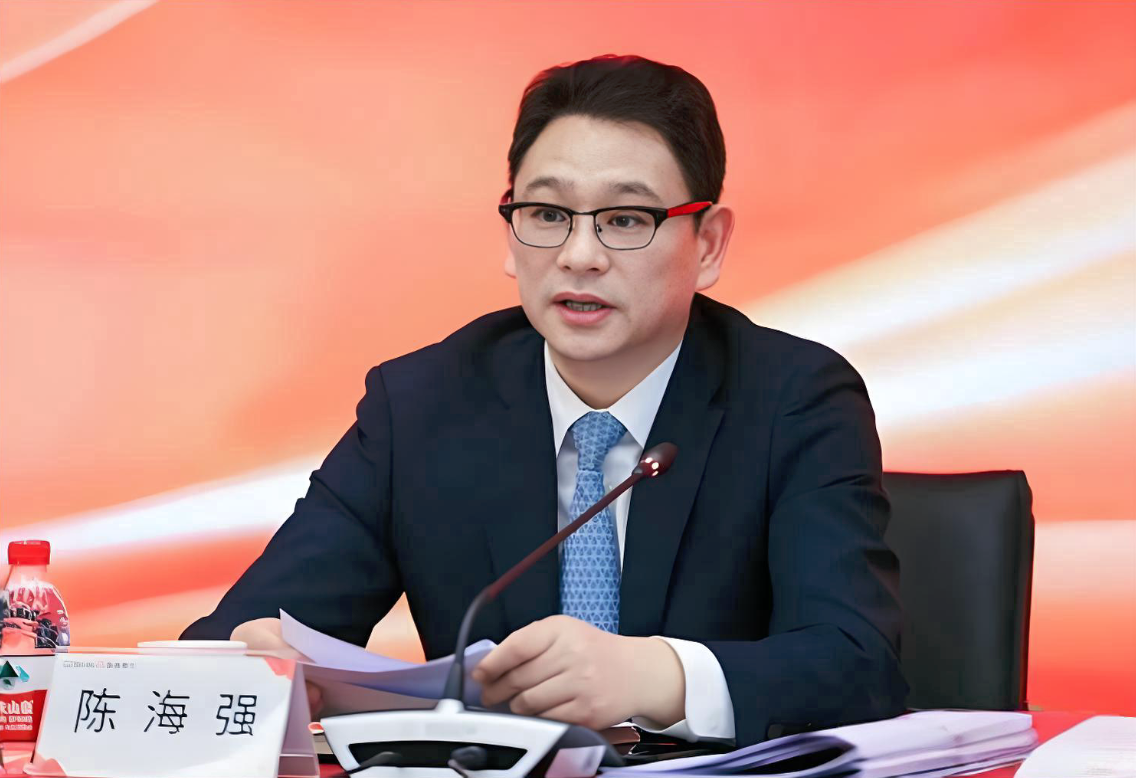
浙系银行“三国杀”:陈海强能否带领浙商银行重夺“一哥”地位?
Feng Huang Wang Cai Jing· 2025-11-26 09:51
Core Viewpoint - The appointment of Chen Haiqiang as the new chairman of Zheshang Bank marks a significant internal promotion, but the bank faces substantial challenges as it has fallen behind competitors in key financial metrics [1][3][4]. Group 1: Leadership Changes - Chen Haiqiang has been nominated as the new chairman of Zheshang Bank, becoming the first internal candidate to hold this position in the bank's 21-year history [1]. - He has rapidly ascended through the ranks, moving from Chief Risk Officer to President and now to Chairman within a few months [1]. Group 2: Financial Performance - Zheshang Bank's total assets, operating income, and net profit have all lagged behind those of Ningbo Bank and Hangzhou Bank, with the latter surpassing Zheshang Bank in net profit by 4.217 billion yuan [3][4]. - In 2019, Ningbo Bank's net profit was 137.14 billion yuan compared to Zheshang Bank's 129.25 billion yuan, and by 2024, the gap had widened to 119.41 billion yuan [4]. - For the first three quarters of 2025, Zheshang Bank reported a net profit of 11.668 billion yuan, down 9.59% year-on-year, with a significant quarterly decline of 18.45% [7][8]. Group 3: Asset Quality and Risk Management - Zheshang Bank has made significant progress in reducing non-performing loans, with the non-performing loan ratio decreasing from 1.53% in 2021 to 1.36% in Q3 2025 [8]. - Despite improvements in asset quality, the bank still faces challenges with a growing balance of non-performing loans and an increase in loans under scrutiny [9]. Group 4: Internal Control and Reputation Issues - The bank has been plagued by a series of corruption scandals involving high-ranking officials, which have tarnished its reputation [11]. - In 2023, Zheshang Bank received 20 regulatory fines totaling over 46 million yuan, indicating significant internal control issues [12]. - Chen Haiqiang's immediate tasks include optimizing internal controls and restoring the bank's reputation while also addressing existing risks [9][12]. Group 5: Competitive Landscape - The competitive dynamics among Zhejiang banks have shifted from a focus on scale to a focus on quality and differentiation, posing additional challenges for Zheshang Bank [12].
城商行板块11月26日跌0.59%,南京银行领跌,主力资金净流出1.47亿元
Zheng Xing Xing Ye Ri Bao· 2025-11-26 09:05
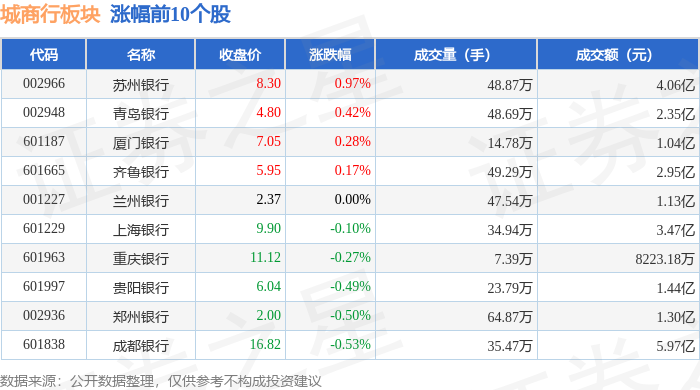
Market Performance - The city commercial bank sector declined by 0.59% on November 26, with Nanjing Bank leading the drop [1] - The Shanghai Composite Index closed at 3864.18, down 0.15%, while the Shenzhen Component Index rose by 1.02% to 12907.83 [1] Individual Stock Performance - Suzhou Bank closed at 8.30, up 0.97% with a trading volume of 488,700 shares and a transaction value of 406 million yuan [1] - Nanjing Bank closed at 11.49, down 1.29% with a trading volume of 514,300 shares and a transaction value of 592 million yuan [2] - Chengdu Bank closed at 16.82, down 0.53% with a trading volume of 354,700 shares and a transaction value of 597 million yuan [2] Capital Flow Analysis - The city commercial bank sector experienced a net outflow of 147 million yuan from institutional investors, while retail investors saw a net inflow of 152 million yuan [2] - Among individual stocks, Suzhou Bank had a net outflow of 31.27 million yuan from institutional investors, while Nanjing Bank saw a net inflow of 27.56 million yuan [3]



上调!建设银行,公告!
券商中国· 2025-11-26 08:55
Core Insights - Commercial banks are actively adjusting the risk ratings of mutual funds they sell, with a significant increase in the number of funds affected, indicating a proactive approach to risk management in the current market environment [2][3] - Banks are also offering promotional activities, such as reduced subscription fees for mutual funds, to enhance sales during the year-end peak season, reflecting a competitive strategy to attract investors [5][6] Group 1: Risk Rating Adjustments - On November 25, China Construction Bank announced an increase in the risk ratings of 87 mutual fund products, marking the largest adjustment in two years, with 32 funds upgraded from R2 (medium-low risk) to R3 (medium risk) and 55 funds from R3 to R4 (medium-high risk) [2] - This adjustment is part of a broader trend, as several banks, including Minsheng Bank and CITIC Bank, have also revised the risk ratings of their mutual fund offerings multiple times throughout the year [3] - The reasons for these adjustments include regulatory requirements, market conditions, and changes in target customer profiles, aimed at ensuring accurate risk assessments for investors [3] Group 2: Promotional Activities - Many banks, including Industrial and Commercial Bank of China and Minsheng Bank, have launched promotional activities offering discounts on subscription fees for certain mutual funds, with some fees reduced to as low as 10% of the original rate [5] - These promotional efforts are part of a broader strategy to boost sales during the year-end peak season, with reports indicating that some branches have exceeded their sales targets significantly [6] - The fee discount structure varies among banks, with options including no discount, 50% off, 10% off, and even full waivers, allowing branches to tailor their offerings based on sales needs [5] Group 3: Wealth Management Trends - As deposit rates decline and residents become more aware of wealth management options, banks are intensifying their efforts in selling mutual funds and other asset management products [1][6] - The trend towards increased sales of wealth management products is reflected in the growth of fee and commission income for many banks, with some reporting year-on-year increases exceeding 10% [6] - Analysts suggest that the changing landscape of deposit rates and the aging population will likely lead to a higher allocation of assets towards mid-to-high-risk financial products [7]


外汇展业改革参与银行增至26家 三季度工行等4家入列
2 1 Shi Ji Jing Ji Bao Dao· 2025-11-26 07:00
Core Insights - The foreign exchange business reform has been positively received by commercial banks and the public, with 26 banks participating as of September 2025, covering various types of banks across the country [1][2] Group 1: Reform Implementation and Participation - As of September 2025, 26 banks are involved in the foreign exchange business reform, including 5 large banks, 9 joint-stock banks, 4 city commercial banks, and 8 foreign banks [1] - The newly added banks in the third quarter include Industrial and Commercial Bank of China, Deutsche Bank, Mizuho Bank, and Mitsubishi UFJ Financial Group [2] Group 2: Benefits of the Reform - The reform has reduced the burden on enterprises, allowing them to handle foreign exchange transactions more efficiently, with some businesses experiencing a significant reduction in processing time from days to minutes [3] - Banks have improved their customer identification and service capabilities, leading to a reduction in average processing time for transactions by over 50% [3] - The reform has enhanced regulatory quality, with banks establishing risk monitoring systems to better track cross-border transactions and identify abnormal activities early [3] Group 3: Future Directions - The State Administration of Foreign Exchange plans to further enhance the foreign exchange management system, focusing on convenience, openness, security, and intelligence [4] - Future efforts will include expanding the coverage of the reform to benefit more enterprises and integrating various facilitation policies [4] - The application of new technologies such as artificial intelligence and big data will be encouraged to improve efficiency in foreign exchange services [4]



