
清华大学

Search documents
中国高校三个学科首度问鼎世界第一,AI专业清华国内领先
Di Yi Cai Jing· 2025-11-27 12:19
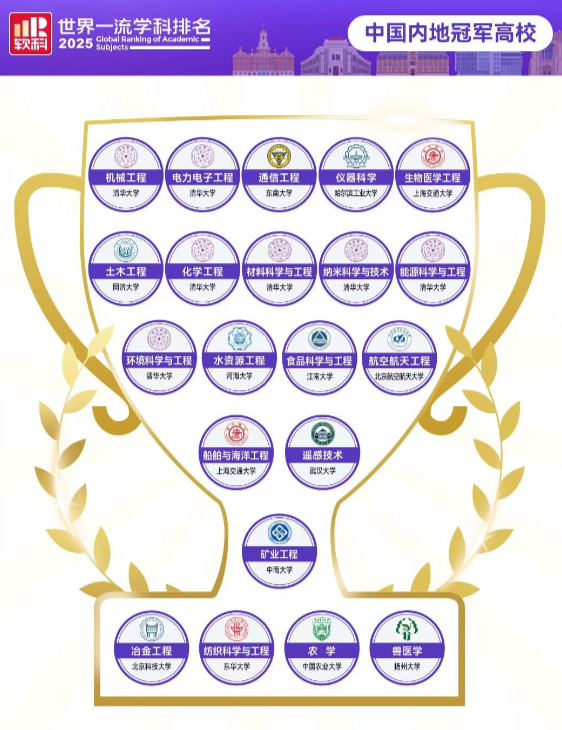
Core Insights - The number of global champion disciplines in Chinese mainland universities has increased to 21, with three new disciplines achieving world firsts in 2025 GRAS rankings [1][2] - The rankings reflect the growing emphasis on interdisciplinary studies in response to technological revolutions and industrial transformations [1][2] Group 1: Rankings and Achievements - Chinese mainland universities ranked first in three disciplines: Power Electronics Engineering, Biomedical Engineering, and Materials Science and Engineering [1][2] - The total number of disciplines ranked in the GRAS has reached 57, covering five major fields: natural sciences, engineering, life sciences, medicine, and social sciences [1][2] - The United States maintains the lead with 27 disciplines ranked first, totaling 4,281 mentions, while Chinese universities follow with 3,747 mentions across 21 disciplines [2] Group 2: Institutional Highlights - Tsinghua University leads with seven champion disciplines, followed by Harvard University with eleven [2] - Shanghai Jiao Tong University and Beijing University of Aeronautics and Astronautics each have one champion discipline [2] - The increase in champion disciplines indicates a shift from follower to leader status for several Chinese universities in their respective fields [2] Group 3: New Disciplines and Trends - The newly added champion disciplines include Artificial Intelligence and Robotics Science and Engineering, reflecting the growing importance of these fields [1][2] - The demand for professionals in Artificial Intelligence is projected to increase sixfold by 2030, highlighting the urgency for educational institutions to adapt [9][10] - The establishment of interdisciplinary research platforms and funding initiatives at institutions like Shanghai Jiao Tong University is driving innovation in health technology [5][9] Group 4: Policy and Structural Changes - The Ministry of Education's reform plan aims to optimize and adjust 20% of academic programs by 2025, leading to the establishment of 3,229 new undergraduate programs and the discontinuation of 2,534 [5][6] - The focus on strategic emerging industries and foundational disciplines is part of a broader initiative to cultivate top-tier innovative talent [6][7]

清华大学:严禁将AI生成内容直接用作学业成果
Zhong Guo Qing Nian Bao· 2025-11-26 23:35
针对研究生群体,"学位论文及实践成果篇"强调,严禁使用人工智能实施代写、剽窃、伪造等行为,研 究生指导教师需提供规范性指导并进行全过程监督,确保学术训练的完整性和学位论文及实践成果的原 创性。 参与《指导原则》制定工作的清华大学在线教育中心主任王帅国表示,《指导原则》也为未来在学术研 究、管理服务等更多场景中拓展人工智能应用边界预留了充分空间,"我们希望它是一个有生命力的、 能随着技术演进不断生长的指导体系"。 中青报·中青网记者 王璟瑄 《指导原则》由"总则""教学篇""学位论文及实践成果篇"3部分构成,覆盖当前教学与学术研究的核心 场景。"总则"部分明确了学校"积极而审慎"的基本立场,并提出"主体责任""合规诚信""数据安全""审慎 思辨""公平包容"五大核心原则。 "主体责任"原则强调人工智能始终是辅助工具,师生才是教学与学习的主导者;"合规诚信"原则要求师 生对人工智能使用情况及生成内容依规进行披露声明,严禁学术不端;"数据安全"原则严禁师生使用敏 感信息、涉密数据或未授权数据训练或驱动人工智能模型;"审慎思辨"原则提醒师生通过多源验证防范 因过度依赖导致的思维惰化;"公平包容"原则呼吁主动识别并努力 ...
第十八届全国大学生创新年会举办
Su Zhou Ri Bao· 2025-11-25 00:43
Core Points - The 18th National College Student Innovation Conference was held at Nanjing University Suzhou Campus from November 21 to 23, with the theme "Endless Innovation, New Trends" [1] - The conference introduced a new roundtable sharing session focused on student innovation and released the "2025 National College Student Innovation and Entrepreneurship Training Program Implementation Report" [1] - A new initiative called "AI Intelligent Agent for College Student Innovation Training Program" named "Suiqi" was launched [1] Summary by Categories Event Overview - The conference gathered over 1,200 representatives from universities across 28 provinces, municipalities, and autonomous regions, including experts from the national innovation training program and industry guests [1] - A total of 1,030 projects were submitted by national and local educational authorities, leading to the selection of 200 academic papers, 250 reform achievements, and 60 entrepreneurial projects [1] Awards and Recognitions - The conference awarded 20 "Outstanding Academic Papers," including Tsinghua University's paper on microplastics and 12 "Best Entrepreneurial Projects," such as Nanjing University's virtual human model for drug dynamics [1] - Additionally, 20 "Best Creative Projects" were recognized, including Zhejiang University's watermark technology research, and 20 "Most Favorite Projects," such as China University of Petroleum's autonomous quadrotor drone [1] - The conference also presented 15 "Outstanding Organization Awards," with Nanjing University receiving a "Special Contribution Award" [1]
专访巴黎政治大学校长:我不太喜欢“精英”这个词,它可能会加剧社会分裂
Xin Lang Cai Jing· 2025-11-23 23:38
Core Viewpoint - The president of Sciences Po, Luis Vassy, emphasizes the importance of "excellence" over "elite," advocating for a commitment to doing one's best to reduce social divisions [1][9]. Group 1: Background of Sciences Po - Founded in 1872, Sciences Po is known as a breeding ground for French political elites, having produced numerous national leaders, including President Emmanuel Macron [3]. - Vassy, a graduate of Sciences Po, previously served as a diplomat and chief of staff for two French foreign ministers, highlighting the importance of international communication in both diplomacy and education [4]. Group 2: Impact of AI on Education - Vassy acknowledges the challenges posed by AI but does not view it as a crisis, noting that the first affected areas are primarily technical fields like programming [7]. - He believes that social sciences and humanities have a unique opportunity to thrive, as human contributions in strategic judgment and critical thinking surpass technical knowledge [7][8]. Group 3: Responsibility of Students - Vassy stresses that students at Sciences Po, which admits only the top 2% of high school graduates in France, have a responsibility to society, as their actions will influence future leaders [8][9]. - He emphasizes the need for students to maintain their ambition and effort, ensuring they can contribute meaningfully even without technological tools [8]. Group 4: European Strategic Autonomy - Vassy discusses the importance of understanding Europe and its operations, especially in light of current geopolitical tensions, and plans to introduce a mandatory course on Europe for all students [10][11]. - He believes that the concept of "strategic autonomy" for Europe is gaining traction, with a growing commitment to independence and the ability to defend its interests [11]. Group 5: Academic Freedom - Vassy advocates for academic and intellectual freedom, arguing that a competitive society relies on well-functioning universities and the ability to conduct research freely [12].

京津冀教育协同发展迈上新台阶 雄安新区已高水平开办中小学、幼儿园五十五所
Ren Min Ri Bao· 2025-11-23 22:44
5年来,京津冀三地基础教育合作持续加强,职业教育协作不断深化,高等教育协同取得实质进展。目 前,京津314所优质中小学幼儿园与河北496所学校合作办学,清华大学、中国人民大学等部属高校对口 帮扶河北10所县域高中;每年组织250名河北中小学骨干校长、教师赴京津优质学校跟岗学习。成立京 津冀职业教育改革示范园区,联合培养高素质技术技能人才;稳步推进三地高职院校开展跨省单独招生 试点和"3+2"中高职联合培养,累计招生1.7万人。组织省属骨干高校广泛对接京津"双一流"高校,164 项合作项目正在有序推进;扎实开展"周末专家河北行"活动,累计达5641场。 (文章来源:人民日报) 本报石家庄11月23日电 (记者马晨)河北省人民政府新闻办公室日前举行"十四五"高质量发展河北答 卷系列主题新闻发布会通报,5年来,河北紧紧抓住京津冀协同发展这一重要战略机遇,积极深化与京 津的教育协作,借助京津两地优势资源,加快推进河北教育事业改革发展,取得了一系列成果。 雄安新区现代教育体系加速构建。在京高校疏解工作进展顺利,首批疏解高校全面开工建设,第二批疏 解高校确定项目选址,第三批疏解高校正在有序启动。雄安新区已高水平开办中小学 ...
清华大学牵头发布“AI+脑机数据”平台
Xin Jing Bao· 2025-11-22 09:56
Core Insights - The "AI + Brain-Computer Interface" industry innovation promotion meeting was held in Haidian, Beijing, focusing on the theme "Brain Intelligence Integration, Wisdom Gathering in Beijing" and announced multiple initiatives and achievements [1] - The "AI + Brain-Computer Data" platform was launched, led by Tsinghua University, aiming to integrate cross-scale, multi-modal brain data resources to break down data barriers and provide high-quality, standardized data resources and analytical tools for innovation [1] - The promotion of brain-computer interface technology is seen as a strategic imperative in global technological competition, with applications across diverse fields such as medical rehabilitation, smart terminals, industrial safety, and education [1] Group 1 - Tsinghua University will strengthen core technology research in brain-computer interfaces, promote collaboration between basic research and clinical medicine, and focus on continuous innovation platform development and talent cultivation [1] - The China Academy of Information and Communications Technology (CAICT) is leading the establishment of the Zhongguancun Brain-Computer Interface Industry Association, which will focus on collaborative research, result transformation, standard system construction, professional talent training, and building an innovative ecosystem [2] - Six innovative achievements in brain-computer interfaces were showcased, demonstrating Beijing's capability in autonomous innovation from single-point technology to system integration [2] Group 2 - Haidian District is recognized as a national high ground for artificial intelligence development and the source of "AI + Brain-Computer Data," with a complete industrial chain from research and development to application [2] - The district possesses unique advantages, including comprehensive foundational disciplines, concentrated clinical resources, and a well-established talent pipeline, providing fertile ground for the research and implementation of "AI + Brain-Computer" technology [2]
内蒙古智慧交管项目获全国大奖!
Nei Meng Gu Ri Bao· 2025-11-21 11:35
Core Insights - The project "Key Technology Research and Application for Intelligent Traffic Management Based on Regional Characteristics" won the second prize at the 2025 China Intelligent Transportation Association Science and Technology Award, highlighting significant achievements in intelligent transportation [1] - The project addresses the unique challenges of Inner Mongolia, such as sparse population, dispersed road networks, and variable climate, by developing a tiered and classified intelligent traffic management framework [1] - The project has resulted in the establishment of five industry standards, six invention patents, five software copyrights, and nine high-quality academic papers [1] Group 1 - The project was led by the Inner Mongolia Public Security Traffic Management Bureau in collaboration with the Hohhot Public Security Traffic Management Detachment and Tsinghua University [1] - The developed AI traffic perception and scenario application technologies are tailored for local conditions, including cold weather and sandstorms [1] - The project has been implemented in Inner Mongolia, supporting precise governance of traffic hazards, cross-departmental data sharing, and emergency response to large-scale incidents [1] Group 2 - The Inner Mongolia traffic management department plans to accelerate the large-scale application of this technology and deepen collaboration with research institutions and technology companies [2] - The initiative aims to extend intelligent traffic management coverage to more urban and rural pastoral areas, contributing to the modernization of Inner Mongolia's transportation system [2]
文博为桥,中外学子与北京文化遗产“对话”
Zhong Guo Xin Wen Wang· 2025-11-21 11:17
Core Insights - The "Bridging Cultures" international exchange project aims to enhance understanding of Beijing's cultural heritage among Chinese and international students through various educational activities [1][3][5] Group 1: Project Overview - The project was initiated in 2024 and fully implemented in 2025, featuring a multi-layered knowledge dissemination and practice system that includes lectures, discussions, field trips, and exhibitions [1][3] - A total of 30 activities have been conducted, attracting nearly 3,000 participants both online and offline, contributing to the exchange of civilizations and storytelling about Beijing's cultural heritage [1][3] Group 2: Educational Approach - The project employs a dual mechanism of offline thematic lectures and online cultural courses, enhancing the depth of understanding of Chinese traditional culture among students [3] - Twelve lectures by renowned experts in the cultural heritage field were held, focusing on the universal value and protection principles of world heritage, as well as the unique value of Beijing as a historical and cultural city [3] Group 3: Academic and Practical Engagement - Five high-quality academic events were organized, fostering deep dialogue between young talents in cultural heritage and experts, establishing a regular and international academic exchange mechanism [3] - Eleven study activities were designed, involving nearly 600 students visiting museums and heritage sites, creating an immersive learning experience that combines knowledge with enjoyment [3] Group 4: Cultural Ambassador Initiative - The project launched a "Cultural Ambassador" recruitment plan, selecting 10 international students to deepen their understanding of Chinese culture through hands-on activities [5] - A comprehensive cooperation agreement was signed between Beijing Municipal Bureau of Cultural Heritage and Tsinghua University to enhance research collaboration and project development in the cultural heritage sector [5]

清华北大共15位学者当选,2025年两院院士增选结果出炉
Xin Jing Bao· 2025-11-21 03:46
中国科学技术大学5位教师当选两院院士,戴子高、彭承志、徐铜文、舒歌群当选中国科学院院士,吴 枫当选中国工程院院士。 北京航空航天大学航空科学与工程学院王晋军、交通科学与工程学院姚仰平、化学学院郭林、空间与地 球科学学院施闯共4位教授当选为中国科学院院士。 北京大学共有6人当选两院院士。北京大学数学科学学院刘若川教授,化学与分子工程学院马丁教授, 生命科学学院邓宏魁教授、瞿礼嘉教授,地球与空间科学学院陈衍景教授当选为中国科学院院士,肿瘤 医院季加孚教授当选为中国工程院院士。 值得一提的是,本月初,2024年度北京市科学技术奖公布,北京大学教授邓宏魁刚刚获得突出贡献中关 村奖。去年,他还曾摘得未来科学大奖"生命科学奖"。他致力于开发调控细胞命运的新方法,并基于干 细胞技术开发治疗重大疾病的新策略,建立了化学小分子诱导体细胞重编程的新体系,提供了细胞命运 调控的全新手段,突破了功能细胞制备的关键瓶颈。在此基础上与临床团队合作,开展了患者自体胰岛 细胞移植治疗I型糖尿病临床研究,并初步实现了功能性治愈。 新京报讯(记者张璐)中国科学院、中国工程院11月21日公布2025年院士增选结果,分别选举产生中国科 学院院士73 ...
北大“博雅AI4S拔尖人才计划”本硕博贯通制项目启动
Xin Jing Bao· 2025-11-20 09:47
Core Insights - Peking University has launched the "Boya AI4S Talent Program" aimed at cultivating top innovative talents in the field of AI for Science, targeting undergraduate students for the first time [1][2] - The program emphasizes the integration of AI, basic sciences, and industry needs, creating a bridge between enterprise demands and academic research [2] Group 1: Program Overview - The "Boya AI4S Talent Program" is designed to explore the fusion of AI with basic sciences and industry requirements, enhancing the practical application of AI in scientific research [2] - The program features a dual-mentor training model and has already enrolled 7 doctoral and 37 master's students since its inception in July 2023 [1][2] Group 2: Curriculum and Structure - The program introduces a "vertical rooting, horizontal integration, and problem-driven" training system, breaking down traditional academic barriers [2] - Core courses will include "AI+" interdisciplinary subjects, with real-world case studies and projects sourced from actual research and enterprise scenarios [2] Group 3: Admission Criteria - The program is open to undergraduate students from various STEM disciplines, including mathematics, statistics, physics, chemistry, life sciences, and computer science, particularly those from Peking University and Tsinghua University [3] - The expected enrollment size is around 50 students per cohort, with plans for direct selection from the college entrance examination process in the future [3]