Amundi

Search documents
X @Bloomberg
Bloomberg· 2025-08-29 09:34
Market Sentiment - Dip buyers are returning to French bonds [1] Bond Market - French bond yields surged following a surprise call for a confidence vote by PM Francois Bayrou [1] Company Actions - Amundi notes the return of dip buyers [1]
CEF Weekly Review: Amundi Shareholders Are Refusing To Say Yes
Seeking Alpha· 2025-08-24 06:23
Group 1 - The article provides a review of the closed-end fund (CEF) market, discussing both individual fund news and broader market trends [1] - It highlights the importance of yield and risk management in the construction of income portfolios [1] - The article promotes the use of Interactive Investor Tools for navigating various financial markets, including BDC, CEF, OEF, preferred, and baby bond markets [1] Group 2 - The article encourages readers to explore investor guides related to CEFs, preferreds, and PIMCO CEFs [2] - It offers a no-risk opportunity for potential investors to sign up for a 2-week free trial [2]



今年涨了34%,欧洲银行股飙升至2008年以来最高!
Hua Er Jie Jian Wen· 2025-08-03 11:33
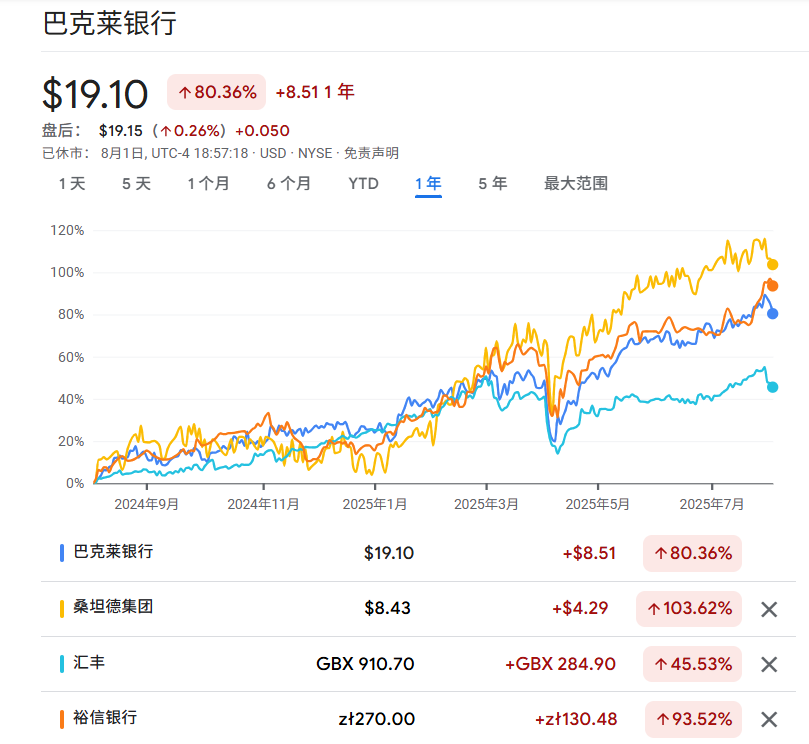
Core Viewpoint - The European banking sector, once considered a "market orphan," is experiencing a significant resurgence, driven by rising long-term interest rates and improved economic prospects [1][2]. Group 1: Market Performance - Major European bank stocks have reached their highest levels since the 2008 global financial crisis, with HSBC, Barclays, Santander, and UniCredit hitting multi-year peaks [2]. - The European Stoxx 600 Bank Index has risen 34% year-to-date, outperforming U.S. counterparts and poised for its best annual performance since 2009 [2]. Group 2: Industry Transformation - The European banking industry is undergoing a transformation from being viewed as a "market orphan" to a favored sector, as noted by Schroders' analyst Justin Bisseker [4]. - After over a decade of being criticized for insufficient capital and facing regulatory pressures, European banks are now benefiting from higher interest rates and a favorable macroeconomic environment [4]. Group 3: Profitability Drivers - Central banks have raised interest rates to combat inflation, significantly increasing banks' net interest income, which is crucial for profitability [4]. - For instance, the yield on Germany's 30-year government bonds is currently 1.3 percentage points higher than that of 2-year bonds, while in the UK, the spread exceeds 1.5 percentage points, creating an excellent profit environment for banks [5]. Group 4: Valuation Appeal - Despite the substantial rise in stock prices, many investors still view European bank stocks as "cheap," with Pictet's chief strategist highlighting their low valuations and unique advantages in a recovering domestic demand environment [6]. - According to FactSet, many European banks' valuations have just returned to their book values, while U.S. counterparts like JPMorgan have a price-to-book ratio of about 2.4 times [6]. - Bloomberg data indicates that the expected price-to-earnings ratio for European banks is around 10 times, lower than the over 13 times for U.S. peers, with many European banks now achieving a tangible return on equity (ROTE) exceeding 10% [6]. Group 5: Future Challenges - There are uncertainties regarding the sustainability of the current rally in European banks without continued increases in long-term interest rates [7]. - Market sentiment is shifting, with some analysts suggesting that the best times for banks may be behind them, despite the current favorable conditions [7]. - Additionally, attempts at industry consolidation, such as BBVA's bid for Sabadell and UniCredit's interest in BPM, have faced political obstacles, limiting growth potential [7]. - However, Bisseker from Schroders notes that European banks still have valuation discounts compared to global peers, indicating potential for further valuation convergence in the future [7].



Amundi: Half-Year Financial Report as of 30 June 2025 available
Globenewswire· 2025-08-01 15:47
Core Points - Amundi has released its first-half 2025 Financial Report, which is now publicly available and filed with the Autorités des Marchés Financiers (AMF) [2] - The company is recognized as the leading European asset manager and ranks among the top 10 global players, managing nearly €2.3 trillion in assets [3][4] Company Overview - Amundi serves approximately 100 million clients, including retail, institutional, and corporate clients, offering a comprehensive range of savings and investment solutions in both active and passive management [3] - The company operates through six international investment hubs and employs 5,500 staff across 35 countries, emphasizing its commitment to responsible investment [4] Additional Information - Amundi is a subsidiary of the Crédit Agricole group and is listed on the stock exchange, enhancing its credibility and market presence [3] - The financial report is accessible on Amundi's official website, providing transparency to stakeholders [2]

X @Bloomberg
Bloomberg· 2025-07-29 05:16
Amundi reports another bumper quarter of inflows, surprising analysts who had predicted a reversal, and says it should be able to keep up the pace for the rest of 2025 https://t.co/OP65xe5GKW ...
Amundi: First half and second quarter 2025 results
GlobeNewswire News Room· 2025-07-29 04:59
Core Insights - Amundi reported record net inflows of €52 billion in the first half of 2025, matching the total inflows for the entire year of 2024 [3][10] - Assets under management reached an all-time high of €2.27 trillion, reflecting a year-on-year increase of 5% despite negative foreign exchange effects [1][8] - Profit before tax for the first half of 2025 was €895 million, up 4% compared to the same period in 2024, driven by revenue growth and cost control [4][16] Financial Performance - Net inflows for medium-to-long-term assets were €48 billion in H1 2025, significantly higher than €34 billion for the whole of 2024 [10] - Adjusted net revenues for H1 2025 totaled €1.703 billion, a 4.9% increase from H1 2024 [16] - The cost-income ratio remained stable at 52.5%, in line with the Ambitions 2025 target [20] Strategic Developments - Amundi finalized a partnership with Victory Capital on April 1, 2025, consolidating a 26% stake in the company [7][30] - The Institutional division saw net inflows of €31 billion, driven by significant mandates including a €22 billion Defined Contribution mandate in the UK [6][13] - The company continued to focus on responsible investment and technology services, with Amundi Technology revenues increasing by 48% year-on-year [6][19] Regional Insights - In Asia, assets under management grew by 2% year-on-year, reaching €460 billion, with net inflows of €22 billion in H1 2025 [6][12] - The Third-Party Distribution segment experienced strong growth, with net inflows of €13 billion in H1 2025, accounting for 40% of total net inflows [6][10] Market Position - Amundi is the only European asset manager among the top 10 global asset managers, managing approximately €1.7 trillion for European clients [5][6] - The company capitalized on renewed interest in European markets, particularly through ETFs, which attracted €19 billion in net inflows [6][10] Future Outlook - A new three-year strategic plan will be presented in Q4 2025, following the success of the Ambitions 2025 plan [6][30] - The company aims to continue leveraging its position in the market to enhance growth and diversification of its offerings [5][6]

国泰海通|非银:殊途同归,全能资管科技平台共享时代——全球公募基金镜揽系列报告之九
国泰海通证券研究· 2025-06-29 14:56
Core Viewpoint - The article emphasizes the trend of asset management companies moving towards platformization, which enhances operational efficiency and drives down fees, benefiting large, capable asset management institutions [1][2]. Group 1: Platformization in Asset Management - Asset management companies are embedding technology platforms across all business segments, including client acquisition, portfolio construction, management, and post-investment risk management [1]. - According to McKinsey's research, leading global asset management firms are actively promoting the process of platformization across various areas such as sales, marketing, investment management, and risk/compliance management [2]. Group 2: Historical Development of Platformization - The origin of platformization in asset management can be traced back to the 1980-2000 period, where risk control and pricing became the starting point for platform development [2]. - From 2000 to 2008, intensified competition in custody services led to the platformization of these services to enhance breadth and efficiency [2]. - The financial crisis from 2008 to 2015 prompted stricter regulations, which accelerated the attempts to platformize trading operations, although only multi-broker platforms survived [2]. - Since 2015, technological capabilities have differentiated various segments of asset management, promoting the comprehensive functionality of platforms and their direct client engagement [2]. Group 3: Advantages of Platformization - Distinctive platforms have emerged in various segments, such as BlackRock's Aladdin for risk control, Goldman Sachs' Marquee for pricing, and AmundiALTO for custody outsourcing, each creating core advantages in data collection, trading efficiency, and operational services [3]. - Platformization enhances overall industry efficiency, favoring large asset management institutions with strong platform capabilities, and promoting brokerage firms with competitive advantages in platformization and institutional service capabilities [3]. - The platformization of asset management drives the outsourcing and centralization of scalable segments, improving operational efficiency and leading to a decline in industry fees [3].

Amundi Third-Party Distribution Investor Workshop: a powerful growth engine
Globenewswire· 2025-06-19 04:59
Core Insights - Amundi is hosting a workshop focused on its Third-Party distribution platform, highlighting its growth and strategic importance [2][4] - The Third-Party distribution business has been the fastest-growing segment for Amundi, with assets under management more than doubling since 2020 to €401 billion by the end of 2024 [3][4] - The platform now accounts for 18% of Amundi's total assets and 57% of its retail assets, with net inflows of €74 billion from 2021 to 2024 and an additional €8 billion in Q1 2025 [4] Company Overview - Amundi is Europe's leading asset manager, managing €2.25 trillion in assets and serving 100 million clients globally [6][7] - The company offers a comprehensive range of investment solutions, including active and passive management, model portfolios, and technological tools [6][7] - Amundi's commitment to responsible investment and its extensive research capabilities position it as a key player in the asset management industry [8] Market Trends - The growth of Amundi's Third-Party distribution is supported by increasing global financial wealth, projected to grow by 6% annually to reach $367 trillion by 2028 [6] - The expansion of the private pensions market in Europe and Asia is expected to support an aging population, further driving demand for investment solutions [6] - The digital wealth segment continues to grow, with a concentration of relationships favoring large asset managers that offer a wide range of products and services [6]
美元“塌房”进行时:逃离大军挤爆 但才刚开场?
智通财经网· 2025-06-18 12:15
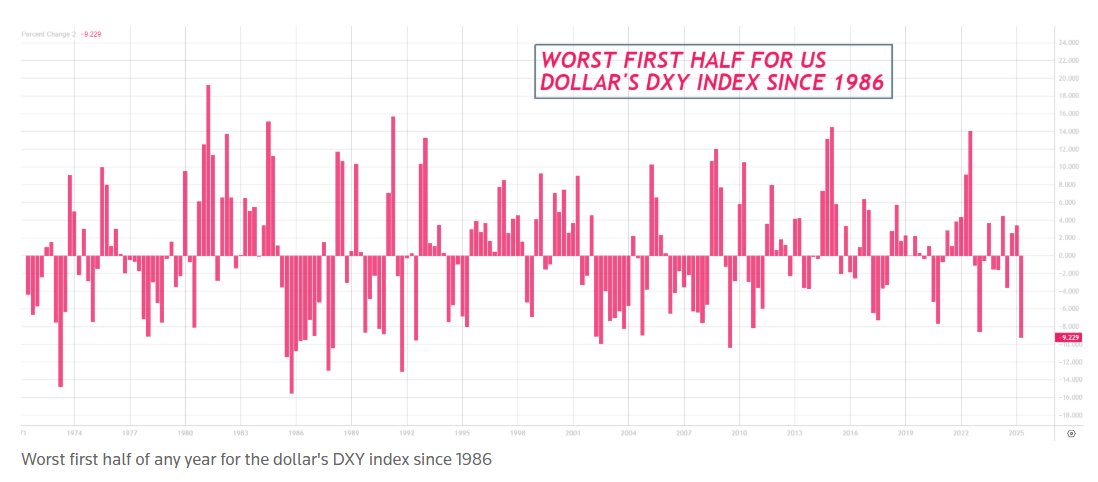
Core Viewpoint - The decline of the US dollar is not a short-term speculative behavior or a cyclical adjustment, and its recovery may take several years [1] Group 1: Dollar Performance - The US dollar index has fallen nearly 10% against major currencies this year, marking the worst first half since 1986 [1] - The current dollar short positions have reached a 20-year high, making "shorting the dollar" one of the three most crowded trades globally [3] Group 2: Market Sentiment and Reactions - Crowded trades are often seen as contrarian indicators, suggesting that the market may have overbet on the dollar's decline [6] - Despite high speculative positions, the dollar's short positions have not reached historical extremes, indicating that the bearish trend may continue [8] Group 3: Short-term Dynamics - The forex market is currently influenced by two opposing forces: potential dovish signals from the Federal Reserve and rising oil prices due to Middle Eastern conflicts [10] - Traders are selling the dollar against most currencies, keeping the dollar index near a three-year low, while anticipating a dovish stance from the Fed [10] Group 4: Long-term Trends - Asset management institutions are showing a record avoidance of dollar assets, reflecting concerns over US trade policies and the structural weakening of the dollar [13] - The capital is shifting from US assets to European and emerging market bonds, driven by geopolitical factors and the reconfiguration of global risk premiums [14] Group 5: Future Outlook - The ongoing capital migration from "light asset" industries to "heavy asset" sectors is expected to continue, with a tilt towards Europe [14][16] - Even if there are technical rebounds in the dollar's value, its long-term downtrend is likely to persist [16]
低利率时代,货基的挑战与应对 | 宏观经济
清华金融评论· 2025-06-17 12:19
Core Viewpoint - The recent reduction in deposit rates by major banks in China, with the one-year fixed deposit rate falling below 1%, poses challenges for money market funds and cash management products, prompting a need for strategies to adapt to this low-yield environment by learning from overseas experiences [2][3]. Group 1: Overview of Low-Interest Rate Environments - In the U.S., the money market fund (MMF) yield entered the "1%" era during three periods: 2003-2004, 2009-2017, and 2020-2021, with significant capital outflows during low yield periods [5][6][7]. - The Eurozone experienced a decline in MMF scale during low-interest periods, but saw an increase during negative interest rates due to the relative attractiveness of MMFs compared to other rates [9][10][11][12]. - Japan's MMFs faced extinction in a negative interest rate environment, with the money reserve fund (MRF) becoming dominant due to its association with securities accounts [14][16]. Group 2: Factors Influencing MMF Scale Changes - The elasticity of nominal interest rates to policy rate changes leads to different behaviors in fund flows, with MMFs showing higher sensitivity compared to bank deposits [21][22]. - The different approaches to negative interest rate policies in Europe and Japan resulted in contrasting outcomes for MMFs, with European funds expanding while Japanese funds contracted [42][43][45]. - Inflation impacts real interest rates, influencing market preferences for low-risk assets, with higher real rates encouraging savings and benefiting MMFs [48][49]. Group 3: Strategies for Fund Managers - Fund managers in low-interest environments often reduce fees to enhance client returns, as seen in the U.S. during the 2003-2004 period [51][56]. - Seeking yield through credit and liquidity premiums becomes crucial, with U.S. MMFs increasing allocations to commercial paper and corporate notes during low yield periods [52]. - Building product ecosystems and increasing overseas investments are strategies employed by fund managers to maintain competitiveness in challenging environments [54][58]. Group 4: Regulatory Responses - Overseas regulators have generally moved towards net asset value (NAV) reform for MMFs to ensure industry health in low-rate environments, with Europe implementing market value-based valuations [61]. - Japan's earlier reforms in MMF valuation have set a precedent for adapting to low-interest conditions, allowing for more flexible investment strategies [61]. Group 5: Implications for China - China's dual-track interest rate system means that the relationship between money market rates and deposit rates is influenced by both market and policy factors, with recent trends showing deposit rates adjusting more rapidly [63][64]. - The future of MMFs in China will depend on whether money market rates fall significantly below deposit rates, with current trends suggesting a continued advantage for MMFs [70]. - A potential decline in inflation could further elevate real interest rates, benefiting low-risk assets like MMFs [71].