邮储银行

Search documents
今日起,数字人民币开始计息,这些变化影响你的钱包
Sou Hu Cai Jing· 2026-01-01 06:56
Core Viewpoint - The People's Bank of China has officially launched a new generation of digital RMB framework, marking the transition of digital RMB from cash to deposits, with wallet balances now earning interest [1][3]. Group 1: Digital RMB Implementation - The new digital RMB management service system and financial infrastructure will be fully implemented by January 1, 2026, transitioning its core positioning from cash in circulation to deposits [3]. - Digital RMB wallet balances will be treated as commercial bank liabilities, allowing users to "deposit" their digital RMB back into bank accounts [3][5]. - The digital RMB wallet will be categorized into four types, with only real-name wallets (types one to three) earning interest, while non-real-name wallets (type four) will not [4]. Group 2: Benefits for Users and Banks - The new system allows both individual and corporate users to earn interest on their digital RMB balances, similar to regular savings accounts, enhancing the appeal of holding digital RMB [5]. - The convenience of personal payments will increase, as digital RMB will facilitate direct and convenient interbank transfers and cross-border transactions [5]. - For commercial banks, digital RMB deposits will provide a new source of funds, encouraging banks to develop more deposit, wealth management, and credit products, thus creating a comprehensive "payment + finance" ecosystem [5][6]. Group 3: Security and Regulatory Framework - The digital RMB will be backed by the central bank, ensuring security and regulatory oversight, while commercial banks will be responsible for customer safety and compliance [7]. - Digital RMB transactions will not incur fees for transfers in or out of wallets, and they can be conducted without internet or power, enhancing user experience [7]. - The deposit insurance for digital RMB will have a maximum compensation limit of 500,000 RMB, providing additional security for users [7].



多家国有银行发布公告,数字人民币余额按0.05%付息
Xin Lang Cai Jing· 2026-01-01 06:24
Core Viewpoint - The People's Bank of China (PBOC) announces the transition of digital RMB from the "digital cash era" to the "digital deposit currency era" after ten years of research and pilot programs [1] Group 1: Digital RMB Development - The PBOC's new action plan will officially implement on January 1, 2026, introducing a new measurement framework, management system, operational mechanism, and ecosystem for digital RMB [1] - Major banks including Industrial and Commercial Bank of China, Agricultural Bank of China, China Construction Bank, Bank of Communications, and Postal Savings Bank will start paying interest on digital RMB wallet balances at the same rate as current deposit rates from January 1, 2026 [1] Group 2: Interest Mechanism - The introduction of an interest mechanism for digital RMB wallet balances is a significant highlight of the new action plan, aligning it with traditional savings accounts [1]





六大国有银行,集体宣布
Sou Hu Cai Jing· 2026-01-01 05:16
Core Viewpoint - Starting from January 1, 2026, the six major state-owned banks in China will begin to pay interest on the balances in customers' real-name digital RMB wallets at the same rate as current deposit rates, which is currently set at 0.05% [1][2]. Group 1: Digital RMB Overview - Digital RMB is a legal digital currency issued by the People's Bank of China, applicable in various scenarios such as transportation, dining, shopping, and bill payments [3]. - The pilot program for digital RMB has expanded from select cities to provincial levels, including major municipalities and several provinces [3]. Group 2: Implementation Details - The People's Bank of China has released an action plan to enhance the management and service system for digital RMB, effective from January 1, 2026, which includes interest payments on wallet balances [3]. - Digital RMB will be included in the deposit insurance scheme, providing the same security guarantees as traditional deposits [3]. Group 3: Wallet Classification - Digital RMB wallets are classified into four categories based on the level of real-name verification, with categories one to three requiring more stringent identity verification than category four [4]. - The balance limits for different wallet categories are as follows: category one has no limit, category two is capped at 500,000 yuan, category three at 20,000 yuan, and category four at 10,000 yuan [4][5]. Group 4: Banking Institutions - Currently, ten commercial banks are authorized to open digital RMB wallets, including the six major state-owned banks and four other banks [6].

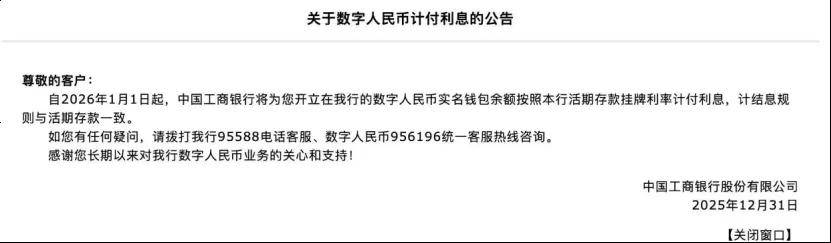
六大国有银行公告:数字人民币实名钱包余额明起计付利息
Sou Hu Cai Jing· 2026-01-01 04:42
Core Viewpoint - Starting January 1, 2026, several major banks in China, including Industrial and Commercial Bank of China, Agricultural Bank of China, Bank of China, China Construction Bank, Bank of Communications, and Postal Savings Bank, will offer interest on the balances of digital RMB real-name wallets at the same rate as current deposit rates [1] Group 1 - The interest calculation rules for digital RMB wallets will align with those of current deposits [1] - China Construction Bank's announcement specifies that four types of wallets are excluded from this interest policy [1] - Bank of Communications states that if a customer opens a type four personal digital RMB wallet, the balance will not earn interest [1]
银行“抢滩”年终奖 跨年理财高收益获投资者青睐
2 1 Shi Ji Jing Ji Bao Dao· 2026-01-01 03:18
Core Insights - The article discusses the increasing demand for wealth management products as year-end bonuses are being distributed, highlighting a competitive marketing environment among banks to attract customers [1][2][4] Group 1: Bank Marketing Strategies - Banks are launching exclusive wealth management activities and products to capture the influx of year-end bonuses, with a focus on flexible redemption and low entry thresholds [2][8] - For example, Bank of Communications has introduced a series of wealth management products with an annualized return of 4.68%, allowing daily purchases and redemptions starting from 1 yuan [2][8] - Industrial and Commercial Bank of China is promoting three wealth management products, with one offering a near-month annualized return of 3.09% and a minimum investment of 1 yuan [2][8] Group 2: Product Design Trends - Mid to low-risk products are becoming mainstream for year-end bonus investments, balancing risk control with potential returns to meet the demand for stable investments [3][9] - The trend of lowering investment thresholds, such as allowing purchases from 1 yuan, is expanding the customer base to include ordinary investors with small amounts of idle funds [3][9] - Traditional deposit products are also being enhanced, with Tianjin Bank offering a three-year deposit with a higher annual interest rate of 1.85%, appealing to conservative investors [3][9] Group 3: Investor Preferences - Investors are showing a preference for stable wealth management options, with many prioritizing safety over high returns when managing their year-end bonuses [4][10] - A common strategy among investors is to allocate funds based on purpose, with approximately 10% for emergency cash, 30-40% for liquidity, and over 50% for medium to long-term investments [5][11] - The trend towards "cross-year wealth management" is noted, where investors seek flexible products that do not interfere with holiday spending while still providing higher returns than regular products [6][12]
今日正式实施!揭秘新一代数字人民币计量框架:从数字现金到数字存款货币 对银行机构和个人有何实质影响?
Sou Hu Cai Jing· 2026-01-01 01:53
根据行动方案,新一代数字人民币计量框架、管理体系、运行机制和生态体系将于2026年1月1日正式启 动实施。对此,智通财经记者采访多位专家,从数字人民币到底有何变化,对商业银行及个人投资者有 何影响,进行多维度解读。 "新"在哪里? "首先,数字人民币的负债主体有了变化。"一位专家对智通财经记者表示,此前,数字人民币是中国人 民银行发行的法定数字货币,是数字现金,即现金的数字形式。 来源:智通财经 近日,中国人民银行出台《关于进一步加强数字人民币管理服务体系和相关金融基础设施建设的行动方 案》。 "如今,变成数字人民币存款后,商业银行就可以对数字人民币钱包的余额开展资产负债经营管理,这 有助于调动商业银行展业的积极性。"管涛进一步解释。 "这意味着,此前,数字人民币是中央银行对公众的负债。"专家指出,"新一代数字人民币计量框架 中,数字人民币负债主体有了变化,不再是中央银行对公众的负债,而成为商业银行的负债。" "这就标志着,数字人民币由现金型1.0版,进入了存款货币型数字人民币2.0版。"另一位行业专家对智 通财经记者表示,"也就是说,现阶段,从货币角度,数字人民币的定位,从流通中现金转变为了存 款。" 专家 ...
今日正式实施!揭秘新一代数字人民币计量框架
财联社· 2026-01-01 01:32
近日,中国人民银行出台《关于进一步加强数字人民币管理服务体系和相关金融基础设施建设的行动方案》。 根据行动方案,新一代数字人民币计量框架、管理体系、运行机制和生态体系将于2026年1月1日正式启动实施。 对此,财联社记者采访多 位专家,从数字人民币到底有何变化,对商业银行及个人投资者有何影响,进行多维度解读。 那么,新一代数字人民币计量框架对商业银行有何实质性影响? 中国人民银行党委委员、副行长陆磊在近日的署名文章中也提到,要"建立科学合理的权责对称关系是数字现金机制设计中不容回避的问 题。" "新"在哪里? "首先,数字人民币的负债主体有了变化。"一位专家对财联社记者表示, 此前,数字人民币是中国人民银行发行的法定数字货币,是数字 现金,即现金的数字形式。 "这意味着,此前,数字人民币是中央银行对公众的负债。"专家指出,"新一代数字人民币计量框架中,数字人民币负债主体有了变化,不 再是中央银行对公众的负债,而成为商业银行的负债。" "这就标志着,数字人民币由现金型1.0版,进入了存款货币型数字人民币2.0版。"另一位行业专家对财联社记者表示,"也就是说,现阶 段,从货币角度,数字人民币的定位,从流通中现金转 ...

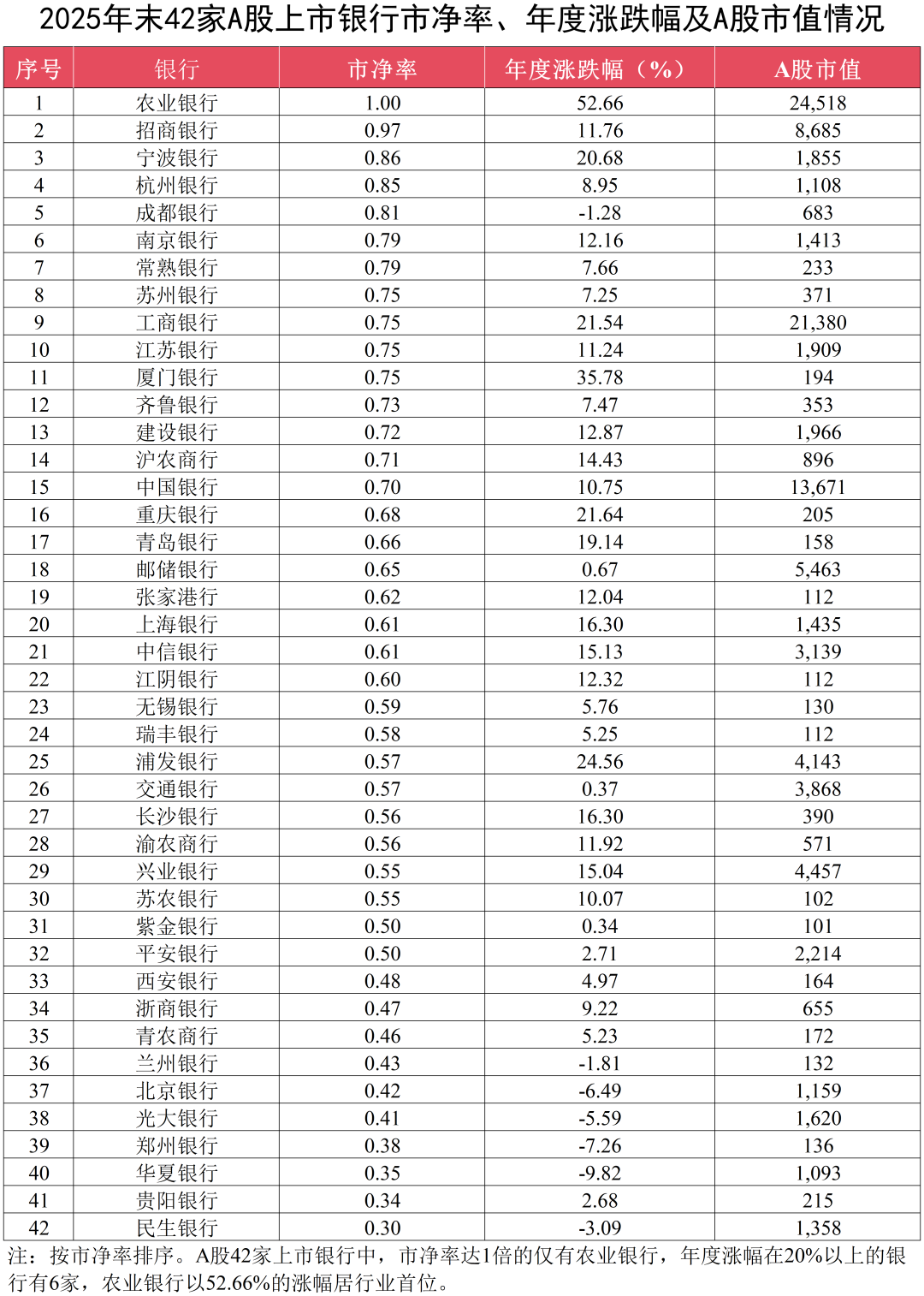
盘点2025年A股上市银行全年表现,农行A、H股价涨幅领先同业
Xin Lang Cai Jing· 2026-01-01 01:17
| 序号 | 银行 | 市净率 | 年度涨跌幅(%) | A股市值 | | --- | --- | --- | --- | --- | | l | 农业银行 | 1.00 | 52.66 | 24,518 | | 2 | 招商银行 | 0.97 | 11.76 | 8,685 | | 3 | 宁波银行 | 0.86 | 20.68 | 1,855 | | 4 | 杭州银行 | 0.85 | 8.95 | 1,108 | | 5 | 成都银行 | 0.81 | -1.28 | 683 | | 6 | 南京银行 | 0.79 | 12.16 | 1,413 | | 7 | 常熟银行 | 0.79 | 7.66 | 233 | | 8 | 苏州银行 | 0.75 | 7.25 | 371 | | 9 | 工商银行 | 0.75 | 21.54 | 21,380 | | 10 | 江苏银行 | 0.75 | 11.24 | 1,909 | | 11 | 厦门银行 | 0.75 | 35.78 | 194 | | 12 | 齐鲁银行 | 0.73 | 7.47 | 353 | | 13 | 建设银行 | 0.72 | ...
2025银行股业绩梳理
2 1 Shi Ji Jing Ji Bao Dao· 2025-12-31 23:42
Core Viewpoint - The A-share banking sector experienced a year of volatility in 2025, with an overall increase of 7%, which is significantly lower than the 34.39% gain in 2024, yet many individual bank stocks reached historical highs [1][3]. Group 1: Market Performance - By the end of 2025, 35 out of 42 bank stocks in the sector recorded gains, with 20 banks hitting historical highs and 21 banks increasing by over 10%, while 6 banks saw gains exceeding 20% [1][6]. - Agricultural Bank of China saw a remarkable stock price increase of over 52% during the year, briefly surpassing Industrial and Commercial Bank of China (ICBC) in market capitalization [1][3]. - ICBC maintained its position as the "king of stocks" with a market capitalization of 2.63 trillion yuan and a stock price increase of 21.54% [1][3]. Group 2: IPO Market - The A-share IPO market for banks remained stagnant in 2025, with no new listings, as several banks, including Guangzhou Bank, withdrew their applications [2][11]. - The only banks still in the IPO queue are Dongguan Bank, Huzhou Bank, Hubei Bank, Jiangsu Kunshan Rural Commercial Bank, and Guangdong Nanhai Rural Commercial Bank [11]. Group 3: Investment Trends - Long-term funds, particularly insurance capital, have been actively purchasing bank stocks, with insurance companies holding 382.5 million shares valued at 37.976 billion yuan by the end of Q3 2025 [8]. - The "stock accumulation for dividends" strategy has gained popularity among investors, with 28 out of 42 listed banks offering dividend yields above 4% [7][8]. Group 4: Capital Support - In 2025, state-owned banks received significant capital injections, with a total of approximately 520 billion yuan raised through targeted placements to enhance their capital structure [10]. - Meanwhile, smaller banks attracted investments from foreign and local state-owned enterprises, although the IPO process remains challenging for most [10][11].
2025年度A股股权承销排行榜
Wind万得· 2025-12-31 22:50
Core Viewpoint - In 2025, the A-share equity financing market experienced a significant rebound, with a total of 315 fundraising events, raising over 1 trillion yuan, marking a year-on-year increase of 226.10% [2][4]. Group 1: Financing Overview - The total amount raised through equity financing in 2025 reached 10,222.68 billion yuan, an increase of 226.10% compared to the previous year [4]. - The IPO market saw 112 issuances, raising 1,308.35 billion yuan, a year-on-year increase of 97.40% [4][22]. - The private placement market expanded significantly with 157 issuances, raising 8,267.20 billion yuan, a growth of 300.05% [4][40]. Group 2: Financing Method Distribution - In 2025, the distribution of financing methods showed that IPOs accounted for 12.80% of the total amount raised, while private placements dominated with 80.87% [8][11]. - Convertible bonds represented 6.33% of the total financing, with 46 issuances raising 647.13 billion yuan [8][11]. Group 3: Industry Distribution of Financing Entities - The banking sector led the fundraising efforts with 5,200 billion yuan, followed by the semiconductor industry with 714.53 billion yuan, and the public utilities sector with 555.05 billion yuan [13][48]. Group 4: Regional Distribution of Financing - Beijing ranked first in fundraising with 4,451.82 billion yuan from 24 projects, followed by Shanghai with 1,875.94 billion yuan from 34 projects, and Guangdong with 964.76 billion yuan from 49 projects [16][19]. Group 5: IPO Trends - The quarterly breakdown of IPOs showed a significant recovery in the third and fourth quarters, with total issuances of 27, 21, 28, and 36 respectively [22]. - The main boards and the innovation board contributed significantly to the total fundraising, with the innovation board raising 378.45 billion yuan, accounting for 28.93% of the total [25]. Group 6: Underwriting Rankings - CITIC Securities topped the underwriting rankings with a total amount of 2,416.68 billion yuan, followed by Guotai Junan with 1,506.59 billion yuan, and CICC with 1,374.87 billion yuan [60][61]. - In terms of the number of underwriting projects, CITIC Securities also led with 61 projects, while Guotai Junan followed with 47 projects [64].