
年终奖理财

Search documents
年终奖到手别乱花!不同人群理财方案全解析,安全第一
Sou Hu Cai Jing· 2026-02-07 03:27
Group 1 - The core viewpoint of the article highlights the rising trend of year-end bonus investment as the 2026 Spring Festival approaches, with popular choices including large time deposits, stable funds, and gold products [1] Group 2 - The demand for investment products is driven by banks competing in the "year-end bonus investment" market, with institutions like Bank of Communications, Postal Savings Bank, and China Merchants Bank offering one-stop services for deposits, funds, and insurance [2] - Current interest rates for one-year deposits at state-owned banks have dropped to 1.75%, while large time deposit rates range from 2% to 3%, prompting investors to seek higher returns through diversified investments [3] Group 3 - Three types of investment strategies are suggested for different demographics: - Conservative strategy for low to middle-income earners includes setting aside emergency funds in money market funds and investing in government bonds for medium-term goals [4][5] - Balanced strategy for middle-class families involves allocating funds to long-term government bonds, stable financial products, and maintaining liquidity through money market funds [8] - Aggressive strategy for high-net-worth individuals focuses on low-volatility bank products or gold ETFs, along with thematic funds for potential excess returns [8][9] Group 4 - The article warns against potential risks associated with year-end bonus investments, including scams promising high returns, liquidity mismatches, and the dangers of following investment trends without proper analysis [13] - Practical advice includes managing funds through separate accounts, utilizing tax benefits from personal pension accounts, and adhering to a disciplined saving approach [14][15]

你的年终奖,银行已备好专属理财方案
Jin Rong Shi Bao· 2026-02-06 09:41
Group 1 - The core viewpoint of the articles highlights the increasing focus of banks on year-end bonus wealth management products, reflecting a shift towards providing comprehensive asset allocation services to meet the evolving needs of investors [1][2][3] - Major banks, including Industrial and Commercial Bank of China and Bank of Communications, are launching specialized products for year-end bonuses, emphasizing low investment thresholds and diverse strategies to cater to different investor needs [1][2] - The year-end bonus wealth management market is experiencing growth, driven by banks' proactive strategies and a rising awareness among residents regarding rational financial management [2][3] Group 2 - The annual report from the China Banking Association indicates that by the end of 2025, the total scale of the wealth management market in China is expected to reach 33.29 trillion yuan, reflecting an 11.15% increase from the beginning of the year [3][4] - The number of individual investors holding wealth management products has reached 143 million, marking a year-on-year growth of 14.37%, indicating a growing trend in wealth management participation among residents [3][4] - The wealth management market is transitioning towards a phase of structural deepening and quality growth, with a focus on optimizing internal structures rather than just expanding absolute scale [4][5]




年终奖怎么打理?这份年终奖“一站式”理财配置指南请收好
2 1 Shi Ji Jing Ji Bao Dao· 2026-02-05 11:29
Group 1 - The core idea of the article revolves around the various investment options available for year-end bonuses, highlighting the challenges posed by low bank interest rates, stock market volatility, and high gold prices [1] - Many banks are offering "one-stop" wealth management products tailored for year-end bonuses, allowing employees to choose investment plans based on risk levels and intended use of funds [3][4] Group 2 - Investment plans are categorized into two main strategies: one based on risk levels (conservative, stable, aggressive) and the other based on the intended duration of fund usage (short-term, medium-term, long-term) [3] - Examples of recommended products include six options from Agricultural Bank of China focusing on liquidity and varying investment durations, and three deposit products from Shanghai Pudong Development Bank with interest rates ranging from 1.3% to 1.75% [4] Group 3 - Most recommended products are of medium to low risk, such as Agricultural Bank's "Agricultural Heart. Flexible 30 Days" with a historical annualized return of 2.16% and "Agricultural Progress. Flexible 180 Days" with an annualized return of 11.89% [5][6] - Some high-risk products are also included, such as Minsheng Bank's recommendations for two high-risk ETFs focused on non-ferrous metals and broad-based indices, suitable for experienced investors [7] Group 4 - Investors are advised to plan their fund usage in advance to ensure liquidity, consider their risk tolerance when allocating investments, and remain cautious of promotional offers from companies to avoid scams [8]

年终奖如何理财:银行资产提升“薅羊毛”攻略来了
2 1 Shi Ji Jing Ji Bao Dao· 2026-02-04 01:47
Core Viewpoint - As the year-end approaches, employees are eagerly anticipating their year-end bonuses, with many considering investment options that may offer higher returns than their mortgage rates [1] Group 1: Year-End Bonus Investment Trends - Multiple banks have launched specialized services for year-end bonus investments, offering a variety of products including deposits, wealth management, funds, insurance, and precious metals [1] - Postal Savings Bank has introduced three low to medium-risk investment products with flexible terms, with annualized returns exceeding 4% for certain options [2] - Construction Bank suggests a strategic allocation of year-end bonuses into four categories, including daily expenses, risk protection, stable savings, and capital market investments [6] Group 2: Marketing Strategies by Banks - Major banks are implementing asset enhancement plans to increase customer retention and attract new clients, utilizing incentives such as points and cash rewards [7] - Agricultural Bank has launched a rewards program for customers who increase their average assets, offering various incentives based on the amount of increase [8] - Banks are focusing on year-end bonuses as a stable source of idle funds, aligning with their goals to optimize liability structures and enhance asset management [9] Group 3: Investor Guidance - Investors are advised to assess their financial situation and investment goals before making decisions regarding year-end bonuses, focusing on liquidity and risk tolerance [10] - It is recommended that investors integrate their year-end bonuses into their overall wealth management strategy to maintain a balanced asset structure [10] - Caution is advised regarding marketing promotions, with a focus on understanding product terms and ensuring alignment with personal financial plans [11]
银行“年终奖理财”卷疯,有人2万元定投黄金
Xin Lang Cai Jing· 2026-02-02 08:12
Core Insights - The year-end bonus wealth management market is heating up as financial institutions launch specialized products and services for year-end bonuses [2][12] - There is a shift in marketing strategies among banks, focusing on integrated financial products and personalized asset allocation based on customer risk preferences and fund usage [2][12] Financial Institutions' Offerings - Major state-owned banks, joint-stock banks, and city commercial banks are actively competing for year-end bonuses, with products primarily in the R2 stable category [3][14] - Notable offerings include: - Bank of Communications' "Year-End Bonus Good Place" with a near 3-month annualized return of 4.93% for short-term idle funds [3][14] - Industrial and Commercial Bank of China's "Salary Manager" promoting low-entry and diverse strategy products with over 3% annualized return [3][14] - Citic Bank's year-end bonus wealth management plan with annualized rates up to 2.13% and additional rewards [5][16] - Suzhou Bank's products covering a wide range of annualized returns from 1.68% to 12.32% [5][16] Market Trends - The low-interest-rate environment has led to more rational financial management among residents, prioritizing stability and layered asset allocation [2][7] - Investors are increasingly focused on "certain returns," avoiding high-risk investments like stocks and funds [7][18] Investor Behavior - Investors are adopting a layered allocation strategy, balancing safety and liquidity with a focus on stable returns [7][18] - Examples include: - An investor allocating 30,000 yuan to a bank's fixed deposit at 1.8% and 30,000 yuan to R2 short-term products for liquidity [18][20] - Another investor planning to invest 60% in fixed-income products and 20% in index funds, reflecting a cautious approach [20][18] Product Differentiation - Wealth management subsidiaries are creating differentiated product matrices, such as the "New Salary Treasure" series from Bank of Communications, with annualized returns up to 4.91% [6][17] - The core attributes of year-end bonus themed wealth management products align with traditional wealth management, focusing on low to medium risk investments [6][17]

如何打理你的年终奖?中小银行密集上线专属理财,主打稳健型产品
Hua Xia Shi Bao· 2026-01-30 13:05
Core Viewpoint - The demand for year-end bonus financial products is increasing as investors seek stable returns and flexible liquidity options, prompting banks to launch specialized financial products to capture market share [2][4][5]. Group 1: Market Trends - There is a noticeable increase in inquiries about financial products, with clients focusing on "controllable risk" and "stable returns," particularly for short-term and mid-to-long-term investment options [2][3]. - Several small and medium-sized banks have launched year-end bonus exclusive financial activities, offering a variety of products to attract customers [4][5]. Group 2: Product Offerings - Jiangsu Siyang Rural Commercial Bank has introduced a comprehensive product lineup covering deposits, financial products, funds, precious metals, and insurance, encouraging customer participation through promotional activities [4]. - Inner Mongolia Bank has focused on a one-stop wealth management approach, offering cash management products with flexible redemption and mid-to-long-term financial products with annualized returns of 4.05% and 4.40% [4]. - Dalian Bank has launched a closed-end financial product series with a minimum investment of 10,000 yuan and a performance benchmark of 2.40%, targeting fixed income and non-guaranteed floating returns [4]. Group 3: Investor Behavior - Investors are actively comparing different banks' exclusive offerings, reflecting a diverse range of investment strategies, including allocating funds for savings, debt repayment, and higher-yield investments [5][6]. - The discussion around year-end bonus financial products is gaining traction on social media, indicating a growing interest among the public [5]. Group 4: Industry Insights - The shift towards differentiated and comprehensive financial product offerings by banks is a response to the low-interest-rate environment, aiming to meet clients' comprehensive wealth management needs [6]. - The annual report projects that by the end of 2025, the total scale of the financial market will reach 33.29 trillion yuan, with a year-on-year growth of 11.15% [6]. - The number of individual investors holding financial products is expected to reach 143 million, reflecting a 14.37% increase year-on-year [6]. Group 5: Recommendations - Investors are advised to consider their liquidity needs, risk tolerance, and existing asset structure when choosing financial products, especially during promotional periods [7][8]. - For short-term idle funds, daily open cash management products are recommended, while mid-term funds can be allocated to "fixed income+" products with a holding period of 3-6 months [8].

“买股票怕追高,放存款又觉得赚得太少?”专家:年终奖理财正转向配置导向
第一财经· 2026-01-28 15:19
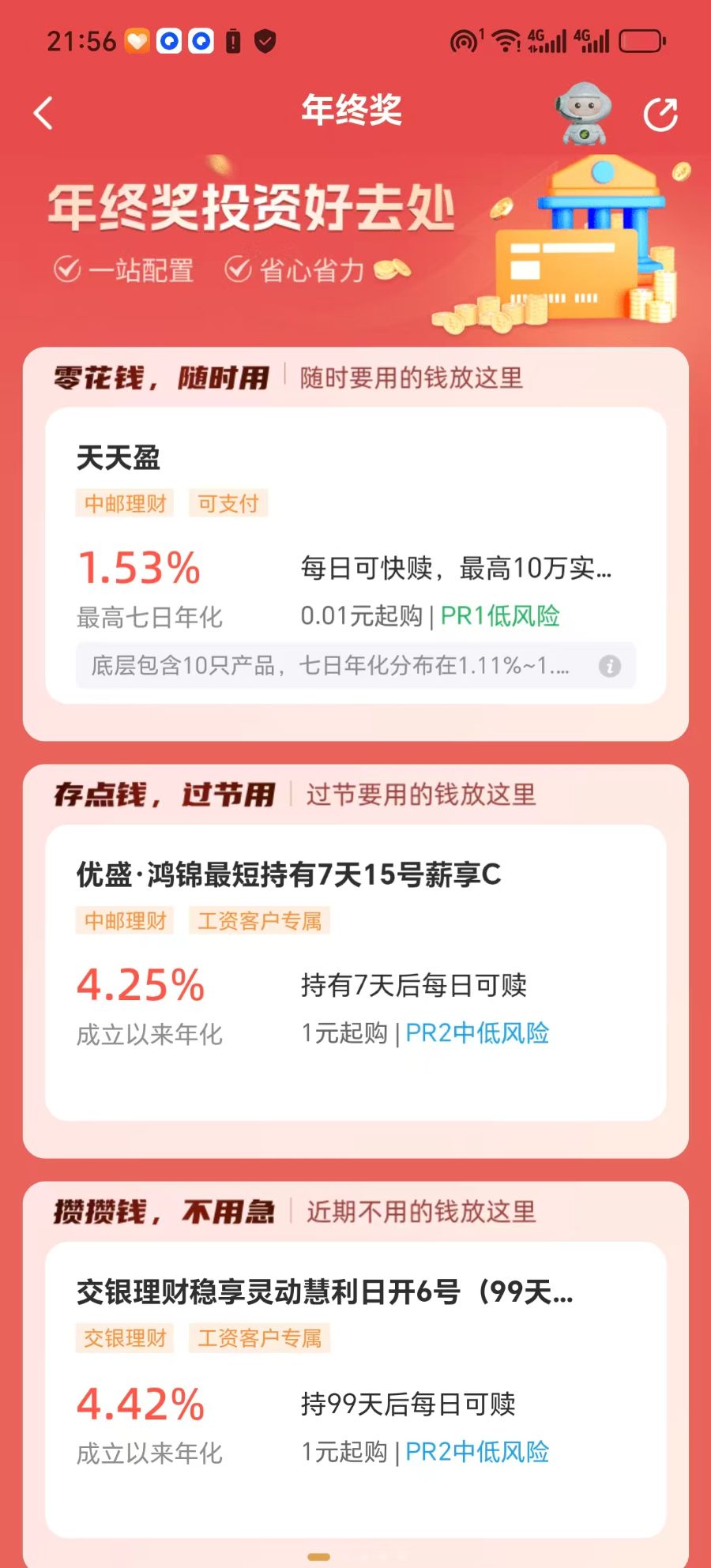
Core Viewpoint - The article discusses the challenges faced by individual investors in allocating their year-end bonuses amidst rising market volatility and the performance of various investment products, highlighting the shift in banks' strategies to offer diversified financial products to attract these funds [3][8]. Group 1: Market Environment and Trends - Since the beginning of 2026, gold prices have surged significantly, with spot gold exceeding $5,220 per ounce, reflecting a year-to-date increase of approximately 20%. The Shanghai Composite Index and Hang Seng Index have also shown gains of 4.82% and 8.17%, respectively [9]. - The total scale of the national wealth management market reached 33.29 trillion yuan by the end of 2025, an increase of over 3 trillion yuan from the beginning of the year, with the number of investors holding wealth management products growing by 14.37% year-on-year to 143 million [9]. Group 2: Bank Strategies and Product Offerings - Major state-owned banks have launched year-end bonus financial products characterized by low investment thresholds and stable returns, aiming to lower the entry barrier for individual investors [4][8]. - The products offered include flexible terms, covering demand for liquidity and varying investment horizons, with a focus on a combination of financial tools such as deposits, wealth management, funds, and insurance [8]. - Specific offerings include the "Lingdong Tianli 6" product from the Bank of Communications with an annualized yield exceeding 4% for short-term investments, and the Postal Savings Bank's "Tian Tian Ying" product, which allows for daily redemption with a minimum investment of 0.01 yuan [4][5]. Group 3: Marketing and Customer Engagement - Banks are employing incentive mechanisms to enhance the retention of year-end bonus funds, such as offering cash rewards for increasing average monthly assets [6]. - The marketing approach has shifted from a product-centric focus to a configuration-oriented strategy, emphasizing comprehensive asset management to meet diverse customer needs [8]. - The article notes that the success of year-end bonus financial marketing in translating into actual asset under management (AUM) growth will depend on the performance of the products, transparency in information disclosure, and the quality of post-investment services [9].

从卖产品到配资产,银行年终奖理财热度升温
Di Yi Cai Jing Zi Xun· 2026-01-28 12:53
Core Viewpoint - The article discusses the challenges faced by individual investors in allocating their year-end bonuses amidst rising stock and gold prices, while banks are actively launching specialized financial products to attract these funds [1] Group 1: Market Trends - Since 2026, gold prices have significantly increased, with the Shanghai Composite Index rising by 4.82% and the Hang Seng Index by 8.17% within the year [6] - The total scale of the national wealth management market reached 33.29 trillion yuan by the end of 2025, growing by over 3 trillion yuan from the beginning of the year [6] Group 2: Bank Initiatives - Major state-owned banks and various commercial banks have launched year-end bonus exclusive financial products, focusing on low-risk, flexible-term options to cater to investors' needs [2][3] - The products include short-term and medium-term options, with some banks offering annualized returns exceeding 4% for short-term investments [2][3] Group 3: Product Features - Banks are emphasizing low initial investment amounts and a variety of strategies, with many products starting at 1 yuan and offering annualized returns around 3% to 4% [3][5] - The marketing strategies have shifted from product-centric to configuration-oriented, integrating various financial tools to better meet customer needs [5] Group 4: Customer Engagement - Some banks are implementing incentive mechanisms to enhance the retention of year-end bonus funds, such as cash rewards for increasing average monthly assets [4] - The focus is on providing a one-stop management solution for year-end bonuses, combining wealth management, insurance, and investment products [5]
各家银行提前布局年终奖专属理财
Jin Rong Shi Bao· 2026-01-06 02:17
Core Insights - The competition for year-end bonuses among banks and wealth management companies is intensifying, with various institutions implementing diverse strategies to attract clients through specialized financial products and marketing campaigns [1][2][4] Group 1: Marketing Strategies - Major state-owned banks are leveraging their customer base to lead the year-end bonus wealth management marketing battle, primarily through online exclusive activities [2][4] - Banks are offering a range of year-end bonus exclusive financial products, such as the "灵动添利6号新薪宝" from China Everbright Bank, which has an annualized yield of 4.76% for a three-month term [2][4] - Marketing activities like "升金有礼" from Industrial and Commercial Bank of China are designed to enhance customer engagement and retention, offering rewards based on asset growth [6] Group 2: Product Offerings - The year-end bonus wealth management products are characterized by a focus on stability and flexibility, with a predominance of medium to low-risk options that cater to various liquidity needs [5] - Financial products are designed to align with specific funding scenarios, maintaining a structure that adheres to mainstream market frameworks while targeting precise customer needs [5] - Banks are creating comprehensive asset allocation solutions that integrate various financial products, including deposits, wealth management, funds, and insurance, to meet diverse customer requirements [4][5] Group 3: Customer Guidance - Financial experts emphasize the importance of investors assessing their financial situation and risk tolerance before engaging in wealth management activities related to year-end bonuses [7] - Investors are advised to maintain independent judgment and critically evaluate marketing promotions, understanding that performance benchmarks are not guarantees of returns [7] - Recommendations include prioritizing liquidity for short-term needs and considering higher-yield products for long-term investments [7]

银行“抢滩”年终奖 跨年理财高收益获投资者青睐
2 1 Shi Ji Jing Ji Bao Dao· 2026-01-01 03:18
Core Insights - The article discusses the increasing demand for wealth management products as year-end bonuses are being distributed, highlighting a competitive marketing environment among banks to attract customers [1][2][4] Group 1: Bank Marketing Strategies - Banks are launching exclusive wealth management activities and products to capture the influx of year-end bonuses, with a focus on flexible redemption and low entry thresholds [2][8] - For example, Bank of Communications has introduced a series of wealth management products with an annualized return of 4.68%, allowing daily purchases and redemptions starting from 1 yuan [2][8] - Industrial and Commercial Bank of China is promoting three wealth management products, with one offering a near-month annualized return of 3.09% and a minimum investment of 1 yuan [2][8] Group 2: Product Design Trends - Mid to low-risk products are becoming mainstream for year-end bonus investments, balancing risk control with potential returns to meet the demand for stable investments [3][9] - The trend of lowering investment thresholds, such as allowing purchases from 1 yuan, is expanding the customer base to include ordinary investors with small amounts of idle funds [3][9] - Traditional deposit products are also being enhanced, with Tianjin Bank offering a three-year deposit with a higher annual interest rate of 1.85%, appealing to conservative investors [3][9] Group 3: Investor Preferences - Investors are showing a preference for stable wealth management options, with many prioritizing safety over high returns when managing their year-end bonuses [4][10] - A common strategy among investors is to allocate funds based on purpose, with approximately 10% for emergency cash, 30-40% for liquidity, and over 50% for medium to long-term investments [5][11] - The trend towards "cross-year wealth management" is noted, where investors seek flexible products that do not interfere with holiday spending while still providing higher returns than regular products [6][12]