
中信银行

Search documents
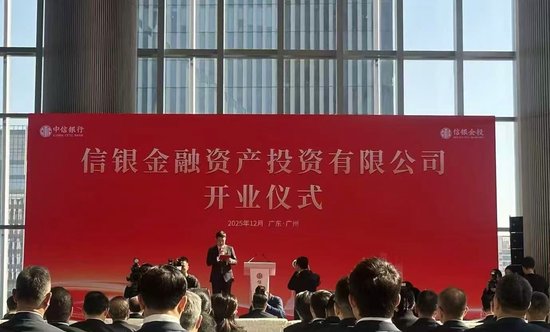
21现场|百亿AIC正式落子广州天河 信银金投今日揭牌开业
2 1 Shi Ji Jing Ji Bao Dao· 2025-12-17 05:21
Core Points - The establishment of Xinyin Financial Asset Investment Co., Ltd. marks the opening of the second shareholding bank financial asset investment company in China, with a registered capital of 10 billion yuan [3][4] - The company aims to support the development of the Guangdong-Hong Kong-Macao Greater Bay Area and contribute to China's modernization through strategic investments [3][4] Company Overview - Xinyin Financial Asset Investment Co., Ltd. is a wholly-owned subsidiary of CITIC Bank, approved for operation by the National Financial Supervision Administration on November 21, 2025 [3] - The company is positioned as a key player in enhancing CITIC Group's comprehensive financial capabilities and brand excellence [3][4] Strategic Goals - The company will focus on serving high-level technological self-reliance and supporting the construction of a modern industrial system [4] - It aims to strengthen "patient capital" to support the real economy and actively participate in the development of strategic emerging industries [4] - Xinyin Financial will engage in market-oriented debt-to-equity swaps and equity investment in key sectors, enhancing support for technology innovation and private enterprises [4]




百亿AIC正式落子广州天河 信银金投今日揭牌开业
Xin Lang Cai Jing· 2025-12-17 05:15
Core Viewpoint - The establishment of Xinyin Financial Asset Investment Co., Ltd. marks the opening of the second shareholding bank financial asset investment company (AIC) in China, aiming to support national strategies and the development of the Guangdong-Hong Kong-Macao Greater Bay Area [1][3][6]. Group 1: Company Overview - Xinyin Financial Asset Investment Co., Ltd. is a wholly-owned subsidiary of CITIC Bank with a registered capital of 10 billion yuan [3][6]. - The company aims to leverage its establishment to contribute to the modernization of China's financial services and support the development of strategic emerging industries [3][6]. Group 2: Strategic Goals - The company is committed to serving high-level technological self-reliance and modern industrial system construction, focusing on supporting the real economy and enhancing "patient capital" strength [4][7]. - Xinyin Financial will engage in market-oriented debt-to-equity swaps and equity investment, particularly in strategic emerging industries, to support innovation and private enterprises [4][7]. Group 3: Partnerships and Collaborations - On the day of its opening, Xinyin Financial signed cooperation agreements with 12 companies in sectors such as technology finance, intelligent manufacturing, and green energy [4][7].
多家银行调整代理上金所贵金属业务,重点“清理”无持仓不动户
Jing Ji Guan Cha Wang· 2025-12-17 04:31
Core Viewpoint - The tightening of personal precious metals trading by banks acting as agents for the Shanghai Gold Exchange is aimed at managing market risks, complying with regulatory pressures, and fulfilling investor suitability obligations, leading to a more concentrated and mature market structure focused on institutional clients [1][3]. Group 1: Bank Adjustments - Several banks, including Industrial and Commercial Bank of China (ICBC), have announced adjustments to their personal precious metals trading business, actively clearing inactive "three-no" clients (no positions, no inventory, no debts) [2][3]. - ICBC's announcement states that from December 19, 2025, it will transfer the balances of these clients' margin accounts to their linked settlement accounts and terminate related business functions [2][3]. - Other banks such as Agricultural Bank of China and China Postal Savings Bank have also made similar announcements regarding the termination of agreements with inactive clients [2]. Group 2: Market Implications - Experts believe that the exit of personal investors from bank channels may lead to a decrease in trading volume and a return of margin funds, while also pushing investors towards futures companies, brokerages, or physical gold platforms, accelerating the differentiation and specialization of precious metals investment channels [4][5]. - The adjustments are expected to help investors reassess the risk-return characteristics of gold investments, promoting a shift from short-term speculation to long-term asset allocation [4][5]. Group 3: Transformation of Banking Precious Metals Business - The retail side of banking precious metals business is transitioning from a trading channel to asset allocation services, moving away from high-risk, high-leverage products towards more stable financial products like gold ETFs [5]. - This shift indicates a transformation in the retail precious metals business model from providing trading channels and physical sales to offering asset allocation services and standardized financial products [5]. - Future growth opportunities for banks in the precious metals sector include promoting lower-risk investment products such as accumulated gold and physical gold bar sales, catering to residents' demand for hedging and asset allocation [5].





港股通央企红利ETF(159266)已连续3日遭遇资金净赎回,区间净流出额897.44万元
Xin Lang Cai Jing· 2025-12-17 02:35
Core Viewpoint - The Hong Kong Stock Connect Central State-Owned Enterprises Dividend ETF (159266) has experienced significant net redemptions recently, indicating a trend of capital outflow from this fund [1][2]. Group 1: Fund Performance - On December 16, the ETF faced a net redemption of 3.9496 million yuan, ranking 14th out of 201 in terms of cross-border ETF net outflows [1]. - The latest fund size is 664 million yuan, down from 680 million yuan the previous day, with a net outflow representing 0.58% of the prior day's size [1]. - Over the past five days, the ETF has seen net redemptions totaling 9.9773 million yuan, ranking 20th out of 201 in cross-border ETF net outflows [1]. - In the last 20 days, the total net redemptions reached 36.7218 million yuan, placing it 19th out of 201 in the same category [1]. Group 2: Fund Details - The Hong Kong Stock Connect Central State-Owned Enterprises Dividend ETF (159266) was established on July 23, 2025, with an annual management fee of 0.50% and a custody fee of 0.10% [2]. - As of December 16, the ETF has a total of 670 million shares outstanding [3]. - The fund's recent trading activity shows a cumulative transaction amount of 286 million yuan over the last 20 trading days, with an average daily transaction amount of 14.28 million yuan [3]. Group 3: Fund Management and Holdings - The current fund managers are Liu Tingyu and Cai Leping, with respective returns of -0.84% and -3.57% since their management began [3]. - The ETF's top holdings include China COSCO Shipping, China Nonferrous Mining, China National Offshore Oil, and others, with significant percentages of the portfolio allocated to these stocks [3].
辽宁省中小企业新型工业化院揭牌成立
Liao Ning Ri Bao· 2025-12-17 01:37
Group 1 - The establishment of the Liaoning Province Small and Medium Enterprises (SMEs) New Industrialization Institute aims to create an innovative platform that integrates policy promotion, industry connection, achievement transformation, and talent cultivation for SMEs [1] - The collaboration between the Provincial Department of Industry and Information Technology and Shenyang University of Technology is designed to bridge the gap between university research resources and the development needs of SMEs, enhancing innovation capacity, technology research and development, and talent training [1] - Strategic cooperation agreements were signed with Citic Bank Shenyang Branch and Liao Shen Bank to innovate financial products and service models, addressing the financing difficulties faced by SMEs and injecting financial vitality into their high-quality development [1]
为何“金融大咖”都爱天河 答案藏在营商环境细节里
Nan Fang Du Shi Bao· 2025-12-16 23:07
Core Insights - The establishment of CITIC AIC's national headquarters in Tianhe District signifies a strategic move to leverage the area's strong business environment and innovation capabilities [2][3] - Tianhe District has consistently ranked first in Guangzhou for the number of enterprises, showcasing its robust economic landscape and favorable conditions for business growth [7][9] Group 1: Financing and Policy Innovations - CITIC AIC offers innovative financing services, including a 30-second online smart matching for financing needs and a one-stop solution through collaboration with local banks [2][8] - The district has developed a "policy calculator" that generates personalized application checklists for businesses based on key input tags [2][8] - Tianhe's business environment observation service stations ensure that enterprise demands are heard and addressed effectively [2][8] Group 2: Strategic Importance of Tianhe District - Tianhe District is home to 50% of the top-tier universities in the Guangdong-Hong Kong-Macao Greater Bay Area, making it a hub for technology and innovation [3] - The district has attracted significant projects, including a 15 billion yuan investment in a smart cold chain industrial park, indicating its appeal to high-quality industries [5][6] - The financial ecosystem in Tianhe, with 80% of licensed financial institutions in Guangzhou, supports a comprehensive financial service model for technology enterprises [4][6] Group 3: Economic Growth and Development Policies - Tianhe District has introduced a series of high-quality development policies, investing over 1 billion yuan annually to support emerging industries and optimize traditional sectors [6][9] - The district's strategic industries, including artificial intelligence and biomedicine, have shown strong growth, with core industries growing at rates of 7.3% and 9.6% respectively [9] - The area has seen the introduction of 232 high-quality industrial projects in the first three quarters of the year, reflecting its successful investment attraction efforts [5][6]

【省商务厅】陕西科创企业赴港上市融资与跨境出海业务对接座谈会举办
Shan Xi Ri Bao· 2025-12-16 22:46
Core Viewpoint - The meeting aims to promote the utilization of international capital markets by Shaanxi enterprises for high-quality development through listing in Hong Kong and cross-border business opportunities [1] Group 1: Event Overview - The seminar was held on December 15, co-hosted by various financial and business institutions in Shaanxi, including the Shaanxi Provincial Financial Office and the Hong Kong Trade Development Council [1] - It focused on discussing the pathways for Shaanxi enterprises to list in Hong Kong and explore cross-border development opportunities [1] Group 2: Financial Services and Support - Citic Bank's Xi'an branch presented comprehensive financial service solutions and specialized product systems tailored for the cross-border financial needs of Shaanxi enterprises before and after their listing in Hong Kong [1] - The Hong Kong Trade Development Council's representative shared the latest developments in the Hong Kong capital market, highlighting the advantages of listing there and the support system for mainland enterprises [1] Group 3: Strategic Importance - Promoting listings and cross-border ventures is a crucial measure for Shaanxi to deepen financial openness, serve the real economy, and cultivate new productive forces [1] - The Shaanxi Capital Market Service Center plans to continue collaborating with financial institutions under the guidance of the Shaanxi Provincial Financial Office and the Shaanxi Securities Regulatory Commission to support enterprises in expanding their international presence [1]
多家银行调整代理上金所贵金属业务 重点“清理”无持仓不动户
Shang Hai Zheng Quan Bao· 2025-12-16 18:34
Core Viewpoint - The tightening of personal precious metal trading by banks acting as agents for the Shanghai Gold Exchange is aimed at managing market risks, complying with regulatory pressures, and fulfilling investor suitability obligations, leading to a more concentrated and mature market structure in the precious metals investment sector [1][2][3]. Group 1: Bank Actions - Several banks, including Industrial and Commercial Bank of China (ICBC), have begun to clear inactive "three-no" clients (no positions, no inventory, no debts) from their precious metal trading services [1][2]. - ICBC announced that starting December 19, 2025, it will transfer the balances of these clients' margin accounts to their settlement accounts and terminate related business functions [1]. - Other banks such as Agricultural Bank of China and China Construction Bank have also announced similar adjustments to their precious metal trading services [2]. Group 2: Market Implications - The banks' actions are seen as a response to increased compliance costs and market risk management, especially following the introduction of new gold tax regulations [2][3]. - The reduction of inactive accounts may lead to a decrease in speculative trading and a potential decline in market liquidity and trading activity in the short term [4][5]. - In the long term, the shift is expected to guide funds towards more transparent and regulated markets, reducing volatility and promoting rational trading behavior among institutional clients [5][6]. Group 3: Business Transformation - The retail precious metal business of banks is transitioning from a focus on trading channels to asset allocation services, moving away from high-risk, high-leverage products [6]. - Banks are expected to promote lower-risk investment products such as gold ETFs and physical gold sales, catering to the demand for risk-averse investment options [6]. - This transformation indicates a shift towards a "light asset" model, focusing on providing asset allocation services rather than merely facilitating transactions [6].
多家银行调整代理上海黄金交易所贵金属业务
Zheng Quan Ri Bao· 2025-12-16 16:09
Core Viewpoint - Recent adjustments by commercial banks regarding the agency business for personal precious metals trading at the Shanghai Gold Exchange are aimed at enhancing risk management and protecting investor interests due to increased market volatility and compliance requirements [1][4]. Group 1: Business Adjustments - Industrial and Commercial Bank of China (ICBC) announced on December 15 that it will strengthen management of its agency business for personal precious metals trading at the Shanghai Gold Exchange [1]. - Several banks, including major state-owned banks and joint-stock banks, have issued similar announcements regarding the adjustment of their agency business for personal precious metals trading [2][3]. - ICBC will transfer the balances of margin accounts with no positions, no inventory, and no debts to the linked settlement accounts starting December 19, 2025, and will terminate related business functions [2]. Group 2: Account Cleanup - Banks are focusing on cleaning up accounts with no positions, no inventory, and no debts, urging clients to withdraw funds [2][3]. - China Construction Bank and other banks have previously issued notices for clients to transfer their margin balances and terminate agreements related to personal precious metals trading [3]. - The adjustments reflect a broader trend among banks to suspend or stop new trading activities in personal precious metals due to compliance and market conditions [4]. Group 3: Risk Management - The agency business for personal precious metals trading involves various risks, including market, compliance, operational, and reputational risks, with market risk being the most significant [5]. - The ongoing volatility in the precious metals market is testing banks' risk management capabilities and pushing them to innovate in product offerings and customer service [5].
关于黄金交易,多家银行调整
Shang Hai Zheng Quan Bao· 2025-12-16 15:33
Core Viewpoint - The Shanghai Gold Exchange's personal precious metals trading business is tightening as banks like ICBC are actively clearing inactive "three-no" customers (no positions, no inventory, no debts) to manage market risks and comply with regulatory pressures [1][3][4]. Group 1: Bank Adjustments - Multiple banks, including ICBC, have announced adjustments to their agency business for the Shanghai Gold Exchange, with ICBC set to transfer inactive customers' margin account balances to settlement accounts starting December 19, 2025 [3]. - Other banks such as Agricultural Bank of China and Postal Savings Bank have also indicated similar adjustments, with Agricultural Bank planning to terminate agreements with inactive customers starting October 29, 2023 [3]. Group 2: Market Implications - Experts believe that the tightening of bank policies will lead to a more concentrated market with institutional clients, potentially resulting in a more mature and stable market structure [1][5][7]. - The reduction in active personal investors may lead to a decrease in trading volume and liquidity in the short term, but it could also encourage a shift towards more professional trading platforms [6][7]. Group 3: Business Transformation - The retail precious metals business of banks is transitioning from a trading channel to asset allocation services, moving away from high-risk, high-leverage products towards more stable financial products like gold ETFs [9]. - This shift indicates a broader trend in the banking sector towards providing risk-averse investment options that meet consumer demand for gold as a hedge and asset allocation tool [9].