
招商银行

Search documents
经营贷利率下探至“2字头”
第一财经· 2026-01-19 13:44
Core Viewpoint - The article discusses the recent implementation of a package of policies by the State Council to promote domestic demand through financial and fiscal collaboration, focusing on optimizing loans for service industry entities and personal consumption loans to lower financing costs and stimulate consumer spending [3]. Group 1: Business Loan Market - Business loan interest rates have generally decreased to the "2" range, with banks increasing loan amounts, terms, and product flexibility, making it a key focus for credit allocation [3][5]. - State-owned banks maintain stable pricing for business loans, with rates around 3%, while collateralized loans can be as low as 2.5% for qualified clients [5]. - Joint-stock banks offer more flexible product structures, with some collateralized loans having rates as low as 2.3%, depending on property evaluations [5][6]. - City commercial banks are competitive, with some offering collateralized business loans at rates as low as 2.2% and flexible repayment options [5]. Group 2: Consumer Loan Market - Consumer loan interest rates have stabilized around 3%, with limited room for further decreases, as products with rates below 3% have largely exited the market [8][9]. - Major state-owned banks have consumer loan rates ranging from 3.0% to 4.5%, with specific products like ICBC's "融e借" averaging 3.5% to 3.65% [8]. - Joint-stock and city commercial banks are also active in the consumer loan market, with some offering interest subsidies to enhance product attractiveness [9]. Group 3: Credit Demand and Risk Control - Despite ongoing financial policies to boost consumption, demand for consumer loans remains weak, with significant declines in both short-term and long-term consumer loans reported [10]. - The tightening of risk controls by banks is evident, with stricter scrutiny on the use of consumer loan funds and customer eligibility to prevent misuse [10][11]. - The asset quality of consumer loans is under observation, with projections indicating a slight increase in the non-performing loan rate for 2026 [11].


利率下探至“2字头” 经营贷成银行新宠
Di Yi Cai Jing· 2026-01-19 13:34
Core Insights - The State Council has implemented a package of fiscal and financial policies to stimulate domestic demand, focusing on optimizing service industry loans and personal consumption loan interest subsidies to lower financing costs and boost consumer spending [1] Group 1: Business Loan Trends - Business loan interest rates have generally decreased to the "2% range," with increased flexibility in terms of limits, duration, and product offerings, becoming a key focus for bank credit allocation [1] - State-owned banks maintain stable pricing for business loans, with rates around 3%, while collateralized loans can be as low as 2.5% for qualified clients [2] - Regional banks are more competitive, with some offering business loans at rates as low as 2.2% and flexible repayment options to meet various cash flow needs [2][3] Group 2: Consumer Loan Trends - Personal consumption loan rates have stabilized around 3%, with limited room for further decreases, as most products now fall within the 3% to 4.5% range [4] - Major banks like ICBC and CCB offer consumer loans with rates between 3.0% and 3.65%, while lower rates below 3% have largely disappeared from the market [4][5] - Some regional banks are enhancing product appeal through interest subsidies for specific consumer categories, such as education and healthcare [5] Group 3: Risk Management and Market Dynamics - Despite ongoing financial policies to promote consumption, demand for consumer loans remains weak, with significant declines in both short-term and long-term consumer loans reported [6] - Banks are tightening risk controls, with stricter scrutiny on the use of consumer loan funds and customer eligibility to prevent misuse of low-cost funds [6][7] - The asset quality of consumer loans is under observation, with projections indicating a potential increase in non-performing loan rates due to stricter regulations and market conditions [7]
海尔新能源B轮融资,共建能源互联网生态平台
Xin Lang Cai Jing· 2026-01-19 13:16
Group 1 - The core viewpoint of the article is that Haier New Energy has successfully completed a B-round financing of over 1 billion yuan, collaborating with various investors to enhance its position in the clean energy sector [2][4][5] - Haier New Energy aims to become a leader in providing intelligent distributed clean energy solutions, focusing on creating an AI-driven energy internet ecosystem [2][5] - The company intends to activate ecological aggregation effects to offer smart energy solutions for global residential and commercial customers [2][5]

银行个人负债成本排名
Xin Lang Cai Jing· 2026-01-19 13:16
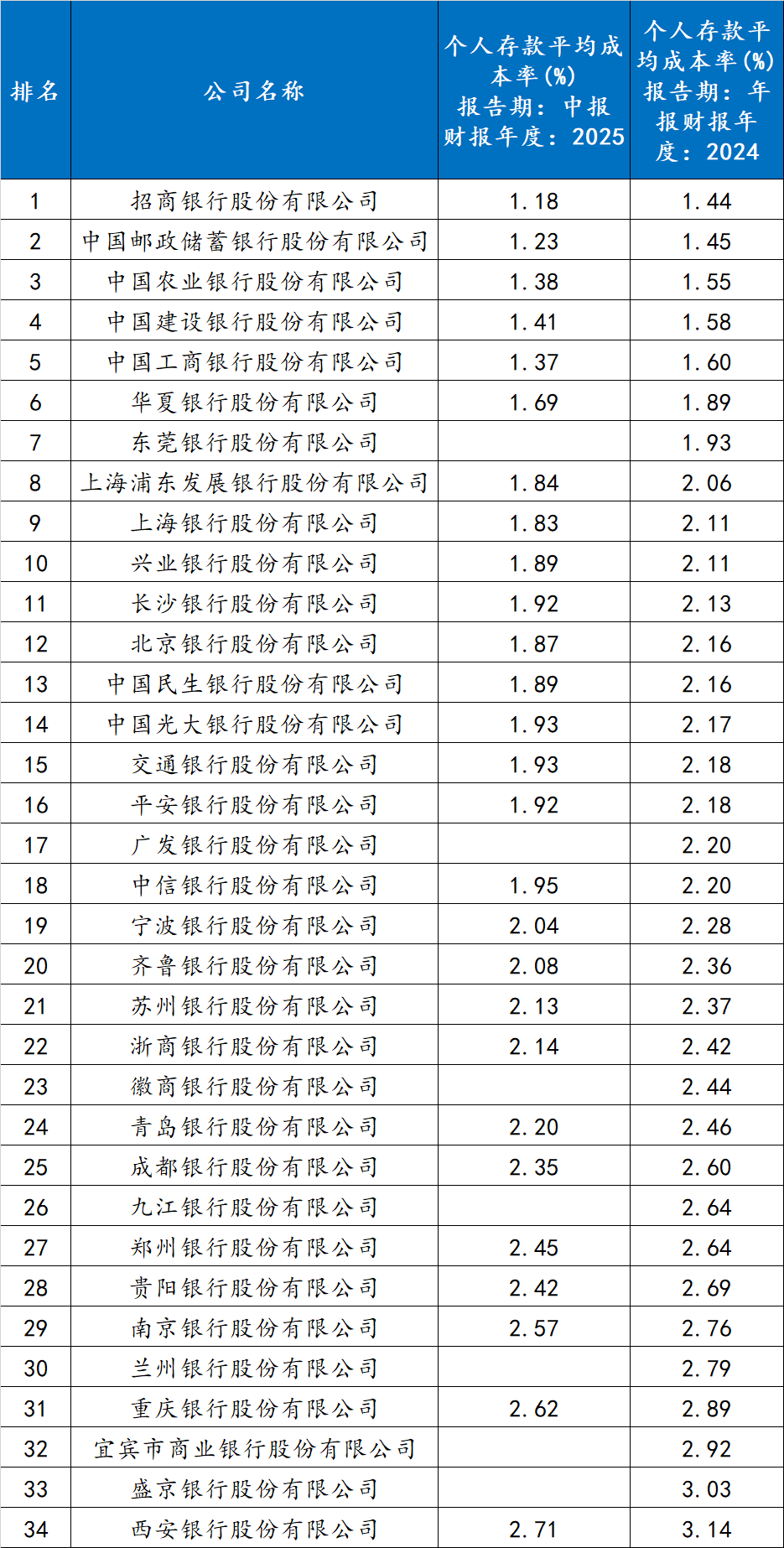
Core Insights - The average cost of personal deposits is a key indicator of banks' liability costs, with lower rates indicating stronger competitiveness in attracting deposits [1][7]. Group 1: Ranking of Banks by Deposit Cost - The banks with the lowest average cost of personal deposits are primarily state-owned large banks and some retail-focused joint-stock banks, with China Merchants Bank leading at 1.18% for the 2025 mid-year report [2][8]. - Following China Merchants Bank are China Postal Savings Bank at 1.23% and Agricultural Bank of China at 1.38%, benefiting from extensive branch networks and strong customer bases [2][8]. - The top six banks all have costs below 2%, indicating strong deposit cost control capabilities [2][8]. Group 2: Cost Trends and Observations - A notable trend is the general decline in average deposit costs across most banks when comparing 2024 annual reports to 2025 mid-year reports, with China Merchants Bank decreasing from 1.44% to 1.18% [6][12]. - This decline reflects a reduction in liability cost pressures for the banking industry, positively impacting net interest margins and profitability [6][12]. - However, lower deposit costs must align with asset yield and risk management capabilities, as a healthy bank seeks to balance these factors [12]. Group 3: Challenges for Joint-Stock and Regional Banks - Joint-stock banks and regional commercial banks generally face higher average deposit costs, often exceeding 2%, which can challenge their net interest margin management [5][11]. - National joint-stock banks like Industrial Bank and Minsheng Bank have costs ranging from 2.11% to 2.18%, while some regional banks experience even greater cost pressures [5][11].



利率下探至“2字头”,经营贷成银行新宠
Di Yi Cai Jing· 2026-01-19 12:52
Core Viewpoint - The recent government policies aim to lower financing costs and stimulate consumer spending, leading to a divergence in bank credit allocation, with operational loan rates dropping to the "2s" and consumer loan rates stabilizing around 3% [1][2][4]. Group 1: Operational Loan Rates - Operational loan rates have generally decreased to the "2s," with banks increasing credit limits, terms, and product flexibility [1][2]. - State-owned banks maintain operational loan rates around 3%, with collateralized loans potentially as low as 2.5% for qualified clients [2]. - Some joint-stock banks offer more flexible product structures, with collateralized loans' rates dynamically adjusted based on property evaluations, with some rates dropping to 2.3% [2]. - City commercial banks are aggressively competing, with some offering collateralized operational loans at rates as low as 2.2% and credit limits up to 20 million yuan [2]. Group 2: Consumer Loan Rates - Consumer loan rates have stabilized around 3%, with limited downward movement expected [4][5]. - Major state-owned banks' consumer loan rates range from 3.0% to 4.5%, with specific products like ICBC's "融e借" averaging between 3.5% and 3.65% [4][5]. - Joint-stock and city commercial banks are also active in the consumer loan market, with some offering interest rate subsidies to enhance product appeal [5]. Group 3: Credit Demand and Risk Control - Despite ongoing financial policies to promote consumption, demand for consumer loans remains weak, with significant declines in both short-term and long-term consumer loans reported [6]. - Banks are tightening risk controls, with stricter scrutiny on the use of consumer loan funds and customer eligibility to prevent misuse [6][7]. - The asset quality of consumer loans is under observation, with projections indicating a potential increase in non-performing loan rates in 2026 [7].
银行股配置重构系列八:指数基金波动,优质银行股超跌
Changjiang Securities· 2026-01-19 12:44
Investment Rating - The investment rating for the banking sector is "Positive" and is maintained [13]. Core Insights - The market sentiment has significantly improved since the beginning of the year, leading to substantial net outflows from major index funds like CSI 300 and SSE 50, with bank stocks experiencing the highest decline among primary sectors [2][6]. - Despite the recent pressure on bank stocks due to net outflows from index funds, there is an expectation that the market will continue to focus on high-quality bank stocks with stable or improving fundamentals, presenting good investment opportunities [2][8]. - The pricing power of fundamental factors for bank stocks is expected to increase in 2026, with a projected reversal in net interest income growth and stable performance from major banks [10]. Summary by Sections Market Dynamics - Since Q3 2025, bank stocks have been under pressure due to capital outflows, primarily from public funds and ETFs, reflecting a shift in institutional investor strategies [6][7]. - The net outflow from CSI 300 and SSE 50 ETFs reached 103.6 billion and 19.7 billion respectively during January 15-16, significantly above normal levels [7]. Valuation and Dividend Yield - Bank stocks are considered systematically undervalued under the PB-ROE framework, with current PB valuations below net asset value [9]. - The expected dividend yields for major state-owned banks have risen above 4%, with some leading banks like China Merchants Bank and Jiangsu Bank reaching yields of 5% to 6% [9][26]. Performance Outlook - Major banks are expected to maintain stable growth in 2026, with credit growth projected to be flat year-on-year, focusing on operational efficiency rather than scale [10]. - The non-interest income pressure from financial market activities has eased, and overall revenue growth is anticipated to be driven by net interest income [10].



狂揽港股!险资一年41次举牌背后的资本盛宴
Xin Lang Cai Jing· 2026-01-19 12:23
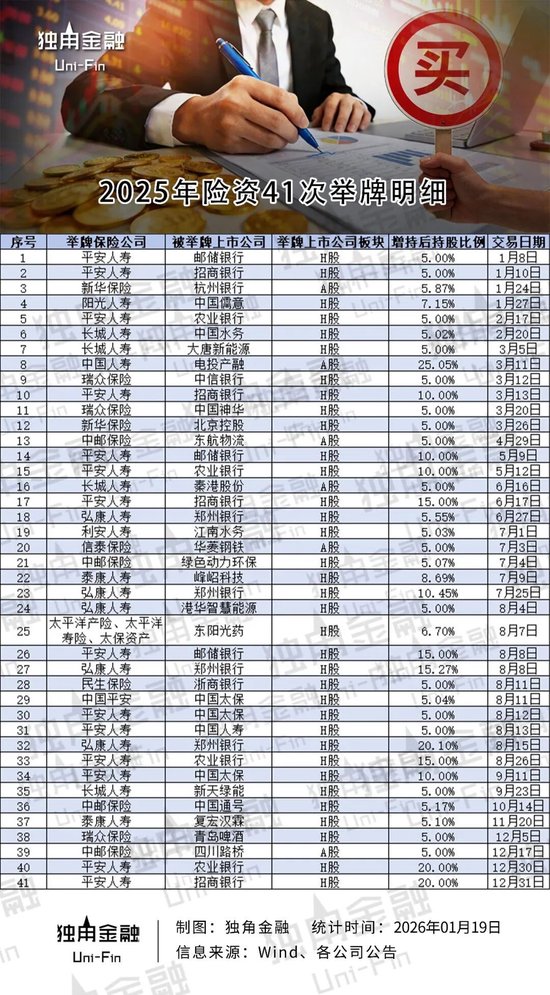
Core Viewpoint - Insurance capital is transitioning from a "barbarian at the gate" to a "strategist in the boardroom," with a focus on long-term investments rather than short-term financial gains, as evidenced by a record 41 public shareholding increases in 2025, the highest in nearly a decade [1][16][19] Group 1: Investment Trends - In 2025, insurance capital engaged in 41 public shareholding increases, more than double the average of recent years, indicating a significant shift in investment strategy [2][16] - The majority of these shareholding increases (over 85%) occurred in H-shares, driven by their substantial valuation discounts and smoother acquisition mechanisms [1][19] - Insurance companies are increasingly focusing on financial stocks, particularly banks, as they seek certainty, safety, and valuation flexibility in a complex market environment [1][9] Group 2: Regulatory Environment - Recent regulatory changes have opened up opportunities for insurance capital in equity investments, shifting from restrictions to encouragement of long-term investments [4][18] - The optimization of solvency regulatory standards has expanded the space for equity investments, allowing insurance companies to better match their long-term liabilities with asset returns [4][18] Group 3: Financial Performance - Insurance companies have reported significant increases in investment income, with 11 companies showing positive growth in 2025, including a remarkable 687.16% increase for New China Life [11][26] - The overall investment yield for major insurers has risen, with Ping An Life and China Life reporting increases exceeding 400% in investment income [12][26] Group 4: Strategic Focus - Insurance capital is not only focusing on traditional financial sectors but is also investing in high-tech fields such as renewable energy, advanced manufacturing, and biotechnology, reflecting a strategic alignment with national economic transformation [9][23] - The long-term nature of insurance capital aligns well with companies that have solid fundamentals and stable cash flows, allowing insurers to share in corporate growth and dividends [3][17]




招行信用卡换帅:刘加隆转任顾问,财富平台部总经理厉明东已到任
2 1 Shi Ji Jing Ji Bao Dao· 2026-01-19 10:55
Core Viewpoint - The leadership change at China Merchants Bank's credit card center marks a significant transition as Liu Jialong retires and Li Mingdong takes over, reflecting the evolving landscape of the credit card industry in China [1] Group 1: Leadership Transition - Liu Jialong, the former general manager of the credit card center, has retired and will serve as a consultant, having been a pivotal figure in the credit card industry since 1996 [1] - Li Mingdong, previously the general manager of the wealth platform department, has assumed the role of general manager of the credit card center, pending regulatory approval [1] Group 2: Industry Insights - Liu Jialong emphasized the importance of recognizing industry cycles, noting that in 2018, the bank anticipated a shift from a growth phase to a more stable market, leading to a reduction in expansion plans by one-third [2] - The credit card industry is transitioning from an incremental growth market to a more mature, stock-based market, necessitating strategic adjustments [2] Group 3: Future Strategies - Liu Jialong outlined a focus on risk management and sustainable growth, advocating for a dual approach of enhancing payment services and small loans while leveraging both branch and direct sales channels [3] - The strategy includes targeting key regions for customer acquisition and improving operational effectiveness to enhance customer value [3] Group 4: Li Mingdong's Background - Li Mingdong has extensive experience in retail finance and wealth management, having held various leadership roles within China Merchants Bank, including assistant president positions in multiple branches [4] - His background includes directorships in consumer finance and asset management, positioning him well to lead the credit card center [4]
金价又创新高,银行保管箱“抢疯了”!
Xin Lang Cai Jing· 2026-01-19 10:45
Core Viewpoint - The international gold price has reached a historic high, exceeding $4,690 per ounce, leading to a surge in demand for gold and other precious metals, while the availability of bank safety deposit boxes has become critically low, especially in major cities like Beijing, Shanghai, Guangzhou, and Shenzhen [1][7]. Group 1: Gold Price and Demand - The spot gold price increased by approximately 70% in 2025, driving a significant rise in consumer investment demand for gold bars and other precious metals [2][8]. - As demand for gold rises, the difficulty in renting safety deposit boxes has become more pronounced, with reports of waiting times extending up to five to six years for certain banks [1][8]. Group 2: Supply Constraints of Safety Deposit Boxes - The supply of safety deposit boxes is characterized by static growth, as banks primarily view this service as a means to maintain high-net-worth clients rather than a profit center, leading to limited resource allocation [2][5]. - High renewal rates and slow turnover of safety deposit boxes exacerbate the supply shortage, creating a rigid gap in availability [3][9]. Group 3: Bank Strategies and Challenges - Banks face challenges in increasing the supply of safety deposit boxes due to low profitability, high operational costs, and the expensive nature of building new secure storage facilities [5][11]. - Current strategies include optimizing existing resources and implementing technology upgrades to improve space utilization, but these measures are gradual and unlikely to resolve the supply-demand imbalance in the short term [6][12].

鲁大师(03601.HK)附属认购招商银行5000万元结构性存款产品
Ge Long Hui· 2026-01-19 10:04
Core Viewpoint - The company, Lu Master (03601.HK), has entered into a structured deposit product agreement with China Merchants Bank, involving an investment of 50 million RMB [1] Group 1 - The agreement is established between Lu Master’s subsidiary, Chengdu Mijia You, and China Merchants Bank [1] - The investment of 50 million RMB is derived from the redeemed principal under a previous structured deposit product agreement [1]