中国移动

Search documents
全球太空资源竞争趋于白热化
Xin Lang Cai Jing· 2026-01-11 02:34
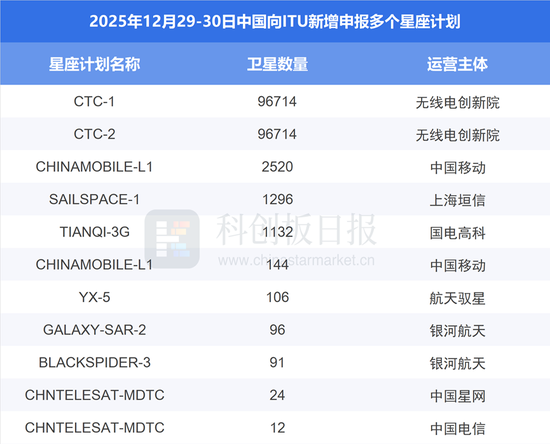
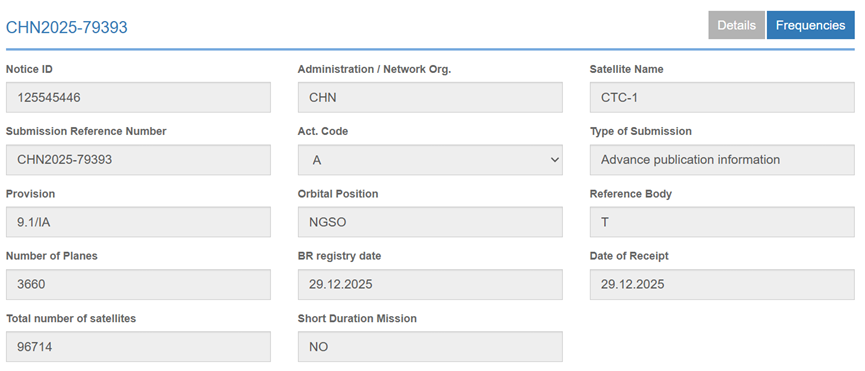
Core Viewpoint - The global competition for space resources is accelerating, with China submitting multiple satellite constellation plans to the International Telecommunication Union (ITU) in late December 2025, totaling over 200,000 satellites [1][8]. Group 1: Satellite Constellation Plans - China has announced several satellite constellation plans, with the largest being CTC-1 and CTC-2, each consisting of 96,714 satellites, operated by the Radio Innovation Institute [2][3][9]. - Other notable plans include CHINAMOBILE-L1 with 2,520 satellites, SAILSPACE-1 with 1,296 satellites, and TIANQI-3G with 1,132 satellites, among others [2][9]. Group 2: Radio Innovation Institute - The Radio Innovation Institute was registered on December 30, 2025, in Xiong'an New Area, aiming to focus on technological innovation and the transformation of results in the field of radio management [4][10]. - The institute is a collaborative effort involving seven entities, including the National Radio Monitoring Center and several universities, with a vision to enhance the satellite internet industry and explore the value of spectrum resources [4][10]. Group 3: Global Space Resource Competition - The allocation of satellite frequency and orbital resources follows a "first-come, first-served" principle, intensifying global competition as countries rush to secure low Earth orbit resources [6][13]. - As of May 12, 2025, there are approximately 10,824 satellites in low Earth orbit, with a utilization rate of about 18% of the theoretical capacity of 60,000 satellites [6][13]. Group 4: Future Outlook - The commercial space industry is expected to experience significant growth in 2026, driven by the launch of multiple reusable and high-capacity rockets, which will facilitate satellite communication development [7][14]. - China's low Earth orbit satellite internet is entering a phase of mass launch construction in the second half of 2025, with expectations for accelerated industry development in 2026 [7][14].

全球太空资源竞争趋于白热化
财联社· 2026-01-11 02:32
Core Viewpoint - The global competition for space resources is accelerating, with China planning to deploy over 200,000 satellites by the end of 2025 through various satellite constellation projects [2][3]. Group 1: Satellite Constellation Plans - China has submitted multiple satellite constellation plans to the International Telecommunication Union (ITU), with a total scale exceeding 200,000 satellites [3]. - The largest constellations are CTC-1 and CTC-2, each consisting of 96,714 satellites, operated by the Radio Innovation Institute [4][8]. - Other notable constellations include CHINAMOBILE-L1 with 2,520 satellites, SAILSPACE-1 with 1,296 satellites, and TIANQI-3G with 1,132 satellites [4]. Group 2: Regulatory and Competitive Landscape - The ITU is responsible for managing global radio frequency and satellite orbital resources, enforcing deployment timelines for satellite operators [9]. - The "first come, first served" principle for satellite frequency and orbital resources is intensifying global competition, as countries rush to secure limited orbital slots [11]. - As of May 2025, approximately 10,824 satellites are in low Earth orbit, with a utilization rate of about 18% of the theoretical capacity of 60,000 satellites [12]. Group 3: Market Outlook and Investment Opportunities - The U.S. leads in the number of operational spacecraft, holding 75.94% of the global share, while China accounts for approximately 9.43% [13]. - China is advancing national-level constellation projects like "GW Constellation" and "Qianfan Constellation," aiming to deploy over 10,000 satellites in the next decade [14]. - The commercial space industry is expected to experience significant growth in 2026, driven by the launch of multiple reusable and high-capacity rockets, facilitating satellite communication development [14]. - Companies to watch include Xinke Mobile, Haige Communication, Tongyu Communication, Guobo Electronics, Shaanxi Huada, Zhenyou Technology, Zhenlei Technology, Chengchang Technology, and Sanwei Communication [14].

唐山机器人产业大脑入围 省产业大脑建设“揭榜挂帅”名单
Xin Lang Cai Jing· 2026-01-11 01:44
Core Viewpoint - The "Tangshan Robot Industry Brain" has been successfully selected as one of the six projects in Hebei Province's 2025 industry brain construction initiative, led by Tangshan High-tech Zone State-owned Holding Group Co., Ltd. [1] Group 1: Project Overview - The project is a collaboration involving five entities, including Tangshan Industrial Vocational and Technical University and China Mobile Communications Group Hebei Co., Ltd. [1] - The initiative aims to create an intelligent industrial ecosystem leveraging industrial internet, big data, and artificial intelligence [1]. Group 2: Objectives and Goals - The project aligns with the "Implementation Plan for Digital Technology Empowering High-Quality Development of Manufacturing Industry in Hebei Province" [1]. - It focuses on "service government governance and empowering enterprise transformation" as its core objectives [1]. Group 3: Data Integration and Services - The project will integrate government public data, industry common data, and enterprise personalized data to build a standardized industrial data warehouse [1]. - It aims to create a robot industry-specific brain that combines data integration, technology research and development, and collaborative services, tailored to the characteristics of Tangshan's industry [1].

大利好!周末 彻底沸腾!20万颗卫星刷屏了!
Zhong Guo Ji Jin Bao· 2026-01-10 16:13
1月10日,商业航天赛道传出重磅利好消息。 据最新消息,国际电信联盟(ITU)官网显示,中国提交了新增20.3万颗的卫星申请,此次申报涵盖14个卫星星座。 兄弟姐妹们啊,周末一条关于卫星的消息,炸锅了! 中国新增20万颗卫星申请 美国批准再部署SpaceX 7500颗星链卫星 周五,美国联邦通信委员会(FCC)表示,已批准SpaceX的请求,允许其再部署7,500颗第二代Starlink(星链)卫星,以提升其在全球范围内的互联网服 务能力。 FCC称,马斯克旗下的SpaceX现在可额外运营7500颗第二代星链卫星,使其获准运营的第二代卫星总数达到15000颗。FCC同时允许SpaceX对卫星进行升 级,并在五个频段开展运营;此外还豁免了此前的一些限制性要求——这些要求曾禁止覆盖区域重叠以及限制容量提升。 其中大部分来自一个新机构:无线电创新院(全称"无线电频谱开发利用和技术创新研究院")。它申报的CTC-1、CTC-2两个星座,各96,714颗,两者合 计超过19万颗。 | | | 【中金军工】中国2025年12月ITU主要新增星座信息 | | | | --- | --- | --- | --- | --- ...
大利好!周末,彻底沸腾了!
中国基金报· 2026-01-10 16:07
【导读】 20万颗卫星刷屏了! 中国基金报记者 泰勒 兄弟姐妹们啊,周末一条关于卫星的消息,炸锅了! 中国新增20万颗卫星申请 1月10日,商业航天赛道传出重磅利好消息。 据最新消息, 国际电信联盟(ITU)官网显示, 中国提交了新增20.3万颗的卫星申请,此次申报涵盖14个卫星星座。 其中大部分来自一个新机构: 无线电创新院 (全称"无线电频谱开发利用和技术创新研究院")。它申报的 CTC-1、CTC-2 两个星座, 各96,714颗 ,两者合计 超过19万 颗 。 | | | 【中金军工】中国2025年12月 ITU主要新增星座信息 | | | | --- | --- | --- | --- | --- | | NTC ID | 名称 | 轨道面数 | 卫星数量 | 运营机构 | | 125545445 | CTC-2 | 3660 | 96714 | 无线电创新院 | | 125545446 | CTC-1 | 3660 | 96714 | 无线电创新院 | | 125545447 | YX-5 | 18 | 106 | 航天驭星 | | 125545455 | CHNTELESAT-MDTC | 12 ...

全球“追星”!我国新增超20万颗申请,马斯克也有大消息
证券时报· 2026-01-10 14:15
Core Viewpoint - The global space race is intensifying, with significant satellite deployment plans from both China and SpaceX, highlighting the competitive landscape for satellite resources and technology advancements [1][10]. Group 1: China's Satellite Plans - China has applied to the International Telecommunication Union (ITU) for frequency and orbital resources for over 200,000 satellites, with more than 190,000 satellites coming from the Radio Innovation Institute [3][4]. - The application includes 14 satellite constellations, with the CTC-1 and CTC-2 constellations each applying for 96,714 satellites, making them the main contributors to this application [3]. - The Radio Innovation Institute aims to serve the satellite internet industry and develop electromagnetic space technology, focusing on spectrum resource value and innovation [4]. Group 2: SpaceX Developments - On January 9, 2023, the U.S. Federal Communications Commission (FCC) approved SpaceX's plan to deploy an additional 7,500 second-generation Starlink satellites, bringing the total approved number to over 15,000 [7][8]. - The FCC's decision supports SpaceX's expansion in global internet services and allows for significant technological upgrades, including operations across five frequency bands [9]. - The new satellites are expected to enhance network performance, potentially achieving internet speeds of up to 1 Gbps, and will provide direct-to-cell services outside the U.S. [9]. Group 3: Global Space Resource Competition - The allocation of satellite frequency and orbital resources follows a "first-come, first-served" principle, intensifying competition as countries rush to secure low Earth orbit resources [10]. - As of May 12, 2025, approximately 10,824 satellites are in low Earth orbit, with a utilization rate of about 18% of the theoretical capacity of 60,000 satellites [10]. - The U.S. currently leads in the number of operational spacecraft, holding 75.94% of the global share, while China accounts for approximately 9.43% [10]. Group 4: Future Projections for China's Satellite Deployment - China's satellite constellations have specific deployment deadlines, with the China Star Network needing to complete 1,300 satellites by September 2029, and other constellations following suit with their respective deadlines [11]. - The commercial space industry in China is expected to enter a high-intensity phase of satellite launches, with significant growth anticipated in the coming years [11]. - Analysts predict that advancements in reusable rockets and increased launch capacity will facilitate a breakthrough in satellite communication development in China [11].

我国新增20万颗卫星申请
21世纪经济报道· 2026-01-10 12:27
在此背景下,中国在此之前已推进"GW星座""千帆星座""鸿鹄-3"等国家级星座计划,拟在未 来十年内完成上万颗部署。 东吴证券指出,展望2026年商业航天行业将迎来多重催化,特别是多枚可回收/大载量的商业 火箭密集首飞,火箭运力将有望迎来显著提升,从而打通此前卫星通信发展的堵点。我国低轨 卫星互联网从2025年下半年已进入批量发射建设阶段,2026年有望迎来更大批量发射,产业 发展进一步加速。 (声明:文章内容仅供参考,不构成投资建议。投资者据此操作,风险自担。) SFC 来源丨上海证券报、科创板日报 编辑丨张嘉钰 江佩佩 81岁芯片大佬恢复中国籍,为交税套现近亿元,60岁归国带出2000亿元半导体巨头 2000万粉丝演员哭穷炫富,多个账号被禁言,代言产品全线停产 顶奢酒店攻入下沉市场 21君荐读 据上海证券报,记者查询国际电信联盟(ITU)官网获悉,我国2025年12月向ITU申请了超20 万颗卫星的频轨资源。其中超19万颗卫星来自近期刚刚成立的无线电创新院。 | | 2025年12月29-30日中国向ITU新增申报多个星座计划 | | | --- | --- | --- | | 星座计划名称 | 卫星数量 ...

全球“追星”!我国新增超20万颗申请,马斯克也有大消息
券商中国· 2026-01-10 12:06
Core Viewpoint - The global space race is intensifying, with significant developments in satellite deployment and frequency resource applications from both China and the United States [1][10]. Group 1: China's Satellite Plans - China has applied to the International Telecommunication Union (ITU) for frequency resources for over 200,000 satellites, with more than 190,000 satellites coming from the Radio Innovation Institute [2][3]. - The application includes 14 satellite constellations, with the CTC-1 and CTC-2 constellations each applying for 96,714 satellites, making them the main contributors to this application [3]. - The Radio Innovation Institute, established in Xiong'an New Area, aims to serve the satellite internet industry and focus on spectrum resource development and technological innovation [4]. Group 2: ITU Regulations - The ITU, responsible for managing global radio frequency and satellite orbit resources, mandates that new satellite applications must launch their first satellite within seven years and complete deployment within 14 years [5]. - Failure to meet these deployment milestones will result in a proportional reduction of frequency rights based on the actual number of satellites launched [5][6]. Group 3: SpaceX Developments - On January 9, 2023, the U.S. Federal Communications Commission (FCC) approved SpaceX's plan to deploy an additional 7,500 second-generation Starlink satellites, bringing the total approved number to over 15,000 [7][9]. - The FCC's decision supports SpaceX's expansion in the global internet service market and allows for significant technological upgrades, including operations across five frequency bands [8][9]. - The new satellites are expected to enhance network performance, potentially achieving internet speeds of up to 1 Gbps, and will provide direct-to-cell services outside the U.S. [9]. Group 4: Global Satellite Landscape - As of May 12, 2025, there are approximately 10,824 satellites in low Earth orbit, with a utilization rate of about 18% of the theoretical capacity of 60,000 satellites [10]. - The U.S. currently leads in the number of operational spacecraft, accounting for 75.94% of the global total, while China holds about 9.43% [10]. - China's commercial satellite constellations are taking shape, with significant deployment deadlines set for various projects, indicating a future surge in satellite launches [10]. Group 5: Future Industry Outlook - The commercial space industry is expected to experience multiple catalysts in 2026, particularly with the introduction of reusable and high-capacity rockets, which will alleviate previous bottlenecks in satellite communication development [11]. - With ongoing policy support and technological advancements, China's rocket launch capacity and frequency are projected to see significant growth, further accelerating the development of the satellite internet sector [11].

李彦宏第 2 家上市公司来了!
程序员的那些事· 2026-01-10 11:29
Core Viewpoint - Baidu's subsidiary Kunlun Chip has submitted an application for a mainboard listing on the Hong Kong Stock Exchange, which has significantly boosted market confidence and led to a notable increase in Baidu's stock prices [1][2]. Group 1: Company Developments - Kunlun Chip completed its shareholding reform in December 2025 and is expected to officially list in the first half of 2026 [2]. - Baidu holds a 59.45% stake in Kunlun Chip, with other major shareholders including China Internet Investment Fund, Beijing Artificial Intelligence Industry Investment Fund, BYD, and a fund under China Mobile [2]. Group 2: Financial Projections - Goldman Sachs predicts that Kunlun Chip's revenue will reach between 3.5 billion to 5 billion yuan in 2025, with the potential to exceed 6.5 billion yuan in 2026 [2]. - The spin-off listing is crucial for Baidu, which is currently facing a decline in revenue, with a 7% year-on-year drop reported in Q3 2025 and a net loss, marking six consecutive quarters of decline in its core online marketing business [2]. Group 3: Strategic Importance - The independent listing of Kunlun Chip is a key step for Baidu in presenting its "full-stack AI" narrative, which encompasses chips, frameworks, large models, cloud services, and applications, thereby showcasing the strategic value of its AI initiatives [2].


我国新增20万颗卫星申请,权威解读来了
华尔街见闻· 2026-01-10 10:48
Core Viewpoint - The article discusses China's strategic application for over 200,000 satellite frequency resources to enhance its satellite internet capabilities and compete with global leaders like SpaceX [2][5]. Group 1: Satellite Resource Application - China has applied for over 200,000 satellite frequency resources from the International Telecommunication Union (ITU), with more than 190,000 satellites coming from the newly established Radio Innovation Institute [2][3]. - The largest satellite constellations in this application are CTC-1 and CTC-2, each consisting of 96,714 satellites [3][4]. - Other significant constellations include CHINAMOBILE-L1 with 2,520 satellites, SAILSPACE-1 with 1,296 satellites, and TIANQI-3G with 1,132 satellites [3]. Group 2: Establishment of Radio Innovation Institute - The Radio Innovation Institute was registered on December 30, 2025, in Xiong'an New Area, Hebei, and is the first new-type research institution in China's radio management technology field [5]. - This institute aims to serve the satellite internet industry, research electromagnetic space technology, and explore the value potential of frequency resources [5]. - The institute is a collaboration among seven entities, including the National Radio Monitoring Center and China Satellite Network Group [5]. Group 3: Strategic Importance and Future Prospects - The application for such a large number of satellites indicates China's commitment to a systematic layout in low Earth orbit and its capability to compete with Western countries [5]. - The ITU's "first come, first served" rule emphasizes the importance of timely applications for frequency and orbital positions to avoid losing access to these resources [7]. - Even if the ITU approves the application, deployment is not guaranteed, and the successful applicant must complete 10% of the deployment within seven years to retain rights [9]. - The potential for deploying 200,000 satellites over a decade is feasible given the large market for low Earth orbit satellites in China [9]. Group 4: Industry Impact - The application by the Radio Innovation Institute is seen as a positive signal for the satellite launch industry, potentially affecting how frequency resources are allocated [10]. - The presence of a national entity applying for such a large number of satellites may change the dynamics of frequency applications, especially for smaller satellite companies [10].