
宁波银行

Search documents
宁波银行:拟赎回1亿股、募资10亿元的第二期优先股
Xin Lang Cai Jing· 2025-11-05 12:11
Core Points - Ningbo Bank plans to redeem the second phase of preferred shares issued in November 2018, which consists of 100 million shares with a face value of 100 yuan each, raising a total of 1 billion yuan [1] - The redemption price will be the face value plus the current dividend, with the redemption date set for November 7, 2025 [1] - As of September 30, 2025, the company's core Tier 1 capital adequacy ratio is 9.21%, Tier 1 capital adequacy ratio is 10.70%, and total capital adequacy ratio is 14.62%, meeting the redemption conditions [1]

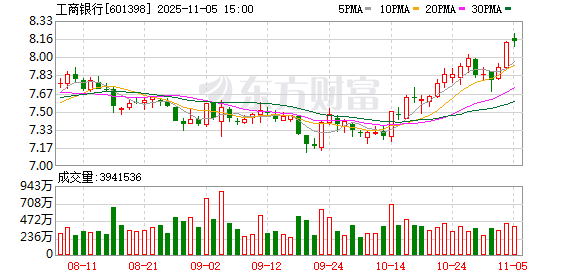
工商银行股价创历史新高,机构热议年末“估值切换”行情
2 1 Shi Ji Jing Ji Bao Dao· 2025-11-05 12:09
Group 1 - Industrial and Commercial Bank of China (ICBC) reached a historical high of 8.21 yuan on November 5, 2023, alongside other banks like Shanghai Pudong Development Bank and Ningbo Bank showing significant gains [2] - Year-to-date performance of the banking sector is underwhelming, with a gain of 12.99% compared to the All A Index's 25.81% [2] - Large-cap stocks have a weighted return of 15.26%, significantly lagging behind small-cap stocks which achieved a return of 61.46% [2] Group 2 - Historical trends suggest a "valuation switch" may occur towards the end of the year, with expectations for a rotation in market styles [4] - Market strategies indicate that from April to October, the focus is on current fundamentals, while from November to the following March, the emphasis shifts to future expectations [4] - November is identified as a critical time for market movements, where the correlation with current fundamentals weakens, indicating a potential for "anti-fundamental" and "forward-looking" trading strategies [4]


外资A股最新持仓曝光
Di Yi Cai Jing· 2025-11-05 11:55
Group 1 - The A-share market has significantly rebounded since the third quarter, with active trading and foreign capital continuing to buy aggressively [2][3] - Major industry leaders such as Kweichow Moutai, Ping An of China, and Wuliangye have attracted over 80 foreign institutional investors each, indicating strong foreign interest [2][3] - As of the end of September, the top three foreign-held A-shares by market value are CATL, Kweichow Moutai, and Midea Group, with values of 265.66 billion, 88.14 billion, and 71.65 billion respectively [2][3] Group 2 - Foreign investment is particularly focused on industry leaders, "Chinese state-owned enterprises," and bank stocks, with major banks holding significant foreign shares [3][4] - As of September 30, 2023, 68 foreign institutions held shares in China Shipbuilding, a 40% increase from the end of June [4][5] - The number of foreign investors in several A-share companies has increased, including Kweichow Moutai, BYD, and Yangtze Power [4] Group 3 - Foreign investors have shown a preference for certain stocks, with UBS significantly increasing its stake in RuiNeng Technology, becoming the third-largest shareholder [5][6] - UBS held 1.1464 million shares of RuiNeng Technology as of September 30, representing a 130.2% increase from the previous quarter [6] - Other major foreign investors in RuiNeng Technology include Goldman Sachs, JPMorgan, and Merrill Lynch, all newly entering the top ten shareholders [5][6] Group 4 - The overall outlook for the A-share market remains positive, with expectations of continued recovery in earnings and strong inflows of capital [9][10] - UBS forecasts a 6% year-on-year growth in total A-share earnings by 2025, driven by sectors like technology and non-financial industries [9][10] - Goldman Sachs predicts a 30% increase in major stock indices by the end of 2027, indicating a potential long-term bull market for A-shares [10][11]





外资A股最新持仓曝光
第一财经· 2025-11-05 11:45
Core Viewpoint - The A-share market has shown significant recovery since the third quarter, with active trading and continued foreign investment, particularly in industry leaders and state-owned enterprises [3][5][14]. Group 1: Foreign Investment Trends - As of the end of September, major industry leaders such as Kweichow Moutai, China Ping An, and Wuliangye attracted over 80 foreign institutional investors each [6][5]. - The top three foreign-held A-shares by market value are CATL (265.66 billion), Kweichow Moutai (88.14 billion), and Midea Group (71.65 billion) [6][5]. - Foreign investment in "Chinese state-owned enterprises" has increased, with China Shipbuilding attracting 68 foreign investors, a rise of over 40% from the end of the first half [7][5]. Group 2: Sector Preferences - Foreign investors favor industry leaders, state-owned enterprises, and bank stocks, with seven of the top ten foreign-held A-shares being banks [6][5]. - Notable bank stocks include Nanjing Bank (2.36 billion shares held by 32 foreign investors) and Ningbo Bank (1.60 billion shares held by 42 foreign investors) [6][5]. Group 3: Individual Stock Movements - UBS significantly increased its stake in RuiNeng Technology, becoming the third-largest shareholder, while Goldman Sachs, JPMorgan, and Merrill Lynch entered the top ten shareholders [9][10]. - RuiNeng Technology's stock price has surged over 40% since mid-October, despite a 32.73% decline in net profit year-on-year [12][10]. Group 4: Market Outlook - UBS analysts remain optimistic about the medium-term outlook for the A-share market, citing a 12% year-on-year profit growth for all A-shares in the third quarter [15][14]. - Goldman Sachs predicts a 30% increase in major stock indices by the end of 2027, indicating a potential long-term bull market for A-shares [16][14].






华尔街大行抱团买入,外资A股最新持仓曝光
第一财经网· 2025-11-05 11:41
Group 1 - Foreign capital favors industry leaders, "Chinese state-owned enterprises," and bank stocks, with significant investments noted in companies like Kweichow Moutai, Ping An, and Wuliangye, each attracting over 80 foreign institutional investors [1][2] - As of the end of September, the top three foreign-held A-shares by market value are CATL, Kweichow Moutai, and Midea Group, with values of 265.66 billion, 88.14 billion, and 71.65 billion respectively [1][2] - The number of foreign investors holding shares in China Shipbuilding increased by over 40% from the end of June to 68 by the end of September [3] Group 2 - Bank stocks are particularly favored by foreign investors, with seven out of the top ten A-shares held by foreign capital being banks, including Nanjing Bank and Ningbo Bank, which have 2.36 billion and 1.60 billion shares held respectively [2] - A total of 42 A-shares have foreign holdings exceeding 10 billion yuan, indicating strong interest in industry leaders [2] Group 3 - UBS significantly increased its stake in RuiNeng Technology, becoming the third-largest shareholder by holding 1.1464 million shares, a 130.2% increase from the previous quarter [4][5] - Other major foreign investors in RuiNeng Technology include Goldman Sachs, JPMorgan, and Merrill Lynch, who entered the top ten shareholders for the first time [4][5] Group 4 - UBS and other foreign institutions have shown a pattern of increasing their stakes in various A-shares, indicating a trend of foreign capital "clustering" around specific stocks [4][8] - The overall market outlook remains positive, with UBS forecasting a 6% growth in A-share earnings by 2025, driven by sectors like technology and non-financial industries [9][10]
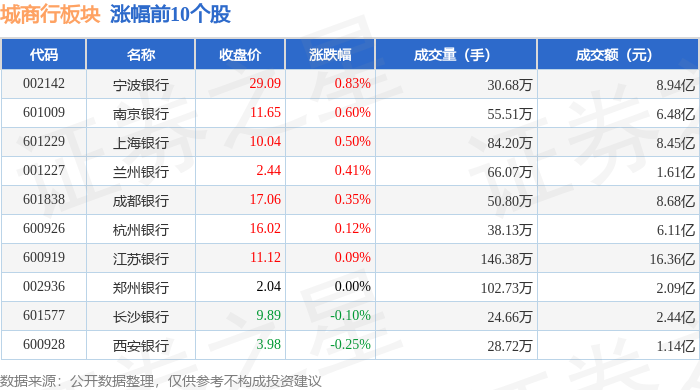
城商行板块11月5日涨0.12%,宁波银行领涨,主力资金净流入5236.36万元
Zheng Xing Xing Ye Ri Bao· 2025-11-05 08:55
Market Performance - The city commercial bank sector increased by 0.12% on November 5, with Ningbo Bank leading the gains [1] - The Shanghai Composite Index closed at 3969.25, up 0.23%, while the Shenzhen Component Index closed at 13223.56, up 0.37% [1] Individual Stock Performance - Ningbo Bank (002142) closed at 29.09, up 0.83% with a trading volume of 306,800 shares and a transaction value of 894 million [1] - Nanjing Bank (6000000) closed at 11.65, up 0.60%, with a trading volume of 555,100 shares and a transaction value of 648 million [1] - Shanghai Bank (601229) closed at 10.04, up 0.50%, with a trading volume of 842,000 shares [1] - Other notable performances include Chengdu Bank (601838) at 17.06, up 0.35%, and Hangzhou Bank (600926) at 16.02, up 0.12% [1] Capital Flow Analysis - The city commercial bank sector saw a net inflow of 52.36 million from institutional investors, while retail investors contributed a net inflow of 89.18 million [2] - The sector experienced a net outflow of 142 million from speculative funds [2] Detailed Capital Flow for Selected Banks - Jiangsu Bank (600919) had a net inflow of 63.74 million from institutional investors, while it faced a net outflow of 46.26 million from speculative funds [3] - Chengdu Bank (601838) reported a net inflow of 63.42 million from institutional investors, with a net outflow of 57.05 million from speculative funds [3] - Ningbo Bank (002142) had a net inflow of 5.72 million from institutional investors but a significant net outflow of 43.57 million from retail investors [3]



银行下探回升,工商银行创新高!规模最大银行ETF(512800)逆市4连涨,银行“顺风期”来了?
Xin Lang Cai Jing· 2025-11-05 03:06
Core Viewpoint - The banking sector is experiencing a strong performance driven by a defensive shift in investor sentiment, with significant trading activity in bank ETFs and individual bank stocks showing positive trends [1] Group 1: Market Performance - On November 5, the largest bank ETF (512800) rose by 0.48%, marking its fourth consecutive day of gains, indicating strong market interest with a trading volume exceeding 1.1 billion yuan within half a day [1] - Major bank stocks such as Shanghai Pudong Development Bank increased by nearly 3%, while others like Agricultural Bank of China, Ningbo Bank, Jiangsu Bank, and Nanjing Bank saw gains of over 1% [1] - Industrial and Commercial Bank of China reached a historical high during the trading session, reflecting overall positive sentiment in the banking sector [1] Group 2: Investment Trends - The recent strength in the banking sector is attributed to a defensive switch by investors as market volatility increases and risk appetite declines [1] - Historical data indicates that banks typically perform well in the last two months of the year, with a 70% probability of generating absolute returns in November and December based on a review of the past decade [1] Group 3: ETF Insights - The bank ETF (512800) and its linked funds are designed to passively track the CSI Bank Index, which includes 42 listed banks in A-shares, making it an efficient investment tool for tracking the overall banking sector [1] - The latest size of the bank ETF (512800) exceeds 19.8 billion yuan, with an average daily trading volume of over 800 million yuan, making it the largest and most liquid among the 10 bank ETFs in A-shares [1]
银行股探底回升,工商银行创历史新高
Di Yi Cai Jing· 2025-11-05 02:44
11月5日早盘,银行板块探底回升,工商银行一度涨近1%,盘中创历史新高。浦发银行、宁波银行、南 京银行、沪农商行等涨幅靠前。 | < 日 | 银行指数(886052) | Q | | --- | --- | --- | | | 7314.07 8.86 0.12% | | | 资料 | 成分 资讯 | 相关基金 | | 名称 | 现价 | 涨跌幅一 | | 浦发银行 | 11.83 | 1.81% | | 600000.SH | | | | 宁波银行 | 29.18 | 1.14% | | 002142.SZ | | | | 沪农商行 | 8.84 | 1.03% | | 601825.SH | | | | 南京银行 | 11.65 | 0.60% | | 601009.SH | | | | 江苏银行 | 11.18 | 0.63% | | 600919.SH | | | 辑丨瑜见 编 ...
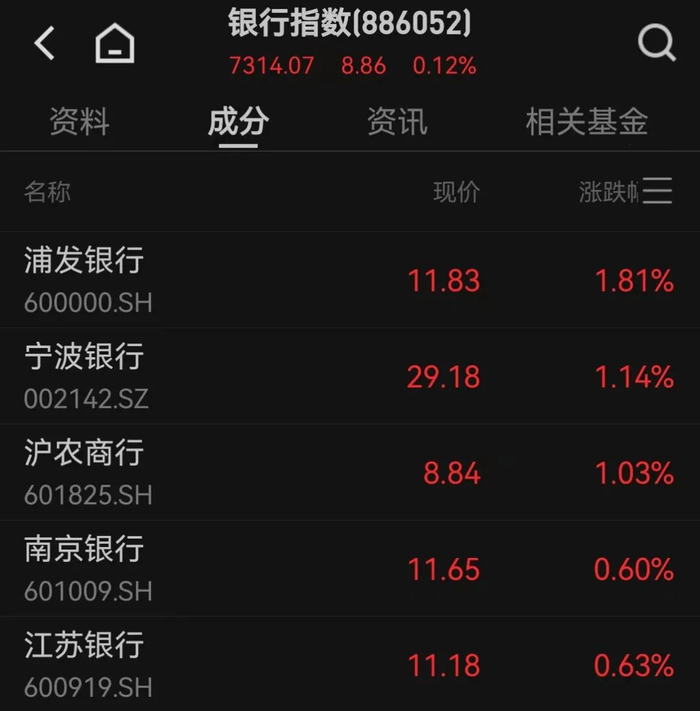
银行板块探底回升,工商银行涨近1%创历史新高
3 6 Ke· 2025-11-05 02:41
36氪获悉,银行板块盘中探底回升,工商银行涨近1%,创历史新高,A股总市值突破2.2万亿,浦发银 行、宁波银行、南京银行、沪农商行等涨幅靠前。 ...
中国金融业 - 追踪行业风险,反内卷努力逐步且明确的进展愈发清晰-China Financials-Tracking industrial risks more clear evidence of gradual but definitive progress on anti-involution efforts
2025-11-05 02:30
Summary of Key Points from the Conference Call Industry Overview - **Industry Focus**: China Financials, specifically the manufacturing sector and industrial risks in Asia Pacific [1][6][8] Core Insights and Arguments - **Capital Expenditure (Capex) Trends**: In September, 20 sectors experienced a slowdown in fixed asset investment (FAI) growth, compared to 16 sectors in August. This trend is attributed to continued moderation in FAI growth, which has helped close the gap between manufacturing FAI and industrial production (IP) [2][8] - **Profit Growth**: Manufacturing profit growth improved to 9.9% year-over-year (YoY) in September from 7.4% in August. Year-to-date (YTD) industrial profit increased by 3.2% YoY, up from 0.9% in August. This indicates a shift from expansion to moderation in industrial credit risks [4][8] - **Anti-Involution Efforts**: The ongoing anti-involution efforts in China are believed to have contained intense price competition in certain sectors, leading to improved profit margins. The moderation in industrial liability growth is linked to these efforts and a gradual reduction in funding support since the first half of 2024 [3][4] - **Manufacturing FAI Growth**: YTD manufacturing FAI growth declined to 4.0% YoY in September from 5.1% in August, contributing to the closure of the gap between manufacturing FAI and IP [8][10] Additional Important Insights - **Sector Performance**: In September, 76.6% of sectors (in terms of liabilities) saw a slowdown in capex growth compared to the first half of 2024. Additionally, 39.5% of manufacturing sectors reported better profit trends [9][8] - **Producer Price Index (PPI)**: The PPI remained flat month-over-month in September, with the YoY decline narrowing to 2.3% from 2.9% in August [8] - **Loan Growth**: Medium- to long-term loan growth for industrial firms moderated to 9.7% YoY, while industrial firms' liability growth decreased to 5.2% YoY [8] Conclusion - The overall sentiment in the China financials sector is cautiously optimistic, with signs of gradual improvement in profit growth and a controlled approach to credit supply and investment. The anti-involution measures are playing a significant role in stabilizing the market dynamics and reducing risks associated with overcapacity and credit [3][4][6]