
重庆银行

Search documents
午评:创业板指半日涨1.16% 算力硬件股再度走强
Zhong Guo Jin Rong Xin Xi Wang· 2025-06-27 04:18
Market Performance - A-shares showed mixed performance on June 27, with the Shanghai Composite Index declining by 0.21% to 3441.30 points, while the Shenzhen Component Index rose by 0.85% to 10431.51 points, and the ChiNext Index increased by 1.16% to 2138.90 points [1] - The trading volume for the Shanghai market was 380.8 billion, while the Shenzhen market recorded 610.5 billion [1] Sector Performance - Strength in sectors included computing hardware stocks, non-ferrous metals, and the financial sector, with notable gains in stocks like Chuangyi Tong, Xin Ya Electronics, and Tianfeng Securities, which hit their daily limit [1][2] - Declines were observed in the banking sector, with stocks like Chongqing Bank dropping over 3% [1] Industrial Insights - The logistics market in China is projected to exceed 360 trillion yuan in 2024, maintaining its position as the largest logistics market globally for nine consecutive years, with total logistics revenue expected to reach 13.8 trillion yuan [5] - The report indicates a shift in the industry from "logistics" to "supply chain," with over 1,000 A-level logistics companies and more than 500 5A-level logistics companies by the end of 2024 [5] Economic Indicators - National Bureau of Statistics reported a 1.1% year-on-year decline in profits for large-scale industrial enterprises from January to May, totaling 27,204.3 billion yuan [4] - State-owned enterprises saw a profit drop of 7.4%, while private enterprises experienced a profit increase of 3.4% [4] Policy Developments - Beijing is proposing measures to support the digital economy, including facilitating international internet access for enterprises and promoting cross-border data flow [6][7] - The focus is on developing industries related to digital space, such as metaverse, gaming, and virtual reality, to enhance international competitiveness [7]

银行板块震荡回落 农业银行等多股跌逾2%
news flash· 2025-06-27 02:44
智通财经6月27日电,银行板块日内震荡回落,农业银行、青岛银行、重庆银行、中国银行均跌超2%, 工商银行、杭州银行、招商银行、交通银行等跌幅靠前。 银行板块震荡回落 农业银行等多股跌逾2% ...


银行“大象群舞”,谁是最强标的?
Ge Long Hui· 2025-06-26 09:43
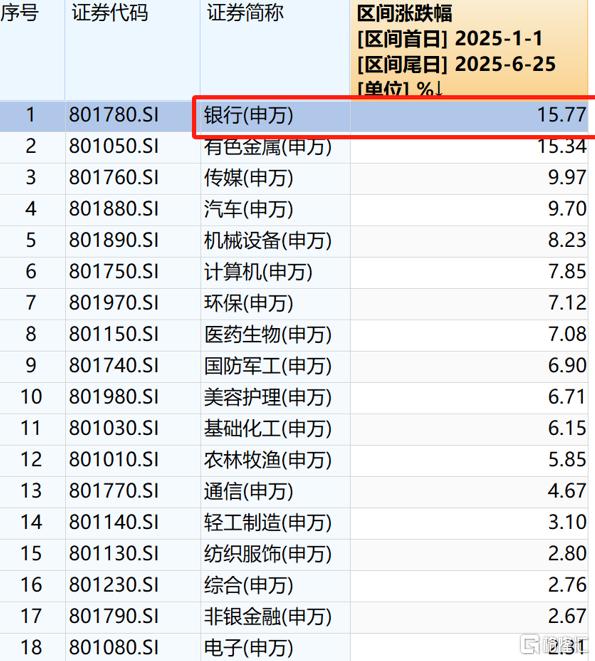
Core Viewpoint - The banking sector in China has seen significant stock price increases, with major banks reaching historical highs, driven by a combination of low interest rates, strong institutional investment, and valuation convergence between A-shares and H-shares [1][4][5]. Group 1: Market Performance - As of June 25, the banking sector index has risen by 14.11% year-to-date, leading all 31 primary industries, with a market capitalization increase of 2.05 trillion yuan, equivalent to "creating two Ningde Times" [1]. - The Bank AH Preferred ETF (517900) has gained nearly 25% this year, with fund shares increasing by 323%, setting new historical records [2]. Group 2: Driving Forces Behind Valuation Increase - The low interest rate environment has created a "defensive premium" for bank stocks, with the ten-year government bond yield dropping to 1.65%, making high dividend yields from banks a scarce resource [5][6]. - Insurance capital has been actively investing in bank stocks, with nine instances of shareholding increases this year, predominantly in Hong Kong bank stocks, totaling a market value of 116.94 billion yuan [7]. - There is a systematic convergence of valuations between A-shares and H-shares, with H-shares trading at an average price-to-earnings ratio of 0.55 compared to 0.67 for A-shares, creating opportunities for cross-market strategies [8]. Group 3: Investment Strategy and Performance - The Bank AH cross-market rotation strategy aims to dynamically compare valuations between A-shares and H-shares monthly, buying the cheaper side to generate excess returns [8]. - Since 2025, the Bank AH total return index has increased by 25.18%, outperforming the CSI Bank total return index by nearly 7 percentage points [9]. - With several banks planning mid-year dividends for 2025, the "normalization of dividends" in a low interest rate environment is expected to further highlight the bond-like attributes of bank stocks [10].

银行体系流动性持续充裕,香港银行LOF(501025) 场内价格续创新高!机构:银行净资产有望重新定价
Sou Hu Cai Jing· 2025-06-26 04:05
Group 1 - The core viewpoint of the news is that Hong Kong bank stocks are experiencing a strong upward trend, with the HK Bank Index aiming for a fifth consecutive day of gains, and the Hong Kong Bank LOF (501025) reaching a new high since its inception [1][2] - The Hong Kong Bank LOF has seen a cumulative increase of 27.70% over the past six months, leading among similar funds, with net inflows exceeding 1.4 billion over the last 13 trading days [1][2] - The People's Bank of China has conducted a 300 billion MLF operation, with a net injection of 1180 billion MLF this month, indicating a continued effort to maintain liquidity in the banking system [1] Group 2 - The Hong Kong Bank LOF closely tracks the HK Bank Index, which includes major banks such as HSBC, China Construction Bank, and Industrial and Commercial Bank of China, with the top ten weighted stocks accounting for 84.38% of the index [2] - As of 11:20, the HK Bank Index rose by 0.25%, with notable increases in stocks such as Qingdao Bank (up 4.20%) and Chongqing Bank (up 1.19%) [2] - The investment strategy for bank stocks emphasizes the importance of liquidity and the potential for revaluation of net assets, driven by macro policies and micro data [1]
四大行再创新高!银行股大爆发,原因曝光
21世纪经济报道· 2025-06-25 23:44
Core Viewpoint - The banking sector has emerged as one of the best-performing industries in the first half of the year, with significant stock price increases and a total market capitalization exceeding 15 trillion yuan [1][3]. Group 1: Performance of Major Banks - On June 25, several banks, including Agricultural Bank of China, Bank of Communications, and others, reached new historical highs, contributing to a 1.03% increase in the banking index on that day [3]. - A total of 18 bank stocks have hit historical highs this year, with no bank stock showing a decline since the beginning of the year. All bank stocks are in the green, with 16 stocks rising over 20% and 32 stocks over 10% [3]. - The top-performing banks include Qingdao Bank, Industrial Bank, and Shanghai Pudong Development Bank, with increases of 33.76%, 32.93%, and 30.81% respectively [3]. Group 2: Reasons for Strong Performance - Analysts attribute the strong performance of the banking sector to macroeconomic conditions and market trends over the past few years. The banking index has outperformed the CSI 300 index by 13.6 percentage points this year [4]. - The current price-to-book (PB) ratio for the banking index is 0.68, indicating potential for future growth. The overall upward trend in the banking sector is expected to continue, particularly for regional banks [4]. - The anticipated recovery in revenue and profit growth is supported by the positive contribution of deposit repricing to net interest margins and a potential decline in bond market volatility [4]. Group 3: Institutional Investment Trends - The global economic environment has led to a decrease in investor risk appetite, making the undervalued banking sector an attractive defensive asset for risk-averse investors [5]. - The recent regulatory changes in public fund management are expected to increase bank holdings among active funds, which currently have a bank holding ratio of only 3.81%, compared to a 13.67% weight in the CSI 300 index [5]. - The new public fund assessment mechanism is likely to encourage active funds to increase their bank holdings, thereby narrowing the performance gap with benchmarks [5]. Group 4: Dividend Policies and Impact - The continuous dividend payouts from banks have significantly contributed to the sector's growth, with several banks announcing mid-year dividend plans for 2025 [8][9]. - Nanjing Bank and Shanghai Rural Commercial Bank have both committed to increasing dividend frequencies in response to policy calls, enhancing shareholder returns [8][9]. - The trend of banks announcing mid-year dividends is expected to bolster their performance and attract more investment [10]. Group 5: Future Outlook - Analysts predict that the core investment logic for the banking sector will persist, driven by high dividend yields, institutional fund inflows, and supportive policies for net interest margins [6]. - The overall funding environment for banks is improving, with increased allocations from passive funds and stable foreign capital holdings [11]. - The combination of macroeconomic policies and microeconomic data is expected to lead to a reassessment of bank net assets, providing intrinsic motivation for industry valuation increases in 2025 [11].

四大行再创新高 银行板块上半年上涨15.6%
2 1 Shi Ji Jing Ji Bao Dao· 2025-06-25 10:44
Group 1 - The banking sector has become one of the best-performing industries in the first half of the year, with 18 bank stocks, including the four major banks, reaching historical highs and the sector's scale surpassing 15 trillion yuan, with the China Securities Banking Index rising by 15.6% [1][2] - On June 25, nine bank stocks, including Agricultural Bank of China and Industrial and Commercial Bank of China, reached new historical highs, with the sector's scale reaching 15.5 trillion yuan and an increase of 1.03% on that day [2] - All bank stocks have shown positive performance this year, with no declines, and 16 stocks have increased by over 20%, while 32 stocks have risen by over 10% [2] Group 2 - Analysts attribute the strong performance of the banking sector to macroeconomic factors and market trends, noting that the banking index has outperformed the CSI 300 index by 13.6 percentage points this year [3] - The current price-to-book (PB) ratio for the banking index is 0.68, indicating a favorable valuation for investors [3] - The banking sector is expected to see a gradual recovery in revenue and profit growth due to positive contributions from deposit repricing and a potential decline in bond market volatility [3] Group 3 - Recent regulatory changes, such as the China Securities Regulatory Commission's new guidelines for mutual fund performance assessments, are expected to lead to increased allocations to bank stocks by fund managers, as many have underweighted this sector in the past [4] - The active fund's allocation to banks is currently only 3.81%, while the banking sector's weight in the CSI 300 index is 13.67%, indicating a significant deviation that is likely to be corrected [4] - The core investment logic for the banking sector remains strong, driven by high dividend yields, underweighting by public funds, and supportive policies for net interest margins [4] Group 4 - The continuous dividend payouts from banks have significantly contributed to the sector's performance, with several banks announcing mid-term dividend plans for 2025 [5][6] - Nanjing Bank and Shanghai Rural Commercial Bank have both committed to increasing dividend frequencies and implementing mid-term dividends, reflecting a trend among banks to enhance shareholder returns [5][6] - Ping An Bank has also indicated the possibility of mid-term cash dividends as part of its shareholder return plan for 2024-2026 [7] Group 5 - Institutional investors are increasingly allocating funds to the banking sector, with a notable increase in the scale of passive funds and a steady rise in active fund holdings of bank stocks [8] - The new public fund regulations are expected to positively impact the banking sector, as insurers and other institutional investors seek stable return assets [8] - The combination of macro policies and micro data suggests a potential revaluation of bank net assets, which could drive the sector's valuation upward in 2025 [8]
金融赋能“小店”向“百年老店”蝶变
Zheng Quan Ri Bao· 2025-06-22 15:11
Core Viewpoint - The newly released "Regulations on the Registration and Management of Individual Industrial and Commercial Households" by the State Administration for Market Regulation aims to standardize the registration management of individual businesses, protect their legal rights, and promote high-quality development, effective from July 15 [1] Group 1: Support for Transformation - The transformation of individual businesses into enterprises is seen as a crucial pathway for scaling up and enhancing competitiveness, with banks actively launching targeted financial services to support this transition [2] - Banks are increasing credit investments and innovating credit products, such as the "Growth Loan" from Zhaoqing Rural Commercial Bank, which offers a monthly interest rate as low as 2.5‰ and flexible repayment options [2] - Financial institutions are providing one-stop financial services, including account management and payment solutions, to facilitate the transition from individual business to enterprise [2][3] Group 2: Collaboration and Value-Added Services - Banks are collaborating with government departments and industry associations to create information-sharing platforms, enabling precise service matching for individual businesses transitioning to enterprises [3] - Additional services offered include financial consulting and risk management to help businesses adapt to an enterprise operational model [3] Group 3: Supporting Long-Term Development - The banking sector is actively supporting individual businesses in achieving long-term sustainability and development, aiming to create "century-old stores" [4] - Banks are providing specialized financial products for businesses with potential for inheritance, such as the "Famous and Special Individual Credit Loan" from Chongqing Bank, offering up to 2 million yuan in pure credit support [4] - Banks are also assisting in brand building through services like brand value assessment and promotional loans, helping businesses enhance their market presence [4][5] Group 4: Future Directions - Future strategies for banks include offering diverse credit products tailored to different stages of business development, simplifying loan application processes, and enhancing service efficiency [6] - The introduction of the new regulations presents opportunities for individual businesses, with banks playing a pivotal role in supporting their growth and cultural heritage [6]
银行业周报(20250616-20250622):市场风险新规发布,提升银行运营效率-20250622
Huachuang Securities· 2025-06-22 13:04
Investment Rating - The report maintains a "Recommended" investment rating for the banking sector, expecting the industry index to outperform the benchmark index by over 5% in the next 3-6 months [24]. Core Insights - The new market risk regulations enhance operational efficiency for banks and establish a solid foundation for future business development [4]. - The regulations clarify the definition of market risk, separating it from interest rate risk, and emphasize the need for improved governance structures and responsibilities among the board, supervisors, and senior management [2][3]. - The report highlights the importance of the new regulations in strengthening banks' risk management capabilities amid increasing complexity in domestic and global trade [4]. Summary by Sections Market Risk Definition and Governance - The new regulations define market risk more rigorously, focusing on risks from adverse changes in interest rates, exchange rates, stock prices, and commodity prices [2]. - The governance structure is refined, specifying the responsibilities of the board, supervisors, and senior management in market risk management [3]. Market Risk Management Requirements - The report details enhanced requirements for risk identification, measurement, monitoring, control, and reporting, aligning with current market practices [3]. - Stricter requirements for the segregation of trading and non-trading activities are introduced, ensuring clearer roles and responsibilities [3]. Investment Opportunities - The report suggests that the banking sector is poised for increased capital inflows due to medium to long-term investments and public fund reforms, recommending a diversified investment strategy focusing on state-owned banks and quality regional banks [9]. - It emphasizes the potential for absolute returns in banks with high dividend yields and strong asset quality, particularly recommending banks like China Merchants Bank and CITIC Bank [9][10].
银行业,再次大降薪
商业洞察· 2025-06-21 09:39
Core Viewpoint - The banking industry is experiencing a significant salary reduction trend, particularly affecting high-level executives, with a notable increase in the number of banks reporting salary cuts and the extent of these reductions [2][3][5]. Group 1: Salary Reduction Trends - In 2023, 14 out of 42 listed banks in A-shares reported a decline in average salary, with the maximum drop reaching 13.59%. This number increased to 18 banks in 2024, with the maximum decline expanding to 15% [2]. - The total compensation for bank management decreased from 870 million yuan in 2023 to 700 million yuan in 2024, a drop of 19.5%. Meanwhile, the average salary for bank employees fell from 462,300 yuan to 444,900 yuan, a decrease of 2.68% [6][7]. Group 2: Executive Salary Cuts - A significant 78.5% of the management teams in listed banks saw their salaries decrease year-on-year in 2024. The average salary for executives in various banks has been notably impacted, with some banks experiencing drastic reductions [5][10]. - Specific banks like Everbright Bank and Zhejiang Commercial Bank saw executive salary reductions of 57.9% and 39.72%, respectively, indicating a trend where executive pay is being cut more severely than that of general employees [10]. Group 3: Factors Influencing Salary Changes - The primary driver of salary fluctuations in banks is the variable component of compensation, which is heavily influenced by the banks' revenue and profit conditions. The floating salary constitutes 65% of the total compensation, making it a critical factor [12][13]. - The banking sector is facing significant revenue pressures, with the average net interest margin dropping to 1.52% in 2024, a decline of 17 basis points from 2023. This has led to a 2.20% decrease in net interest income, marking two consecutive years of negative growth [14][15]. Group 4: Structural Adjustments and Policy Impacts - The banking industry is undergoing structural adjustments, with a focus on risk management and governance. Policies such as the "salary limit order" have imposed constraints on executive compensation, leading to a shift in how salaries are structured [16][17]. - The emphasis on "cost reduction and efficiency enhancement" has resulted in banks prioritizing compensation for frontline and value-creating positions, further contributing to the decline in executive salaries [18][17]. Group 5: Performance-Based Salary Recovery - The trend of "reverse salary recovery" has emerged, where banks reclaim performance bonuses from executives based on risk management failures. This practice aims to align compensation with long-term risk management rather than short-term performance [20][21]. - The total amount reclaimed through reverse salary recovery has approached 99 million yuan, indicating a significant shift in the banking industry's approach to executive compensation and risk management [20].







重庆银行: 重庆银行股份有限公司公开发行A股可转换公司债券受托管理事务报告(2024年度)
Zheng Quan Zhi Xing· 2025-06-18 10:33
Group 1 - The core point of the article is the issuance of A-share convertible bonds by Chongqing Bank, with a total face value of 13 billion yuan approved for public offering [2][3][11] - The initial conversion price for the bonds is set at 11.28 yuan per share, which will be adjusted based on specific corporate actions such as stock dividends and capital increases [4][5][12] - The bonds are scheduled to pay interest annually, with the first interest payment occurring on March 24, 2025, at a rate of 1.00% [12][11] Group 2 - Chongqing Bank's financial performance for 2024 shows a net profit of 5.52 billion yuan, reflecting a year-on-year increase of 5.59% [9][10] - Total assets reached 856.64 billion yuan, marking a 12.73% increase from the previous year, while customer loans and advances totaled 440.62 billion yuan, up 12.13% [9][10] - The bank's core tier 1 capital adequacy ratio stands at 9.88%, slightly improved from the previous year, while the non-performing loan ratio decreased to 1.25% [10][9] Group 3 - The funds raised from the bond issuance are fully allocated to support the bank's future business development and will be used to supplement core tier 1 capital after bondholders convert their bonds [11][10] - The bond trustee, China Merchants Securities, has been actively monitoring the issuer's credit status and the use of raised funds to protect bondholders' interests [11][12] - The bonds do not require a guarantee as the bank's net assets exceed the required threshold [11][10]