联影医疗

Search documents
强势股追踪 主力资金连续5日净流入48股
Zheng Quan Shi Bao Wang· 2025-08-12 09:23
Core Insights - A total of 48 stocks on the Shanghai and Shenzhen exchanges have experienced net inflows of main funds for five consecutive days or more, indicating strong investor interest [1] Group 1: Stocks with Significant Net Inflows - Hengshang Energy has seen net inflows for 11 consecutive days, ranking first among the stocks [1] - Agricultural Bank of China ranks second with net inflows for 10 consecutive days, totaling 1.917 billion yuan [1] - BoRui Pharmaceutical follows with net inflows for 8 days, amounting to 868 million yuan [1] Group 2: Performance Metrics - Agricultural Bank of China has the highest total net inflow amount, with a cumulative net inflow of 1.917 billion yuan over 10 days, and a price increase of 11.56% [1] - BoRui Pharmaceutical has a net inflow of 868 million yuan over 8 days, with a price increase of 16.13% [1] - Xinjiang Communications Construction has the highest net inflow ratio at 24.39%, with a price increase of 38.33% over 6 days [1] Group 3: Additional Notable Stocks - Huicheng Environmental Protection and Xinke Materials both recorded net inflows of 606 million yuan over 7 days, with price increases of 14.40% and 18.70% respectively [1] - Fuling Electric Power has a net inflow of 477 million yuan over 9 days, with a significant price increase of 31.03% [1] - Other notable stocks include Huaguang Huaneng and Wanchen Group, with net inflows of 327 million yuan and 315 million yuan respectively, and price increases of 55.15% and 12.61% [1]




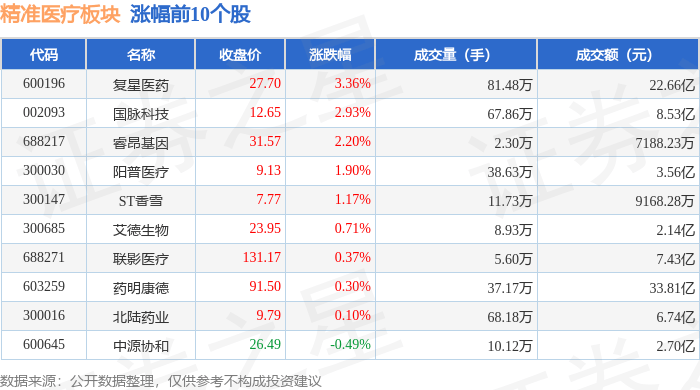
精准医疗板块8月12日涨0.09%,复星医药领涨,主力资金净流出6.94亿元
Sou Hu Cai Jing· 2025-08-12 08:43
Core Viewpoint - The precision medicine sector experienced a slight increase of 0.09% on August 12, with Fosun Pharma leading the gains, while the overall market indices also showed positive movement [1]. Market Performance - The Shanghai Composite Index closed at 3665.92, up 0.5% - The Shenzhen Component Index closed at 11351.63, up 0.53% [1]. Individual Stock Performance - Fosun Pharma (600196) closed at 27.70, up 3.36% with a trading volume of 814,800 shares and a transaction value of 2.266 billion - Guomai Technology (002093) closed at 12.65, up 2.93% with a trading volume of 678,600 shares and a transaction value of 853 million - Ruian Gene (688217) closed at 31.57, up 2.20% with a trading volume of 23,000 shares and a transaction value of 71.8823 million - Other notable stocks include Yangpu Medical (300030) up 1.90% and ST Xiangxue (300147) up 1.17% [1]. Fund Flow Analysis - The precision medicine sector saw a net outflow of 694 million from institutional investors, while retail investors contributed a net inflow of 582 million [2]. - The overall fund flow indicates a mixed sentiment, with institutional investors withdrawing capital while retail investors showed interest [2]. Detailed Fund Flow for Selected Stocks - Guomai Technology (002093) had a net inflow of 39.2158 million from institutional investors, while retail investors had a net outflow of 51.1835 million - Lianying Medical (688271) saw a net inflow of 32.2221 million from institutional investors, but a net outflow of 23.1791 million from retail investors - Yangpu Medical (300030) had a net inflow of 19.3205 million from institutional investors, with retail investors also showing a net outflow [3].


上证消费品指数下跌0.01%,前十大权重包含中国中免等
Jin Rong Jie· 2025-08-12 08:23
从指数持仓来看,上证消费品指数十大权重分别为:药明康德(6.76%)、恒瑞医药(5.4%)、中国中 免(5.11%)、山西汾酒(5.04%)、片仔癀(4.8%)、贵州茅台(4.67%)、联影医疗(4.67%)、复 星医药(3.62%)、今世缘(3.17%)、惠泰医疗(2.68%)。 从上证消费品指数持仓的市场板块来看,上海证券交易所占比100.00%。 从上证消费品指数持仓样本的行业来看,医药卫生占比68.88%、主要消费占比21.91%、可选消费占比 9.21%。 金融界8月12日消息,上证指数高开高走,上证消费品指数 (沪消费品,000103)下跌0.01%,报8329.93 点,成交额328.24亿元。 数据统计显示,上证消费品指数近一个月上涨5.09%,近三个月上涨6.19%,年至今上涨5.77%。 据了解,上证投资品、消费品指数在上证全指样本的投资品、消费品主题证券中选取规模大、流动性好 的50只证券作为样本,以反映沪市投资品、消费品主题证券的整体走势。该指数以2003年12月31日为基 日,以1000.0点为基点。 资料显示,指数样本每半年调整一次,样本调整实施时间分别为每年6月和12月的第二个星 ...

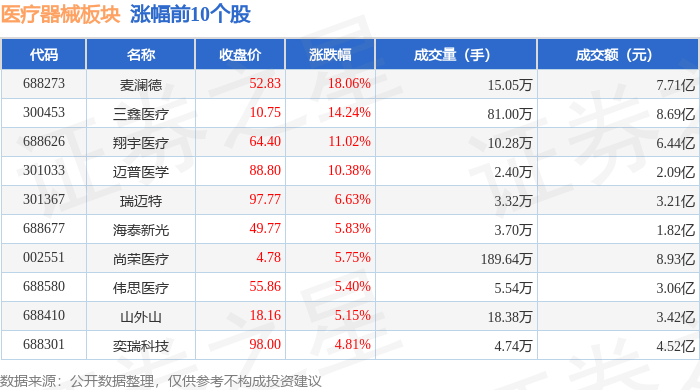
医疗器械板块8月12日涨1.16%,麦澜德领涨,主力资金净流出7.3亿元
Zheng Xing Xing Ye Ri Bao· 2025-08-12 08:22
Market Overview - The medical device sector rose by 1.16% on August 12, with Mai Lande leading the gains [1] - The Shanghai Composite Index closed at 3665.92, up 0.5%, while the Shenzhen Component Index closed at 11351.63, up 0.53% [1] Top Gainers in Medical Device Sector - Mai Lande (688273) closed at 52.83, up 18.06%, with a trading volume of 150,500 shares and a transaction value of 771 million [1] - Sanxin Medical (300453) closed at 10.75, up 14.24%, with a trading volume of 810,000 shares [1] - Xiangyu Medical (688626) closed at 64.40, up 11.02%, with a trading volume of 102,800 shares [1] - Maipu Medical (301033) closed at 88.80, up 10.38%, with a trading volume of 24,000 shares [1] - Ruimaite (301367) closed at 97.77, up 6.63%, with a trading volume of 33,200 shares [1] Decliners in Medical Device Sector - Kehua Bio (002022) closed at 7.58, down 3.44%, with a trading volume of 417,400 shares [2] - Yirui Bio (300942) closed at 12.91, down 2.93%, with a trading volume of 104,400 shares [2] - Rendu Bio (688193) closed at 51.64, down 2.68%, with a trading volume of 8,204 shares [2] Capital Flow Analysis - The medical device sector experienced a net outflow of 730 million from institutional investors, while retail investors saw a net inflow of 112 million [2] - The top stocks with significant net inflows from retail investors include Yirui Medical and Mai Lande, while major outflows were observed in stocks like Aiyu Technology and Meihua Medical [3]


科创50增强ETF(588460)涨超2.1%,寒武纪股价一度刷新历史新高
Xin Lang Cai Jing· 2025-08-12 06:58
Group 1 - The core viewpoint is that the semiconductor sector is experiencing a strong rally, with significant stock price increases among key players like Cambrian (20.00%) and Chipone (8.83%) [1] - The ChiNext 50 Enhanced ETF (588460) has risen by 2.13%, indicating positive market sentiment towards technology stocks [1] - Shanghai Securities predicts a comprehensive recovery in the electronic semiconductor industry by 2025, with an accelerated clearing of competitive landscape and a sustained recovery in industry profitability [1] Group 2 - As of June 30, 2025, the top ten weighted stocks in the ChiNext 50 Index account for 54.16% of the index, highlighting the concentration of market power among leading companies [2] - The top ten stocks include major players such as SMIC, Haiguang Information, and Cambrian, which are critical to the index's performance [2] - The ChiNext 50 Index comprises 50 companies with significant market capitalization and liquidity, focusing on six strategic emerging industries [1][2]






国产算力自主可控重要性凸显,高弹性科创50ETF龙头(588060)盘中涨超2%,半导体为指数第一大重仓行业
Xin Lang Cai Jing· 2025-08-12 06:51
Group 1 - The core index, the Shanghai Stock Exchange Sci-Tech Innovation Board 50 Index, has shown a strong increase of 2.05% as of August 12, 2025, with significant gains in constituent stocks such as Cambricon (20% limit up) and Chipone (up 7.88%) [1] - The leading Sci-Tech 50 ETF (588060) has seen a trading volume of 1.91 billion yuan with a turnover rate of 3.01% during the session, and its average daily trading volume over the past year is 2.69 billion yuan [1] - The leading Sci-Tech 50 ETF has experienced a net asset value increase of 48.36% over the past year, with the highest monthly return since inception being 25.33% [1] Group 2 - The Sci-Tech 50 ETF closely tracks the Sci-Tech Innovation Board 50 Index, which consists of 50 securities with high market capitalization and liquidity, primarily in the semiconductor (60.6%), medical devices (6.6%), and software development (5.2%) sectors [2] - The top ten weighted stocks in the index account for 54.71% of the total, including major companies like SMIC and Cambricon [2] - The impact of the 232 semiconductor tariffs on domestic semiconductor companies is considered limited, reinforcing the necessity for localized production [2] Group 3 - The current electronic sector is expected to experience a valuation expansion due to the convergence of macro policy cycles, industry inventory cycles, and AI innovation cycles [3] - The Sci-Tech 50 ETF offers a convenient investment option, allowing investors to buy a basket of leading Sci-Tech stocks with no asset or investment duration requirements [3]
跻身全球一流水平 国产磁共振仪器再上新台阶
Xin Hua Wang· 2025-08-12 05:48
Core Insights - The domestic high-end medical equipment market, particularly MRI machines, has been historically dominated by foreign companies, but this is changing as domestic firms like United Imaging Healthcare are making significant technological breakthroughs [1][2][3] - United Imaging Healthcare has achieved self-sufficiency in core MRI technology, launching China's first 1.5T and 3.0T superconducting MRI machines, and has seen substantial revenue growth in this segment [2][4] - The company has recently broken the long-standing record of 3.0T MRI technology, achieving advancements in 5.0T MRI technology, positioning itself among the top global developers of high-end medical equipment [4][5] Market Dynamics - The global market for high-end MRI machines has been largely monopolized by companies like GE, Siemens, and Philips, leading to high prices and limited availability for hospitals [2][3] - In 2022, United Imaging Healthcare ranked first in the market share for 1.5T MRI machines and third for 3.0T machines, indicating a shift in the competitive landscape [3] Technological Advancements - United Imaging Healthcare has made significant strides in MRI technology, including the development of a 5.0T MRI machine, which is recognized as a cutting-edge medical device globally [4][5] - The company has integrated artificial intelligence into its MRI technology, significantly reducing scan times and improving patient accessibility, with some scans now taking only seconds [6][7] Future Outlook - The global medical imaging equipment market is projected to grow, with estimates suggesting it will reach 108.5 billion RMB by 2030, indicating a substantial opportunity for companies in this sector [8]

科创龙头领衔 上海上市公司掀回购潮
Xin Hua Wang· 2025-08-12 05:48
Core Viewpoint - Shanghai-listed companies are actively engaging in share buybacks, reflecting their confidence in their own value and aiming to stabilize stock prices amid market fluctuations [1][2]. Group 1: Share Buyback Trends - Over 40 Shanghai-listed companies have announced share buyback plans or progress since October, including major firms like Baosteel, United Imaging, Putailai, and Lattice Technology, all with market capitalizations exceeding 50 billion [1]. - The buyback trend is seen as a positive signal to the secondary market, indicating companies' recognition of their intrinsic value and helping to prevent stock prices from deviating from actual value [1][2]. Group 2: Specific Company Actions - Baosteel plans to repurchase up to 500 million shares at a maximum price of 8.86 yuan per share, with a total expenditure not exceeding 3 billion yuan, citing a need to reflect its intrinsic value amid a challenging global economic environment [2]. - Yirui Technology announced a buyback plan of 10 million to 20 million yuan, with a maximum price of 345 yuan per share, aimed at employee stock ownership plans [2][3]. - Siwei Technology intends to use 30 million to 50 million yuan for share repurchases to support employee stock ownership and incentive plans [3]. Group 3: Financial Commitments by Tech Leaders - Putailai has repurchased 9.75 million shares at an average price of 30.76 yuan, totaling approximately 299.99 million yuan, with shares intended for employee stock ownership plans [4]. - United Imaging has repurchased 4.04 million shares at prices ranging from 102.20 to 111.00 yuan, with a total expenditure of 435 million yuan, also for employee stock ownership plans [4]. - Lattice Technology has repurchased 348,330 shares at prices between 47.95 and 52.00 yuan, with a total expenditure of about 174 million yuan, designated for employee stock ownership plans [5].


医疗器械板块走强,医疗器械指数ETF、医疗器械ETF基金、医疗器械ETF上涨
Ge Long Hui· 2025-08-12 04:08
Core Viewpoint - The medical device sector is experiencing significant growth, driven by supportive policies and technological advancements, particularly in brain-computer interface technology and commercial health insurance development [2][4]. Group 1: Medical Device Sector Performance - Medical device stocks such as Mindray, Sanxin Medical, and Maipu Medical have seen increases of over 10%, while others like Xiangyu Medical and Shanhai Mountain have risen over 5%, contributing to the overall rise of medical device ETFs [1]. - The medical device market in China surpassed 1,032.8 billion yuan in 2023, maintaining its position as the second-largest globally, supported by policy backing, aging population, and technological innovation [3]. Group 2: Policy Developments - A joint initiative by seven government departments aims to promote the innovation and development of brain-computer interface technology, targeting breakthroughs by 2027 and establishing a competitive industry ecosystem by 2030 [2][4]. - Shanghai has introduced 18 measures to support the development of commercial health insurance and innovative medical devices, focusing on expanding coverage and integrating new medical technologies into insurance plans [3]. Group 3: Market Outlook - The medical device industry is expected to benefit from the integration of innovative products into insurance coverage, which may enhance market confidence and stimulate growth [5]. - The focus on commercial health insurance and innovative medical devices is anticipated to create new opportunities for investment in the sector, particularly in areas like AI and high-end domestic equipment [3][4].
中信建投研报:医疗仪器行业拐点已至
仪器信息网· 2025-08-12 03:58
Core Viewpoint - The medical device sector is expected to witness a performance turning point from the second half of 2025 to 2026, driven by the continuous improvement in the technological strength and product competitiveness of domestic medical device companies, transitioning from "domestic substitution + penetration enhancement" to "international expansion + technological innovation" [2] Group 1: Policy Improvement and Industry Recovery - Historical performance shows a continuous decline in the medical device sector from 2021 to 2024, with further pressure in 2023-2024 due to upgraded medical compliance requirements and a slowdown in equipment renewal [3] - Signals of recovery are emerging, particularly in high-value consumables, where policy optimization is driving valuation recovery and there is significant room for penetration improvement [4] - In the medical equipment sector, a turning point in bidding growth is expected in Q4 2024, with leading companies' performance stabilizing and accelerating domestic substitution by Q3 2025 [5] - The in vitro diagnostics (IVD) sector is currently under policy pressure, but the chemical luminescence field may stabilize in terms of volume and price by Q4 2026, with significant potential for domestic substitution in the medium to long term [6] - For low-value consumables, attention is needed on overseas production capacity layout and progress with major customer collaborations under tariff policies [7] - The home medical device market, including respiratory machines and continuous glucose monitoring (CGM), presents vast opportunities, with a focus on consumer sentiment and international expansion [8] Group 2: Corporate Strategic Transformation - Companies are focusing on cost reduction and efficiency improvement through large-scale production, process optimization, and supply chain management to maintain profit margins [9] - Technological innovation is key, with differentiated product layouts helping to mitigate procurement risks, and healthcare insurance policies providing longer release cycles for innovative devices [10] - The transformation in consumption patterns shows that the impact of healthcare cost control is minimal, while consumption upgrades drive growth in optional medical demand, indicating a higher market ceiling [11] - International breakthroughs are being made as domestic companies leverage cost and supply chain advantages to accelerate overseas expansion [12] - Mergers and acquisitions are being utilized to break through existing market ceilings and enter emerging fields such as surgical robots and brain-computer interfaces [13] Group 3: Global Leadership in Innovative Medical Devices - Several Chinese companies have achieved technological breakthroughs, leveraging population size, clinical data accumulation, and industrial chain advantages [14] - Notable achievements include the world's first full-body PET/CT by United Imaging, leading chemical luminescence detection speeds by Mindray and New Industries, and the FDA breakthrough designation for Sino Medical's intracranial stent [15] Group 4: Growth Path of Global Medical Device Leaders - The strategy of going global is shifting from domestic substitution to global competition, with local operations and factory construction driving high growth in overseas business [16] - Technological innovation is fueled by R&D investment, with some companies accelerating internationalization through a license-out model [17] - Mergers and acquisitions are seen as a pathway for Chinese companies to release global growth potential, drawing lessons from U.S. medical device giants [18] Group 5: Investment Opportunity Analysis - In the Hong Kong stock market, attention should be paid to companies with strong innovation attributes and license-out potential, as well as undervalued companies with sufficient cash reserves that may turn profitable from 2025 to 2027 [19] - In the A-share market, companies expected to see performance turning points in Q2-Q3 2025 should be monitored, along with those benefiting from optimized procurement policies and new medical technologies [20] - The Chinese medical device industry is transitioning from a "follower" to a "leader," with technological innovation and international expansion becoming core driving forces, positioning leading companies to become world-class benchmarks [20]