
艾力斯

Search documents
医药生物行业双周报2026年第1期总第150期:脑机接口推荐性标准立项促进行业规范化《第四批鼓励仿制药品目录》发布-20260112
Great Wall Glory Securities· 2026-01-12 09:12
Investment Rating - The investment rating for the industry is "Positive" and the rating has been maintained [1] Core Insights - The pharmaceutical and biotechnology industry index increased by 5.60%, ranking 8th among 31 primary industries, outperforming the CSI 300 index which rose by 2.18% [4][16] - The PE (TTM overall method, excluding negative values) for the pharmaceutical and biotechnology industry as of January 9, 2026, is 30.56x, up from 29.20x at the end of the previous period, indicating an upward valuation trend [4][21] - The top three sub-industries in terms of PE are vaccines (47.64x), hospitals (43.33x), and medical devices (39.44x), while pharmaceutical circulation has the lowest valuation at 15.42x [4][21] Industry Review - The report highlights significant developments in the pharmaceutical sector, including the release of the "Fourth Batch of Encouraged Generic Drug Catalog" aimed at optimizing the drug supply guarantee system and enhancing industry structure [6][26] - The report notes that 43 listed companies in the pharmaceutical and biotechnology sector experienced a net reduction in shareholder holdings amounting to 2.779 billion yuan, with 8 companies increasing holdings by 20 million yuan and 35 companies reducing holdings by 2.799 billion yuan [4] Important Industry News - The National Health Commission and other departments released the "Fourth Batch of Encouraged Generic Drug Catalog," which includes 21 varieties and 47 specifications, focusing on clinical needs and disease burdens [26][27] - The NMPA announced measures to strengthen the supervision and management of entrusted drug production, aiming to enhance drug quality assurance levels [29][30] - The NMPA also optimized the review and approval process for urgently needed overseas drugs, encouraging simultaneous global development and submission [31][32] Investment Recommendations - The report suggests focusing on innovative pharmaceutical companies with strong pipeline differentiation, rapid clinical advancement, and robust overseas collaboration capabilities [7][8] - In the medical device sector, it recommends paying attention to companies with solid technical foundations and deep collaborations with leading hospitals and research institutions [8]
1月9日科创板主力资金净流出54.49亿元
Zheng Quan Shi Bao Wang· 2026-01-09 09:28
Group 1 - The main point of the news is that the net outflow of main funds in the Shanghai and Shenzhen markets reached 24.126 billion yuan, with the Sci-Tech Innovation Board experiencing a net outflow of 5.449 billion yuan [1] - A total of 224 stocks on the Sci-Tech Innovation Board saw net inflows, while 376 stocks experienced net outflows [1] - Among the stocks with significant net inflows, Haiguang Information led with a net inflow of 457 million yuan, followed by Xinke Mobile-U and Qiangyi Co., with net inflows of 337 million yuan and 323 million yuan respectively [1] Group 2 - There are 56 stocks that have seen continuous net inflows for more than three trading days, with Anxu Bio leading at 10 consecutive days of inflow [2] - The stock with the longest continuous net outflow is Dameng Data, which has seen outflows for 23 consecutive trading days [2] - The top stocks by net inflow include Haiguang Information, Xinke Mobile-U, and Qiangyi Co., with respective inflows of 457.4 million yuan, 337.4 million yuan, and 323.1 million yuan [2][3]






解密主力资金出逃股 连续5日净流出387股


Zheng Quan Shi Bao Wang· 2026-01-09 09:28
Core Viewpoint - The report highlights a significant outflow of main capital from various stocks in the Shanghai and Shenzhen markets, with 387 stocks experiencing net outflows for five consecutive days or more, indicating potential investment risks in these companies [1][2][3][4]. Group 1: Main Capital Outflow Statistics - The stock with the longest continuous net outflow is Dameng Data, with 23 days of outflows [1]. - Daqin Railway follows with 20 days of net outflows, totaling 2.711 billion yuan [1]. - The total net outflow for Daqin Railway over 20 days is the highest at 2.711 billion yuan, while Xiechuang Data has a net outflow of 1.914 billion yuan over five days [1][2]. Group 2: Stocks with Significant Outflows - The top stocks by net outflow duration include: - Daqin Railway: 20 days, 2.711 billion yuan, 18.68% of trading volume, -6.22% cumulative change [1]. - Dameng Data: 23 days, 0.503 billion yuan, 7.58% of trading volume, 14.15% cumulative change [2]. - Haima Automobile: 12 days, 1.626 billion yuan, 8.26% of trading volume, -18.59% cumulative change [1]. Group 3: Other Notable Stocks - Other stocks with notable outflows include: - Wuzhou Xinchun: 5 days, 1.574 billion yuan, 5.24% of trading volume, 11.62% cumulative change [1]. - Dongshan Precision: 6 days, 1.512 billion yuan, 6.91% of trading volume, -6.80% cumulative change [1]. - Shengtai Electronics: 10 days, 1.377 billion yuan, 8.47% of trading volume, -8.71% cumulative change [1].
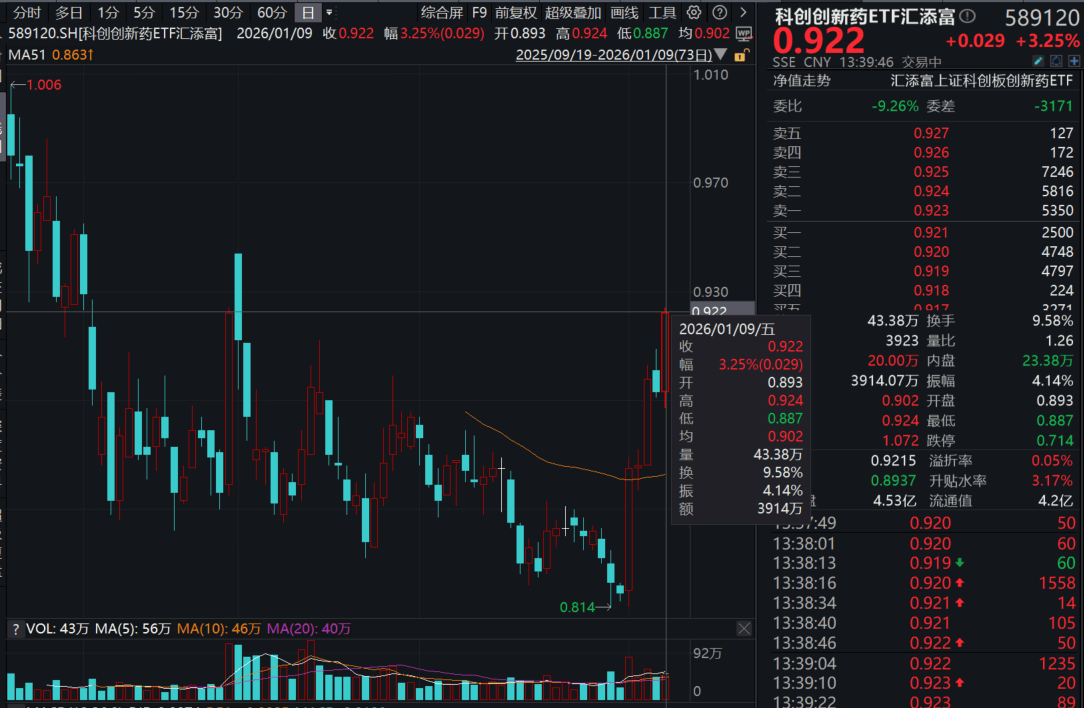
创新药午后蹿升!骨髓瘤注射液获上市审批,智翔金泰大涨超8%,科创创新药ETF汇添富(589120)涨超3%,强势反包!创新药2026投资前瞻来了
Sou Hu Cai Jing· 2026-01-09 06:05
Core Viewpoint - The A-share market is experiencing a significant upward trend, with the Shanghai Composite Index returning to 4100 points for the first time in 10 years, driven by a strong performance in the innovative pharmaceutical sector, particularly the Sci-Tech Innovation Drug ETF Huatai (589120) which rose over 3% [1] Group 1: Market Performance - The Sci-Tech Innovation Drug ETF Huatai (589120) saw most of its constituent stocks surge, with notable increases such as Yuekang Pharmaceutical up over 10%, Zhixiang Jintai up over 8%, and Micron Biologics up over 6% [3] - The top ten constituent stocks of the ETF include major players in the pharmaceutical sector, with BeiGene (688235) rising by 1.77% and Aier Eye Hospital (688578) increasing by 2.18% [3] Group 2: Regulatory Support - A national drug supervision conference held from January 6 to 7 emphasized the need to actively support the pharmaceutical industry in enhancing quality and efficiency, alongside comprehensive reforms in drug regulation [4] Group 3: Innovation and Drug Approvals - Innovation remains a key theme in the Sci-Tech Innovation Drug sector, with recent announcements including Zhixiang Jintai's conditional listing application for a dual-antibody drug and Micron Biologics receiving approval for clinical trials of a new drug for pancreatic cancer [5] - BeiGene announced the conditional approval of its new BCL2 inhibitor, providing new treatment options for patients with chronic lymphocytic leukemia [6] - Rongchang Biologics is seeking breakthrough therapy designation for a new indication of its drug, which would mark a significant regulatory achievement for domestic ADC products [7] Group 4: Future Outlook - The Pacific Securities report anticipates that by 2026, the innovative drug sector will benefit from enhanced international capabilities and supportive industry policies, leading to increased market confidence and investment [8] - The report highlights that the average deal value for innovative drugs purchased from China by top multinational corporations is significantly higher than those from overseas, indicating a growing recognition of the value of Chinese innovative drugs in the global market [9]




艾力斯涨2.02%,成交额2.20亿元,主力资金净流出4475.75万元
Xin Lang Zheng Quan· 2026-01-09 03:25
Group 1 - The core viewpoint of the news is that Ailis has shown a positive performance in stock price and financial results, indicating growth potential in the pharmaceutical sector [1][2][3] - As of January 9, Ailis's stock price increased by 2.02% to 106.30 CNY per share, with a total market capitalization of 47.835 billion CNY [1] - The company reported a revenue of 3.733 billion CNY for the first nine months of 2025, representing a year-on-year growth of 47.35%, and a net profit of 1.616 billion CNY, up 52.01% year-on-year [2] Group 2 - Ailis has a total of 19,100 shareholders as of September 30, 2025, which is an increase of 46.82% compared to the previous period [2] - The company has distributed a total of 653 million CNY in dividends since its A-share listing [3] - The top ten circulating shareholders include significant institutional investors, with Hong Kong Central Clearing Limited holding 20.9471 million shares, an increase of 10.5693 million shares from the previous period [3]
1月8日医疗健康(980016)指数涨0.03%,成份股科伦药业(002422)领涨
Sou Hu Cai Jing· 2026-01-08 10:40
Group 1 - The Medical Health Index (980016) closed at 6402.95 points on January 8, with a slight increase of 0.03% and a trading volume of 27.797 billion yuan, resulting in a turnover rate of 0.92% [1] - Among the constituent stocks of the index, 21 stocks rose, with Kelun Pharmaceutical leading the gains at 6.19%, while 25 stocks declined, with Aier Eye Hospital leading the losses at 3.87% [1] Group 2 - The net outflow of main funds from the Medical Health Index constituent stocks totaled 762 million yuan, while retail investors saw a net inflow of 176 million yuan [2] - Over the past 10 days, there has been an adjustment in the constituent stocks of the Medical Health Index, with one stock added and one stock removed [2]


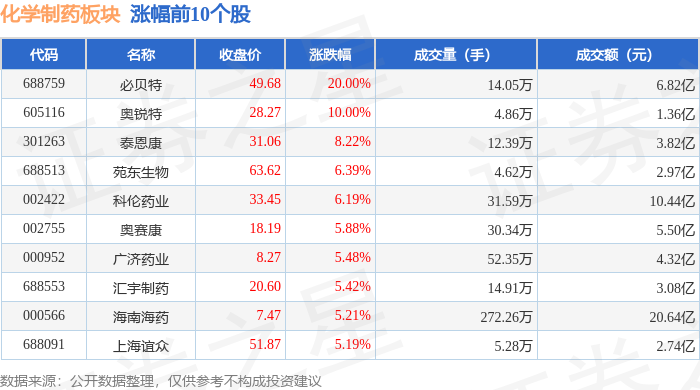
化学制药板块1月8日涨0.24%,必贝特领涨,主力资金净流出1.91亿元
Zheng Xing Xing Ye Ri Bao· 2026-01-08 08:51
Group 1 - The chemical pharmaceutical sector increased by 0.24% on January 8, with Bibete leading the gains [1] - The Shanghai Composite Index closed at 4082.98, down 0.07%, while the Shenzhen Component Index closed at 13959.48, down 0.51% [1] - Notable gainers in the chemical pharmaceutical sector included Bibete, which rose by 20.00% to a closing price of 49.68, and Qijingt, which increased by 10.00% to 28.27 [1] Group 2 - The chemical pharmaceutical sector experienced a net outflow of 191 million yuan from institutional investors, while retail investors saw a net inflow of approximately 84.42 million yuan [2] - The trading volume for Bibete was 140,500 shares, with a transaction value of 682 million yuan, indicating strong market interest [1] - The sector's overall trading activity showed a mix of inflows and outflows, with specific stocks like Hainan Haiyao and Xinyu Pharmaceutical seeing significant institutional interest [3]


科创板迎开门红!上交所团队守护试验田结硕果
Xin Lang Cai Jing· 2026-01-05 11:29
Core Viewpoint - The A-share market experienced a strong start in 2026, with major indices rising collectively, particularly the Sci-Tech Innovation Board, which saw a gain of 3.61% [1] Group 1: Market Performance and Reforms - The Sci-Tech Innovation Board has become increasingly prominent as a "testbed" for capital market reforms, with the introduction of the "1+6" reform measures enhancing its focus on "hard technology" [1] - The board welcomed its 600th listed company, a semiconductor equipment firm that has successfully achieved domestic substitution for critical hardware [1] - The Sci-Tech Innovation Board's index rose over 46% last year, outperforming most broad-based indices, indicating strong market performance [5] Group 2: Support for Hard Technology Companies - The introduction of the fifth set of listing standards has opened doors for unprofitable but technically capable companies to access capital markets [2] - The recent acceptance of the IPO application for Blue Arrow Aerospace, dubbed the "first commercial rocket stock" in China, exemplifies the benefits of these new listing standards [2] - Companies in the commercial aerospace sector are at a critical juncture, requiring capital market support for scaling up operations [2] Group 3: Financing and Growth Opportunities - The ability to access capital markets significantly accelerates the growth and market capture of companies, as evidenced by the experiences of several biotech firms on the Sci-Tech Innovation Board [2] - Shanghai Ailis Pharmaceutical Technology Co., which achieved profitability two years after listing, highlights the importance of timely financing in the competitive pharmaceutical market [3] - Among the 60 companies listed on the Sci-Tech Innovation Board that were unprofitable at the time of listing, 22 have since turned profitable, with others showing a 62% reduction in net profit losses [3] Group 4: Regulatory Oversight and Investor Protection - Regulatory bodies emphasize the importance of timely and accurate disclosure of clinical and R&D progress to maintain market fairness and transparency [4] - The regulatory framework is designed to help companies efficiently acquire essential resources such as funding, talent, and quality assets for growth [3]
600家公司撬动逾10万亿硬科技版图
第一财经· 2026-01-05 03:04
Core Viewpoint - The article discusses the significant changes in China's capital market and "hard technology" development since the establishment of the Sci-Tech Innovation Board (STAR Market) over seven years ago, highlighting its role in supporting technological innovation and providing a favorable investment environment [3]. Group 1: Overview of the Sci-Tech Innovation Board - As of January 5, 2026, the number of listed companies on the Sci-Tech Innovation Board reached 600, with a total market capitalization exceeding 10 trillion yuan, and IPO and refinancing funds raised exceeding 1.1 trillion yuan [3][5]. - Over 80% of the listed companies are from emerging industries such as new-generation information technology, biomedicine, and high-end equipment manufacturing, with an average R&D intensity maintained above 10% [3][5]. - The Sci-Tech Innovation Board has over 100 listed ETFs, with a total scale of over 310 billion yuan for related index tracking products [3]. Group 2: Impact on Companies - Companies listed on the Sci-Tech Innovation Board have experienced significant growth, with a compound annual growth rate (CAGR) of 19% in revenue and 8% in net profit over the past five years [5][6]. - The board has facilitated a balanced match between policy supply and industry demand, helping companies like Zhongwei achieve multi-channel financing and enhance market recognition [4][8]. - The board's inclusive and adaptive system has allowed companies to overcome uncertainties in technology innovation and capital returns, providing solid support for national strategic goals [4][6]. Group 3: Characteristics of the Sci-Tech Innovation Board - The Sci-Tech Innovation Board exhibits "three highs and one strong" characteristics: high "new" content, high "science" content, high "gold" content, and strong institutional adaptability [7]. - The board has introduced innovative systems and continuously optimized them, serving as a "testbed" for capital market reforms [7]. - Companies like Ailis have benefited from the board's inclusive policies, achieving rapid development post-listing [7]. Group 4: Sector-Specific Developments - The semiconductor industry has become a core focus, with 127 listed companies on the Sci-Tech Innovation Board, accounting for 60% of the total A-share semiconductor companies [11]. - These semiconductor companies have a combined market value of 5 trillion yuan, with a revenue increase of 25% year-on-year in the first three quarters of 2025 [11][12]. - The board has supported semiconductor companies through direct financing, high-quality mergers and acquisitions, and talent retention strategies [12]. Group 5: Biomedicine Sector Growth - The Sci-Tech Innovation Board has become a major listing venue for biomedicine, with nearly 120 companies and a total market value of 1.75 trillion yuan [13]. - The board has implemented policies to support unprofitable biotech companies, enhancing their financing flexibility [13][14]. - Biomedicine companies listed on the board have significantly contributed to the development of innovative drugs, with 14% of new drugs approved in China originating from these companies [14][15].

600家公司撬动逾10万亿硬科技版图,科创板七年跑出改革创新加速度
Di Yi Cai Jing Zi Xun· 2026-01-05 01:40
Group 1 - The Science and Technology Innovation Board (STAR Market) has seen significant growth since its establishment over seven years ago, with 600 listed companies and a total market capitalization exceeding 10 trillion yuan [1][3] - The STAR Market has raised over 1.1 trillion yuan through IPOs and refinancing, with more than 80% of companies in emerging industries such as new-generation information technology, biomedicine, and high-end equipment manufacturing [1][3] - The average R&D intensity of STAR Market companies remains above 10%, leading all A-share sectors, and over 100 STAR Market ETFs have been launched, with a total scale exceeding 310 billion yuan [1][3] Group 2 - STAR Market companies have achieved a compound annual growth rate of 19% in revenue and 8% in net profit over the past five years, based on 2019 figures [3] - The STAR Market has created a favorable investment environment, allowing investors to share in the benefits of China's technological innovation [1][3] - The STAR Market has established a "three highs and one strong" characteristic, focusing on high innovation, high technology, high financial performance, and strong institutional adaptability [4] Group 3 - The semiconductor and biomedicine sectors have become the main forces in achieving self-sufficiency, with 127 semiconductor companies listed on the STAR Market, accounting for 60% of the total A-share semiconductor companies [7][8] - The total market value of semiconductor companies on the STAR Market has reached 5 trillion yuan, representing half of the total market capitalization of the STAR Market [7] - Biomedicine companies on the STAR Market have raised a total of 184.2 billion yuan, with a combined market value of 1.75 trillion yuan, making it a major listing venue outside the US and Hong Kong [9][10] Group 4 - STAR Market has implemented policies to support the rapid development of semiconductor companies, including significant financing for R&D and high-quality mergers and acquisitions [8] - The STAR Market has also facilitated talent retention and attraction through stock incentive plans, with 93 semiconductor companies launching such plans, covering over 50,000 core technical or business personnel [8] - The STAR Market has become a backbone for China's innovative drug industry, with approximately 14% of the total number of domestically approved Class 1 new drugs coming from STAR Market companies [10]