
常熟银行

Search documents
农商行板块1月7日跌0.57%,瑞丰银行领跌,主力资金净流入5042.72万元
Zheng Xing Xing Ye Ri Bao· 2026-01-07 08:58
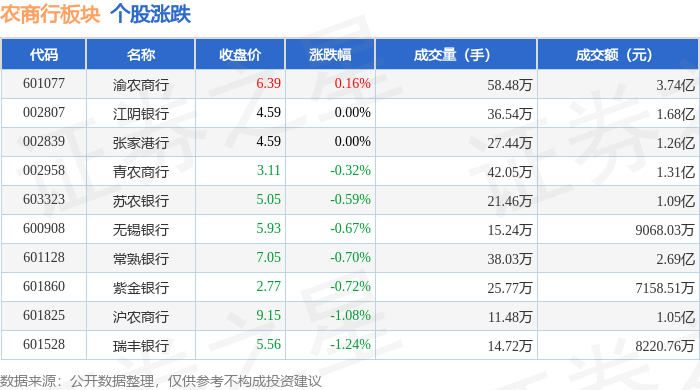
Core Viewpoint - The rural commercial bank sector experienced a decline of 0.57% on January 7, with Ruifeng Bank leading the drop, while the Shanghai Composite Index rose by 0.05% and the Shenzhen Component Index increased by 0.06% [1] Group 1: Market Performance - The closing prices and performance of key rural commercial banks on January 7 are as follows: - Yunnan Rural Commercial Bank (601077) closed at 6.39, up by 0.16% - Jiangyin Bank (002807) closed at 4.59, unchanged - Zhangjiagang Bank (002839) closed at 4.59, unchanged - Qingnong Bank (002958) closed at 3.11, down by 0.32% - Sunan Bank (603323) closed at 5.05, down by 0.59% - Wuxi Bank (600908) closed at 5.93, down by 0.67% - Changshu Bank (601128) closed at 7.05, down by 0.70% - Zijin Bank (601860) closed at 2.77, down by 0.72% - Hunan Rural Commercial Bank (601825) closed at 9.15, down by 1.08% - Ruifeng Bank (601528) closed at 5.56, down by 1.24% [1] Group 2: Capital Flow - On January 7, the rural commercial bank sector saw a net inflow of 50.43 million yuan from main funds, while retail investors experienced a net outflow of 84.63 million yuan [1] - The capital flow for individual banks is as follows: - Zhangjiagang Bank (002839) had a main fund net inflow of 13.66 million yuan, but a retail net outflow of 13.84 million yuan - Changshu Bank (601128) had a main fund net inflow of 13.25 million yuan, with a retail net outflow of 22.78 million yuan - Qingnong Bank (002958) had a main fund net inflow of 12.24 million yuan, but a retail net outflow of 8.34 million yuan - Wuxi Bank (600908) had a main fund net inflow of 9.53 million yuan, with a retail net outflow of 6.99 million yuan [2]






银行业 2026 年经营展望:资产负债篇到期存款流向是资负格局的关键
Guoxin Securities· 2026-01-07 07:12
Investment Rating - The report maintains an "Outperform the Market" rating for the banking sector [4][5]. Core Insights - The banking industry is expected to see a reasonable M2 growth target of approximately 7.5%, with credit growth around 6.0% and social financing growth at about 8.0% for 2026. This aligns with the anticipated nominal GDP growth of about 5.0% and actual GDP growth of approximately 4.9% [1][15][21]. - The report highlights that the flow of deposits will be a key factor affecting the asset-liability structure of banks in 2026, with a significant amount of term deposits maturing, estimated at around 57 trillion yuan [3][49]. - The credit allocation is expected to show strong support for corporate lending, contributing approximately 80% to 85% of new loans, while retail lending is projected to improve marginally, contributing about 10% to 15% [2][36]. Summary by Sections M2 and Credit Growth - The M2 growth target for 2026 is set at approximately 7.5%, with an expected M2 increment of about 25.4 trillion yuan, driven by fiscal net injection of around 12.0 trillion yuan and bank credit issuance of about 16.8 trillion yuan [1][21][22]. - The anticipated credit growth for 2026 is around 6.0%, with new social financing expected to reach approximately 35.3 trillion yuan, reflecting an 8.0% growth rate [21][26][30]. Deposit Flow and Asset-Liability Structure - The report indicates that the flow of deposits from large banks to smaller banks will be a critical factor in determining the marginal changes in the asset-liability gap for large banks in 2026. The pressure from deposit migration is expected to ease somewhat [2][41][54]. - The maturing term deposits for the six major banks are estimated to be between 27 trillion and 32 trillion yuan, with a significant portion being long-term deposits [3][49][50]. Investment Recommendations - The report suggests focusing on two main lines for investment in 2026: high-quality companies with improving fundamentals, such as Ningbo Bank and Changshu Bank, and stable high-dividend stocks like China Merchants Bank and Industrial and Commercial Bank of China [3][4].





银行业2026年经营展望:资产负债篇:期存款流向是资负格局的关键
Guoxin Securities· 2026-01-07 05:15
Investment Rating - The report maintains an "Outperform the Market" rating for the banking sector [4][5]. Core Insights - The banking sector is expected to see a reasonable M2 growth target of approximately 7.5%, with credit growth around 6.0% and social financing growth at about 8.0% for 2026. This aligns with the goal of stabilizing economic growth and ensuring reasonable price recovery [1][21]. - The report highlights that the flow of deposits will be a key factor affecting the asset-liability structure of banks in 2026, with a significant amount of term deposits maturing, estimated at around 57 trillion yuan [3][49]. - The credit allocation is expected to remain strong for corporate lending, contributing approximately 80% to 85% of new loans, while retail lending is anticipated to show marginal improvement, contributing about 10% to 15% [2][36]. Summary by Sections Economic Outlook - The actual GDP growth target for 2026 is estimated at 4.9%, with a nominal GDP growth target of about 5.0%, which corresponds to a reasonable M2 growth target of 7.5% [1][15]. - The projected M2 increment for 2026 is approximately 25.4 trillion yuan, with fiscal net M2 injection around 12.0 trillion yuan and bank credit (including write-offs and ABS) contributing about 16.8 trillion yuan [21][22]. Credit Allocation - Corporate lending is expected to remain the primary support for new loans, while retail lending will experience structural differentiation, with personal operating loans maintaining good growth and housing loans likely showing slight positive growth [2][36]. - The report indicates that the flow of deposits from large banks to smaller banks will be a critical factor in the marginal changes in the asset-liability gap for large banks in 2026 [3][41]. Investment Recommendations - The report suggests focusing on two main lines for investment in 2026: high-quality companies with improving fundamentals, such as Ningbo Bank and Changshu Bank, and stable high-dividend stocks like China Merchants Bank and Industrial and Commercial Bank of China [4][5].
多家商业银行取消,5年期定存产品为何变少了?
Xin Hua Wang· 2026-01-06 12:21
Core Viewpoint - The reduction of 5-year fixed deposit products by multiple commercial banks is a direct consequence of the current low interest rate environment, reflecting a broader trend towards specialized wealth management in the financial market [5][9][15] Group 1: Market Environment - The overall market interest rates have remained low, leading banks to reduce the supply of long-term deposit products, particularly 5-year fixed deposits [6][9] - As of December 2022, the 5-year Loan Prime Rate (LPR) was 4.30%, which dropped to 3.50% by December 2025, indicating a significant decline in interest rates over the years [7] - Many banks have shifted focus to shorter-term deposit products, with 2-year and 3-year options becoming more prevalent [7][8] Group 2: Customer Reactions - Customers have varied responses to the reduction of 5-year fixed deposits; some continue to prefer bank deposits, while others are exploring alternative investment options due to declining interest rates [8][9] - A customer from Shijiazhuang expressed disappointment over the reduction of long-term deposits, indicating a shift to 3-year products as a compromise [8] - Younger customers are increasingly diversifying their investments, opting for gold and other liquid assets instead of traditional fixed deposits [8][9] Group 3: Banking Strategies - Banks are actively compressing long-term deposit offerings to maintain net interest margins, which have been under pressure due to low interest rates [9][10] - Some banks have raised the minimum investment threshold for large-denomination certificates of deposit, reflecting a strategic shift in response to the current funding market [9][10] - Financial institutions are focusing on optimizing their asset-liability structures to stabilize net interest margins and enhance profitability [10][11] Group 4: Wealth Management Trends - The trend towards wealth management is becoming more pronounced, with banks enhancing their service offerings to meet diverse customer needs [13][15] - Banks are increasingly integrating various financial products, such as insurance and investment funds, to provide comprehensive wealth management solutions [15] - The shift from savings to diversified asset allocation is expected to continue, indicating a growing market for wealth management services [14][15]

过渡期临近,银行业首席合规官纷纷“就位”
2 1 Shi Ji Jing Ji Bao Dao· 2026-01-06 10:22
Core Viewpoint - The appointment of Chief Compliance Officers (CCOs) in Chinese banks is a response to regulatory requirements aimed at enhancing compliance systems and governance structures within the banking industry [1][3][10]. Group 1: Regulatory Framework - The Financial Regulatory Bureau issued the "Compliance Management Measures for Financial Institutions," mandating the establishment of CCOs at the headquarters of financial institutions, effective from March 1, 2025, with a one-year transition period [3][9]. - The implementation of CCOs is seen as a shift from "formal compliance" to "substantive compliance" across various types of banks, including state-owned banks, city commercial banks, and rural banks [3][7]. Group 2: Appointment Trends - A wave of appointments for CCOs has been observed, with banks like Zhangjiagang Rural Commercial Bank and others appointing existing senior management to these roles, reflecting a trend towards integrating compliance into the upper management structure [1][6][8]. - Different banks are adopting varied models for appointing CCOs, with many choosing to have existing senior executives, such as vice presidents or assistants to the president, take on these responsibilities [8][9]. Group 3: Compliance Needs and Challenges - Compliance pressures differ among banks of varying sizes, with larger banks facing more significant challenges due to their complex structures and global operations, while smaller banks focus on high-risk areas like credit and anti-money laundering [7][8]. - The need for a systematic and intelligent compliance framework is emphasized for larger banks, while smaller banks prioritize practical compliance integration into business processes [8][9]. Group 4: Qualifications and Responsibilities - CCOs must meet specific qualifications, including a minimum of eight years in financial work and three years in legal compliance, or equivalent experience, to ensure they can effectively manage compliance risks [9][10]. - The role of CCOs is crucial for establishing a robust compliance governance system, transitioning banks from reactive to proactive risk management [10][11]. Group 5: Future Trends - The future development of the CCO role is expected to trend towards systematization and technological integration, with compliance becoming a core part of risk management and corporate governance [10][11]. - There is potential for collaboration between CCOs and other roles such as Chief Risk Officers and Chief Technology Officers, expanding the scope of compliance from local to global standards [11].

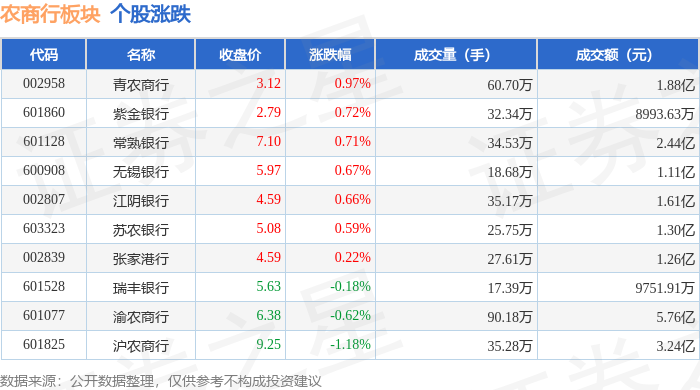
农商行板块1月6日跌0.31%,沪农商行领跌,主力资金净流入8461.81万元
Zheng Xing Xing Ye Ri Bao· 2026-01-06 09:00
Core Viewpoint - The agricultural commercial bank sector experienced a decline of 0.31% on January 6, with the Shanghai Agricultural Commercial Bank leading the drop, while the overall Shanghai Composite Index rose by 1.5% [1] Group 1: Market Performance - The Shanghai Composite Index closed at 4083.67, up 1.5% [1] - The Shenzhen Component Index closed at 14022.55, up 1.4% [1] - The agricultural commercial bank sector's individual stock performance varied, with 青农商行 (Qingnong Bank) increasing by 0.97% to a closing price of 3.12 [1] Group 2: Trading Volume and Value - 青农商行 had a trading volume of 607,000 shares and a transaction value of 1.88 billion yuan [1] - 紫金银行 (Zijin Bank) recorded a trading volume of 323,400 shares with a transaction value of 89.93 million yuan [1] - 常熟银行 (Changshu Bank) had a trading volume of 345,300 shares and a transaction value of 244 million yuan [1] Group 3: Capital Flow - The agricultural commercial bank sector saw a net inflow of 84.62 million yuan from institutional investors, while retail investors experienced a net outflow of 87.57 million yuan [1] - The main capital inflow for 沪农商行 (Shanghai Agricultural Commercial Bank) was 39.95 million yuan, accounting for 12.31% of its trading [2] - 无锡银行 (Wuxi Bank) had a net inflow of 17.62 million yuan from institutional investors, representing 15.88% of its trading [2]
平安人寿2025年四度举牌农行H股,险资年内举牌7家银行
Jin Rong Jie· 2026-01-06 04:49
Group 1 - Ping An Life increased its holdings in Agricultural Bank of China (ABC) H-shares to 20% of the total H-share capital by acquiring 95.582 million shares on December 30, 2025, marking its fourth stake increase in 2025 [1] - From February 17 to December 30, 2025, Ping An Life cumulatively acquired over 4.69 billion H-shares of ABC, bringing its total holdings to approximately 6.18 billion H-shares by the end of December [1] - In addition to H-shares, Ping An Life entered the top ten shareholders of ABC A-shares in Q3 2025, holding 4.913 billion A-shares by the end of September, which could lead to total holdings of at least 11.09 billion shares (3.17% of total capital) if no reduction occurs in Q4 [1] Group 2 - In the A-share market, insurance funds continued to increase their stakes in bank stocks, with five insurance companies entering the top ten shareholders of six A-share listed banks in Q3 2025 [2] - China Life became a top ten shareholder in both Industrial and Commercial Bank of China and Nanjing Bank, while other insurers like Lian'an Life and Dongwu Life also entered the top ten of various banks [2] - By the end of September 2025, at least two insurance companies appeared in the top ten shareholders of 12 listed banks, indicating a growing trend of insurance capital in the banking sector [2]
农行,又又又被举牌!
券商中国· 2026-01-05 23:30
港交所披露易最新信息显示,平安人寿于2025年12月30日增持9558.2万股农业银行H股股份后,于当日达到该 行H股股本的20%,根据香港市场规则,触发举牌。 险资扫货不停! 在此之前,平安人寿曾在2025年2月17日、5月12日、8月26日分别举牌农行H股,所持该行H股数量占其H股总 数分别突破5%、10%、15%。 据统计,2025年合计7家上市银行被险资举牌。其中,农行H股、郑州银行H股均获四度举牌;招商银行H股、 邮储银行H股均被三度举牌。 四度举牌农行H股 披露易信息显示,早在2025年2月17日,平安人寿就首次举牌农行H股,所持该行H股数量当时就达到该行H 股股本的5%。 5月12日,平安人寿又耗资约7.1亿港元,在场内增持近1.47亿股农行H股,持股占比突破该行H股总数的 10%,构成二度举牌。 8月26日,再度增持829万股农行H股股份之后,平人寿所持该行农行H股总数已达该行H股股本的15%,构 成第三次举牌。 披露易最新消息显示,平安人寿于12月30日继续增持9558.2万股农行H股股份,达到该行H股股本的20%, 完成第四次举牌。 以此计算,2月17日至12月30日,平安人寿合计增持超过 ...


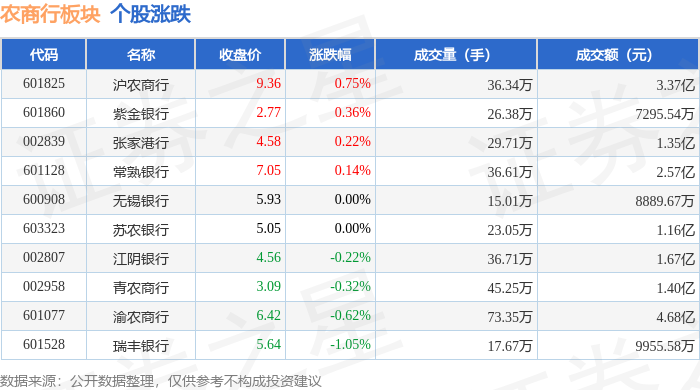
农商行板块1月5日涨0.09%,沪农商行领涨,主力资金净流入7699.1万元
Zheng Xing Xing Ye Ri Bao· 2026-01-05 09:09
Core Insights - The agricultural commercial bank sector experienced a slight increase of 0.09% on January 5, with Shanghai Agricultural Commercial Bank leading the gains [1] - The Shanghai Composite Index closed at 4023.42, up by 1.38%, while the Shenzhen Component Index closed at 13828.63, up by 2.24% [1] Stock Performance - Shanghai Agricultural Commercial Bank (601825) closed at 9.36, with a rise of 0.75% and a trading volume of 363,400 shares, totaling a transaction value of 337 million yuan [1] - Other notable banks include: - Zijin Bank (601860) at 2.77, up 0.36% with a transaction value of 72.96 million yuan [1] - Zhangjiagang Bank (002839) at 4.58, up 0.22% with a transaction value of 135 million yuan [1] - Changshu Bank (601128) at 7.05, up 0.14% with a transaction value of 257 million yuan [1] - Wuxi Bank (600908) remained unchanged at 5.93 with a transaction value of 88.9 million yuan [1] Capital Flow - The agricultural commercial bank sector saw a net inflow of 76.99 million yuan from institutional investors and 84.57 million yuan from retail investors, while individual investors had a net outflow of 162 million yuan [1] - Specific capital flows for key banks include: - Shanghai Agricultural Commercial Bank had a net inflow of 47.24 million yuan from institutional investors, but a net outflow of 54.86 million yuan from individual investors [2] - Changshu Bank saw a net inflow of 32.72 million yuan from institutional investors, with a net outflow of 33.53 million yuan from individual investors [2] - Suzhou Agricultural Bank had a net inflow of 13.51 million yuan from institutional investors, with a net outflow of 12.27 million yuan from individual investors [2]

常熟银行(601128) - 江苏常熟农村商业银行股份有限公司可转债转股结果暨股份变动的公告
2026-01-05 08:01
证券代码:601128 证券简称:常熟银行 公告编号:2026-001 转债代码:113062 转债简称:常银转债 可转债转股结果暨股份变动的公告 江苏常熟农村商业银行股份有限公司(以下简称"本行")董事会及全体董 事保证本公告内容不存在任何虚假记载、误导性陈述或者重大遗漏,并对其内容 的真实性、准确性和完整性承担个别及连带责任。 重要内容提示: 累计转股情况:截至 2025 年 12 月 31 日,累计已有人民币 535,000 元常 银转债转为本行 A 股普通股,累计转股股数为 76,414 股,占常银转债转股前本 行已发行普通股股份总额的 0.003%。 2025 年第四季度转股情况:2025 年 10 月 1 日至 2025 年 12 月 31 日,累 计有人民币 24,000 元常银转债转为本行 A 股普通股,累计转股股数为 4,065 股。 未转股可转债情况:截至 2025 年 12 月 31 日,尚未转股的常银转债金额 为人民币 5,999,465,000 元,占常银转债发行总量的比例为 99.9911%。 一、可转债发行上市概况 江苏常熟农村商业银行股份有限公司 常银转债的转股期为:2023 ...