
晨鸣纸业

Search documents
南华期货2026造纸产业年度展望:残雪消融春意浅,弱风拂柳态犹迟
Nan Hua Qi Huo· 2025-12-21 12:13
1. Report Industry Investment Rating No relevant content provided. 2. Core Viewpoints of the Report - In 2026, the price trends of softwood pulp and offset printing paper are expected to be described as "low recovery" and "weak stabilization" respectively. The price center of softwood pulp is expected to move slightly upward, while the price of offset printing paper is expected to remain weak and stable, mainly supported by costs [5]. - Overall, the futures prices of pulp and offset printing paper will fluctuate. In the medium - term, low - buying opportunities can be considered for pulp futures, and high - selling opportunities can be considered for the near - month contracts of offset printing paper [8]. 3. Summary According to the Table of Contents 3.1 Viewpoint Summary 3.1.1 Trend Forecast - In 2026, the supply expansion trend of softwood pulp will slow down, and the demand is expected to stabilize and rebound. However, the market sentiment is limited, and there are still upper limits, with inventory pressure needing continuous attention. The price of double - offset paper is expected to be mainly supported by costs and remain weak and stable [5]. 3.1.2 Strategy Outlook - Pulp and offset printing paper futures prices will fluctuate. Mid - term, consider low - buying for pulp futures and high - selling for near - month offset printing paper contracts [8]. 3.1.3 Risk Points - Risks include changes in macro - policies, significant changes in international trade situations, large - scale shutdowns or resumptions of pulp and paper mills, and restrictions on some supply and transportation channels [9]. 3.2 Market Review 3.2.1 Spot Price Review of Softwood Pulp and Double - Offset Paper - Softwood pulp spot prices declined this year, with a short - term increase in January - February due to domestic supply gaps. After reaching a high of about 6617 yuan/ton in early February, prices dropped by 17.84% by the end of November. Recent slight rebounds are due to traders' reluctance to sell and spot enterprise regulation. The spread between softwood and hardwood pulp prices has fallen to a reasonable range. Double - offset paper prices also declined after a slight increase in Q1, dropping by 13.02% from 5087.5 yuan/ton in mid - March to 4425.0 yuan/ton at the end of November, due to weak demand and over - supply [10][12][16]. 3.2.2 Futures Price Trend Review of Pulp and Offset Printing Paper - Pulp futures reached a high of 6204 yuan/ton in February, then declined, with a temporary halt in the decline in Q3 due to North American pulp mill maintenance expectations. After reaching a low of 4750 yuan/ton in mid - October, prices reversed and rose due to downstream paper mills' price increases, positive macro - sentiment, and news of a US pulp mill shutdown. Offset printing paper futures were listed in September, fluctuated in the first month, rose to 4360 yuan/ton due to paper mills' price support, and then dropped to 3980 yuan/ton, a decline of 8.72% [19]. 3.2.3 Continued Weak Overall Demand - Weak demand is a major factor for the weak pulp and double - offset paper prices. China's softwood pulp monthly apparent consumption in the first 10 months was 707.3 tons, up 2.84% year - on - year, with only 6, 7, 9 months above the average. European consumption of bleached softwood pulp was the lowest in a decade. Paper industry's start - up rates were low, with softwood pulp downstream demand improving slightly but still weak. Double - offset paper demand was even weaker, with the apparent consumption in the first 10 months at 666.7 tons, down 9.87% year - on - year [25]. 3.2.4 Supply Growth Slowed but Pressure Persisted - Pulp supply growth slowed this year, but the overall stock was still high. China's softwood pulp imports had low growth but a high base and increased since August. Paper pulp production increased significantly after mid - September, with a 17.43% year - on - year increase in early December. Global pulp shipments were relatively high, and those to China were lower than in 2023 but higher than last year. Double - offset paper's start - up rate was at a low, but production increased in the second half of the year, and the supply pressure remained due to new capacity [30][32]. 3.2.5 High Inventory and Low Profit - High inventory suppressed pulp and paper prices. China's pulp port inventory was above 200 tons for a long time this year, dropping to 199.3 tons by December 19. Double - offset paper inventory also increased, with both production enterprise and social inventories above the average. Most small and medium - sized enterprises in the softwood pulp and double - offset paper markets were in a loss - making state, with negative gross margins for Chinese softwood pulp since April last year [34][37]. 3.3 Core Focus Points 3.3.1 Macro Changes - Pulp is significantly affected by macro - factors. Interest rate cuts may reduce import costs. Policy changes and tariff adjustments can also impact the industry. For example, if Brazil's export tariff exemption to the US is removed, it may increase China's pulp supply pressure [41]. 3.3.2 Inventory Reduction - High inventory is a key factor suppressing pulp and paper prices. Pulp inventory has declined recently, and the reduction in available registered warehouse receipts due to the adjustment of delivery standards has provided some support to futures prices [42]. 3.3.3 Shutdown/Resumption of Pulp and Paper Mills - Shutdowns or resumptions of pulp and paper mills can affect supply and market sentiment. For example, Domtar's permanent shutdown of the Crofton pulp mill had a positive impact on futures prices [44]. 3.4 Valuation Feedback and Supply - Demand Outlook 3.4.1 Valuation: Relatively Reasonable - Pulp futures valuation is relatively reasonable, with the basis fluctuating and the number of warehouse receipts at a historical low. Offset printing paper futures valuation is currently weak, but the rising basis provides some support at the bottom. The volatility of both pulp and offset printing paper futures is expected to remain low in 2026 [45][47][50]. 3.4.2 Demand: Weak Stabilization - Pulp demand is expected to stabilize and rebound in 2026, with the "14th Five - Year Plan" promoting economic growth and the narrowing price spread between softwood and hardwood pulp potentially increasing softwood pulp demand. Double - offset paper demand is expected to be weak, with factors such as the decline in textbook demand and the popularity of paperless office, but policies like the "National Reading Promotion Regulations" may bring some positive effects [52][57]. 3.4.3 Supply: Pressure Converging - In 2026, the supply pressure of softwood pulp is expected to converge, with limited new capacity growth. Double - offset paper supply pressure remains due to continuous new capacity investment in recent years. Overall, the supply - demand situation of softwood pulp in 2026 is expected to be slightly better than this year, while double - offset paper supply and demand are expected to remain weak and stable [59][61][63].

2026年胶版印刷纸年度行情展望:余寒未消,寻底路迢
Guo Tai Jun An Qi Huo· 2025-12-18 13:04
Report Industry Investment Rating No relevant information provided. Core Viewpoints of the Report - The paper price will fluctuate and seek the bottom throughout the year, with possible seasonal rebounds. The estimated price fluctuation range for the first half of 2026 is about 3,600 - 4,400 yuan/ton [3][83]. - The supply side will still see new capacity put into operation, and the resumption of production at Zhanjiang Chenming is on the agenda. The demand side will continue to be stable. The long - term supply surplus pattern remains unchanged, but the contradiction is relatively alleviated. Short - selling on rallies is still a relatively safe choice [3][83]. - Double - offset paper consumption has obvious seasonality. From March to May (with a delay in recent years) and from September to November are the tendering time points for the next spring's teaching and auxiliary materials. During these periods, there may be seasonal inventory replenishment in the distributor link and improved consumption, driving the paper price to rebound [3][83]. - The long - term decline of paper prices has forced paper mills to adjust formulas and optimize costs. The ton - paper costs of mainstream large - scale mills are concentrated in the range of 3,750 - 4,350 yuan/ton, and enterprises with integrated layouts have stronger competitiveness [3][83]. - In terms of bargaining power, pulp mills have stronger bargaining power than paper mills. From the perspective of industrial chain transmission, production enterprises naturally have the willingness to raise prices, but whether it can be implemented still depends on many factors [3][83]. Summary According to the Directory 1. Low - price Quagmire under Weak Supply and Demand 1.1 Market Review - In 2025, the price center of the domestic double - offset paper spot market moved down significantly, and the double - offset paper futures generally maintained a range - bound trend after listing [6]. - From January to March 2025, the double - offset paper price remained firm. The price of natural white double - offset paper fluctuated between 5,000 - 5,200 yuan/ton, and the high - white double - offset paper price was between 5,300 - 5,500 yuan/ton. The support for the paper price came from strong pulp prices before the Spring Festival, reduced supply pressure due to the shutdown of most production lines of Chenming Paper, and short - term inventory replenishment by distributors. The upward pressure came from the lack of concentrated tendering by publishers, poor continuity of printer orders, and the decline of pulp prices after the Spring Festival [6]. - Since April 2025, the spot market has shown a unilateral downward trend. The average price of natural white double - offset paper has fallen to about 4,400 yuan/ton, and the high - white double - offset paper price has fallen to about 4,700 yuan/ton. The reasons include the decline in double - offset paper consumption due to the population cycle and the "one textbook, one supplementary material" policy, the resumption of production at some Chenming production bases, and the limited support of pulp prices for paper prices [7]. - In the futures market, the trading volume and open interest of double - offset paper futures were low at the beginning of listing and gradually improved later. After the introduction of market - makers by the Shanghai Futures Exchange, the activity of double - offset paper futures increased significantly. As of early December, the open interest of the main contract exceeded 18,000 lots, and the trading volume was in the range of 3,000 - 5,000 lots. The futures price was at a discount to the spot price, and the basis was always positive [9]. 1.2 Profit Characteristics - Due to the stronger scarcity of pulp than finished paper, higher downstream dependence on high - quality virgin wood pulp, and more severe downstream supply - demand surplus, the upstream has stronger bargaining power, and the industrial chain profit has shifted from the downstream to the upstream. After April 2025, the pulp price was relatively firm, the production cost of double - offset paper increased, and the gross profit per ton declined significantly, reaching a historical low [12]. 2. The Pressure of Capacity Expansion Eases, but Supply Remains in Excess 2.1 Slowdown in Domestic Capacity Expansion - The double - offset paper production capacity expansion cycle is not over, but the growth rate of capacity expansion has slowed down. In 2025, the newly put - into - operation cultural paper capacity in China was about 1.9 million tons, mainly double - offset paper. It is expected that by the end of 2025, the domestic double - offset paper capacity will reach 17.98 million tons, a year - on - year increase of 12%. In 2026, Liansheng will put into operation two cultural paper production lines with a total capacity of about 1.2 million tons. It is expected that the domestic double - offset paper capacity in 2026 will be 19.18 million tons, a year - on - year increase of 6.67% [20]. - The overall capacity utilization rate of the cultural paper industry should be considered comprehensively. Since specific paper machines can produce multiple paper types, simply using double - offset paper production divided by the total cultural paper capacity may underestimate the industry's capacity utilization rate. The overall operating level of the uncoated woodfree paper industry may remain at around 79% [24][25]. 2.2 Resumption of Production at Chenming Paper - The resumption of production at Zhanjiang Chenming is on the agenda, and the supply pressure will increase. The company plans to resume production at the Zhanjiang base by the end of the year, and the market expects two cultural paper production lines with a total capacity of about 450,000 tons and one chemimechanical pulp production line to start operation in January 2026 [28]. - In 2025, from January to October, the domestic double - offset paper production decreased significantly due to the decline in terminal demand and insufficient orders. From January to November 2025, the double - offset paper production statistics from different information agencies showed a decline. The industry's operating rate was generally low, and although there was a slight improvement in November, it still reflected the supply - side surplus [30][33]. 2.3 Imports Remain at a Low Level - China has a low import dependence on double - offset paper. From 2021 to 2025, the import volume of double - offset paper in China showed a decreasing trend. In 2025, from January to October, the import volume of double - offset paper was about 142,000 tons, a year - on - year decrease of 18%, mainly due to the prominent domestic supply - demand contradiction and the lack of price advantage for imported paper [36]. 3. Demand Remains Stable with Little Fluctuation 3.1 Consumption Structure and Apparent Consumption Performance in 2025 - The main domestic consumption of double - offset paper comes from books, accounting for about 90% of the total consumption. The consumption of books and notebooks has declined in recent years due to the population cycle and policies, while the consumption of periodicals and other products has remained relatively stable [38]. - In 2025, from January to October, the apparent consumption of double - offset paper decreased significantly. According to different information agencies' statistics, the year - on - year decrease ranged from 5% to 10% [42]. 3.2 Slow Growth in Terminal Consumption - From January to October 2025, the consumption of double - offset paper continued to decline due to the "one textbook, one supplementary material" policy and the population cycle decline. The consumption has obvious seasonality, with traditional peak seasons from March to May and from October to December. However, in recent years, the tendering and printing time of autumn teaching and auxiliary materials have been delayed [44][45]. - The decline in the consumption of standard products is mainly due to the "one subject, one supplementary material" policy and the decrease in the number of school - age students. The "double - reduction" and "one subject, one supplementary material" policies have reduced the demand for teaching and training supplementary materials. The number of school - age students is expected to continue to decline in 2026 [47][50]. - The consumption of social books is also affected by e - reading, but the growth rate of the Chinese online literature user scale has slowed down. The "National Reading Promotion Regulations" to be implemented in 2026 may drive the consumption of double - offset paper for social books [52][54]. 3.3 Exports May Remain Stable - The export volume of double - offset paper in China has increased first and then decreased in the past five years. In 2024, it was about 970,000 tons, a year - on - year decrease of 12%. In 2025, from January to October, the export volume decreased by 15% year - on - year, mainly due to the increasing international environmental uncertainty and the loss of some overseas orders [57][60]. - China's double - offset paper exports are mainly to Southeast Asian countries. In 2025, from January to October, the top five export destinations were Japan, South Korea, the United Arab Emirates, Australia, and Hong Kong, China. Considering the local market conditions and the relaxation of the US tariff policy on China, the exports in 2026 may remain stable [62]. 3.4 Synchronous Inventory Accumulation in the Upstream and Downstream - Since the second half of 2025, the industrial chain inventory has shown synchronous accumulation in social inventory and enterprise inventory. Different information agencies' statistics show some differences, but the overall trend is inventory accumulation. It is expected that paper mills will still face inventory - reduction pressure in the first half of 2026, which is negative for the price [66][67]. 4. How to Measure the Pulp - Paper Contradiction 4.1 Spot Profit Calculation - The current apparent profit level of the pulp - paper industry has reached the lowest level in the same period of history, but there has been no large - scale capacity clearance. The main reason is the adjustment of formulas and cost optimization by paper mills. The mainstream large - scale mills' ton - paper costs are concentrated in the range of 3,750 - 4,350 yuan/ton [72]. - Newly added capacity is mostly equipped with pulp lines. Enterprises with integrated layouts have stronger competitiveness. In 2026, more pulp lines will be put into operation, further enhancing the cost advantage and competitiveness of integrated enterprises [73]. - It is expected that about 3.45 million tons of pulp capacity will be put into operation in China in 2026, and the growth rate of capacity expansion will slow down. The supply pressure will be mainly concentrated in the fourth quarter [74]. 4.2 Strengthened Linkage between Pulp and Paper - The contradiction between pulp and paper has deepened in recent years. The reasons include the higher scarcity of pulp, higher dependence on imported pulp in China, more concentrated upstream pulp mill capacity, and higher supply surplus in the papermaking industry [76][79][80]. - As the downstream profit is continuously compressed, the price linkage between pulp and paper is strengthening. Whether pulp mills and paper mills can raise prices depends on factors such as maintaining stable customer orders, inventory pressure, downstream customer acceptance, and market seasonality and price expectations [80]. 5. Market Outlook and Investment Strategy - The paper price will fluctuate and seek the bottom throughout the year, with possible seasonal rebounds. The estimated price fluctuation range for the first half of 2026 is about 3,600 - 4,400 yuan/ton [83]. - Investment outlook: In the first half of 2026, conduct bilateral operations around the range of 3,600 - 4,400 yuan/ton; short - sell processing profits on rallies (long SP, short OP) [83].
ST晨鸣剥离亏损业务,33亿出售融资租赁资产回归造纸主业
Sou Hu Cai Jing· 2025-12-17 08:27
Core Viewpoint - ST晨鸣 has decided to divest its financing leasing business for 3.336 billion yuan, refocusing on its core paper manufacturing operations [2][3]. Group 1: Transaction Overview - On December 12, ST晨鸣 announced the sale of its entire financing leasing business to Shouguang Shengjia Investment Co., Ltd. for 3.336 billion yuan, which includes both equity and related debts [2]. - The transaction will be executed in three phases, with the first payment of 50% (1.668 billion yuan) due initially, and the remaining amount to be paid over two years [5]. Group 2: Background of Divestment - The financing leasing business has incurred significant losses, totaling over 4.5 billion yuan from 2023 to 2024, with asset impairment losses reaching 2.8 billion yuan, leading to two consecutive years of negative net profit for the company [3]. - The paper manufacturing segment is also under pressure due to fluctuating raw material prices and weak market demand, resulting in a gross margin decline to 18% [4]. Group 3: Use of Proceeds - The funds from the divestment will primarily be used to repay over 30 billion yuan in interest-bearing debt, alleviating financial pressure [6]. - Additional funds will support working capital needs and be invested in the integrated pulp and paper project to enhance control over the paper production chain [6]. Group 4: Industry Impact and Market Reaction - By shedding the non-core financing leasing business, ST晨鸣 aims to concentrate resources on expanding high-end paper production capacity in Guangdong and Hubei, targeting a 15% market share in cultural and packaging paper by 2026 [7][8]. - The local government’s support in the acquisition reflects a commitment to stabilizing leading enterprises, reducing the risk of delisting for ST晨鸣 [9]. - Following the announcement, ST晨鸣's stock price rose by 5.46%, closing at 3.85 yuan per share, indicating positive market sentiment towards the strategic shift [10]. Group 5: Trends in the Paper Industry - The paper industry is currently facing overcapacity and demand differentiation, prompting accelerated consolidation among leading companies [11]. - ST晨鸣 plans to enhance cost control by leveraging scale advantages in raw material procurement, potentially improving profitability [12]. - The company is also responding to increasing market demand for eco-friendly products by raising the proportion of recycled pulp usage from 20% to 35% [13].
山东国企改革板块12月16日跌1.32%,宝鼎科技领跌,主力资金净流出10.44亿元
Sou Hu Cai Jing· 2025-12-16 09:24
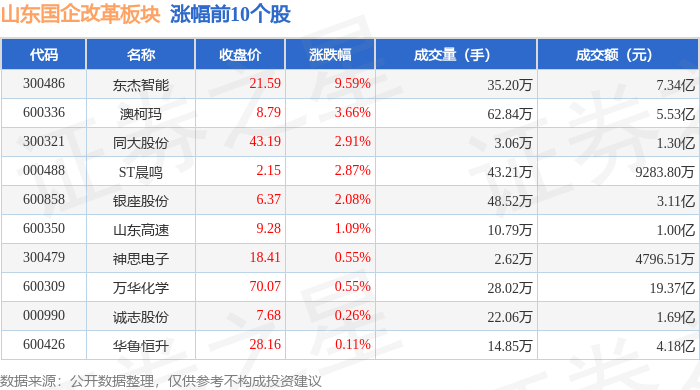
Market Overview - On December 16, the Shandong state-owned enterprise reform sector fell by 1.32% compared to the previous trading day, with Baoding Technology leading the decline [1] - The Shanghai Composite Index closed at 3824.81, down 1.11%, while the Shenzhen Component Index closed at 12914.67, down 1.51% [1] Stock Performance - Notable gainers in the Shandong state-owned enterprise reform sector included: - Dongjie Intelligent (300486) with a closing price of 21.59, up 9.59% and a trading volume of 352,000 shares, totaling 734 million yuan [1] - Aokema (600336) closed at 8.79, up 3.66% with a trading volume of 628,400 shares, totaling 553 million yuan [1] - Tongda Co. (300321) closed at 43.19, up 2.91% with a trading volume of 30,600 shares, totaling 130 million yuan [1] - Conversely, Baoding Technology (002552) led the declines with a closing price of 15.98, down 5.94% and a trading volume of 90,800 shares, totaling 147 million yuan [2] - Other significant decliners included: - Xingri Co. (002083) down 5.22% to 10.71 with a trading volume of 1,345,500 shares [2] - Qingdao Double Star (000599) down 4.93% to 5.98 with a trading volume of 296,700 shares [2] Capital Flow - On the same day, the Shandong state-owned enterprise reform sector experienced a net outflow of 1.044 billion yuan from institutional investors, while retail investors saw a net inflow of 796 million yuan [2] - The capital flow for specific stocks showed: - Wanhua Chemical (600309) had a net inflow of 1.05 billion yuan from institutional investors, but a net outflow of 94.08 million yuan from retail investors [3] - Dongjie Intelligent (300486) saw a net inflow of 81.92 million yuan from institutional investors, with a net outflow of 69.01 million yuan from retail investors [3]




晨鸣纸业33亿元剥离融资租赁资产,专注制浆造纸主业
Cai Jing Wang· 2025-12-16 05:21
Core Viewpoint - Shandong Chenming Paper Holdings Co., Ltd. is divesting its financing leasing assets worth 3.336 billion yuan to focus on its core pulp and paper business, aiming for high-quality development [1] Group 1: Transaction Details - The company plans to transfer 100% equity of Shandong Chenming Financing Leasing Co., Ltd. and 25% equity stakes in both Qingdao Chenming Leasing and Shanghai Chenming Financing Leasing [1] - The total transaction amount is 3.336 billion yuan, comprising 1.073 billion yuan for equity and 2.263 billion yuan for debt [1] - Following the transaction, the financing leasing companies will no longer be included in Chenming Paper's consolidated financial statements, and the company will cease all financing leasing operations [1]

港股异动 晨鸣纸业(01812)涨超4% 拟33亿元剥离融资租赁业务
Jin Rong Jie· 2025-12-16 04:04
消息面上,晨鸣纸业公布剥离融资租赁业务,向国有全资企业寿光市晟嘉投资出售山东晨鸣融资租赁、 青岛晨鸣纸制品销售及上海晨鸣融资租赁全部股权连贷款,总代价33.36亿元。估计出售收益约3893.95 万元。所得净额拟用作偿还集团债务。 智通财经获悉,晨鸣纸业(01812)涨超4%,截至发稿,涨4.11%,报0.76港元,成交额81.5万港元。 公告指出,出售事项完成后,集团日常业务运营在完成前后将基本保持不变。集团将继续专注于生产及 销售纸制品的主要业务。目前,集团五个生产基地中有四个已经复产。董事预计在出售事项完成后,集 团业务及经营规模将不会出现重大变动,且出售事项将不会对集团业务及运营产生重大影响。 本文源自:智通财经网 ...
晨鸣纸业(01812.HK)涨超4%
Mei Ri Jing Ji Xin Wen· 2025-12-16 03:10
每经AI快讯,晨鸣纸业(01812.HK)涨超4%,截至发稿,涨4.11%,报0.76港元,成交额81.5万港元。 ...
港股异动 | 晨鸣纸业(01812)涨超4% 拟33亿元剥离融资租赁业务
Zhi Tong Cai Jing· 2025-12-16 03:09
(原标题:港股异动 | 晨鸣纸业(01812)涨超4% 拟33亿元剥离融资租赁业务) 消息面上,晨鸣纸业公布剥离融资租赁业务,向国有全资企业寿光市晟嘉投资出售山东晨鸣融资租赁、 青岛晨鸣纸制品销售及上海晨鸣融资租赁全部股权连贷款,总代价33.36亿元。估计出售收益约3893.95 万元。所得净额拟用作偿还集团债务。 公告指出,出售事项完成后,集团日常业务运营在完成前后将基本保持不变。集团将继续专注于生产及 销售纸制品的主要业务。目前,集团五个生产基地中有四个已经复产。董事预计在出售事项完成后,集 团业务及经营规模将不会出现重大变动,且出售事项将不会对集团业务及运营产生重大影响。 智通财经APP获悉,晨鸣纸业(01812)涨超4%,截至发稿,涨4.11%,报0.76港元,成交额81.5万港元。 ...
晨鸣纸业早盘涨超5% 拟33亿元剥离融资租赁业务
Xin Lang Cai Jing· 2025-12-16 03:03
公告指出,出售事项完成后,集团日常业务运营在完成前后将基本保持不变。集团将继续专注于生产及 销售纸制品的主要业务。目前,集团五个生产基地中有四个已经复产。董事预计在出售事项完成后,集 团业务及经营规模将不会出现重大变动,且出售事项将不会对集团业务及运营产生重大影响。 晨鸣纸业(01812)早盘股价上涨5.48%,现报0.77港元,成交额108.17万港元。 晨鸣纸业公布剥离融资租赁业务,向国有全资企业寿光市晟嘉投资出售山东晨鸣融资租赁、青岛晨鸣纸 制品销售及上海晨鸣融资租赁全部股权连贷款,总代价33.36亿元。估计出售收益约3893.95万元。所得 净额拟用作偿还集团债务。 来源:新浪港股 ...
晨鸣纸业涨超4% 拟33亿元剥离融资租赁业务
Zhi Tong Cai Jing· 2025-12-16 03:00
晨鸣纸业(01812)涨超4%,截至发稿,涨4.11%,报0.76港元,成交额81.5万港元。 公告指出,出售事项完成后,集团日常业务运营在完成前后将基本保持不变。集团将继续专注于生产及 销售纸制品的主要业务。目前,集团五个生产基地中有四个已经复产。董事预计在出售事项完成后,集 团业务及经营规模将不会出现重大变动,且出售事项将不会对集团业务及运营产生重大影响。 消息面上,晨鸣纸业公布剥离融资租赁业务,向国有全资企业寿光市晟嘉投资出售山东晨鸣融资租赁、 青岛晨鸣纸制品销售及上海晨鸣融资租赁全部股权连贷款,总代价33.36亿元。估计出售收益约3893.95 万元。所得净额拟用作偿还集团债务。 ...