美的集团

Search documents
家电行业周报(25年第51周):11月家电零售表现筑底,冰洗出口增速有所改善-20251222
Guoxin Securities· 2025-12-22 11:16
Investment Rating - The report maintains an "Outperform the Market" rating for the home appliance industry [6][5][10]. Core Viewpoints - The home appliance retail sector is experiencing a bottoming out in November, with expectations for recovery driven by continued national subsidies and improvements in exports [1][18]. - Despite a challenging environment with high base effects from the previous year, the resilience of leading companies in the home appliance sector remains strong, particularly in the white goods segment [13][14]. - The report highlights a potential rebound in retail demand for home appliances, supported by ongoing national subsidy policies and improved export conditions [18][19]. Summary by Sections 1. Key Recommendations - Recommended companies include Midea Group, Haier Smart Home, TCL Smart Home, Gree Electric Appliances, and Hisense Home Appliances in the white goods category; Hisense Visual Technology in the black goods category; and Roborock, Bear Electric, and Ecovacs in the small appliances category [5][6][14]. 2. Market Performance and Insights - In November, the retail sales of home appliances and audio-visual equipment fell by 19.4% year-on-year, while the overall retail sales in China grew by 1.3% [2][19]. - The export value of home appliances decreased by 6% year-on-year in November, with air conditioning exports down by 25.7%, while refrigerators and washing machines showed signs of recovery with growth rates of 7.6% and 15.8%, respectively [3][46]. - Air conditioning production and sales saw declines exceeding 30% in November, but January production is expected to improve due to the timing of the Spring Festival [4][59]. 3. Key Data Tracking - The home appliance sector achieved a relative return of +0.44% compared to the broader market [61]. - Prices for copper and aluminum increased by 0.4% and 2.4%, respectively, while cold-rolled steel prices remained stable [63][64]. - The real estate sector continues to face challenges, with residential construction and sales areas down by 20.1% and 8.1% year-on-year, respectively [73].




8%企业已试点“强制下班”
第一财经· 2025-12-22 10:35
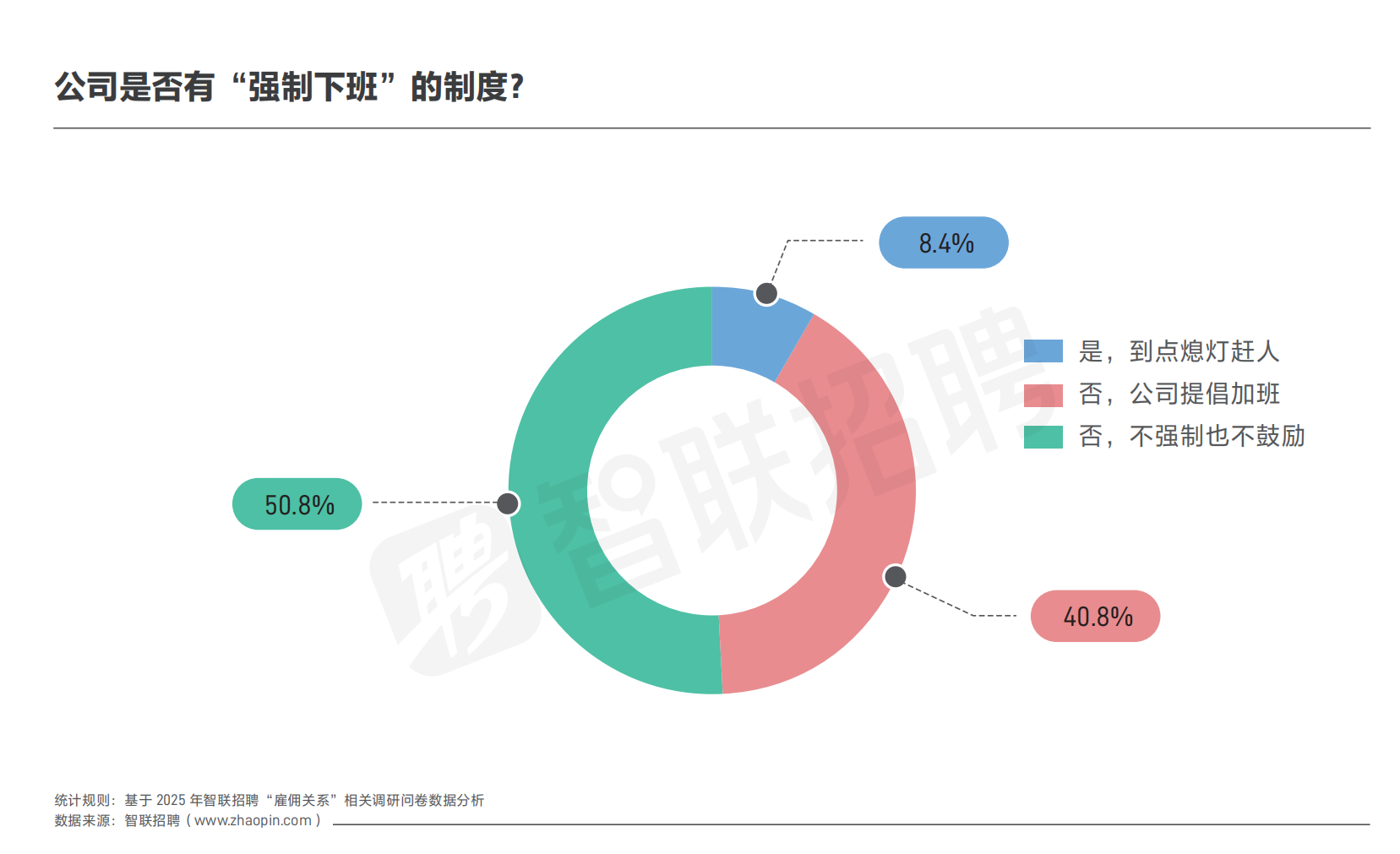
本文字数:1148,阅读时长大约2分钟 作者 | 第一财经 郭晋晖 从年初的政府工作报告到年末到中央经济工作会议,都将"整治'内卷式'竞争"列为经济工作的重要任 务。这一年自上而下的"反内卷"对普通打工人有何影响? 智联招聘近日发布的《2025雇佣关系趋势报告》(下称报告)的调查显示,"反内卷"已经成为职场 新共识,78%职场人会因内卷跳槽,职场人对健康工作环境与生活平衡的诉求,也在推动企业人力 资源管理的转变,国内8.4%的公司已正式推行"强行下班"制度。 2025.12. 22 这份报告称,当职场内卷挤压个体成长空间、侵蚀生活质量,造成无效消耗时,越来越多的人便开始 重新权衡这份工作是否值得继续坚持。 调研数据显示,近八成职场人坦言,若长期处于过度内卷的环境中,会萌生离职念头,其中31.5% 表示"更倾向于寻找工作节奏更健康的企业"。职场人也会采用"策略性摸鱼"、下班后开启消息免打 扰,拒绝"表演式"工作等行为来进行"反内卷"。 今年3月,中共中央办公厅、国务院办公厅印发《提振消费专项行动方案》,要求对各单位休息休假 制度执行情况的常态化监督,依法保障劳动者休息休假权益,不得违法延长劳动者工作时间,"保障 ...


调查:8成职场人会因内卷跳槽,8%企业已试点“强制下班”
Di Yi Cai Jing· 2025-12-22 10:16
大疆、海尔、美的等企业相继推出"反卷"措施 从年初的政府工作报告到年末到中央经济工作会议,都将"整治'内卷式'竞争"列为经济工作的重要任务。这一年自上而下的"反内卷"对普通打工人有何影 响? 智联招聘近日发布的《2025雇佣关系趋势报告》(下称报告)的调查显示,"反内卷"已经成为职场新共识,78%职场人会因内卷跳槽,职场人对健康工作环 境与生活平衡的诉求,也在推动企业人力资源管理的转变,国内8.4%的公司已正式推行"强行下班"制度。 今年3月,中共中央办公厅、国务院办公厅印发《提振消费专项行动方案》,要求对各单位休息休假制度执行情况的常态化监督,依法保障劳动者休息休假 权益,不得违法延长劳动者工作时间,"保障休息休假权益"成为职场反内卷的一个标志。 年初,大疆、海尔、美的等企业相继推出"反卷"措施——到点强制下班、抵制无效加班、严禁非必要会议,浙江民企也开始自觉推行4.5天工作制。 上海社科院经济研究所研究室主任詹宇波曾对第一财经表示,"内卷"和竞争激烈,是人才市场长期热议的话题。因此,减少劳动时间,增加闲暇时光,趋势 兴起就很容易获得认可,也具有内生的动力。 报告显示,这些变化表明企业开始调整考核考核和激励 ...
美的集团(000333) - 关于回购股份注销完成暨股份变动公告
2025-12-22 09:31
证券代码:000333 证券简称:美的集团 公告编号:2025-093 美的集团股份有限公司 1、实施股份回购:公司于2025年3月28日召开第五届董事会第六次会议、于 2025年5月30日召开2024年度股东会审议通过了《关于以集中竞价方式回购公司 A股股份的方案》,同意公司以集中竞价交易方式回购公司部分已发行的A股股 份,用于依法注销减少注册资本及实施股权激励计划及/或员工持股计划。回购 价格为不超过人民币100元/股,回购金额为不超过100亿元且不低于50亿元,实 施期限为自股东会审议通过回购股份方案之日起12个月内。公司于2025年6月17 日首次实施股份回购,并按照相关法律法规的要求就回购期间相关进展情况进 行了披露,具体内容请详见公司于2025年6月17日披露的《关于首次实施以集中 竞价交易方式回购A股股份的公告》。回购期间,公司按照相关规定披露了回购 进展情况。 公司于2025年12月9日披露了《关于回购公司股份结果暨股份变动公告》, 截至2025年12月8日,公司累计回购股份数量为135,012,663股,占公司总股本的 1.76%,最高成交价为83.11元/股,最低成交价为69.91元/股, ...
美的集团:完成回购注销9500万股
Xin Lang Cai Jing· 2025-12-22 09:25
Core Viewpoint - Midea Group announced a share buyback plan, with a total of 135 million shares repurchased, accounting for 1.76% of the company's total share capital, with a total expenditure of 10 billion yuan excluding transaction fees [1] Summary by Categories Share Buyback Details - The highest transaction price for the repurchased shares was 83.11 yuan per share, while the lowest was 69.91 yuan per share [1] - 70% or more of the repurchased shares will be used for cancellation and reduction of registered capital, with 95 million shares to be legally canceled [1] Impact on Capital Structure - The canceled shares will account for 1.23% of the total share capital before cancellation [1]
贝莱德:在美的集团的持股比例升至5.03%
Ge Long Hui· 2025-12-22 09:19
Group 1 - BlackRock's stake in Midea Group's H-shares increased from 4.92% to 5.03% as of December 17 [1]
白色家电板块12月22日跌0.57%,澳柯玛领跌,主力资金净流出1.84亿元
Zheng Xing Xing Ye Ri Bao· 2025-12-22 09:03
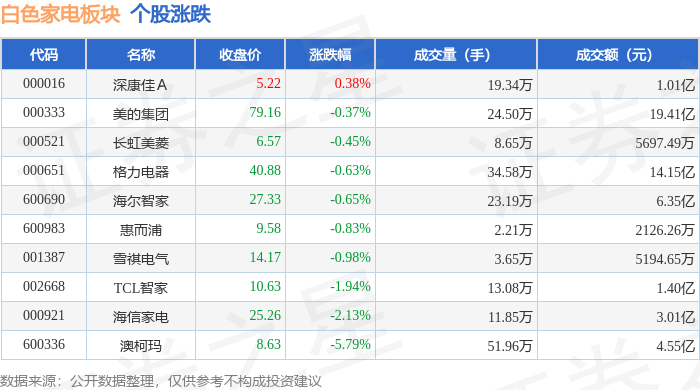
Core Viewpoint - The white goods sector experienced a decline of 0.57% on December 22, with Aucma leading the drop, while the overall Shanghai Composite Index rose by 0.69% and the Shenzhen Component Index increased by 1.47% [1] Group 1: Market Performance - The closing price for Midea Group was 79.16, down by 0.37%, with a trading volume of 245,000 shares and a transaction value of 1.94 billion yuan [1] - Gree Electric Appliances closed at 40.88, down by 0.63%, with a trading volume of 345,800 shares [1] - Haier Smart Home closed at 27.33, down by 0.65%, with a trading volume of 231,900 shares [1] - Aucma saw the largest decline at 5.79%, closing at 8.63, with a trading volume of 519,600 shares [1] Group 2: Capital Flow - The white goods sector had a net outflow of 184 million yuan from institutional investors, while retail investors saw a net inflow of 16.2 million yuan [1] - Haier Smart Home had a net inflow of 7.685 million yuan from institutional investors, but a net outflow of 5.353 million yuan from retail investors [2] - Midea Group experienced a significant net outflow of 136 million yuan from institutional investors, while retail investors had a net inflow of 74.33 million yuan [2] - Aucma faced a net outflow of 37.77 million yuan from institutional investors, but retail investors contributed a net inflow of 34.78 million yuan [2]


超级品牌概念下跌0.48%,7股主力资金净流出超亿元
Zheng Quan Shi Bao Wang· 2025-12-22 08:41
Group 1 - The Super Brand concept index declined by 0.48%, ranking among the top declines in concept sectors, with notable declines in stocks such as Aucma, Zhonggong Education, and TCL Technology [1] - Among the Super Brand concept stocks, 13 stocks saw price increases, with Anfu Technology, SF Holding, and Dong'e Ejiao leading the gains at 2.40%, 1.22%, and 1.11% respectively [1] - The Super Brand concept experienced a net outflow of 1.662 billion yuan from main funds, with 32 stocks facing net outflows, and 7 stocks seeing outflows exceeding 100 million yuan [2] Group 2 - The top net outflow stocks included China Mobile, TCL Technology, and Kweichow Moutai, with net outflows of 359.45 million yuan, 219.80 million yuan, and 155.96 million yuan respectively [2] - Conversely, the stocks with the highest net inflows included SF Holding, Dong'e Ejiao, and Yunnan Baiyao, with net inflows of 89.39 million yuan, 34.34 million yuan, and 14.78 million yuan respectively [2] - The trading volume for China Mobile was 2.28%, while TCL Technology had a turnover rate of 2.06% [3]






智通AH统计|12月22日
智通财经网· 2025-12-22 08:21
Core Insights - The article highlights the top and bottom AH share premium rates as of December 22, with Northeast Electric (00042), Zhejiang Shibao (01057), and Hongye Futures (03678) leading in premium rates, while CATL (03750), China Merchants Bank (03968), and Hansoh Pharmaceutical (01276) are at the bottom [1][2][3] Group 1: Top AH Share Premium Rates - Northeast Electric (00042) has a premium rate of 864.29% with a deviation value of -11.58% [2][5] - Zhejiang Shibao (01057) shows a premium rate of 354.83% and a deviation value of 86.04% [2][4] - Hongye Futures (03678) has a premium rate of 274.70% with a deviation value of 3.11% [2][4] Group 2: Bottom AH Share Premium Rates - CATL (03750) has a premium rate of -12.58% and a deviation value of -4.76% [3][5] - China Merchants Bank (03968) shows a premium rate of -1.90% with a deviation value of -1.08% [3][5] - Hansoh Pharmaceutical (01276) has a premium rate of 3.44% and a deviation value of 0.44% [3][5] Group 3: Deviation Values - Zhejiang Shibao (01057) leads in deviation value at 86.04% [4] - Junda Co. (02865) follows with a deviation value of 46.60% [4] - COSCO Shipping Development (02866) has a deviation value of 19.01% [4] Group 4: Negative Deviation Values - GAC Group (02238) has the lowest deviation value at -26.02% [5] - Yangtze Optical Fibre and Cable (06869) shows a deviation value of -16.85% [5] - Andeli Juice (02218) has a deviation value of -14.47% [5]



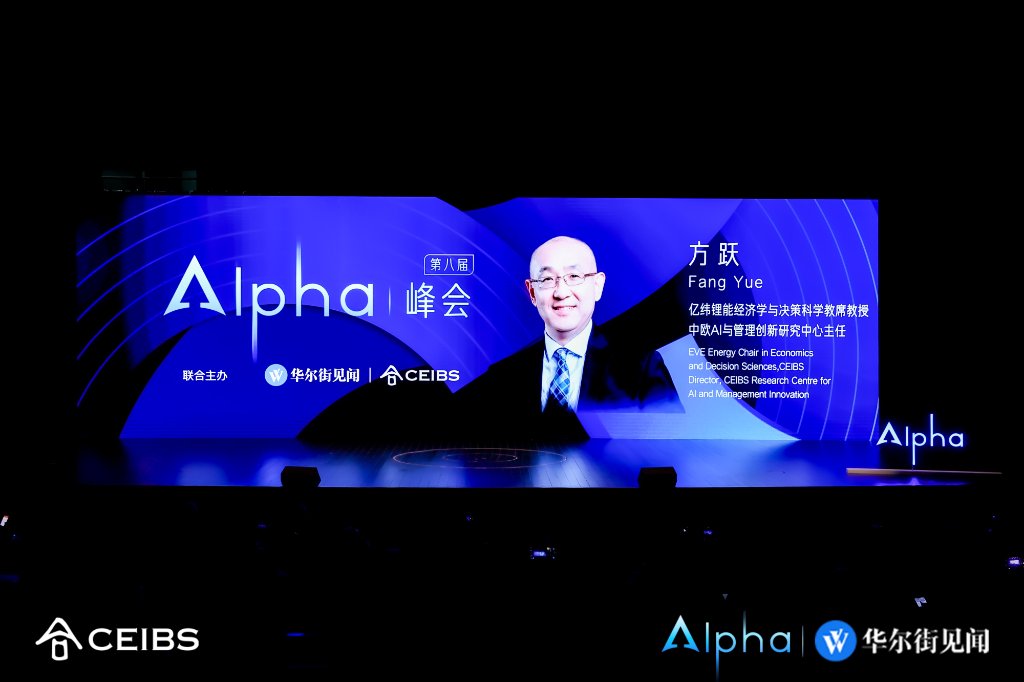
方跃教授:AI若无法规模化落地,市场或重演2000年互联网泡沫|Alpha峰会
Hua Er Jie Jian Wen· 2025-12-22 07:55
Core Insights - The true value of technology lies in how companies transform it into structural productivity revolutions, which is crucial for global economic growth in the coming years [1][6] - Significant investments in AI, if successfully scaled in application, can lead to disruptive productivity improvements; otherwise, it risks repeating the 2000 internet bubble [1][6] - AI's most prominent applications are in coding and healthcare, with the latter accounting for nearly half of all AI spending in vertical sectors [1][6] Group 1 - AI will rewrite the structure of productivity, breaking down internal organizational boundaries and enabling effective human-machine collaboration, leading to "super-intelligent" organizations [2][3] - The traditional agile and flat organizational frameworks are becoming insufficient; future organizations will evolve into intelligent collaborative networks that dynamically combine human and AI capabilities [2][3] - Companies should view AI not merely as a technology to deploy but as "talent" to cultivate, necessitating a shift towards "organizational intelligence" [2][3] Group 2 - The role of human employees will shift from "collaborative division of labor" to "human-machine symbiosis," where humans will focus on defining value and managing outcomes rather than controlling and executing tasks [3][8] - The competition in AI is not strictly zero-sum; the key to success lies in leadership foresight and the ability to integrate AI into business processes to drive efficiency and innovation [3][8] - Companies must not just enhance work with AI but fundamentally "reshape work," requiring a complete rethinking of business models in the AI era [3][8] Group 3 - The current market is pricing in a future defined by significant productivity gains and organizational restructuring, despite some companies still in the "burning cash" phase [6][10] - The AI investment landscape has shifted, with global investments in data centers surpassing commercial real estate, indicating a major shift in competitive focus [7][9] - The energy consumption for AI training and applications is projected to exceed that of all other electricity uses combined, highlighting the scale of AI's infrastructure demands [9][10] Group 4 - AI's transition from laboratory to large-scale application hinges on organizational capabilities, with many companies still struggling to scale pilot projects effectively [16][17] - The core disruption of AI lies in its ability to blur the lines between labor, production tools, and production materials, fundamentally altering production relationships [18][19] - Future organizational structures will likely evolve into dynamic project-based teams that integrate human and digital employees, moving away from fixed job roles [19][20] Group 5 - Companies must cultivate AI as a form of talent, requiring a robust understanding of business processes and the ability to collaborate effectively with both humans and other AI systems [20][21] - The ultimate form of organizations will be "super-intelligent bodies," which necessitate high-quality data and a solid foundation in digitalization and information technology [21][22] - The evolution path for organizations includes stages from initial AI readiness to comprehensive AI integration, emphasizing the need for immediate action and strategic planning [22][26]