伊利股份

Search documents
ESG不应被视为成本负担 而是高效的风险管理和价值投资
Nan Fang Du Shi Bao· 2025-10-24 23:15
Core Viewpoint - The 2025 ESG Annual Report highlights the increasing importance of ESG practices among Chinese companies, with a significant focus on the need for standardized and transparent disclosures in response to regulatory pressures and market expectations [2][5][6]. Group 1: ESG Disclosure Trends - A total of 5,506 A-share listed companies exist, with 2,572 disclosing ESG reports, resulting in a disclosure rate of 46.71%, an increase of approximately 5 percentage points from 2023 and 12 percentage points from 2022 [6]. - Central state-owned enterprises lead in ESG disclosure with a rate of 95.67% for 2024, while private enterprises lag significantly at 32.8% [6][10]. - The consumer sector shows a notable disparity in ESG reporting, with some companies engaging in selective disclosure, often omitting critical data [5][6]. Group 2: Industry-Specific Insights - The liquor industry boasts a 95% disclosure rate, but quality issues persist, with many reports lacking essential data and third-party verification [10][11]. - In the beverage and dairy sector, 48.15% of companies disclosed ESG reports, with notable innovations in packaging and carbon neutrality initiatives [13]. - The seasoning industry has a low disclosure rate of 33.3%, with a collective absence of supply chain carbon management practices [15]. Group 3: Regulatory and Market Implications - Future regulations are expected to enforce stricter verification requirements for ESG disclosures, particularly concerning Scope 3 emissions and pollution metrics [8][9]. - Companies with strong ESG performance may benefit from reduced financing costs and enhanced market value, while poor performance could pose significant investment risks [8][9]. - The emphasis on anti-corruption and business ethics disclosures is increasing, with future regulations mandating transparency in these areas [9]. Group 4: Challenges and Opportunities - Small and medium-sized enterprises face challenges in aligning with ESG practices due to limited resources and lack of communication with government bodies [4]. - The next five years are critical for implementing carbon management policies at various governance levels, presenting both challenges and opportunities for companies [8]. - The consumer sector's ESG practices are evolving into a regulatory-driven phase, necessitating improved data quality and transparency [9].







内蒙古伊利实业集团股份有限公司 关于召开2025年第三季度业绩说明会的公告
Zhong Guo Zheng Quan Bao - Zhong Zheng Wang· 2025-10-24 21:07
Core Viewpoint - The company will hold a performance briefing on October 31, 2025, to discuss its Q3 2025 results and address investor inquiries [2][3][4]. Group 1: Meeting Details - The meeting will be conducted via two formats: a telephone conference and an audio live broadcast on the Shanghai Stock Exchange Roadshow Center, combined with online interaction [3][4]. - The meeting is scheduled for October 31, 2025, from 9:00 to 10:30 AM, with the telephone conference and audio live broadcast from 9:00 to 10:00 AM, followed by online interaction from 10:00 to 10:30 AM [2][4]. Group 2: Participation Information - Investors can pre-register for the telephone conference from October 24 to October 30, 2025, until 4:00 PM, to facilitate quicker access on the day of the meeting [7]. - Investors can also participate through the Shanghai Stock Exchange Roadshow Center by logging in online and submitting questions in advance [7][8]. Group 3: Participants - Key participants in the meeting will include the company’s Secretary of the Board, independent directors, and the General Manager of the Investor Relations Department [5].
“拾”光织锦 不啻微芒 第十届中国特殊食品大会在西安拉开帷幕
Zhong Guo Jing Ji Wang· 2025-10-24 13:52
Group 1 - The 10th China Special Food Conference commenced on October 23 in Xi'an, Shaanxi, with the theme "'Weaving Light and Color, Not Just Tiny Sparks, Striving for a New Chapter" [1] - The conference is organized by the China Nutrition and Health Food Association, with support from various universities and government agencies, featuring 1 main forum and 28 specialized forums over four days [1] - The event gathered representatives from government, regulatory bodies, research institutions, and industry enterprises to discuss the forefront of special food technology, innovation, safety regulations, and application trends [1][2] Group 2 - The President of the China Nutrition and Health Food Association emphasized the importance of scientific foundation, innovation, safety, and cross-industry integration for the future of the special food industry [2] - The Shaanxi provincial government highlighted its commitment to developing the special food industry, leveraging its unique advantages and fostering a competitive environment [3] - West North Agricultural and Forestry University expressed its intention to collaborate on research projects and share resources to enhance the special food and nutrition health industry [3] Group 3 - The Vice President of Xibei University welcomed participants and emphasized the importance of collaboration in food safety and nutrition [4] - The Vice President of Xinhua News Corporation discussed the changing landscape of information dissemination in health, stressing the need for credible and transparent communication [4] - The Chairman of the Academic Committee of the conference called for a focus on strategic value and innovation in the nutrition and health industry [4] Group 4 - The Director of the National Food Safety Risk Assessment Center underscored the critical role of food safety in the industry's development and called for collective efforts to enhance scientific foundations and policy support [5] - The Vice President of the International Alliance of Dietary Supplements congratulated the conference and highlighted the global challenge of micronutrient deficiencies affecting over 2 billion people [5] Group 5 - The CEO of China Resources Pharmaceutical introduced the company's growth strategies in the health sector, emphasizing technological and cultural empowerment [6] - The R&D Manager of Amway China noted the shift in health consciousness among Chinese consumers from passive to proactive health management [6] Group 6 - A book titled "New Quality Production Power of Special Foods" was launched during the conference, aimed at guiding the high-quality development of the nutrition and health food industry [7] - The conference included a T20 forum discussing industry trends, collaboration, and innovation in the special food sector [7] Group 7 - The conference featured participation from various industry leaders and executives from companies like Nestlé, Danone, and Abbott, who shared insights on the future of the special food industry [8]
养乐多告别广州首厂!广州益力多回应:扩大及进一步增长中国市场的方针并未改变
Hua Xia Shi Bao· 2025-10-24 13:36
Core Insights - Yakult will close its first factory in Guangzhou on November 30, 2023, marking a significant shift in its operations in China, where it has been a prominent player since entering the market in 2002 [2][3] - The closure is part of a broader strategic adjustment aimed at enhancing competitiveness and sustainable growth in the Chinese market, despite ongoing challenges in the industry [2][4] Company Performance - Yakult's daily sales in China have declined for three consecutive years, dropping from 625.7 million bottles in 2022 to an estimated 443.9 million bottles in 2024 [3][4] - In Guangzhou, daily sales decreased from 259.6 million bottles in 2022 to 184.6 million bottles in 2024, reflecting a significant contraction in its core market [3] Industry Trends - The traditional yogurt drink market is facing challenges due to rising health consciousness among consumers, leading to a shift towards low-sugar and functional beverages [5][7] - The market for sugar-free beverages in China has grown from 3.12 billion yuan in 2016 to an estimated 19.96 billion yuan in 2022, with projections to reach 61.56 billion yuan by 2025 [5] Strategic Adjustments - The closure of the Guangzhou factory is part of a structural adjustment strategy to improve production efficiency and resource allocation in response to slowing growth, rising costs, and intensified competition [4][6] - Yakult is attempting to innovate its product offerings, introducing new variants such as a high-fiber, high-calcium drink and a sugar-free option to cater to evolving consumer preferences [6][7] Market Challenges - The competitive landscape has intensified, with similar products now offering features like zero sugar and high fiber, which have become standard in the market [6][7] - If Yakult cannot transition from a focus on sweetened probiotic drinks to a more diversified product line that emphasizes low sugar and functional benefits, it risks stagnation or marginalization in the market [7]
吃喝板块逆市下挫,白酒股集体“醉倒”!食品ETF(515710)跌超1%,机构高呼看好四季度行情!
Xin Lang Ji Jin· 2025-10-24 11:43
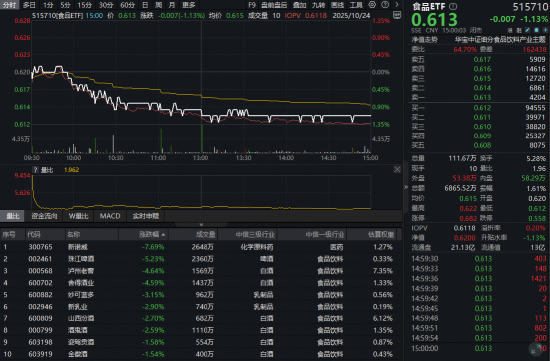
Group 1 - The food and beverage sector experienced a decline on October 24, with the Food ETF (515710) closing down 1.13% after fluctuating near the surface at the opening [1] - Key stocks in the sector, particularly in the liquor category, saw significant drops, with Zhujiang Beer down 5.23%, and both Luzhou Laojiao and Shede Distillery falling over 4% [1] - The overall performance of the sector was negatively impacted by declines in several stocks, including Miaokelando and New Dairy, which dropped over 3% and 2% respectively [1] Group 2 - Guosen Securities noted that as the impact of second-quarter consumption policies weakens, the restaurant supply chain is gradually recovering, with positive signals from the supply side, such as frequent mergers among leading companies [2] - The food and beverage sector is currently at a low valuation, with the food ETF's price-to-earnings ratio at 20.49, which is at the 7.06% percentile of the past decade, indicating a favorable configuration opportunity [2] - Historical trends suggest that any changes in supply and demand could catalyze stock price increases, especially in the fourth quarter when macro policies are expected to be active [2] Group 3 - Future outlook indicates that the food and beverage industry will focus on growth, with beverage leaders maintaining structural prosperity driven by major products, while companies in food raw materials and health products are expected to see accelerated performance [3] - The white liquor industry is currently in a "low expectation, weak reality" state, with the third-quarter reports being a crucial observation window as external factors diminish and liquor companies adjust strategies [3] - There is a mixed performance in consumer goods, with snacks, beverages, and health products showing good demand, while traditional products like dairy and beer are experiencing flat demand [3] Group 4 - Major liquor brands such as Luzhou Laojiao and Yanghe have launched new products recently, indicating ongoing innovation in the sector [4] - Luzhou Laojiao's new product was launched on Douyin, while Yanghe's new offering was showcased during the Nanjing Autumn Sugar event [4] Group 5 - The Food ETF (515710) focuses on core assets in the food and beverage sector, with approximately 60% of its portfolio allocated to high-end and mid-range liquor leaders, and nearly 40% to leading stocks in beverages, dairy, and condiments [5] - The top ten weighted stocks in the ETF include well-known brands such as Moutai, Wuliangye, and Yili [5] - Investors can also access the core assets of the food and beverage sector through the Food ETF linked funds [5]





A股ESG披露央国企领跑!南都发布年度ESG调研报告
Nan Fang Du Shi Bao· 2025-10-24 11:00
在全球应对气候变化、推进可持续发展的浪潮中,环境、社会和治理(ESG)已从企业"加分项",升级 为衡量长期价值与韧性的核心标尺。对于迈向高质量发展的中国经济而言,ESG更是激活新质生产力、 推动产业绿色转型的关键引擎。 目前,新"国九条"明确可持续信息披露要求,财政部、证监会及沪深北交易所联动完善规则,欧盟《企 业可持续发展报告指令》(CSRD)、《欧盟电池法》等全球监管,也倒逼国内企业加速接轨,A股 ESG披露正式进入规范化新时代。 作为与民生紧密关联的核心领域,大消费行业的ESG表现直接关系品牌声誉与市场竞争力。10月24日, 由南方都市报湾财社主办的2025责任中国ESG年度盛典在广州举行,现场公布了《2025年度企业ESG调 研报告》。 截至2025年10月9日,A股5506家上市企业中,2572家披露了ESG报告,整体披露率达46.71%,较2022 年提升12个百分点,呈现稳步提升态势。但大消费行业内部差异显著:白酒、白电等领域披露率超 70%,小家电、调味品等领域不足40%;部分企业虽披露报告,却存在"报喜不报忧""关键数据缺失"等 问题,涉及供应链碳排的范围3碳排放更是多数消费行业的集体盲区。 ...
食品饮料行业资金流出榜:贵州茅台等5股净流出资金超亿元
Zheng Quan Shi Bao Wang· 2025-10-24 10:05
Core Viewpoint - The Shanghai Composite Index rose by 0.71% on October 24, with 16 out of 28 sectors experiencing gains, particularly in the communication and electronics sectors, which increased by 4.73% and 4.72% respectively. Conversely, the oil and coal sectors saw declines of 1.36% and 1.29% [1]. Market Overview - The net inflow of capital in the two markets reached 21.96 billion yuan, with 11 sectors experiencing net inflows. The electronics sector led with a net inflow of 22.39 billion yuan and a daily increase of 4.72%. The power equipment sector followed with a 2.20% increase and a net inflow of 3.71 billion yuan [1]. - A total of 20 sectors experienced net outflows, with the pharmaceutical and biological sector leading with a net outflow of 2.49 billion yuan, followed by the food and beverage sector with a net outflow of 1.75 billion yuan [1]. Food and Beverage Sector Performance - The food and beverage sector declined by 1.18% with a net outflow of 1.75 billion yuan. Out of 124 stocks in this sector, 18 rose, including one that hit the daily limit, while 106 fell, including one that hit the lower limit [2]. - Among the stocks with net inflows, the top performer was汤臣倍健 (Tao Chen Bei Jian) with a net inflow of 48.44 million yuan, followed by伊利股份 (Yili) and安琪酵母 (Anqi Yeast) with inflows of 40.69 million yuan and 22.60 million yuan respectively [2]. - The stocks with the highest net outflows included贵州茅台 (Kweichow Moutai) with a net outflow of 444.07 million yuan,泸州老窖 (Luzhou Laojiao) with 235.87 million yuan, and五粮液 (Wuliangye) with 195.41 million yuan [4].



A股大盘新高之际,吃喝板块估值跌至十年低位!食品ETF(515710)盘中跌超1%
Mei Ri Jing Ji Xin Wen· 2025-10-24 08:33
Core Viewpoint - The food and beverage sector is experiencing a decline despite the overall market reaching new highs, indicating a potential opportunity for investment as valuations remain low [1] Group 1: Market Performance - The food ETF (515710) has decreased by 1.13% as of October 24, reflecting the overall downturn in the food and beverage sector [1] - As of October 23, the price-to-earnings ratio of the food ETF's underlying index is 20.49, which is at the 7th percentile of the past decade, suggesting a favorable configuration for long-term investment [1] Group 2: Policy and Economic Outlook - Recent important meetings have emphasized the need to build a strong domestic market and accelerate the construction of a new development pattern, focusing on expanding domestic demand and enhancing consumer spending [1] - The government aims to stimulate consumption and investment while ensuring a positive interaction between supply and demand, which could enhance the internal dynamics of the domestic economy [1] Group 3: Industry Recovery Signals - According to Guosen Securities, the demand in the restaurant supply chain is gradually recovering, and there are positive signals from the supply side, such as frequent mergers among leading companies, which are increasing industry concentration [1] - Historical trends suggest that with low expectations in the capital market and low institutional holdings, any changes in supply and demand could catalyze stock price increases in the fourth quarter [1] Group 4: ETF Composition - The food ETF (515710) tracks the CSI segmented food and beverage industry theme index, with approximately 60% of its holdings in leading high-end and mid-range liquor stocks, and nearly 40% in leading stocks from beverage, dairy, seasoning, and beer sectors [2] - Major holdings include well-known brands such as Moutai, Wuliangye, Luzhou Laojiao, and Yili, as well as Haitian Flavoring [2]
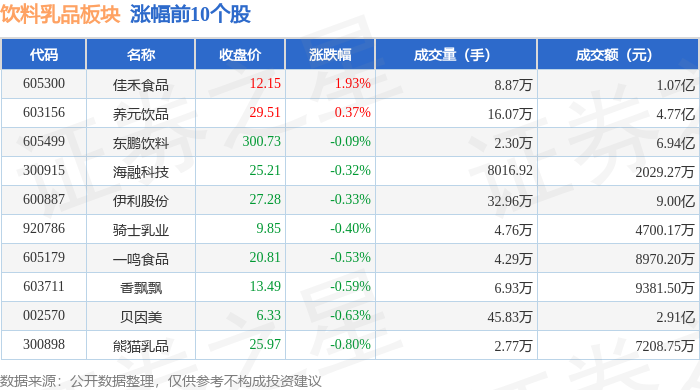
饮料乳品板块10月24日跌0.52%,天润乳业领跌,主力资金净流出1.3亿元
Zheng Xing Xing Ye Ri Bao· 2025-10-24 08:29
Market Overview - The beverage and dairy sector experienced a decline of 0.52% on October 24, with Tianrun Dairy leading the drop [1] - The Shanghai Composite Index closed at 3950.31, up 0.71%, while the Shenzhen Component Index closed at 13289.18, up 2.02% [1] Individual Stock Performance - Jiamu Food (605300) closed at 12.15, up 1.93% with a trading volume of 88,700 shares and a turnover of 107 million yuan [1] - Yiyili (600887) closed at 27.28, down 0.33% with a trading volume of 329,600 shares and a turnover of 900 million yuan [1] - Tianrun Dairy (600419) closed at 9.96, down 4.41% with a trading volume of 172,900 shares and a turnover of 173 million yuan [2] Capital Flow Analysis - The beverage and dairy sector saw a net outflow of 130 million yuan from institutional investors, while retail investors had a net inflow of 42.26 million yuan [2] - Major stocks like Yiyili and Tianrun Dairy experienced significant capital movements, with Yiyili seeing a net outflow of 86.86 million yuan from retail investors [3] Summary of Key Stocks - Yiyili had a net inflow of 68.63 million yuan from institutional investors, but a net outflow of 86.86 million yuan from retail investors [3] - Tianrun Dairy attracted a net inflow of 23.83 million yuan from institutional investors, but also faced a net outflow of 40.36 million yuan from retail investors [3] - Jiamu Food had a net inflow of 17.74 million yuan from institutional investors, indicating positive interest [3]


吃喝板块逆市下探,估值跌至十年低位!食品ETF(515710)盘中跌超1%!机构高呼:估值底部配置时机或现
Xin Lang Ji Jin· 2025-10-24 06:03
Group 1 - The overall performance of the food and beverage sector is declining despite the market reaching new highs, with the Food ETF (515710) down 1.13% as of the latest report [1] - Key stocks in the sector, such as Zhujiang Beer and Shede Liquor, have seen significant declines, with Zhujiang Beer dropping over 5% and several others falling more than 3% [1] - The consumption market is expected to maintain steady growth in the fourth quarter, with the Ministry of Commerce projecting the annual consumption market to exceed 50 trillion yuan [2][3] Group 2 - Guizhou Moutai is anticipated to undergo a revaluation as the white liquor industry prepares for accelerated reporting in the third quarter, while the beer industry is waiting for demand recovery [3] - The food and beverage sector is currently at a low valuation, with the Food ETF's underlying index PE ratio at 20.4 times, indicating a favorable long-term investment opportunity [3] - The white liquor sector is at a valuation bottom, and there is a recommendation to focus on companies with good growth potential and low valuations [4] Group 3 - The Food ETF (515710) tracks the China Securities Index's segmented food and beverage industry theme index, with approximately 60% of its holdings in high-end and mid-range liquor stocks [5] - The top ten weighted stocks in the ETF include major brands like Moutai, Wuliangye, and Yili, indicating a strong focus on leading companies in the sector [5]