创想三维

Search documents
从「绿皮火车」到「高铁」:潮阔的3D打印突围|最前线
36氪· 2025-09-25 23:55
Core Viewpoint - The article discusses the evolution and breakthroughs in the 3D printing industry, particularly focusing on a company named ChaoKuo, which has made significant advancements in printing speed and efficiency, positioning itself as a leader in the consumer-grade 3D printing market [4][5][6]. Industry Evolution - Ten years ago, 3D printers were primarily seen as novelty items with limited speed and precision, dominated by Western manufacturers like Stratasys, which held patents that restricted market entry for others [4]. - The expiration of patents around 2008 allowed Chinese manufacturers to enter the market, initially offering low-cost kits that required extensive assembly, resulting in slow production speeds [4][5]. Company Development - ChaoKuo was founded in 2015 by Shen Kang, who identified the potential for breakthroughs in a rapidly growing industry. Initially, the company relied on low-cost kits but later pivoted to focus on high-speed printing technology [5]. - In 2019, ChaoKuo developed its first high-speed prototype, and by 2020, it launched the SR series, achieving speeds of 150 mm/s, marking a significant milestone in the industry [5][6]. - The introduction of the V400 model in 2022 further increased printing speeds to 600 mm/s, leading to a new era in 3D printing efficiency [5][6]. Technological Advancements - By 2024, ChaoKuo released the Xunyingguang S1 Pro, which reached speeds of 1200 mm/s, becoming the fastest consumer-grade FDM 3D printer globally. This advancement reduced printing time for models from two hours to fifty minutes [6]. - The company is also set to launch the Zhuirizuo T1 Max in 2025, targeting agricultural production scenarios and significantly improving efficiency [6]. Market Dynamics - The global consumer-grade 3D printer market saw a 22% year-on-year increase in shipments in Q1 2025, surpassing 1 million units for the first time, while professional-grade printer shipments declined [6]. - In 2024, China exported 3.778 million 3D printers (excluding components), generating 8.16 billion yuan in revenue, a 32.75% increase year-on-year, with the majority being consumer-grade printers [6][7]. Changing Demand - The demand for 3D printers has shifted from hobbyists to practical applications, with over 80% of devices now used as tools rather than toys. This shift has led to the emergence of new business models and industries [7]. - The cost of materials has decreased significantly, enabling lower production costs and unlocking new possibilities for 3D printing applications [7]. Competitive Landscape - ChaoKuo is not the only player in the high-speed 3D printing market, but its early commitment to speed has differentiated it from competitors like TuoZhu and ChuangXiang SanWei, which have taken different approaches [7]. - The company’s focus on speed and efficiency has allowed it to establish a unique position in the market, transitioning from a hardware manufacturer to a technology-driven industry participant [7].

国金证券:消费级3D打印市场规模快速增长 重点关注高性价比PLA耗材
智通财经网· 2025-09-25 07:25
Group 1: Market Growth - The global consumer-grade 3D printing market is expected to grow from $1.5 billion in 2020 to $4.1 billion in 2024, with a CAGR of approximately 28% [1] - From 2025 to 2029, the market size is projected to increase from $4.9 billion to $16.9 billion, with a CAGR of about 33% [1] - The annual shipment of consumer-grade printers is expected to exceed 4 million units in 2024, with a CAGR of approximately 10.2%, reaching 13.4 million units by 2029, with a CAGR of about 26.6% [1] Group 2: Competitive Landscape - Four Shenzhen companies, including Creality and Tobo, hold 90% of the global entry-level 3D printer market share [2] - Entry-level 3D printers (priced ≤ $2,500) are the only segment expected to see growth in 2024, with a shipment increase of 26% [2] Group 3: Catalysts for Growth - The price of consumer-grade 3D printers has decreased by 60% compared to three years ago, with many entry-level products priced below $1,000 [2] - AI tools, such as those from Hitem3D, have significantly lowered the creative barriers, facilitating the adoption of consumer-grade 3D printing [2] Group 4: Material Demand - PLA is the most common material in 3D printing, with a projected domestic demand of 120,000 tons in 2024, representing a 48.1% year-on-year increase [3] - 3D printing is expected to account for approximately 35% of PLA's application in 2024, making it the largest application area [3] - PLA's characteristics, such as environmental friendliness and ease of use, position it well for growth in consumer-grade 3D printing [3]

独家丨前安克 UV 打印机产品负责人付瀚龙计划创业,多家头部机构火速跟进
雷峰网· 2025-09-18 00:24
Core Viewpoint - The article discusses the entrepreneurial plans of Fu Hanlong, a former product head at Anker, who is currently seeking investment for his new project after leaving the company [3][4]. Group 1: Background of Fu Hanlong - Fu Hanlong has previously worked at DJI and Yuanrong Qixing before joining Anker in September 2023 as the UV printer product head [4]. - He played a significant role in defining the product for Anker's UV printer, contributing to its development [4]. Group 2: Current Entrepreneurial Endeavors - Fu Hanlong is actively seeking direction for his new venture while simultaneously building a team [5]. - He has explored the 3D imaging industry but has not yet confirmed whether he will pursue this field, as it is considered a less favorable entrepreneurial direction due to the current state of the VR industry [5]. Group 3: Market Interest - Fu Hanlong's project is reportedly attracting significant interest in the primary market, with multiple leading institutions looking to invest [4]. - There is potential for the project to complete multiple rounds of financing quickly, indicating strong market confidence [4].

消费级设备系列报告之四:腾讯混元3D3.0模型发布,消费级3D打印渗透率加速提升
Shenwan Hongyuan Securities· 2025-09-16 15:14
Investment Rating - The industry investment rating is "Positive" (看好) indicating that the industry is expected to outperform the overall market [2][10]. Core Insights - The release of Tencent's Hunyuan 3D 3.0 model significantly enhances modeling precision by three times, achieving a geometric resolution of 1536³ and supporting ultra-high-definition modeling with 3.6 billion voxels [2][4]. - The model introduces a novel 3D-DiT hierarchical sculpting approach, improving the understanding and restoration of invisible areas, thus addressing the challenges of generating complex structures and fine details [4]. - The model has been optimized for character generation, enhancing the realism and aesthetic appeal of 3D models, particularly for creating lifelike figurines [4]. - Tencent's Hunyuan model has accelerated iterations, releasing over 30 new models and embracing open-source, with the 3D model community achieving over 2.6 million downloads [4]. - Several companies have integrated Tencent's models, lowering the barriers for 3D modeling and accelerating the penetration of consumer-grade 3D printing [4]. Summary by Sections Industry Overview - The report highlights the rapid advancement in consumer-grade 3D printing technology, driven by Tencent's innovations [2][4]. Key Players in the Industry - Core industry players include: 1. Hardware: Anker Innovation, Tuo Zhu Technology, and others 2. Components: Jietu, Ruike Laser, and others 3. 3D Scanners: Sikan Technology, Obi Zhongguang 4. Materials: Haizheng Biomaterials, Huitong Technology, and others [4]. Valuation Table - The valuation table provides insights into the market capitalization and projected net profits for key companies in the industry, indicating a positive outlook for growth in the coming years [5].

「创想三维」招股书分析
Sou Hu Cai Jing· 2025-09-07 11:38
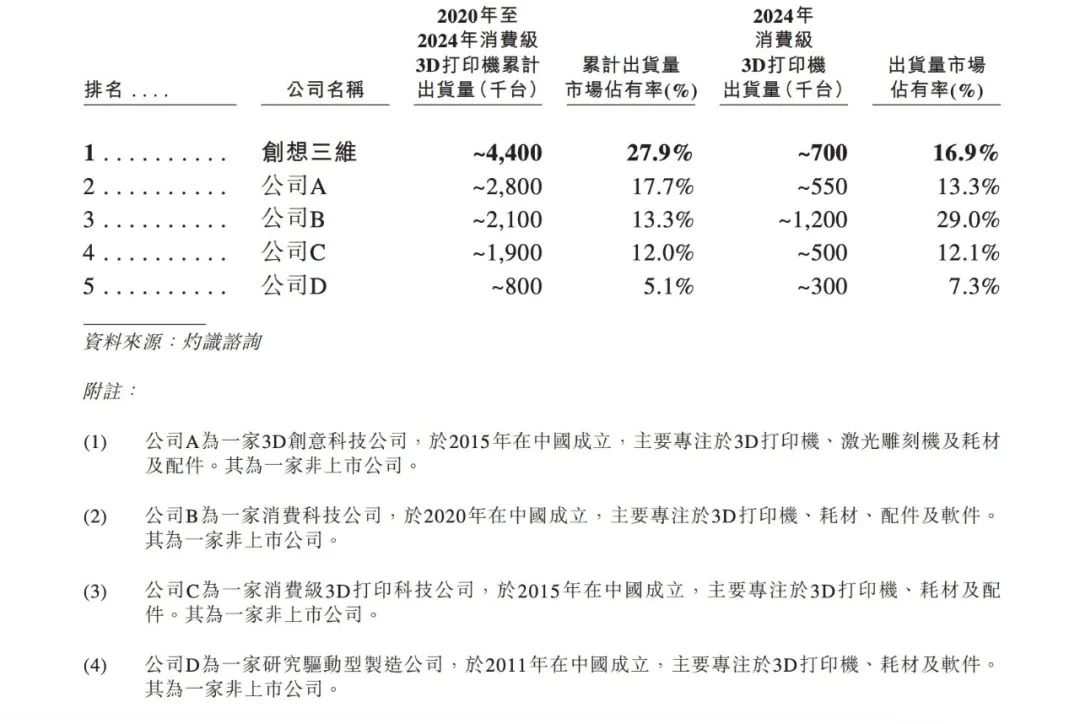
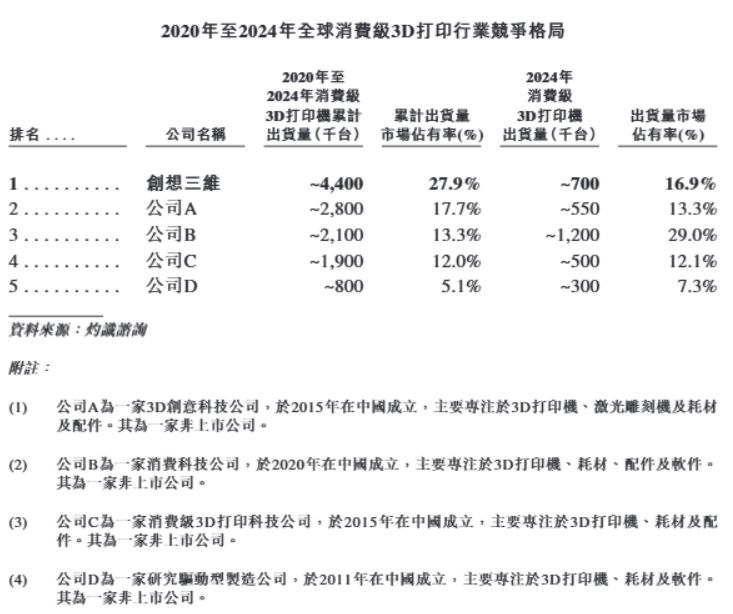
Company Overview - Chuangxiang Sanwei is a leading player in the consumer-grade 3D printing industry and a major cross-border independent seller, recently filing for an IPO on the Hong Kong Stock Exchange [1] - The company positions itself as the "largest global provider of consumer-grade 3D printing products and services," leveraging its first-mover advantage and historical accumulation [4] Industry Position and Competitive Landscape - Between 2020 and 2024, Chuangxiang Sanwei shipped approximately 4.4 million units, achieving a market share of 27.9%, significantly surpassing the second competitor [4] - However, in 2024, the company shipped around 700,000 units, resulting in a market share drop to 16.9%, while a newer competitor, Tuo Zhu Technology, surged to the top with 1.2 million units and a 29% share [4][6] - The competitive landscape is characterized by intense rivalry, with Tuo Zhu Technology redefining performance standards in consumer-grade 3D printing, thereby eroding Chuangxiang Sanwei's market position [6] Financial Performance Revenue Structure and Growth - In 2022, 3D printers accounted for 82% of the company's revenue, decreasing to 62% by 2024, but still representing the primary revenue source [9] - The company experienced a compound annual growth rate (CAGR) of 30% from 2022 to 2024, reaching a revenue of 2.3 billion RMB in 2024 [12] - The core 3D printer business showed stagnation, with a CAGR of only 13% and a year-on-year growth of just 0.8% in 2024, driven primarily by price increases rather than volume growth [14] Profit Margin Analysis - The company's profit margins have declined, with operating profit margin dropping from 12.1% to 4.3% between 2022 and 2024, and net profit margin decreasing from 7.7% to 3.8% [17] - Sales and marketing expenses surged from 8.1% in 2022 to 16.7% in 2024, indicating a heavy reliance on marketing for growth [19] Key Balance Sheet Items and Cash Flow - Operating cash flow net amount decreased from 260 million RMB in 2022 to 170 million RMB in 2024, with a negative cash flow of 80.32 million RMB in Q1 2025 [20] - The company has accumulated significant inventory, with a book value of 516 million RMB and an extended turnover period, indicating sales difficulties [20] Future Development and Potential Risks - Chuangxiang Sanwei is attempting to transition from a pure manufacturer to an "hardware + software + content + service" ecosystem, with "Chuangxiang Cloud" as a key initiative [21] - The company is also exploring Nexbie, an overseas e-commerce platform for 3D creative products, although it currently contributes only 0.2% to revenue [22] - The consumer-grade 3D printing market is poised for explosive growth, and the company's ability to navigate its transformation will be crucial for its future competitive position [22]
“全球最大”消费级3D打印企业创想三维递表港交所:去年“增收不增利” 今年一季度平均存货周转天数超100天
Mei Ri Jing Ji Xin Wen· 2025-08-29 12:34
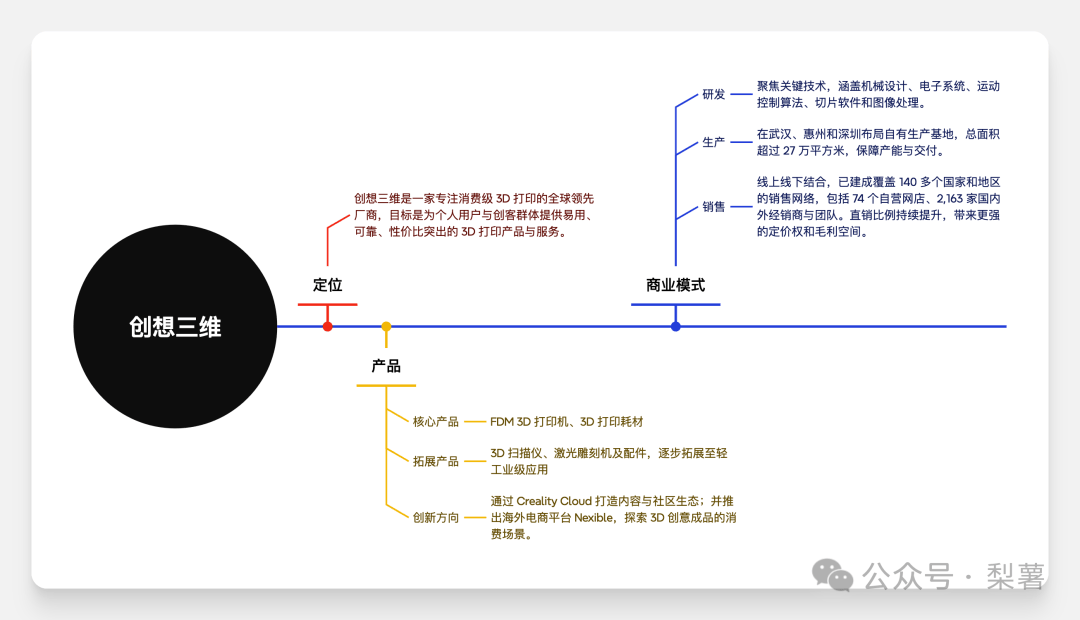
Core Viewpoint - Shenzhen Chuangxiang 3D Technology Co., Ltd. (Chuangxiang 3D) has submitted its IPO application to the Hong Kong Stock Exchange, aiming to raise funds for R&D, overseas operations, global brand promotion, and sales channel development, as well as seeking strategic partnerships, investments, or acquisitions [1] Group 1: Company Overview - Chuangxiang 3D, established in 2014, is a provider of consumer-grade 3D printing products and services, including 3D printers, consumables, and a global online community called "Chuangxiang Cloud" [2] - The company is the largest provider of consumer-grade 3D printing products and services globally, with a market share of 27.9% from 2020 to 2024, ranking second in consumer-grade 3D printers, first in consumer-grade 3D scanners, and third in consumer-grade laser engravers [2][8] Group 2: Financial Performance - Chuangxiang 3D's revenue from 2022 to Q1 2025 shows a declining trend in the revenue share from 3D printers, decreasing from 81.7% in 2022 to 61.3% in Q1 2025, while the revenue share from 3D printing consumables increased from 3% to 12% during the same period [3] - The company's revenue figures for the reporting period were 1.346 billion, 1.883 billion, 2.288 billion, and 708 million yuan, with net profits of 104 million, 129 million, 88.66 million, and 81.56 million yuan respectively, indicating a 21.5% revenue growth in 2024 but a 31% decline in net profit [4] - Raw material costs accounted for over 75% of the sales cost during the reporting period, with specific percentages of 82.7%, 76.7%, 76.4%, and 75.2% [4] Group 3: Inventory and Supply Chain - Chuangxiang 3D's inventory, which includes finished goods, raw materials, and work-in-progress, has shown a growth trend, with values of 184 million, 356 million, 438 million, and 516 million yuan during the reporting period [5] - The average inventory turnover days increased from 86.5 days to 100.8 days, indicating a gradual extension in inventory turnover [6] Group 4: Market Position and Competition - In terms of 2024 shipment volume, Chuangxiang 3D shipped approximately 700,000 consumer-grade 3D printers, giving it a market share of 16.9%, ranking second globally [8][10] - The company has only completed one round of external financing since its establishment, raising approximately 508 million yuan in June 2021 [11]
发力UV打印机,创想三维IPO前景如何?
雷峰网· 2025-08-27 08:13
Core Viewpoint - Chuangxiang 3D is expected to fill the gap in the secondary market for consumer-grade 3D printers as it seeks to go public in Hong Kong, positioning itself as the first stock in this category [4][10]. Market Dynamics - Following the successful crowdfunding of Anker's UV printer, the market has seen a surge of new players entering the space [2]. - The secondary market has begun to focus on consumer-grade 3D printers, with some companies experiencing significant stock price increases despite being marginal players [6]. Company Positioning - Chuangxiang 3D has submitted its IPO application and plans to heavily invest in UV printer technology to capture new market opportunities [3][12]. - The company has seen a decline in market share for its 3D printers, leading to a need for a second growth curve to maintain its position in the second tier of the consumer-grade 3D printer industry [4][24]. Financial Performance - Chuangxiang 3D's revenue has grown from 1.346 billion RMB in 2022 to 2.288 billion RMB in 2024, with a compound annual growth rate of 30.4%. However, profits have decreased from 1.04 billion RMB in 2022 to 886.6 million RMB in 2024, indicating a situation of revenue growth without profit growth [14][18]. - The company’s 3D printer sales are projected to drop from 870,700 units in 2023 to 720,600 units in 2024 due to a focus on higher-end products [13][21]. Market Share and Competition - Chuangxiang 3D is the largest consumer-grade 3D printer company globally, with a cumulative shipment of 4.4 million units and a market share of 27.9% from 2020 to 2024 [8][9]. - In the 3D scanner market, Chuangxiang 3D leads with a market share of 37.7% by shipment volume in 2024 [15][16]. Future Outlook - The company is actively developing its product matrix, including launching new series of 3D scanners and enhancing its UV printing capabilities [12][22]. - Analysts suggest that if Chuangxiang 3D can improve its profit margins to levels comparable to competitors like Tuozhu, it could unlock significant valuation potential in the secondary market [22][23].

从消费电子到模具鞋履,来深圳这个展看3D打印最新趋势
Sou Hu Cai Jing· 2025-08-26 22:27
Core Insights - The Formnext Asia Shenzhen exhibition, covering 20,000 square meters, features 265 leading companies in the additive manufacturing industry, including 131 first-time exhibitors, showcasing innovations in on-demand production and mass customization [1][3] Industry Overview - The exhibition highlights the transformation of production methods across various industries through additive manufacturing technologies, emphasizing innovations such as lightweight designs and customized applications [1][5] - The event has seen a significant increase in international participation, with notable companies from Germany, France, the Netherlands, the USA, Singapore, and Spain attending [3] Event Highlights - The exhibition includes specialized forums and thematic display areas to facilitate the connection between technology and industry applications, featuring 14 conferences and over 150 presentations focused on industry trends and applications [5] - A dedicated area for 3D printing in the footwear industry will explore lightweight, breathable, and customizable shoe designs, as well as sustainable production methods [7] Technological Advancements - The use of advanced alloys like titanium in the 3C (computer, communication, and consumer electronics) sector is expanding the functional boundaries of additive manufacturing components [7] - The exhibition showcases a range of additive manufacturing equipment, from industrial-grade printers to desktop devices, and explores innovative materials, software, and automation solutions [5]

创想三维冲刺港股IPO,去年出货量不及拓竹六成丨IPO观察
36氪· 2025-08-25 13:31
Core Viewpoint - The article emphasizes the intense competition among Chinese hardware companies in the global market, particularly in the 3D printing sector, where domestic players dominate and pose significant challenges to emerging firms [4][10]. Group 1: Company Overview - Creality, founded in 2014, is on the verge of going public in Hong Kong, marking a significant milestone in its journey [6]. - The company has achieved remarkable revenue growth, surpassing 2.288 billion RMB in 2024, with a notable increase from 1.346 billion RMB in 2022 [19][27]. - Creality's market share in the global consumer-grade 3D printer segment is reported at 27.9% based on cumulative shipments from 2020 to 2024, making it a leading player [14]. Group 2: Competitive Landscape - The entry of new competitors like Bambu Lab has reshaped the market dynamics, with Bambu Lab reportedly achieving revenues exceeding 5.5 billion RMB in 2024, overshadowing Creality's 2.288 billion RMB [9][16]. - The article highlights that Creality's shipment volume decreased from 870,000 units in 2023 to 720,000 units in 2024, indicating a shift towards higher-end products [17]. - The competitive environment is characterized by a "Matthew Effect," where leading companies like Bambu Lab and xTool significantly outpace others in revenue and market share [20][34]. Group 3: Financial Performance - Creality's revenue from 3D printing machines has decreased from 81.7% in 2022 to 61.9% in 2024, indicating a diversification in its product offerings [18]. - The company's gross profit margin improved slightly from 28.8% in 2022 to 30.9% in 2024, despite a decline in net profit from 104 million RMB in 2022 to 88.66 million RMB in 2024 [19]. - The revenue contribution from 3D scanning devices has grown rapidly, reaching 208 million RMB in 2024, accounting for 9.1% of total revenue [27]. Group 4: Market Trends - The global consumer-grade 3D scanning market is projected to grow significantly, with a compound annual growth rate of 47.8% from 2020 to 2024 [26]. - Creality's average selling price for 3D scanners dropped from 2,700 RMB in 2022 to 1,700 RMB in 2023, reflecting increased price competition [28]. - The laser engraving machine segment is also competitive, with Creality generating 160 million RMB in revenue from this category in 2024, representing 7.1% of total revenue [32]. Group 5: Strategic Focus - The company is focusing on enhancing its product offerings and expanding its sales channels, with online sales accounting for 47.9% of total revenue in Q1 2024 [36]. - Creality's sales expenses have increased from 8.1% in 2022 to 16.7% in 2024, indicating a growing investment in marketing and sales efforts [38]. - The article suggests that for hardware companies, product quality and innovation are critical for success, as evidenced by the achievements of competitors like Bambu Lab and xTool [37].
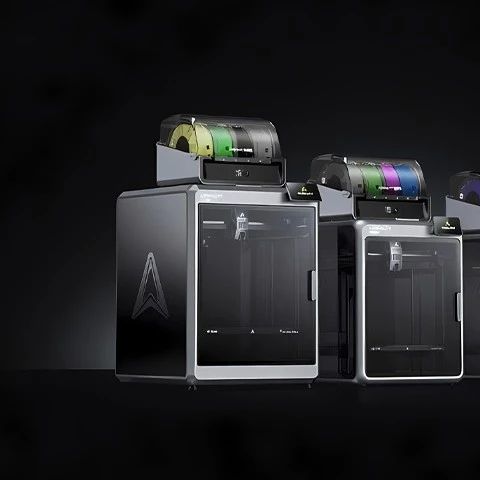
创想三维冲刺港股IPO,去年出货量不及拓竹六成|IPO观察
3 6 Ke· 2025-08-23 01:39
Core Insights - The article discusses the competitive landscape of the 3D printing industry, particularly focusing on the challenges faced by Creality, a leading Chinese 3D printer manufacturer, as it prepares for its IPO in Hong Kong. The company is facing intense competition from both established players and new entrants in the market [1][4][31]. Group 1: Company Overview - Creality was founded in 2014 and has grown to become a significant player in the 3D printing market, with revenue exceeding 2.288 billion RMB in 2024 [3][13]. - The company claims to be the largest consumer-grade 3D printer provider globally, with a cumulative market share of 27.9% from 2020 to 2024 [8][10]. - However, Creality's market position is challenged by competitors like Bambu Lab, which has rapidly gained market share, achieving revenue of over 5.5 billion RMB in 2024 [5][10]. Group 2: Market Dynamics - The consumer-grade 3D printing market is dominated by four Shenzhen-based companies, which collectively account for over 90% of global shipments [7][8]. - The market is experiencing a "Matthew Effect," where larger companies are gaining a disproportionate share of the market, making it increasingly difficult for smaller players to compete [8][10]. - Creality's sales of 3D printers are projected to decline from 870,000 units in 2023 to 720,000 units in 2024, as the company shifts focus to higher-end products [11][12]. Group 3: Financial Performance - Creality's revenue has shown modest growth over the past three years, with figures of 1.346 billion RMB in 2022, 1.883 billion RMB in 2023, and 2.288 billion RMB in 2024 [13]. - The company's gross margin improved slightly from 28.8% in 2022 to 30.9% in 2024, but net profit has decreased from 104 million RMB in 2022 to 88.66 million RMB in 2024 [13]. - The share of revenue from 3D printing machines has decreased from 81.7% in 2022 to 61.9% in 2024, indicating a diversification in revenue streams [12][13]. Group 4: New Business Ventures - In 2024, Creality became the leading company in global shipments of consumer-grade 3D scanners and ranked third in consumer-grade laser engraving machines [15]. - The market for consumer-grade 3D scanners is growing rapidly, with a compound annual growth rate of 47.8% from 2020 to 2024 [16]. - Creality's revenue from 3D scanners reached 208 million RMB in 2024, contributing 9.1% to total revenue, although this is still less than the revenue from 3D printing consumables [17][18]. Group 5: Competitive Landscape - The laser engraving machine market is also highly competitive, with xTool emerging as a significant player, projecting revenues of 20-30 billion RMB in 2024 [24]. - Creality's sales network has expanded significantly, with 74 self-operated online stores and 2,163 distributors covering approximately 140 countries [27]. - Despite the expansion of sales channels, product competitiveness remains crucial in the hardware industry, as evidenced by the success of competitors like Bambu Lab and xTool [28][29].