欣旺达

Search documents
理想汽车跨界造电池,合作方为欣旺达动力
Ju Chao Zi Xun· 2025-10-15 03:49
Core Insights - Shandong Ideal Automotive Battery Co., Ltd. was established on October 13, 2025, with a registered capital of 300 million RMB [2][3] - The company is a joint venture between Ideal Automotive and Xinwanda Power Box, each holding a 50% stake [3] Company Overview - The registered address is located at No. 999, Shenzhen Road, Building B6, 1st Floor, Zhangfan Street, Zaozhuang High-tech Zone, Shandong Province [2][3] - The business scope includes battery manufacturing, sales, emerging energy technology research and development, electric vehicle charging infrastructure operation, and various electronic product sales [2][3] Strategic Partnerships - Ideal Automotive maintains a long-term strategic partnership with CATL, focusing on battery safety and ultra-fast charging technology [4] - This diversified collaboration model helps ensure supply chain stability while enhancing the autonomy of battery technology [4] Technological Investment - Significant investments have been made in battery technology, particularly in the development of 5C ultra-fast charging batteries [4] - The self-developed battery technology encompasses chemical systems, battery structures, and core algorithms for battery management systems (BMS), which will improve charging speed and range [4]


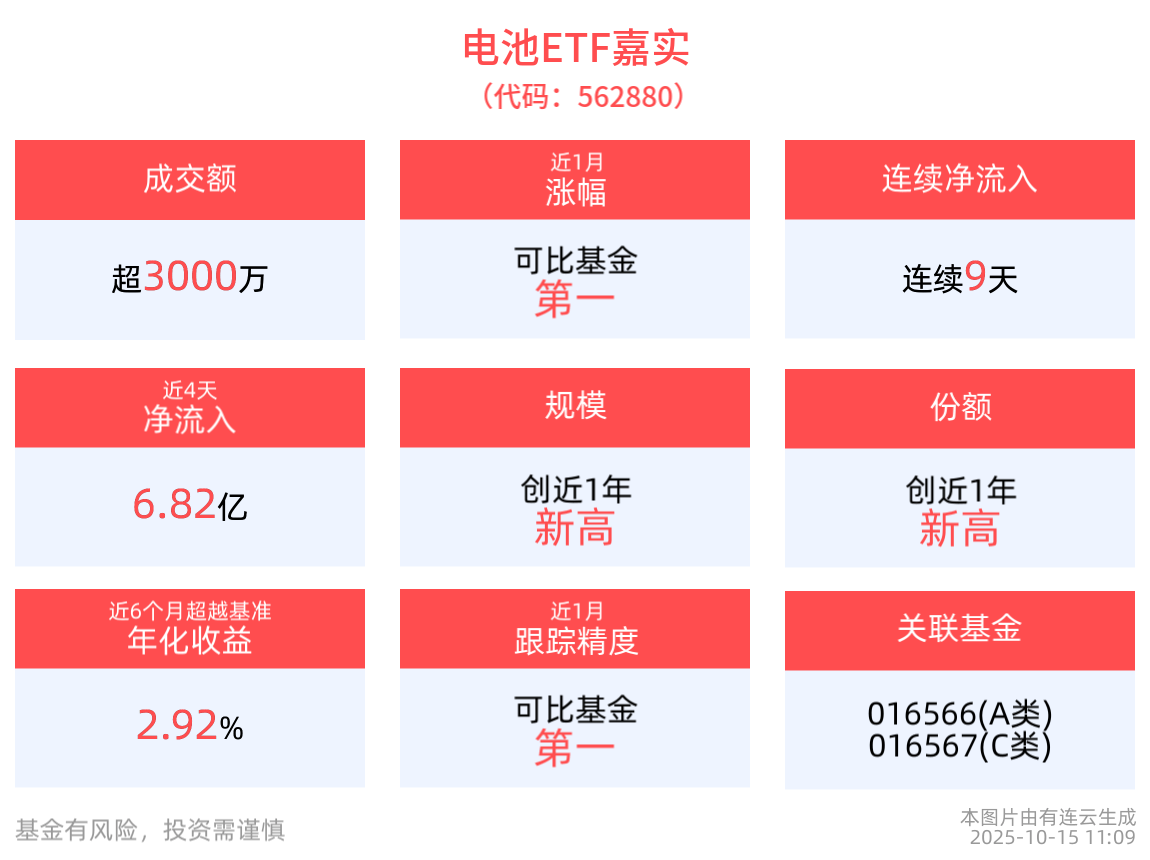
国内动力电池需求有望持续提升,电池ETF嘉实(562880)“吸金”不止,近9天获得连续资金净流入超8亿元
Sou Hu Cai Jing· 2025-10-15 03:43
Core Viewpoint - The battery sector is experiencing mixed performance, with notable fluctuations in stock prices and a significant increase in the scale and net inflow of the battery ETF, indicating strong investor interest and market dynamics [1][3]. Group 1: Market Performance - As of October 15, 2025, the China Securities Battery Theme Index decreased by 0.01%, with stocks showing mixed results; Artesian led with a 4.65% increase, while Jinlang Technology faced a decline [1]. - The battery ETF, Jiashi, recorded a turnover of 1.61% and a transaction volume of 31.11 million yuan, reaching a new high in scale at 1.933 billion yuan and a total of 2.469 billion shares [3]. Group 2: Fund Inflows and Performance - The Jiashi battery ETF has seen continuous net inflows over the past nine days, with a peak single-day inflow of 281 million yuan, totaling 825 million yuan [3]. - As of October 14, 2025, the Jiashi battery ETF's net value increased by 70.54% over the past six months, ranking 51 out of 3739 index stock funds, placing it in the top 1.36% [3]. Group 3: Industry Dynamics - Dongwu Securities reported that production in September slightly exceeded expectations, with a further 10% increase anticipated in October, driven by strong demand in the energy storage sector, leading to a supply shortage expected to last until mid-2026 [4]. - Huaxi Securities noted that domestic demand for power batteries is likely to continue rising, benefiting from the upward trend in the energy storage sector, with clear price increases expected in both lithium batteries and upstream materials [4]. - As of September 30, 2025, the top ten weighted stocks in the China Securities Battery Theme Index accounted for 55.79% of the index, including major players like Sungrow Power, CATL, and Yiwei Lithium Energy [4].
欣旺达跌2.02%,成交额7.39亿元,主力资金净流出3574.70万元
Xin Lang Cai Jing· 2025-10-15 03:40
Core Viewpoint - The stock of XINWANDA has experienced fluctuations, with a recent decline of 2.02% and a year-to-date increase of 31.31%, indicating volatility in investor sentiment and market performance [1]. Financial Performance - For the first half of 2025, XINWANDA reported a revenue of 26.985 billion yuan, representing a year-on-year growth of 12.82%, and a net profit attributable to shareholders of 856 million yuan, up 3.88% from the previous year [2]. - Cumulatively, since its A-share listing, XINWANDA has distributed a total of 1.661 billion yuan in dividends, with 645 million yuan distributed over the past three years [3]. Shareholder Structure - As of June 30, 2025, the number of shareholders for XINWANDA increased to 114,600, a rise of 5.76%, while the average number of circulating shares per person decreased by 5.45% to 14,946 shares [2]. - The top circulating shareholders include Hong Kong Central Clearing Limited, holding 90.6951 million shares, and E Fund's ChiNext ETF, holding 33.9136 million shares, with both experiencing a decrease in holdings [3]. Market Activity - On October 15, XINWANDA's stock price was 29.10 yuan per share, with a trading volume of 739 million yuan and a turnover rate of 1.46%, reflecting active trading [1]. - The stock has seen a net outflow of 35.747 million yuan from major funds, with significant selling pressure observed [1]. Business Overview - XINWANDA, established on December 9, 1997, specializes in the research, design, production, and sales of lithium-ion battery modules, with its main revenue sources being consumer batteries (51.47%), electric vehicle batteries (28.18%), and other categories [1]. - The company operates within the power equipment industry, specifically in the battery sector, and is involved in various concepts such as energy interconnection and solid-state batteries [1].
整车厂& Tier1 &汽车电子产业链1v1创新产品技术对接会
Zhong Guo Qi Che Bao Wang· 2025-10-15 03:28
Event Overview - The 23rd Guangzhou International Auto Show will be held from November 21-24, 2025, at the Guangzhou Import and Export Fair Complex, covering a total area of 240,000 square meters [2] - Over 90 mainstream car manufacturers and 12,000 journalists are expected to attend, with an estimated audience of over 800,000 from various industries [2] Event Activities - The Shenzhen Automotive Electronics Industry Association will host a "1v1 Innovation Product Technology Matching Conference" during the event, aimed at facilitating communication between vehicle manufacturers and Tier 1 suppliers [2] - The conference will help automotive electronic companies understand the latest demands and trends from OEMs, allowing them to align their product strategies effectively [2] Product and Technology Focus - The event will cover a wide range of product and technology areas, including intelligent chassis, smart cockpits, advanced driver assistance systems (ADAS), new energy technologies, and various electronic components [4] - The 1v1 matching format will allow for direct communication between R&D and procurement leaders from automotive manufacturers and Tier 1 suppliers, enhancing the efficiency of information exchange [3] Target Participants - The event aims to invite various OEMs and Tier 1 suppliers, including notable companies such as Huawei, Baidu, and Valeo, among others [7]

山东理想汽车电池有限公司成立
Zheng Quan Ri Bao Wang· 2025-10-15 02:41
Group 1 - The establishment of Shandong Ideal Automotive Battery Co., Ltd. has been reported, with a registered capital of 300 million yuan [1] - The company's business scope includes battery manufacturing, battery sales, emerging energy technology research and development, and electric vehicle charging infrastructure operation [1] - The shareholders of the company are Beijing Ideal Automotive Co., Ltd. and Xinwangda Power Technology Co., Ltd. [1]
三菱自动车工业株式会社收购广汽三菱股权案获无条件批准
Bei Ke Cai Jing· 2025-10-15 02:29
新京报贝壳财经讯(记者张冰)10月15日,新京报贝壳财经记者从国家市场监督管理总局官网获悉,其 发布了2025年9月22日-9月30日无条件批准经营者集中案件列表,其中包括重庆千里智驾科技有限公司 与浙江极氪汽车研究开发有限公司新设合营企业案、北京理想汽车有限公司与欣旺达动力科技股份有限 公司新设合营企业案、三菱自动车工业株式会社收购广汽三菱汽车销售有限公司股权案等。 校对 王心 编辑 杨娟娟 ...
高端材料出口遇管制,多家锂电企业回应
2 1 Shi Ji Jing Ji Bao Dao· 2025-10-15 00:23
Core Viewpoint - China's export control on lithium batteries and key materials is set to take effect on November 8, 2025, targeting products with energy density ≥300Wh/kg, which includes critical production technologies and materials [1][12]. Industry Impact - The announcement has led to significant market reactions, with major companies like CATL and Yiwei Lithium Energy experiencing stock declines of 6.82% and 10.96% respectively on October 10 [3]. - The Shenwan Battery Index fell over 4% after three consecutive trading days of decline following the announcement [3]. Company Responses - Companies like Siengda Intelligent and Liyuanheng stated that the new policy's impact on their overall business is minimal, as their overseas orders primarily come from domestic battery manufacturers, which are not subject to the new controls [5][6]. - Rongbai Technology emphasized that the policy is a regulation rather than a prohibition, and it mainly affects products related to semi-solid and solid-state batteries, which do not significantly impact their supply [6][11]. - Companies such as Dingsheng Technology noted that their exports mainly consist of multi-element positive materials, which are not included in the control scope [7]. Market Dynamics - The Chinese lithium battery industry is projected to produce 1170 GWh in 2024, with a total industry output value exceeding 1.2 trillion yuan, reflecting a 24% year-on-year growth [9]. - China supplies approximately 90% of the global lithium battery market, making exports a crucial part of capacity digestion [9]. Long-term Outlook - The export control is expected to reshape the global lithium battery industry landscape, shifting focus from capacity to high-end technology [11]. - The policy may lead to increased emphasis on the domestic market and accelerate the application of high-end battery technologies within China [12].





高端材料出口遇管制,多家锂电企业回应
21世纪经济报道· 2025-10-15 00:14
Core Viewpoint - China's export control on lithium batteries and key materials is set to take effect on November 8, 2025, targeting high-energy-density batteries and critical production equipment, which reflects a shift towards high-end technology in the lithium battery industry [1][10]. Industry Impact - The new regulations have triggered a market reaction, with significant declines in stock prices for major lithium battery companies, including a 6.82% drop for CATL and a 10.96% drop for EVE Energy on October 10 [4][6]. - The Shenwan Battery Index fell over 4% after three consecutive trading days of decline, indicating market concerns about the impact of export restrictions [4][9]. Company Responses - Several companies, including Siengda Intelligent and Rongbai Technology, have stated that the new policy will have a minimal impact on their operations, as their primary overseas orders do not fall under the restricted categories [6][7]. - Companies like Dingsheng Technology emphasized that their exports mainly consist of materials not affected by the new regulations, suggesting a focus on domestic markets moving forward [7][9]. Market Dynamics - The Chinese lithium battery industry has a significant production capacity, with a total output expected to reach 1,170 GWh in 2024, a 24% increase year-on-year, and an industry value exceeding 1.2 trillion yuan [9]. - China supplies approximately 90% of the global lithium battery market, making export a crucial aspect of capacity utilization [9]. Long-term Outlook - The export control is seen as a strategic move to maintain China's leading position in high-end battery technology, potentially reshaping the global supply chain and encouraging domestic market focus [10]. - Analysts suggest that while there may be short-term market adjustments, the long-term implications could favor Chinese companies in the high-end battery sector [10].
高端材料出口遇管制 多家锂电企业回应
2 1 Shi Ji Jing Ji Bao Dao· 2025-10-14 23:13
Core Viewpoint - China's export control on lithium batteries and key materials is set to take effect on November 8, 2025, targeting products with energy density ≥300Wh/kg, which includes critical production technologies and materials [1] Group 1: Export Control Announcement - The Ministry of Commerce and the General Administration of Customs announced the export control measures, emphasizing the dual-use nature of the targeted items and aligning with international practices to safeguard national security [1] - The measures are not aimed at any specific country or region, and legitimate export applications will be reviewed and potentially approved [1] Group 2: Market Reactions - On October 10, several listed companies in the lithium battery sector experienced significant stock declines, with CATL down 6.82%, EVE Energy down 10.96%, and other second-tier leaders dropping over 8% [2] - The Shenwan Battery Index fell for three consecutive trading days, closing down over 4% on October 14 [2] Group 3: Company Responses - Companies like Siengda Intelligent stated that the policy's impact on their overall business is minimal, as their overseas orders primarily come from domestic battery manufacturers, which are not subject to the export control [3] - Li Yuanheng, a lithium battery equipment supplier, mentioned that they have established a robust R&D and manufacturing base overseas to mitigate potential trade policy changes [3] - Rongbai Technology held an investor communication meeting, clarifying that the export policy is a control rather than a ban, and it mainly affects products related to semi-solid and solid-state batteries [4] Group 4: Industry Insights - The lithium battery industry in China has developed a vast capacity and complete supply chain, with a projected total production of 1170GWh in 2024, representing a 24% year-on-year increase [5] - China supplies approximately 90% of the global lithium battery market, with domestic sales of power and other batteries reaching 920.7GWh in the first eight months of the year, including 173.1GWh in exports, a 48.5% increase year-on-year [6] - The recent export control is seen as a shift in the lithium battery competition from capacity to high-end technology, potentially reshaping the global industry landscape [7]
理想汽车电池公司正式成立
DT新材料· 2025-10-14 16:04
Core Viewpoint - The establishment of Shandong Ideal Automotive Battery Co., Ltd. marks a significant collaboration between Ideal Auto and Xiwanda Power, focusing on the production and sales of lithium-ion batteries for electric vehicles, with a registered capital of 300 million RMB [2][3]. Company Overview - Shandong Ideal Automotive Battery Co., Ltd. was officially established on October 13, with a registered capital of 300 million RMB, and its business scope includes battery manufacturing, sales, and research in emerging energy technologies [2]. - The joint venture is owned equally by Xiwanda Power and Beijing Ideal Auto, each holding a 50% stake [2]. Industry Context - The trend of car manufacturers partnering with battery manufacturers is not new, with several major collaborations established between leading automotive companies and battery producers from 2017 to 2023 [4]. - Future prospects indicate that more battery companies may form joint ventures with automotive manufacturers, including international collaborations [5]. Research and Development - Ideal Auto has taken a leading role in the design of battery products, processes, and materials in its collaboration with Xiwanda, referring to it as self-developed batteries [3]. - The R&D team for Ideal Battery consists of approximately 200 members, with regular project reviews conducted by Ideal Auto's president [3].