Palantir Technologies Inc.

Search documents
甲骨文暴跌重燃AI泡沫论,但几乎无人敢做空!
Hua Er Jie Jian Wen· 2025-12-12 13:55
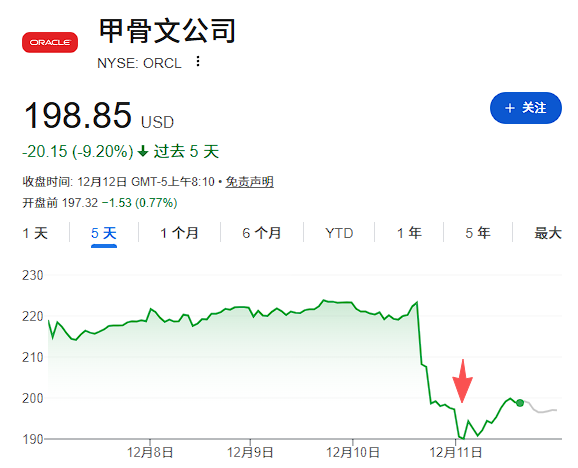
Core Viewpoint - Oracle's earnings warning has reignited concerns about an AI valuation bubble, yet Wall Street investors remain cautiously optimistic about the AI sector, with no consensus that the AI rally has peaked [1][4]. Group 1: Oracle's Performance and Market Reaction - Oracle's stock price fell by 16.5% after the company warned that its capital expenditures for fiscal year 2026 would exceed previous expectations by $15 billion [1]. - The decline in Oracle's stock also affected Broadcom, which saw a drop in after-hours trading due to concerns that increased AI business exposure would hurt profit margins [1]. - The sell-off extended to other tech stocks, raising investor concerns about the scale of AI spending and the uncertainty of investment returns [4]. Group 2: Market Sentiment and Analysis - Despite the sell-off, the S&P 500 index rose slightly, reaching a new all-time high, indicating broader market resilience [4]. - Analysts suggest that Oracle's issues are specific to the company and do not reflect a systemic crisis in the AI sector [5]. - Notable investors, including Michael Burry, have compared the current AI hype to the 1990s internet bubble, but short-selling activity is primarily focused on smaller companies, with limited short positions on leading AI stocks [4][5]. Group 3: Changing Investor Attitudes - Investor criteria for AI investments are becoming more stringent, with a notable shift in the correlation between capital expenditures and stock prices [5]. - Meta's stock dropped by 11% after announcing significant increases in capital expenditures, highlighting the market's changing response to aggressive AI investments [5]. - Market participants believe that Oracle's challenges are more of an isolated incident rather than indicative of a broader issue within the AI investment landscape [6]. Group 4: Short Selling and Market Dynamics - There is a rising willingness among investors to short smaller AI stocks, but major AI beneficiaries remain lightly shorted [7]. - Despite some setbacks for leading AI stocks, the broader market continues to perform strongly, with technology stocks comprising 35% of the S&P 500 index [7]. - Concerns persist that a decline in enthusiasm for high-flying AI stocks could negatively impact the overall market, which has seen a 17% increase this year [7].


Palantir Lawyers Target 'Copycat Company.' Is Palantir A Buy Heading Into 2026?
Investors· 2025-12-12 12:24
Core Viewpoint - Palantir Technologies (PLTR) has experienced significant stock volatility, with a notable 122% increase in 2025 despite recent declines, indicating a complex market perception of the company as both a tech and defense stock [1][2][3]. Financial Performance - In Q3, Palantir reported earnings of 21 cents per share, doubling from the previous year, and revenue of $1.18 billion, a 63% increase, surpassing analyst expectations of 17 cents and $1.09 billion respectively [4]. Market Position and Strategy - Palantir is transitioning from predictive AI to generative AI, aiming to expand its commercial market presence in sectors like healthcare and financial services while maintaining its government contract roots [5][6]. - The company is well-positioned to benefit from U.S. government initiatives, particularly under the Trump administration, which may lead to increased defense contracts [6][8]. Stock Performance and Technical Ratings - Palantir's stock has retreated 19% from its record high of 207.52 set on November 3, with a 340% increase in 2024 largely attributed to Donald Trump's election win [3][10]. - The stock currently holds a Composite Rating of 98 out of 99, indicating strong growth potential, but has seen a decline in institutional ownership, reflected in an Accumulation/Distribution Rating of C [10][11]. Industry Context - The artificial intelligence sector is experiencing a slowdown, with many stocks, including Palantir, pulling back from their 52-week highs, suggesting a cautious market sentiment [3][14].

甲骨文业绩受挫冲击AI概念股,但多数投资者仍持乐观态度
Xin Lang Cai Jing· 2025-12-12 12:17
Core Viewpoint - Oracle's disappointing earnings report has negatively impacted the trading of AI-related stocks, raising concerns about overvaluation and the risk of an AI bubble [1][9][10] Group 1: Market Reactions - Investors remain optimistic about AI, with many cautious about declaring the AI sector has peaked [10] - Oracle's stock fell by 16.5% after it warned that capital expenditures for fiscal year 2026 would exceed September's expectations by $15 billion [1][11] - Broadcom also warned that increased revenue from AI could pressure profit margins, further dampening market sentiment [1][11] Group 2: Broader Market Impact - Despite Oracle's stock drop affecting other tech stocks, the overall market remained stable, with the S&P 500 index slightly rising to a historical high [12] - Some analysts believe Oracle's issues are specific and do not indicate systemic risks for the entire AI sector [12] Group 3: Investment Sentiment - Investors are becoming more selective in AI stock picking, moving away from blindly rewarding AI investments with stock price premiums [14] - The correlation between aggressive capital expenditures and stock prices has significantly changed in recent months [14] Group 4: Short Selling Trends - Even skeptical investors are hesitant to short-sell AI stocks, with some believing the market is in a phase of extreme growth [15] - Concerns about an AI bubble are perceived as exaggerated, with major cloud service providers still struggling to meet strong demand for data centers [16] - Data shows that while short-selling interest in small-cap AI stocks has increased, the short ratio for major AI beneficiaries remains low [16] Group 5: Sector Performance - The technology sector is currently the largest component of the S&P 500 index, accounting for 35% as of the latest close [17] - The S&P 500 index has risen 17% this year, largely driven by strong AI stocks, leading to concerns about the market's reaction if enthusiasm for these stocks wanes [17] - Despite the sell-off in the AI sector, the S&P 500 index showed resilience, alleviating some market concerns [18]
FEPI: High Tech, High Income, Both Good Things For 2026
Seeking Alpha· 2025-12-12 10:30
Core Insights - The REX FANG & Innovation Equity Premium Income ETF (FEPI) has been highlighted as a significant investment opportunity, with a previous assertion that ignoring this fund would be a mistake [1] Group 1 - The ETF has been on the radar of investment analysts for its potential benefits in the current market environment [1]

Should You Buy BigBear.ai Stock Before 2026?
The Motley Fool· 2025-12-12 10:30
Group 1 - The core viewpoint is that investors are optimistic about BigBear.ai's potential to replicate the success of Palantir [1] - BigBear.ai is currently one of the most popular AI stocks in the market [1]


Stocks Could See Fast 20% Drop If Recession Hits in 2026, Stifel Says
Business Insider· 2025-12-12 10:15
Core Viewpoint - Stifel projects a 9% upside for the S&P 500 in 2026 if the US economy remains stable, but warns of a potential 20% decline in the event of a recession [1][2] Economic Outlook - A recession is not the base case for Stifel or other major banks, with a 25% chance assigned to a downturn occurring next year [2] - The Federal Reserve has increased its growth forecast for 2026, indicating a more optimistic economic outlook [2] Labor Market Concerns - The labor market shows signs of instability, with rising unemployment and layoffs, which could lead to reduced consumer spending [3] - Consumer spending accounts for 68% of GDP, making its decline a significant concern for economic health [3] Stock Valuation Risks - Current stock valuations are historically high, with median pullbacks during recessions averaging 20% and average drops at 23% since World War II [4] - The S&P 500 is considered expensive, and P/E ratios may become critical in a downturn [4] Speculative Assets and Market Behavior - In the event of a bear market, speculative assets are expected to decline first, followed by the broader market [5] - A basket of seven highly-volatile stocks has already seen significant declines, indicating a shift in market sentiment [5] Defensive Investment Recommendations - Despite a positive base case for the S&P 500, Stifel recommends building hedge positions with defensive stocks [6] - Suggested funds for exposure to defensive assets include Consumer Staples Select Sector SPDR Fund (XLP), Invesco S&P 500 Low Volatility ETF (SPLV), JPMorgan Equity Premium Income ETF (JEPI), and iMGP DBi Managed Futures Strategy ETF (DBMF) [6]

CFOs On the Move: Week ending Dec. 12
Yahoo Finance· 2025-12-12 09:17
Group 1: Executive Changes in Companies - ExxonMobil CFO Kathryn Mikells will retire on February 1, 2026, to focus on recovery after medical procedures; Neil Hansen will succeed her [2] - Barbara Larson has been appointed CFO of Workiva, effective January 20, 2026, succeeding Jill Klindt, who will leave on December 26 [3] - Timothy Regan, CFO of Dropbox, is stepping down after five years; Ross Tennenbaum will take over on December 16 [4] - Crusoe appointed Michael Gordon as CFO and COO, succeeding Matthew DeNezza, who will leave after an advisory role through 2026 [5] - Lambda appointed Heather Planishek as finance chief, who previously held roles at Tines and Palantir Technologies [6]


Beyond the Magnificent 7: Meet 3 of Tech’s Rising Stars
Investing· 2025-12-12 06:42
Core Insights - The Magnificent Seven, a group of trillion-dollar corporations, have significantly influenced the stock market and established the foundation of the digital economy, but they face growth limitations due to the Law of Large Numbers [1][4] - A market shift is occurring as institutional investors are moving capital from mega-cap stocks to high-growth mid-cap companies that specialize in applying artificial intelligence (AI) [2][3] Company Summaries Micron Technology - Micron Technology is positioned at the center of a supply shortage for High Bandwidth Memory (HBM), specifically HBM3E chips, which are critical for AI servers [7][8] - The demand for HBM has outstripped supply, with Micron's production capacity sold out through 2026, granting the company significant pricing power and higher profit margins [8][9] - Micron's memory stacks are approximately 30% more power-efficient than previous generations, providing substantial energy savings for data centers [11] - The company is experiencing a Super Cycle driven by insatiable demand for AI infrastructure, leading to clearer revenue visibility [12] Palantir Technologies - Palantir Technologies has emerged as a leader in Operational AI, transitioning from a reliance on government contracts to significant growth in US commercial revenue, which accelerated over 50% year-over-year in 2025 [13][14] - The company's Bootcamp sales strategy allows for rapid implementation of its software, significantly shortening the time to close large deals [16] - Inclusion in the S&P 500 has provided stability to Palantir's stock price, supported by institutional buying and strong performance on the Rule of 40 metric [17] SentinelOne - SentinelOne offers AI-driven security solutions to combat automated attacks, positioning itself as a necessary defense against evolving threats [18] - The company achieved GAAP profitability by the end of fiscal year 2025, followed by positive free cash flow, indicating a sustainable business model [20] - Rapid adoption of SentinelOne's generative AI tool, Purple AI, is enhancing the capabilities of junior security analysts, making it appealing to mid-sized companies [21] - The stock is currently trading at a discount compared to larger rival CrowdStrike, with potential for significant appreciation as profitability concerns are resolved [22] Market Trends - The stock market is evolving, with explosive growth shifting from established giants to emerging companies that address critical bottlenecks in memory supply, operational efficiency, and automated security [23][24]



为AI巨头“松绑”!特朗普签署行政令限制各州监管权,力推联邦“单一规则”
智通财经网· 2025-12-12 03:11
Group 1 - The executive order signed by President Trump aims to limit state regulations on artificial intelligence (AI) and establish a national framework to maintain the U.S.'s leadership in the global AI sector [1][2] - The order directs the formation of an "AI Litigation Task Force" to challenge state laws that conflict with the administration's vision for light regulation of AI [1][2] - The order also requires the identification of state laws that impose burdensome requirements on AI models, which aligns with previous efforts to prevent what the administration terms "woke AI" [1][2] Group 2 - The executive order follows the failure of Congress to pass similar policies, highlighting the administration's push for a unified federal standard over state regulations [2][3] - Critics argue that the order may hinder meaningful AI regulation and express skepticism about Congress's ability to replace existing state laws with national standards [3][4] - The political debate surrounding AI regulation has intensified, with calls for effective laws addressing various concerns, including corporate power and consumer protection [4][5] Group 3 - The order reflects a broader trend among Republicans to prioritize federal AI legislation, especially as states like California and New York implement their own regulations [6][7] - Key figures in Silicon Valley, including Nvidia's CEO Jensen Huang, have expressed concerns that disparate state regulations threaten U.S. technological advancement [7][8] - The executive order is part of a series of initiatives by the Trump administration aimed at reducing regulatory burdens and enhancing investment in AI [8][9] Group 4 - The "Genesis Plan," launched by the Trump administration, aims to significantly enhance U.S. scientific research capabilities in AI, drawing comparisons to historical initiatives like the Manhattan Project [8][9] - The implementation of the executive order could lower compliance costs for tech companies and accelerate their expansion in the AI sector, potentially benefiting stocks of companies like Nvidia and Google [9]



RGA Investment Advisors Q3 2025 Investment Commentary
Seeking Alpha· 2025-12-12 00:00
Market Concentration and Performance - The S&P 500 is experiencing historic concentration, with the top 10 companies accounting for over 40% of the index's total weight, leading to a divergence between equal-weighted and capitalization-weighted indices [4][5] - The performance divide indicates that the median stock's performance is not accurately reflected by the cap-weighted index, highlighting the challenges for active investment strategies that typically focus on smaller and mid-cap stocks [5][6] Market Dynamics - High retail participation and speculation are distorting valuation logic, with some stocks trading at levels disconnected from fundamentals, exemplified by Palantir's high multiples [6] - The dominance of AI is influencing market dynamics, with many winning stocks connected to AI, even among smaller companies in the Russell 2000 index, which often have high EV/S ratios despite lacking revenue [6][8] Investment Opportunities - The healthcare sector is identified as mispriced, with a widening valuation gap favoring investors [8] - Capital One's acquisition of Discover is seen as transformative, positioning it to generate substantial value and redefine its competitive standing in the payments landscape [19][29] - The acquisition allows Capital One to leverage a key exemption related to the Durbin Amendment, potentially increasing debit interchange rates and delivering over $1 billion in network synergies by 2027 [21][29] Capital One's Strategic Positioning - The merger with Discover enhances Capital One's scale, making it the largest credit card issuer in the U.S. and improving its loan book mix by reducing consumer subprime risk [26][30] - Capital One's technological infrastructure and operational expertise are crucial for integrating Discover's systems, with expected annual expense savings of approximately $1.5 billion [23][25] - The combined entity is projected to achieve an EPS of $25 by 2027, with a ROTCE exceeding 20%, justifying a higher market multiple than its current valuation [31]