联影医疗

Search documents
习近平总书记关切事|勇立潮头竞风流——科技工作者大有作为(上篇)
Xin Hua She· 2025-05-28 10:18
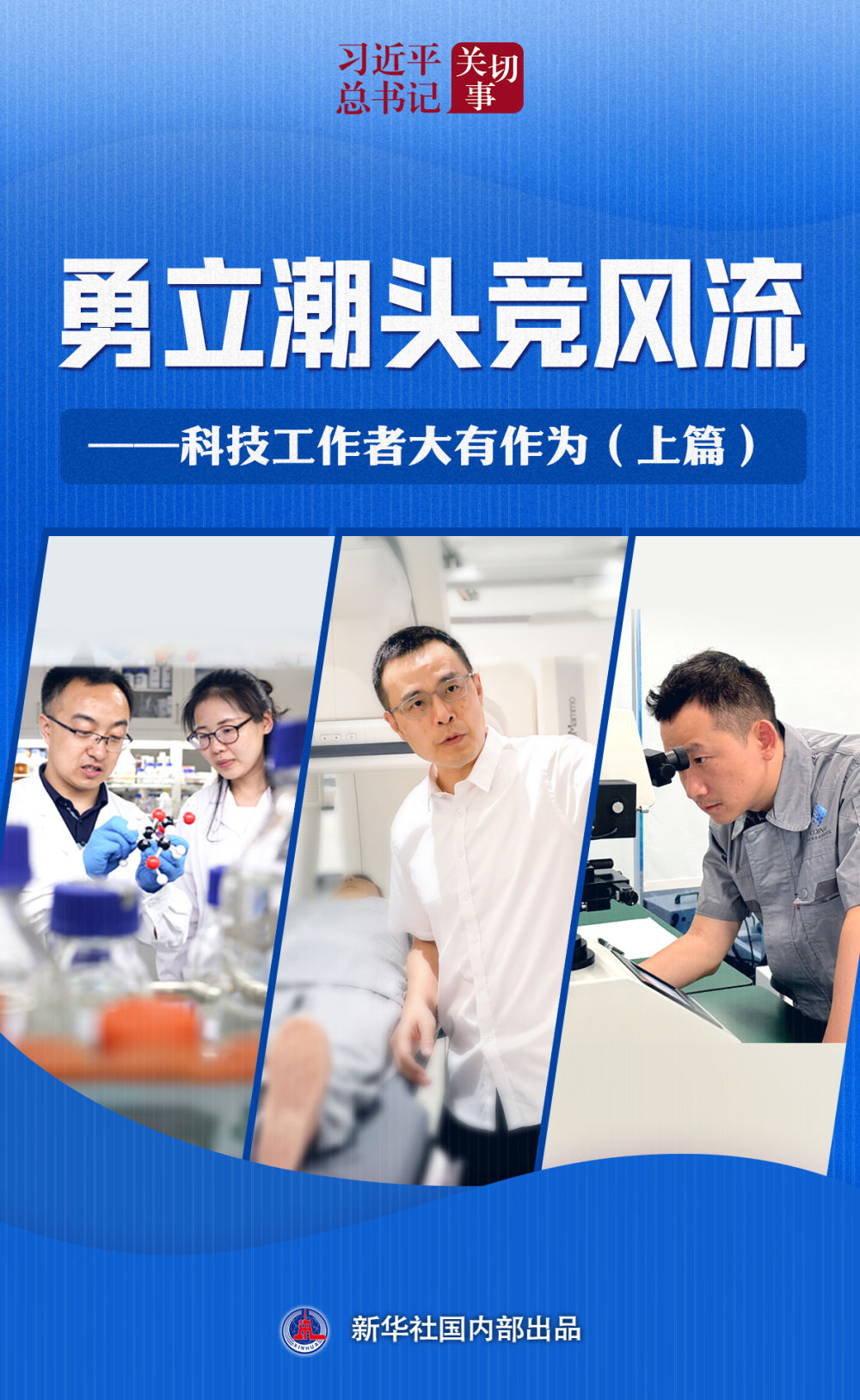
Group 1 - The article emphasizes the significant achievements and transformations in China's scientific and technological sectors since the 18th National Congress of the Communist Party, highlighting the importance of innovation and the role of scientists in modernizing the country [3] - The "National Science Workers Day" on May 30 showcases stories of innovation and breakthroughs, reflecting the robust development of China's technology industry [3] Group 2 - Researchers at the Tianjin Institute of Industrial Biotechnology have successfully increased the yield of artificial sugar synthesis from carbon dioxide by 30%, marking a significant advancement in the field [5][7] - The team has been working on enzyme catalysts to improve the efficiency of sugar synthesis, achieving a conversion rate increase from 10% to over 40%, surpassing traditional plant photosynthesis [7][8] Group 3 - The article discusses the innovative approach of integrating engineers into research and clinical settings, as exemplified by the efforts of Hu Peng, the director of the United Imaging Healthcare Research Institute [10][11] - The collaboration between academia and industry is highlighted, with a focus on the establishment of innovation consortia to facilitate the commercialization of research outcomes [13][14] Group 4 - The article addresses the challenges faced in bridging the gap between research and industrial application, as illustrated by Huang Chunsen from the Chongqing Nano Metal Research Institute, who acts as a translator between scientists and industry [17][18] - The successful application of gradient nano technology in production lines demonstrates the effective integration of scientific research with market needs, supported by government policies and funding [20][22]

上证科创板医疗指数报723.15点,前十大权重包含心脉医疗等
Sou Hu Cai Jing· 2025-05-28 08:38
Group 1 - The core viewpoint of the article highlights the performance of the Shanghai Stock Exchange Sci-Tech Innovation Board Medical Index, which has shown a 2.05% increase over the past month but a 3.91% decrease over the past three months, and a year-to-date decline of 0.28% [1] - The index consists of no more than 30 listed companies in the medical field selected from the Sci-Tech Innovation Board, reflecting the overall performance of medical listed companies [1] - The index was established with a base date of December 30, 2022, and a base point of 1000.0 [1] Group 2 - The top ten weighted companies in the index include: Huatai Medical (11.71%), United Imaging (10.72%), Aibo Medical (6.92%), Yirui Technology (6.59%), Nanwei Medical (5.3%), Shengxiang Biology (4.93%), Xinmai Medical (4.6%), Haier Biomedical (4.24%), Yahui Long (3.64%), and Aohua Endoscopy (3.34%) [1] - The index's holdings are entirely composed of companies listed on the Shanghai Stock Exchange, with a 100% market share [1] - The industry composition of the index holdings includes 45.64% in medical consumables, 33.41% in medical devices, and 20.95% in in vitro diagnostics [1] Group 3 - The index sample is adjusted quarterly, with adjustments implemented on the next trading day following the second Friday of March, June, September, and December [2] - Weight factors are generally fixed until the next scheduled adjustment, with special circumstances allowing for temporary adjustments [2] - Companies that are delisted or undergo mergers, acquisitions, or splits will be handled according to calculation and maintenance guidelines [2]

万东医疗重大人事变动 董事长胡自强提前两年离职
Xi Niu Cai Jing· 2025-05-28 06:44
Core Insights - The chairman of Wandong Medical, Hu Ziqiang, resigned for personal reasons, effective immediately, and was succeeded by Ma Chibing, head of Midea Group's medical business, marking a significant personnel change in the company's leadership [2][5] - This change indicates a new phase in the integration of Midea Group's medical segment since acquiring Wandong Medical in 2021 [2] Financial Performance - In 2024, Wandong Medical's revenue is expected to grow by 23.26% to 1.524 billion yuan, but the net profit attributable to shareholders is projected to decline by 16.54% to 157 million yuan, with a gross margin decrease to 36.55% [5] - Over the past four years since Midea Group's acquisition, Wandong Medical has experienced a decline in net profit for three years, with both revenue and net profit decreasing in 2022 [5] Strategic Direction - Ma Chibing, the new chairman, has over 20 years of experience at Midea Group and has been tasked with leading the company's shift from "equipment manufacturing" to "ecosystem building" [5] - Under Ma's leadership, Wandong Medical will focus on an "AI + medical" strategy, aiming to position itself as a "Chinese solution provider" in the global medical imaging field, rather than directly competing with rivals like United Imaging [5]



医疗创新ETF(516820)盘中翻红,港股医药ETF(159718)盘整蓄势,机构:国产药物有望进一步提升竞争力
Xin Lang Cai Jing· 2025-05-28 03:22
Group 1 - The core viewpoint is that the Chinese biotech industry is experiencing significant growth, supported by substantial investments and a positive outlook for domestic innovative drug development [1][2] - The CSI Medical and Medical Device Innovation Index (931484) has shown a 0.45% increase, with notable gains from stocks such as Aier Eye Hospital (688578) up 5.62% and Innovent Biologics (688278) up 2.57% [1] - The Medical Innovation ETF (516820) has also seen a 0.29% increase, reflecting a positive trend in the sector [1] Group 2 - The CSI Medical and Medical Device Innovation Index includes 30 companies with strong profitability and growth potential, representing a significant portion of the industry [2] - As of April 30, 2025, the top ten weighted stocks in the index account for 66.51% of the total index, highlighting the concentration of performance among leading companies [2] - The upcoming ASCO conference is expected to provide further data that could positively impact related companies, indicating ongoing advancements in cancer treatment [1]

2025年中国数字化X射线诊断系统(DR)行业发展全景分析及未来前景研判:国产化率持续提升,未来三年国产化率有望突破80%[图]
Chan Ye Xin Xi Wang· 2025-05-28 01:38
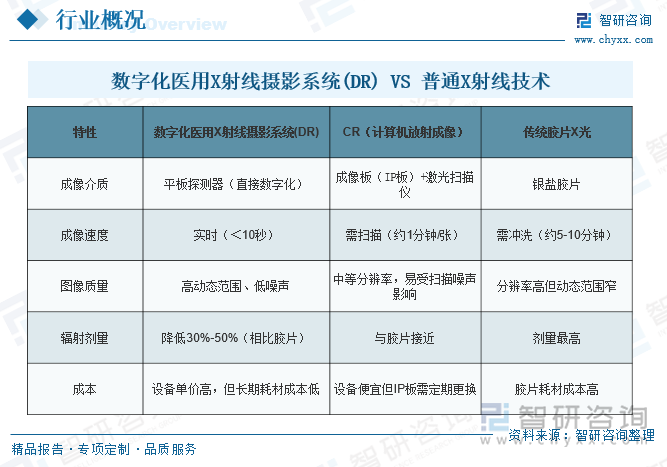
Core Viewpoint - The digital X-ray diagnostic system (DR) market in China is experiencing rapid growth, with domestic brands increasing their competitive strength and achieving a record high localization rate of 68.78% in 2024. The upcoming "equipment update" projects are expected to drive significant demand for upgrading old systems, creating new growth opportunities in the mid-to-high-end DR market by 2025 [1][5][19]. Industry Definition - Digital X-ray diagnostic systems (DR) utilize X-ray and computer technology for image acquisition and processing, becoming essential equipment in modern radiology. DR systems typically consist of an X-ray imaging system, digital image acquisition plates, and image control workstations, favored for their speed, accuracy, and lower radiation doses [2][5]. Current Industry Status - The medical imaging equipment market in China has historically been dominated by foreign brands like GE, Siemens, and Philips, which held over 90% market share in high-end products. However, domestic brands are increasingly replacing imports, with the DR market showing significant growth and a localization rate reaching 68.78% in 2024 [5][19]. Regional Distribution - In 2024, the procurement of digital X-ray diagnostic systems (DR) in China's eastern regions increased compared to 2023, while the central, western, and northeastern regions saw declines, particularly in the central region [7]. Industry Chain - The upstream of the DR industry includes core components such as X-ray generators, digital detectors, image processing systems, and AI-assisted diagnosis. The midstream involves the manufacturing and system integration of DR equipment, while the downstream applications are primarily in clinical diagnostics, health check centers, and emergency departments [9]. Development Environment - Related Policies - The digital X-ray diagnostic system (DR) is gradually replacing traditional film X-ray photography due to its efficiency and low radiation. Recent government policies have been introduced to support the development of medical imaging equipment, emphasizing the need for equipment updates in rural healthcare settings [11][12]. Competitive Landscape - Major players in the Chinese DR market include United Imaging, Wandong Medical, Siemens Healthineers, and Mindray. Domestic manufacturers like Mindray and Wandong Medical are expanding their market share, with United Imaging and Wandong Medical leading the market in 2024 [13][15]. Development Trends - The maturity of DR technology and decreasing costs are leading to widespread adoption in tertiary hospitals, with gradual expansion into primary hospitals and grassroots medical institutions. The "equipment update" trend is expected to drive the replacement of outdated systems, creating new growth opportunities in the mid-to-high-end DR market by 2025. The industry is transitioning from assembly manufacturing to core component autonomy and intelligent value-added services, with localization rates projected to exceed 80% in the next three years [19].


联影医疗(688271):25Q1扣非业绩增速亮眼,首创类+超声等重磅新品持续加码
Huafu Securities· 2025-05-27 09:28
Investment Rating - The report maintains a "Hold" rating for the company, indicating that the stock is expected to perform in line with the market benchmark over the next six months [4][18]. Core Insights - The company reported a revenue of 10.3 billion in 2024, a decrease of 9.7% year-on-year, and a net profit of 1.262 billion, down 36.1% year-on-year. However, in Q1 2025, the company achieved a revenue of 2.48 billion, reflecting a growth of 5.4% year-on-year, and a net profit of 370 million, up 1.9% year-on-year [2][4]. - The domestic bidding trend is accelerating, leading to a recovery in performance in Q1 2025, supported by policy implementation and market recovery. The company is expected to continue to see growth as installations increase [2][3]. - The company achieved a market share increase of over 3 percentage points in 2024, despite an overall industry slowdown, with high-end products seeing a 5 percentage point increase in market share [3]. Financial Performance Summary - In 2024, the company’s revenue from CT was 3.04 billion (down 25%), MR revenue was 3.19 billion (down 2.7%), MI revenue was 1.3 billion (down 16.3%), XR revenue was 590 million (down 22.8%), and RT revenue was 320 million (up 18.1%). Maintenance revenue grew significantly to 1.356 billion, up 26.8% [3]. - The company’s overseas revenue reached 2.2 billion in 2024, a 34% increase year-on-year, with nearly 300 high-end machines sold globally [2][3]. - The report projects revenues for 2025-2027 to be 12.5 billion, 15 billion, and 17.5 billion respectively, with corresponding year-on-year growth rates of 21%, 21%, and 16% [4][6]. Product Development and Market Strategy - The company is launching several innovative products, including the uMR Jupiter 5T and uLinac HalosTx, which are expected to enhance its competitive edge in the market [3]. - The company is also focusing on AI integration with its imaging devices, which is anticipated to open new avenues for market penetration [3].
一众投资大佬,来自这所120岁的顶流高校
母基金研究中心· 2025-05-27 01:00
Core Viewpoint - Fudan University celebrates its 120th anniversary, highlighting its contributions to national development and the cultivation of talent in various fields, particularly in investment and finance [1][9]. Group 1: Fudan University Achievements - Fudan University has established itself as a leading institution with 20 disciplines recognized as first-class, and nearly 80% of its disciplines ranked among the top 100 globally [1]. - The university has produced approximately 500,000 graduates, many of whom have become prominent figures in the investment sector [1]. Group 2: Notable Alumni in Investment - Notable alumni include Shan Junbao, Chairman of CICC Capital, who has over 20 years of experience in private equity and has led investments exceeding 50 billion yuan in various sectors [1]. - Liu Chengwei, Chairman of Yuanhe Holdings, has helped the company grow to manage over 120 billion yuan in assets since its establishment in 2001 [2]. - Ding Guorong, Director of AIIB, represents Fudan's influence in international finance, with AIIB having a capital of 100 billion USD, of which China contributes 50% [3]. - Chen Wei, Chairman of Dongfang Fuhai, has managed over 35 billion yuan in funds and has been influential in the Shenzhen financial sector [4]. - Shao Jun, founder of Dazhong Capital, has led investments in significant companies, showcasing Fudan's impact on the investment landscape [5]. - Mi Qun, founding partner of Light Speed China, has successfully invested in several high-profile companies, demonstrating the entrepreneurial spirit of Fudan alumni [6]. - Hu Xubo, Managing Partner of Qiming Venture Partners, has played a crucial role in the development of the healthcare investment sector, managing assets totaling 9.5 billion USD [7]. Group 3: Fudan University Initiatives - Fudan University has established the Fudan Science and Technology Innovation Fund, with an initial scale of 1 billion yuan, aimed at fostering technology transfer and innovation [9][10]. - The fund will focus on "hard technology" sectors, including life sciences, integrated circuits, and artificial intelligence, to support high-growth projects [10]. - The university's alumni are actively giving back, as evidenced by the establishment of a development fund for Fudan University Affiliated Hospital, with an initial donation of 100 million yuan [8].

医疗服务价格项目立项指南让新技术更普惠
Ke Ji Ri Bao· 2025-05-26 23:40
Group 1 - The average price of CT equipment has decreased from 30 million to 10 million yuan, raising questions about whether service fees should also be reduced [1] - The guidelines issued by the National Medical Insurance Administration clarify that bedside X-ray photography can only charge once for multiple body parts during the same examination [1] - The guidelines aim to promote reasonable pricing for medical services, helping patients access high-quality and affordable healthcare [1] Group 2 - The previous uniform pricing for different types of examinations, such as cardiac MRI and other body parts, has been criticized for not reflecting the varying technical difficulties and time requirements [2] - The guidelines allow for separate pricing for more complex and time-consuming examinations, enabling hospitals to allocate medical resources more effectively [2] - The shift from physical film to electronic film in medical imaging has been facilitated by the guidelines, which also require hospitals to upload data for better efficiency [2] Group 3 - The guidelines have introduced over 100 new pricing items for innovative medical technologies and equipment, such as boron neutron capture therapy [4] - The introduction of a 5.0T MRI, which significantly improves early detection rates for diseases, is part of the new pricing structure [4] - The guidelines emphasize clinical significance over technical indicators when setting prices, allowing new technologies that meet clinical needs to reach patients more effectively [4]
5月26日工银医疗保健股票净值下跌1.16%,近1个月累计上涨3.52%
Sou Hu Cai Jing· 2025-05-26 13:02
Core Viewpoint - The article discusses the performance and holdings of the Industrial and Commercial Bank of China Medical Healthcare Stock Fund, highlighting its recent net value, returns, and top holdings [1]. Fund Performance - The latest net value of the ICBC Medical Healthcare Stock Fund is 2.5580 yuan, reflecting a decrease of 1.16% - The fund's return over the past month is 3.52%, ranking 172 out of 940 in its category - Over the last six months, the return is 9.79%, with a ranking of 202 out of 914 - Year-to-date, the return stands at 12.24%, ranking 98 out of 926 [1]. Fund Holdings - The top ten holdings of the ICBC Medical Healthcare Stock Fund account for a total of 39.79%, with the following key positions: - Heng Rui Medicine: 8.90% - WuXi AppTec: 5.12% - Aier Eye Hospital: 4.94% - BeiGene: 3.77% - Zai Lab: 3.52% - New Horizon Health: 3.27% - Mindray Medical: 2.80% - Yuwell Medical: 2.76% - United Imaging Healthcare: 2.47% - Innovent Biologics: 2.24% [1]. Fund Management - The ICBC Medical Healthcare Stock Fund was established on November 18, 2014, and as of March 31, 2025, it has a total scale of 2.724 billion yuan - The fund is managed by Zhao Bei and Ding Yang, both of whom have extensive experience in the healthcare sector [1][2].


港股医药ETF(159718)、医疗创新ETF(516820)小幅调整,机构:预计更多全球资金将流入港股医疗
Xin Lang Cai Jing· 2025-05-26 03:44
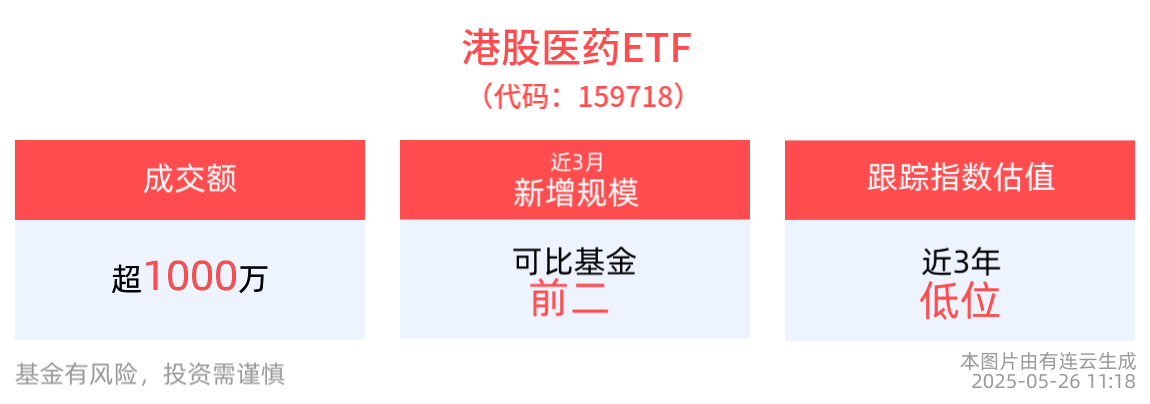
Market Performance - As of May 26, 2025, the CSI Hong Kong Stock Connect Healthcare Index (930965) decreased by 1.59%, with mixed performance among constituent stocks [1] - The Hong Kong Medical ETF (159718) fell by 1.49%, with a latest price of 0.73 HKD, but saw a 4.68% increase over the past week as of May 23 [1] - The CSI Medical and Medical Device Innovation Index (931484) declined by 1.16%, with the Medical Innovation ETF (516820) down by 0.86% and a latest price of 0.35 HKD [4] Notable Stocks - HeartTech Medical (02291) led gains with an increase of 11.11%, while three pharmaceutical companies, including 3SBio (01530), saw declines of over 6% [1] - The top ten weighted stocks in the CSI Hong Kong Stock Connect Healthcare Index accounted for 60.54% of the index, with companies like BeiGene (06160) and WuXi Biologics (02269) among the leaders [6][8] IPO and Market Sentiment - On May 23, 2025, the chairman of Innovent Biologics (1276.HK) rang the bell at the Hong Kong Stock Exchange, marking a successful "A+H" dual listing with a first-day stock price increase of 29.4% [1] - According to a report by China Merchants Securities International, market sentiment towards the Hong Kong healthcare sector is more optimistic compared to 2024, with expectations that the IPO of Innovent Biologics will attract more global capital [2] Industry Trends - Haitong International predicts a significant turning point for the Hong Kong healthcare industry in 2025, driven by stricter regulatory policies and accelerated review processes for innovative drugs and devices [2] - The shift towards digital marketing and the increase in new product approvals are expected to lead to growth in the industry, particularly for leading companies transitioning from generics to innovative products [2]