OPPO

Search documents
天玑9500芯片问世,最有看点的不是跑分
远川研究所· 2025-09-22 13:04
Core Viewpoint - The global smartphone market is expected to rebound in 2024 with a 7% increase in shipment volume, following two years of decline, and a 4% growth in the first half of this year [2] - The high-end smartphone segment (priced above $600) saw an 8% year-on-year growth in the first half of the year, marking a historical high [2] - MediaTek's Dimensity series chips have positioned the company as a leader in shipment volume, particularly with the launch of the Dimensity 9500, which doubles AI computing power [2] Group 1: Market Trends - The smartphone market is recovering with a projected 7% growth in 2024 and a 4% increase in the first half of this year [2] - High-end smartphone sales have reached a historical high with an 8% growth in the first half of the year [2] Group 2: Technological Advancements - MediaTek's Dimensity series has undergone significant architectural improvements, with the Dimensity 9500 featuring a "1+3+4" core architecture that enhances performance [5][7] - The Dimensity 9500 achieves a 32% increase in single-core performance and a 17% increase in multi-core performance compared to its predecessor [5] - The chip's GPU and NPU have also seen significant enhancements, with the GPU's ray tracing performance more than doubling and energy efficiency improving by over 40% [7] Group 3: AI Integration - The Dimensity 9500 incorporates a dual NPU architecture, enhancing AI computing efficiency while managing power consumption effectively [16] - The chip supports Always-On AI applications, allowing for real-time responses in various scenarios [16] - The integration of generative AI capabilities enables the Dimensity 9500 to generate 4K images directly on the device, significantly improving response times for language models [25] Group 4: Competitive Positioning - MediaTek is transitioning from being a mere "compute power supplier" to a company that deeply understands user needs and integrates AI capabilities into user experiences [22] - The Dimensity 9500's advancements in gaming performance, including support for ray tracing and dynamic cache architecture, position it as a leading solution in the mobile gaming market [19][18] - MediaTek's focus on real-world applications and user-centric design has allowed it to rise to the forefront of the global chip design industry [26]


首创双NPU架构一鸣惊人!联发科天玑9500重磅加码主动式AI体验
量子位· 2025-09-22 11:16
克雷西 发自 深圳 量子位 | 公众号 QbitAI 一个问题,在当前的智能手机中,如果AI需要成为具有自主意识、会主动实现功能的"常驻能力",而不只是一个需要频繁被动焕新的"功能模 块",什么样的芯片架构才能真正跟得上这样的改变? 联发科给出的答案是:以更犀利的算力和更友好的能效表现,创造 超性能+超能效双NPU架构 ,始终让"AI Always on"。 这是一次从技术形态到使用方式的转变:目的是 让AI不再依赖被动唤醒,而是作为系统能力始终在线 、随时响应,融入用户的每一次操作。 这一趋势正在形成共识。 随着大模型下沉,端侧AI的使用频率越来越高,从输入法里的预测补全,到拍照时的构图建议,从锁屏摘要到图像生成,AI正在从"调用一 次"变为"时刻可用"。 为此,SoC不仅要能跑得快,更要 让AI跑得久、跑得稳 ,甚至在用户毫无察觉的情况下完成实时响应。 天玑9500 围绕这一目标重构芯片底座:首发双NPU架构,结合存算一体、硬件压缩等多项关键技术,在ETHZ苏黎世移动SoC AI榜单中蝉联 榜首,相比上一代跑分翻倍。 天玑9500正在让手机的AI变得更快、更聪明,也更贴近你的使用节奏。 写文案、整理想法、 ...

46亿封单!引爆整条赛道
格隆汇APP· 2025-09-22 10:38
Core Viewpoint - The article highlights a significant surge in the consumer electronics sector, driven by strong demand for Apple's iPhone 17 and the collaboration between OpenAI and Luxshare Precision, indicating a new growth cycle in the industry [10][20][24]. Market Performance - A-shares saw collective gains, with the Shanghai Composite Index rising by 0.22%, Shenzhen Component by 0.67%, and the ChiNext Index by 0.55% [3]. - The trading volume in the Shanghai and Shenzhen markets reached 21,215 billion, a decrease of 2,023 billion from the previous trading day [4]. Key Company Movements - Luxshare Precision experienced a significant stock price increase, reaching a limit up with a maximum order amount exceeding 4.6 billion [2][13]. - Other Apple-related stocks in Hong Kong also rose sharply, with companies like AAC Technologies and Sunny Optical Technology seeing gains of nearly 10% [10]. OpenAI Collaboration - OpenAI has signed an agreement with Luxshare Precision to develop a consumer-grade device, which is currently in the prototype stage and expected to collaborate closely with OpenAI's AI models [10]. - Luxshare has reportedly secured at least one assembly contract for an OpenAI device, indicating strong future growth potential [10]. iPhone 17 Demand - Following the strong pre-sale performance of the iPhone 17, Apple has requested Luxshare to increase the daily production of the standard version by approximately 40% [10]. - The Chinese market's subsidy policy for electronic products priced below 6,000 yuan is expected to further stimulate demand for the iPhone 17, which is priced at 5,999 yuan [11]. Consumer Electronics Growth Cycle - The article suggests that the consumer electronics sector is entering a new growth cycle, supported by multiple favorable factors, including a series of product launches from major companies [16][19]. - Historical trends indicate that the consumer electronics sector has experienced strong growth cycles in the past, driven by technological advancements and market demand [20][21]. Future Market Outlook - The global high-end smartphone market is projected to grow by 8% in the first half of 2025, indicating a robust demand for premium devices [22]. - The wearable device market is also expected to see significant growth, with a forecasted shipment of 49.22 million units in Q2 2025, a year-on-year increase of 12.3% [22]. Investment Strategy - The article recommends focusing on leading companies within the consumer electronics supply chain, such as Luxshare Precision and other core players, as they are likely to benefit from the ongoing growth cycle [25][27]. - For investors seeking stable returns, investing in consumer electronics ETFs, particularly those with high exposure to Apple-related stocks, is suggested as a suitable strategy [27][28].


这一次,天玑9500的端侧AI能力,友商赶不上了
机器之心· 2025-09-22 10:27
Core Viewpoint - MediaTek has launched its flagship 5G AI chip, Dimensity 9500, which significantly enhances on-device AI capabilities, moving from experimentation to practical applications [2][12]. Group 1: AI Capabilities and Performance - The Dimensity 9500 can process long texts up to 128K characters in just two seconds, summarizing meeting notes and correcting typos automatically [3]. - Image generation on mobile devices has improved, with the Dimensity 9500 producing detailed images in 10 seconds, compared to 30 seconds with previous models [7]. - The chip supports 4K quality image generation, allowing users to create images from simple prompts in under 10 seconds [9]. - The AI applications running on the Dimensity 9500 are designed for real-world scenarios, operating locally without cloud data uploads, and consuming 50% less power than its predecessor, the Dimensity 9400 [11]. Group 2: Technological Advancements - The Dimensity 9500 features a new architecture built on a 3nm process, integrating over 30 billion transistors, resulting in a 111% increase in NPU peak performance while reducing power consumption by 56% [18][22]. - It achieved a score of 15015 on the AI Benchmark platform, nearly doubling the performance of the previous generation [19]. - The chip employs a dual NPU architecture, enhancing both performance and efficiency, and introduces a new BitNet 1.58-bit quantization framework, reducing power consumption by 50% compared to the previous model [25][28]. Group 3: Developer Support and Ecosystem - MediaTek has introduced the Dimensity AI development kit, which supports key technologies for AI model development, enabling the execution of 7 billion parameter AI models on-device [30][33]. - The company is focused on providing a standardized AI development paradigm, which is expanding the ecosystem for native AI applications [33]. Group 4: Industry Trends and Future Outlook - Major smartphone manufacturers like vivo and OPPO are set to launch devices powered by the Dimensity 9500, showcasing a shift towards advanced AI capabilities in mobile technology [36]. - The upcoming devices will feature personalized AI functionalities and enhanced performance for complex tasks, indicating a trend towards more intelligent and responsive mobile devices [39][40].

联发科天玑9500AI智能体芯片发布 首批搭载手机预计四季度上市
Zheng Quan Shi Bao Wang· 2025-09-22 10:25
Group 1 - MediaTek launched the Dimensity 9500 flagship 5G AI chip, which is the most powerful mobile chip to date [1] - The Dimensity 9500 features a third-generation 3nm process, a new all-core CPU, the next-generation flagship GPU G1-Ultra, and the Imagiq 1190 image processor, significantly enhancing performance, power consumption, imaging, and AI capabilities [1] - The chip achieved a GeekBench single-core score of 4007, a 32% increase, and a multi-core score of 11217, a 17% increase [1] Group 2 - The first smartphones equipped with the MediaTek Dimensity 9500 chip are expected to be launched in Q4 2025 [1] - OPPO announced that its Find X9 series will be the first to feature the Dimensity 9500 chip, with a launch date set for October 16 [2] - MediaTek's General Manager emphasized that AI technology is rapidly integrating into daily life, reshaping convenience and efficiency, and the Dimensity 9500 is a culmination of their efforts in the AI era [2]
OPPO Find X9系列手机官宣10月16日发布:首批搭载天玑9500旗舰芯
Feng Huang Wang· 2025-09-22 08:46
Core Viewpoint - OPPO is set to launch the Find X9 series smartphone on October 16, featuring the Dimensity 9500 flagship chip and a new generation of tidal engine technology [1] Group 1: Product Features - The Find X9 series will globally debut the Tianma "Tian Gong" display, which includes multiple eye protection technologies such as flicker-free, 1 nit eye care, low blue light, and adaptive ambient light [1] - The peak brightness of the display will reach 3600 nits, enhancing visibility in various lighting conditions [1] - The new smartphone will also be the first to feature the ColorOS 16 system, which will be released on October 15 [1]
消费电子旺季来临,消费电子ETF富国(561100)盘中涨幅达4.22%
Mei Ri Jing Ji Xin Wen· 2025-09-22 08:37
Group 1 - The consumer electronics sector is experiencing a significant rise, with the consumer electronics ETF (561100) showing an intraday increase of 4.22% [1] - Key stocks within the consumer electronics ETF include Lixun Precision, which hit the daily limit, and GoerTek, which rose over 7% [1] - The upcoming "Golden September and Silver October" season is marked by a flurry of new product launches, including Huawei's Mate XTs, Apple's iPhone 17 series, and Xiaomi's 16 series [1] Group 2 - The consumer electronics ETF closely tracks the CSI Consumer Electronics Theme Index, which selects 50 listed companies involved in component production and brand design from the A-share market [1] - Investors without stock accounts can also access opportunities through the consumer electronics ETF fund connectors (Class A 015876; Class C 015877) [1]



InterDigital raises third quarter outlook
Globenewswire· 2025-09-22 08:30
Core Viewpoint - InterDigital, Inc. has signed a new license agreement with a major Chinese smartphone vendor, increasing its projected annualized recurring revenue (ARR) to a record $579 million, reflecting a $26 million increase from previous estimates [2]. Financial Outlook - The company has revised its outlook for Q3 2025, projecting revenue between $155 million and $159 million, up from a prior estimate of $136 million to $140 million [4]. - Adjusted EBITDA is expected to be between $91 million and $97 million, compared to the previous range of $69 million to $75 million [4]. - Diluted EPS is projected to be between $1.39 and $1.56, an increase from the prior estimate of $0.94 to $1.11 [4]. - Non-GAAP EPS is expected to range from $2.08 to $2.27, up from the previous range of $1.52 to $1.72 [4]. Company Overview - InterDigital is a global research and development company focused on wireless, video, AI, and related technologies, licensing innovations to various sectors including wireless communications, consumer electronics, and cloud-based services [5]. - The company has established licensing agreements with eight of the ten largest smartphone vendors, covering approximately 85% of the global smartphone market [2].


外媒关注苹果新机划痕,明年折叠屏售价或超1.4万元
Guan Cha Zhe Wang· 2025-09-22 07:37
Group 1 - The core point of the articles is the anticipated launch of Apple's foldable iPhone, expected to be priced over $2000, making it potentially the most expensive iPhone ever [1][2] - The foldable iPhone is expected to be unveiled in the fall of 2026, possibly alongside the iPhone 18 series, with a design resembling two iPhone Airs placed side by side [1][2] - There are plans for Apple to introduce a foldable iPad by 2028, with a price range between $2000 and $2500 [2] Group 2 - The iPhone 17 series has recently launched, but it lacks standout features, focusing instead on engineering design improvements in battery life, screen, and durability [3] - Despite the lack of innovative features, the iPhone 17 series has shown strong market resilience, particularly in the Chinese market, where Apple has faced significant challenges [3][4] - The iPhone 17 Pro series has faced criticism for its susceptibility to scratches, raising concerns about its aluminum casing, although analysts believe this issue will not significantly impact sales [5][6] Group 3 - Analysts express concerns about Apple's competitive position, particularly regarding its lag in AI capabilities and the delayed introduction of foldable devices [6] - The market is witnessing increasing competition from companies like Meta, Google, and OpenAI, which may challenge Apple's dominance in the coming years [6]
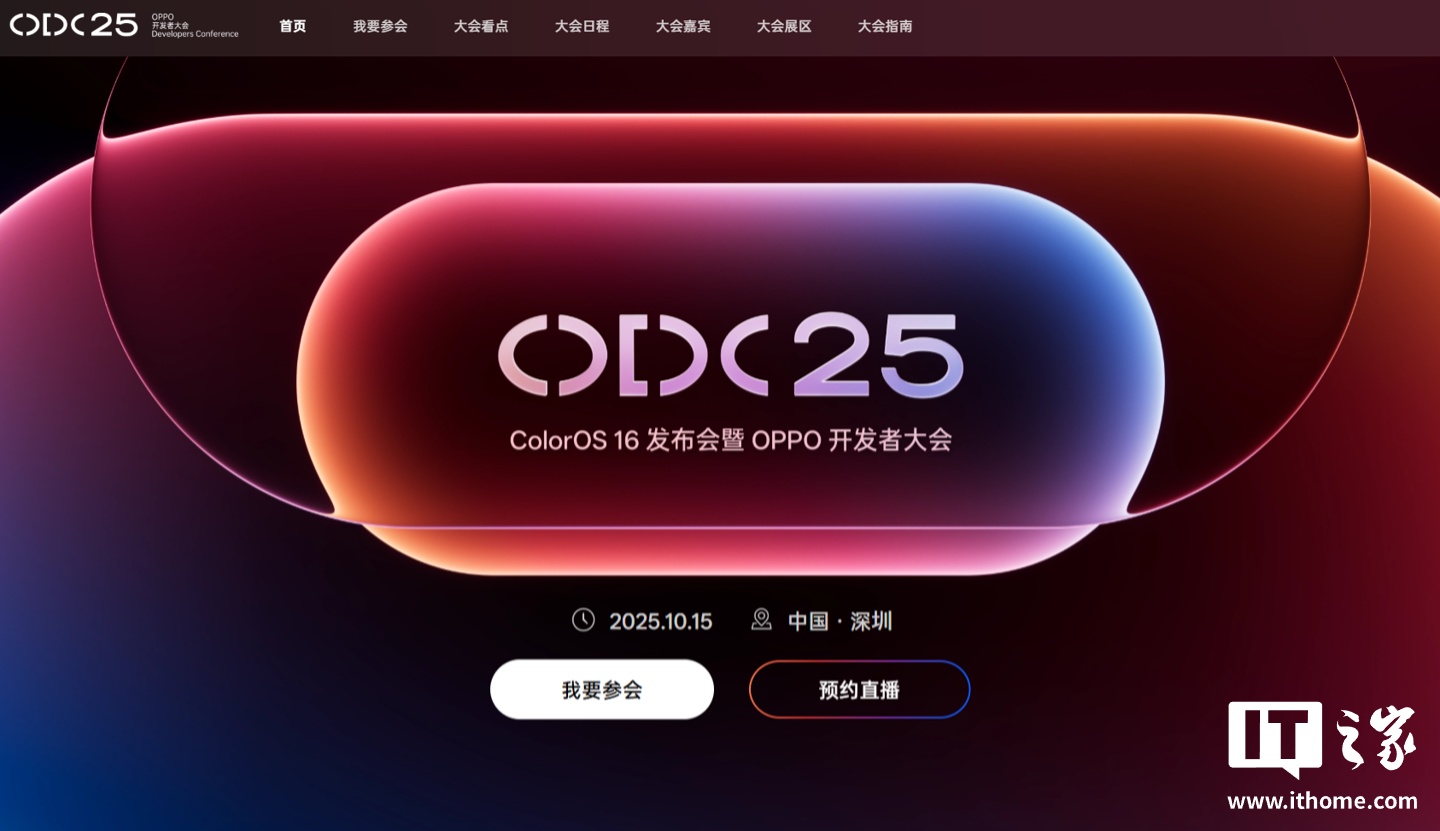
ColorOS 16 发布会暨 OPPO 开发者大会定档 10 月 15 日,官网展示液态玻璃设计元素
Xin Lang Cai Jing· 2025-09-22 05:37
Core Points - OPPO will hold the ColorOS 16 launch event and OPPO Developer Conference on October 15, 2025, in Shenzhen, focusing on OPPO AI's latest strategy and the new ColorOS 16 release [1][7] - The event will feature ten sub-forums and six exhibition areas, showcasing various aspects of AI and technology [1][5] Event Schedule - The main forum is scheduled from 10:00 to 11:30 on October 15, 2025 [4] - The summit and sub-forums will take place from 14:30 to 17:00 on the same day, covering topics such as OPPO AI strategy, AI mobile experience design, and more [5] Venue Information - The event will be held at the Shenzhen International Convention and Exhibition Center, specifically in Hall 20 [7][8] - Public transportation options include Metro Line 12 or 20, with specific exit instructions provided for attendees [8]