中国稀土

Search documents
稀有金属ETF基金(561800)获资金持续流入,锂市供给端扰动持续,小金属长期景气可期
Xin Lang Cai Jing· 2026-02-05 02:41
Group 1 - The rare metal ETF (561800) has seen a recent decline, with the China Rare Metals Theme Index (930632) dropping by 4.20% as of February 5, 2026, while the ETF has experienced a 13.04% increase over the past month [1] - The top ten weighted stocks in the China Rare Metals Theme Index account for 59.71% of the index, with companies like Luoyang Molybdenum, Northern Rare Earth, and Ganfeng Lithium among the leaders [1] - The rare metal ETF has recorded a net inflow of 111.43 million yuan as of February 4, 2026, with a total of 16.18 million yuan attracted over the last ten trading days [1] Group 2 - Lithium concentrate prices have reached multi-year highs, with Pilbara Minerals reporting an average price of $1,161 per ton for Q4 2025, reflecting a 56% quarter-over-quarter increase and a 66% year-over-year increase [2] - The demand for lithium is improving due to a recovery in market conditions, reduced expectations for idle capacity, and increased purchasing willingness from downstream customers [2] - The CS Rare Metal Index tracked by the rare metal ETF primarily allocates to lithium carbonate, minor metals, and rare earths, with lithium carbonate comprising 30%-40% of the index, making it a key investment tool for market participants [2]
稀土的钱,可赚可不赚
投中网· 2026-02-05 02:33
将投中网设为"星标⭐",第一时间收获最新推送 以下文章来源于松果财经 ,作者青元 松果财经 . 专注于产业经济报道,深度解析企业、产品、策略商业、经济价值。 估值不从利润来。 作者丨 青元 来源丨 松果财经 2月3日,稀土概念大涨。消息面上,媒体报道美国计划启动关键矿产储备项目"金库计划",用120亿美元支持关键矿产保障,稀土占重要位置,战略金 属的长期溢价逻辑再次被强化。 不过,之前几大稀土龙头——北方稀土、中国稀土、中稀有色、盛和资源的业绩预告显示,归母净利润均明显上涨,但都没达到市场的一致预期。 截至目前,几大龙头中北方稀土市值超过1800亿元,前几天巅峰曾超过2000亿元。从估值来看,稀土的钱,实在是可赚可不赚。 稀土经济学 稀土的第一层误解叫"稀"。它在地壳里并不罕见,难点落在浓度与分离。 你可以把它想象成蛋糕里的巧克力碎。巧克力不少,但要剔除出来难上加难,还要按颜色、大小、口感干净地分类。稀土元素化学性质相似,矿床常常 共生复杂,原矿品位又低,先选矿得到精矿,再化学处理、溶剂萃取、离子交换把不同元素逐一分离提纯,最后还原成金属单质。 对于习惯了轻资产高收益赚钱模式的国家,从筹资到规模化产出显著收益 ...

中国稀土跌2.13%,成交额1.68亿元,主力资金净流出2062.33万元
Xin Lang Cai Jing· 2026-02-05 01:44
Core Viewpoint - China Rare Earth's stock price has experienced fluctuations, with a year-to-date increase of 12.86% but a recent decline of 10.58% over the past five trading days, indicating volatility in the market [2]. Group 1: Stock Performance - As of February 5, China Rare Earth's stock price was reported at 52.41 yuan per share, with a trading volume of 1.68 billion yuan and a market capitalization of 556.19 billion yuan [1]. - The stock has seen a 10.58% decline over the last five trading days, while it has increased by 4.69% over the past 20 days and 9.69% over the last 60 days [2]. Group 2: Financial Performance - For the period from January to September 2025, China Rare Earth achieved a revenue of 2.494 billion yuan, representing a year-on-year growth of 27.73%, and a net profit attributable to shareholders of 192 million yuan, which is a significant increase of 194.67% year-on-year [2]. - The company has distributed a total of 346 million yuan in dividends since its A-share listing, with 124 million yuan distributed over the last three years [3]. Group 3: Shareholder Information - As of January 20, 2025, the number of shareholders for China Rare Earth was 195,700, a decrease of 11.12% from the previous period, while the average number of circulating shares per shareholder increased by 12.51% to 5,423 shares [2]. - Among the top ten circulating shareholders, Hong Kong Central Clearing Limited holds 29.0694 million shares, an increase of 9.4669 million shares from the previous period, while the Southern CSI 500 ETF and the Jiashi CSI Rare Earth Industry ETF are new entrants among the top shareholders [3].

没人能挑战中国稀土大国地位!日媒:海底稀土开采成本是中国数倍
Sou Hu Cai Jing· 2026-02-04 07:05
Core Viewpoint - The article discusses Japan's recent efforts to extract rare earth elements from the seabed, highlighting the challenges and costs associated with this endeavor, particularly in the context of Japan's reliance on China for these resources [3][7][11]. Group 1: Rare Earth Elements Extraction - Japan's ocean research agency successfully extracted several tons of rare earth-containing mud from the seabed at a depth of approximately 5,600 meters [3]. - The extraction process faced significant challenges, including adverse weather conditions that temporarily halted operations [3]. - The extracted rare earth mud may not meet the minimum standards required for refining, leading to concerns about its economic viability [3]. Group 2: Economic Implications - The cost of extracting rare earth mud from the South Bird Island area is reported to be several times, even tens of times, higher than the price of processed rare earth products from China [3]. - Japan's historical dependence on China for over 70% of its rare earth needs has been jeopardized due to deteriorating Sino-Japanese relations [7]. - The potential for China to impose strict export controls on rare earth elements could have devastating impacts on Japan's industrial sector, potentially leading to a halt in industrial activities within six months [7]. Group 3: Strategic Considerations - Japan's lack of large-scale land-based rare earth mining capabilities has led it to explore deep-sea extraction, but the high costs and lack of core refining technology hinder its competitive position [5]. - The article suggests that Japan may soon need to engage in negotiations with China regarding rare earth purchases, as the geopolitical landscape shifts [9]. - China's strategic control over rare earth elements positions it favorably in international relations, allowing it to leverage these resources for economic and political gain [11].
中国稀土跌2.00%,成交额12.02亿元,主力资金净流出7071.25万元
Xin Lang Cai Jing· 2026-02-04 05:21
Core Viewpoint - The stock price of China Rare Earth has experienced fluctuations, with a recent decline of 2.00% and a year-to-date increase of 13.87% [1][2]. Group 1: Stock Performance - As of February 4, the stock price is reported at 52.88 yuan per share, with a trading volume of 1.202 billion yuan and a turnover rate of 2.10% [1]. - Over the past five trading days, the stock has decreased by 6.49%, while it has increased by 2.82% over the last 20 days and 8.43% over the last 60 days [2]. Group 2: Company Overview - China Rare Earth Group Resources Technology Co., Ltd. was established on June 17, 1998, and listed on September 11, 1998. Its main business includes rare earth smelting and separation, as well as technology research and development [2]. - The revenue composition of the company is as follows: rare earth oxides account for 63.51%, rare earth metals and alloys for 35.95%, with other services contributing 0.35% and technical service income at 0.18% [2]. Group 3: Financial Performance - For the period from January to September 2025, the company achieved a revenue of 2.494 billion yuan, representing a year-on-year growth of 27.73%. The net profit attributable to shareholders was 192 million yuan, showing a significant increase of 194.67% year-on-year [2]. - The company has distributed a total of 346 million yuan in dividends since its A-share listing, with 124 million yuan distributed in the last three years [3]. Group 4: Shareholder Information - As of January 20, the number of shareholders is reported at 195,700, a decrease of 11.12% from the previous period, with an average of 5,423 circulating shares per shareholder, an increase of 12.51% [2]. - Among the top ten circulating shareholders, Hong Kong Central Clearing Limited holds 29.0694 million shares, an increase of 9.4669 million shares from the previous period [3].
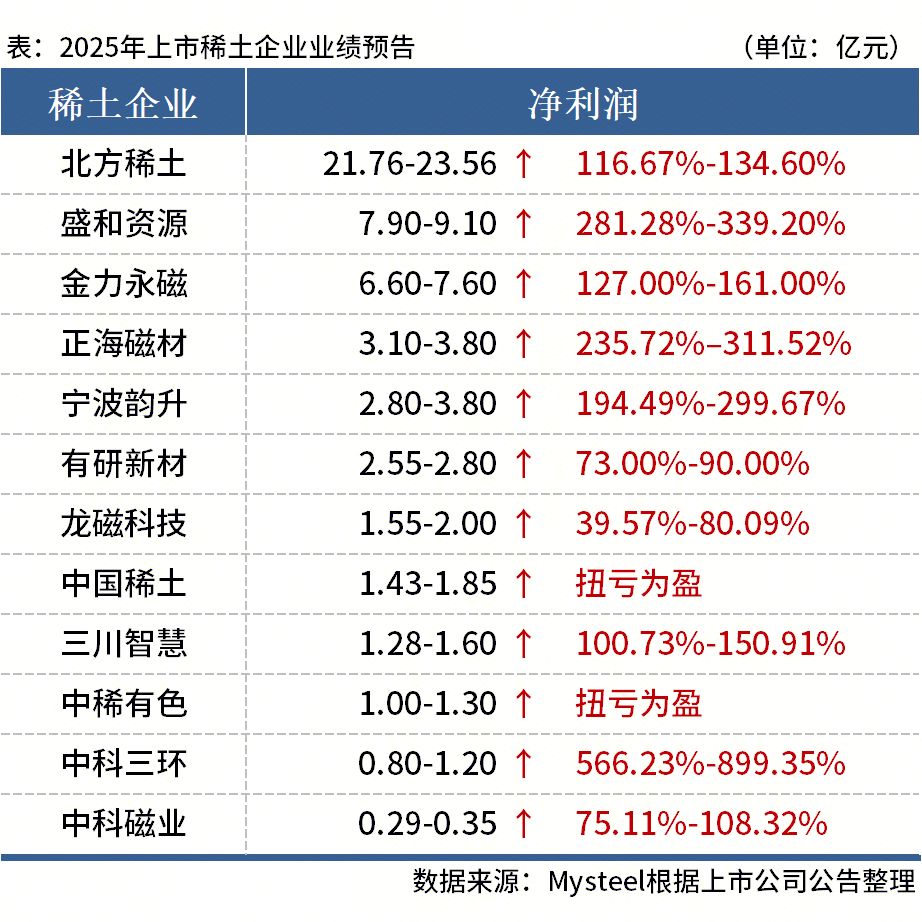
12家上市稀土企业2025年业绩全部预喜
Xin Lang Cai Jing· 2026-02-04 05:21
Core Insights - All 12 listed rare earth companies have reported positive earnings forecasts for 2025, indicating a strong performance outlook for the sector [1][2][3] Group 1: Earnings Forecasts - Northern Rare Earth is expected to achieve a net profit of 2.176-2.356 billion, reflecting an increase of 116.67%-134.60% year-on-year [4][5] - Shenghe Resources anticipates a net profit of 0.790-0.910 billion, with a year-on-year growth of 281.28%-339.20% [4][5] - Jien Mining is projected to report a net profit of 0.660-0.760 billion, representing a growth of 127.00%-161.00% [4][5] - Zhenghai Magnetic Materials expects a net profit of 0.310-0.380 billion, with an increase of 235.72%-311.52% [4][5] - Ningbo Yunsheng forecasts a net profit of 0.280-0.380 billion, indicating a growth of 194.49%-299.67% [4][5] - Yuyuan New Materials anticipates a net profit of 0.255-0.280 billion, with a year-on-year increase of 73.00%-90.00% [4][5] - Longi Magnet Technology expects a net profit of 0.155-0.200 billion, reflecting a growth of 39.57%-80.09% [4][5] - China Rare Earth is projected to turn a profit with a net profit of 0.143-0.185 billion [4][5] - Sanchuan Wisdom anticipates a net profit of 0.128-0.160 billion, with a year-on-year growth of 100.73%-150.91% [4][5] - Zhongxi Rare Metals expects to turn a profit with a net profit of 0.100-0.130 billion [4][5] - China Science and Technology is projected to achieve a net profit of 0.080-0.120 billion, with a significant increase of 566.23%-899.35% [4][5] - China Science Magnetics anticipates a net profit of 0.029-0.035 billion, reflecting a growth of 75.11%-108.32% [4][5]




稀有金属ETF基金(561800)跟踪标的含锂量同类最高!锂供给侧持续偏紧,碳酸锂进一步调整空间有限
Xin Lang Cai Jing· 2026-02-04 05:14
场内ETF方面,截至2026年2月4日午间收盘,中证稀有金属主题指数(930632)下跌0.62%。成分股方面 涨跌互现,东方钽业领涨3.86%,金钼股份上涨2.45%,川能动力上涨2.06%;中稀有色领跌,西部材 料、云路股份跟跌。稀有金属ETF基金(561800)换手5.33%,半日成交1230万元。 数据显示,截至2026年1月30日,中证稀有金属主题指数(930632)前十大权重股分别为洛阳钼业、北方 稀土、华友钴业、盐湖股份、赣锋锂业、厦门钨业、中矿资源、天齐锂业、中钨高新、中国稀土,前十 大权重股合计占比59.71%。 华西证券指出,全球头部锂矿企业2025年四季度锂精矿销量同比大幅增长,其中Mt Marion锂精矿销量 同比增长63%,Wodgina同比增长29%,叠加平均售价环比上涨29%–31%,反映海外优质锂资源端在价 格企稳背景下正加速释放量价弹性;与此同时,Kathleen Valley矿山完成露天开采转型100%地下开采, 地下矿石品位达1.4% Li₂O,产能爬坡顺利,为中长期低成本稳定供应奠定基础。 稀有金属ETF基金(561800)跟踪的CS稀金属指数,该指数主要配置碳酸锂+小 ...
再call稀土击球区
2026-02-04 02:27
Summary of Conference Call on Rare Earth Sector Industry Overview - The discussion primarily focuses on the rare earth sector, highlighting significant changes in the market dynamics and price trends [1][2]. Key Points and Arguments 1. **Market Conditions**: The rare earth market is experiencing notable fluctuations, with precious metals like gold benefiting from delayed expectations of monetary easing by the Federal Reserve. This has led to a significant retreat of speculative funds from the futures market, impacting metals like copper and tin, while rare earths have shown relatively better performance [1][2]. 2. **Leverage Reduction**: The overall logic of reducing leverage in the non-ferrous sector is expected to be less pronounced. The volatility in the market suggests that the systemic leverage is relatively low, and recent reductions in leverage have created more room for price adjustments [2]. 3. **Price Expectations**: There are three key logical points regarding the rare earth sector: - Prices are expected to reach new highs, with fundamentals likely to exceed market expectations. - Negative sentiment is not anticipated to worsen, as the major bearish factors have already passed. - The sector is at a critical point where specific companies, such as China Rare Earth and Zhongxi Rare Earth, are expected to resolve intra-industry competition issues [2][3]. 4. **Supply and Demand Dynamics**: - Supply-side reforms are crucial, with policies implemented in the previous year regulating the total amount of rare earth mining and smelting. This has led to a structural reform in the supply side of the industry [3][4]. - The integration of state-owned enterprises has streamlined control over domestic rare earth resources, reducing the number of companies involved in mining and smelting [4][5]. - The demand side shows a mixed picture, with export volumes hitting historical highs in the latter half of 2025, despite an overall annual decline in demand. This indicates strong overseas replenishment needs [6][7]. 5. **Strategic Stockpiling**: The trend of strategic stockpiling in response to supply chain risks is expected to continue, particularly in the context of geopolitical tensions. This will likely sustain demand for rare earths, especially in sectors like electric vehicles and industrial robotics [7][8]. 6. **Valuation Insights**: - Current valuations in the rare earth sector are considered undervalued compared to historical levels. For instance, the valuation of Northern Rare Earth is significantly lower than its historical average, suggesting potential for upward correction [8][9]. - The ongoing "valuation kill" phase has persisted since late 2025, but the expectation is that this trend may stabilize, allowing for potential recovery in valuations [9][10]. 7. **Future Outlook**: The year 2026 is seen as pivotal for resolving intra-industry competition, with significant expectations for asset injections into companies like China Rare Earth. This could create substantial arbitrage opportunities due to the disparity between internal and external profit margins [10][11]. 8. **Investment Recommendations**: The overall sentiment is bullish on the rare earth sector, with expectations of a 50% to 100% upside potential for key players like Northern Rare Earth, Zhongxi Rare Earth, and China Rare Earth, especially following recent price corrections [12][13]. Additional Important Content - The integration of various rare earth companies and the regulatory environment surrounding mining and smelting are critical factors influencing future supply and demand dynamics [4][5]. - The anticipated changes in management and operational strategies within companies like Zhongxi Rare Earth may enhance their market position and operational efficiency [12][13]. This summary encapsulates the key insights and projections discussed during the conference call regarding the rare earth sector, emphasizing the interplay between supply, demand, and market sentiment.
涉格陵兰岛稀土开采,这家A股公司被澳洲企业“单方面毁约”
Jing Ji Guan Cha Wang· 2026-02-03 11:08
Core Viewpoint - Shenghe Resources (600392.SH) is facing a unilateral termination of its strategic partnership with Energy Transition Minerals Ltd (ETM), which is planning to restart its rare earth project in Greenland [1][2]. Group 1: Investment and Shareholding - In 2016, Shenghe Resources and its subsidiary Leshan Shenghe signed an agreement with Greenland Minerals Energy Ltd (the predecessor of ETM) to participate in a capital increase, acquiring 12.5% of the company and a non-executive director seat [1]. - As of now, Shenghe Resources holds approximately 129 million shares of ETM, representing about 6.5% of the company [1]. Group 2: Legal and Strategic Response - ETM has announced the termination of the strategic relationship and claims that Shenghe's "increased shareholding rights" have expired, which Shenghe disputes and plans to protect its legal rights through communication and legal measures [2]. Group 3: Business Operations and Market Context - Shenghe Resources operates in the rare earth and zircon-titanium sectors, with a complete industrial chain from mining to deep processing, and has established a dual layout in both domestic and international markets [2]. - The application of rare earths is expanding in various fields such as new energy, new materials, aerospace, and electronics, with specific uses in permanent magnets, catalysts, and precision ceramics [2]. Group 4: Financial Performance - In the first three quarters of 2025, Shenghe Resources achieved a revenue of 10.456 billion yuan, a year-on-year increase of 26.87%, and a net profit attributable to shareholders of 788 million yuan, a significant increase of 748.07% [3]. - Shenghe completed the acquisition of 100% of Peak Rare Earths in September 2025, with the core asset being the Ngualla rare earth project in Tanzania, expected to produce 18,000 tons of rare earth concentrate annually starting in 2026 [3]. Group 5: ETM Company Overview - ETM is an Australian mining exploration and development company, primarily engaged in the exploration and development of rare earth elements, lithium, and other strategic metals, with its flagship project located in Greenland [3]. - The Kvanefjeld project has faced delays due to new legislation in Greenland, leading ETM to seek international arbitration for its project rights [3]. Group 6: Recent Developments - In early 2026, ETM announced plans to restart the Kvanefjeld project, having raised 24.7 million AUD through a private placement to fund exploration activities and infrastructure development [4].
美国日本为稀土疯狂!日本称开采出含稀土泥浆,中方回应 A股稀土板块雄起
Jin Rong Jie· 2026-02-03 10:47
Core Insights - The U.S. and Japan are actively seeking to reduce their dependence on rare earth elements, with Japan conducting successful trials for rare earth mud extraction in the Pacific Ocean [1] - Japan currently relies on China for over 70% of its rare earth imports, prompting increased focus on domestic development following China's export restrictions [1] - The U.S. plans to initiate a critical mineral reserve program with an initial funding of $12 billion to decrease reliance on China for rare earth resources [1] - China maintains a dominant position in rare earth resources, extraction technology, and downstream applications, making it challenging for other countries to rebuild their rare earth supply chains [1] Industry Performance - The A-share rare earth sector showed strong performance, with the sector rising by 3.80%, led by companies like Longhua Technology, which increased by 11.46% [3] - Analysts highlight a supply-demand resonance in the rare earth market, with increasing supply concentration and growing demand from sectors like new energy and high-end manufacturing [3] - The strategic value of rare earth resources is becoming more pronounced globally, with many countries emphasizing the importance of critical mineral reserves [3] Company Highlights - Shenghe Resources is a significant player in the domestic rare earth industry, involved in mining, refining, and recycling, with projected earnings growth exceeding 339% by 2025 [5] - Northern Rare Earth is one of the largest rare earth production and processing bases in China, benefiting from resource advantages and stable product supply [5] - Jieneng Permanent Magnet is a high-tech enterprise specializing in rare earth permanent magnet materials, positioned to benefit from the growing demand in sectors like electric vehicles and wind power [5]