
平安银行

Search documents
半年新增15万高净值客户 私人银行成中收增长动力
2 1 Shi Ji Jing Ji Bao Dao· 2025-09-03 11:10
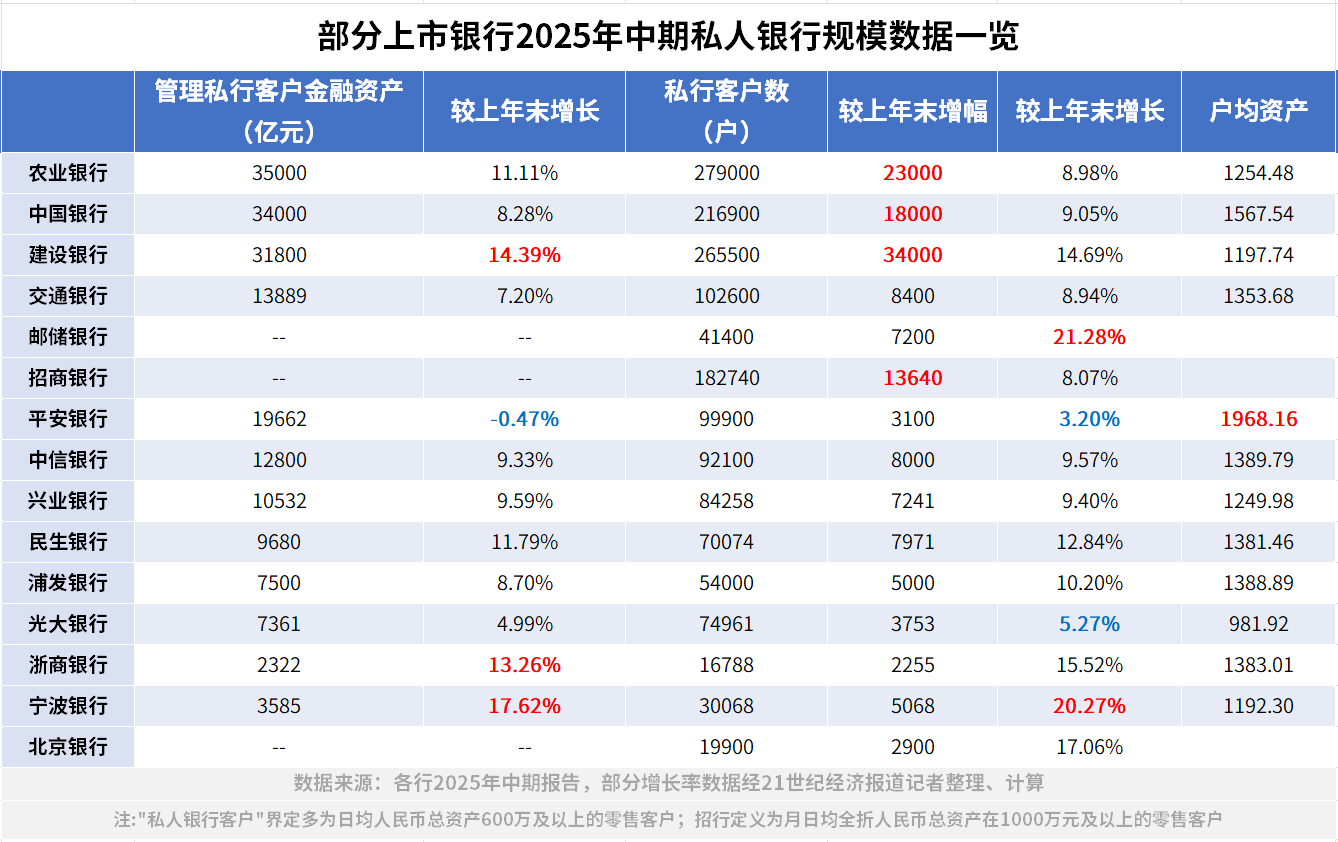
Core Insights - The private banking sector has shown robust growth in the first half of 2025, with many banks reporting double-digit increases in both client numbers and assets under management (AUM) despite a complex economic environment [1][2][5] - The total number of private banking clients across 15 banks exceeded 1.63 million, with an increase of nearly 150,000 clients, reflecting a growth rate of over 10% [1] - Major banks like Agricultural Bank and China Bank have maintained significant AUM, with Agricultural Bank reaching 3.5 trillion yuan, marking an 11.11% increase year-on-year [2][4] Private Banking Growth - The private banking industry is experiencing steady expansion, with major banks leading the market due to their strong client bases and resource networks [2][5] - Agricultural Bank's AUM reached 3.5 trillion yuan, with a client increase of 23,000 to 279,000, while China Bank followed closely with 3.4 trillion yuan AUM and 216,900 clients [2][4] - Construction Bank reported a 14.39% increase in AUM, reaching 3.18 trillion yuan, and a 14.69% rise in client numbers [2][4] Client Quality and Asset Management - Despite the growth in client numbers and AUM, average assets per client have generally declined, indicating a shift from rapid expansion to a focus on deeper client engagement [5][6] - Only Agricultural Bank and Industrial Bank reported increases in average client assets, while other banks experienced varying degrees of decline [5] Strategic Focus Areas - Banks are increasingly focusing on high-net-worth clients, family trusts, retirement finance, and enhancing private banking centers to differentiate themselves in a competitive market [1][6][8] - For instance, Citic Bank is enhancing its services for ultra-high-net-worth clients, while Everbright Bank is targeting family-oriented and female clients [7][8] Family Trusts and Lifecycle Services - Family trusts have become a key area for private banking, with significant growth reported in this segment; Everbright Bank's family trust assets grew by 56.12% year-on-year [8] - Agricultural Bank has launched a retirement finance management center, adding 12,000 clients and managing 1.3 trillion yuan in assets [8] Private Banking Centers and Revenue Generation - The establishment of private banking centers has accelerated, with Construction Bank setting up 248 centers and China Bank 205 centers, contributing to improved client retention and AUM [9][10] - Private banking is increasingly driving middle-income revenue, with Beijing Bank reporting a 16.89% increase in product sales, boosting its middle-income revenue by 17.77% [10]




半年新增15万高净值客户,私人银行成中收增长动力
2 1 Shi Ji Jing Ji Bao Dao· 2025-09-03 11:01
Core Insights - The private banking sector has shown robust growth in the first half of 2025, with many banks reporting double-digit increases in both client numbers and assets under management (AUM) despite a complex economic environment [1][2][5] - The total number of private banking clients across 15 banks exceeded 1.63 million, with an increase of nearly 150,000 clients, reflecting a growth rate of over 10% [1] - Major banks like Agricultural Bank and China Bank have AUM exceeding 3 trillion yuan, while Industrial Bank has crossed the 1 trillion yuan mark for the first time [1][4] Client and AUM Growth - Agricultural Bank's AUM reached 3.5 trillion yuan, growing by 11.11%, with client numbers increasing by 23,000 to 279,000 [2][4] - China Bank's AUM stood at 3.4 trillion yuan with 216,900 clients, while Construction Bank reported a 14.39% increase in AUM, reaching 3.18 trillion yuan and 265,500 clients [2][4] - The overall expansion of private banking clients and AUM indicates a strong performance among large banks, which continue to dominate the market [2][5] Performance of Listed Banks - Among listed banks, the performance varied, with some banks like Ping An Bank experiencing a slight decline in AUM by 0.47% [4] - Industrial Bank reported a significant increase in private banking clients, reaching 92,100, with AUM at 1.28 trillion yuan [5] - Regional banks like Ningbo Bank and Beijing Bank also showed impressive growth, with Ningbo Bank's AUM increasing by 17.62% [5][4] Focus on High-Net-Worth Clients - The industry is shifting from rapid expansion to a more refined approach, focusing on high-net-worth clients and family trusts [1][8] - Banks are implementing differentiated services for ultra-high-net-worth clients, with some banks reporting a 40.96% increase in such clients [8][9] - Family trusts have become a key area of development, with banks like Everbright Bank and China Bank reporting significant growth in this segment [9] Wealth Management and Revenue Growth - Private banking is increasingly contributing to banks' middle-income revenue, with Beijing Bank reporting a 16.89% increase in product sales, boosting its middle-income revenue by 17.77% [10] - Construction Bank noted that over 60% of its fee income comes from wealth management and related services, indicating a strategic focus on enhancing its advisory capabilities [11] - The establishment of private banking centers is accelerating, with banks like Construction Bank and China Bank expanding their networks to improve client retention and service quality [10]

深圳金融的服务样本:平安银行以“三专机制”助力特区科技集群再腾飞
券商中国· 2025-09-03 09:10
Core Viewpoint - Shenzhen Special Economic Zone has achieved remarkable growth over 45 years, with significant contributions from both technology and finance sectors, exemplified by the development of Ping An Bank and its support for local tech enterprises [1][2]. Group 1: Shenzhen Economic Development - Shenzhen has 4.508 million business entities, including 25,000 national high-tech enterprises, averaging 12 per square kilometer [1]. - The city's R&D investment is projected to account for 6.46% of GDP in 2024, with PCT international patent applications leading the nation for 21 consecutive years [1]. Group 2: Ping An Bank's Role - Ping An Bank's value added in the financial sector grew from 0.16 billion yuan at the establishment of the special zone to 471.1 billion yuan in 2024 [1]. - The bank has provided significant financial support to technology enterprises, including a 20 million yuan credit loan to XWD for expansion, which later successfully listed on the Sci-Tech Innovation Board [2]. Group 3: Financial Services for Technology Enterprises - Ping An Bank's financial services for XWD represent a broader strategy of "relay financing" to support the entire lifecycle of tech enterprises [3]. - The bank has provided 600 billion yuan in credit support to a specific new energy vehicle company, facilitating financing for approximately 700 downstream dealers [3]. Group 4: Organizational and Product Innovation - Ping An Bank has established a Technology Finance Center to address the needs of tech enterprises at various stages, creating a comprehensive financial service system [4]. - The bank has developed innovative products like "Tengfei Loan" and "Listing Loan" to cater to the high-growth characteristics of tech companies [5]. Group 5: Financial Performance Indicators - As of June, Ping An Bank's corporate deposit balance reached 2.37 trillion yuan, with corporate loan balance at 1.68 trillion yuan [6]. - The bank issued 239.77 billion yuan in new loans to foundational industries and 123.82 billion yuan to emerging industries in the first half of the year [6].


消费贷财政贴息正式实施:利率下探,银行分化或加剧
第一财经· 2025-09-03 09:08
Core Viewpoint - The implementation of the personal consumption loan interest subsidy policy is expected to stimulate growth in personal consumption credit, leading to further differentiation among banks in the industry, with asset quality remaining a key focus [2][10]. Group 1: Policy Implementation and Consumer Impact - The personal consumption loan interest subsidy policy officially took effect on September 1, allowing consumers to receive interest subsidies directly through the banking system, with a maximum subsidy of 3,000 yuan per loan [2]. - Many banks have optimized their processes for applying for subsidies, enabling customers to easily apply through mobile banking apps or in-person at branches [4][8]. - For example, after applying the subsidy, a consumer's loan interest rate can drop significantly, as demonstrated by a case where a loan of 50,000 yuan at a 3.1% interest rate was reduced to 2.1% after a 1% subsidy [4]. Group 2: Market Trends and Bank Performance - The personal consumption loan market has shown steady growth, with the total balance of personal consumption loans across 36 listed banks exceeding 5.49 trillion yuan, a year-on-year increase of 10.24% [10]. - State-owned banks have continued to expand their market share, with notable growth in personal consumption loans: China Construction Bank's balance reached 614.19 billion yuan, up 28.32% year-on-year, while Agricultural Bank of China reported a 23% increase [11]. - In contrast, many joint-stock banks have seen a decline in their consumption loan balances, with some experiencing significant drops, such as Ping An Bank and CITIC Bank, which reported decreases of 6.2% and 7.3%, respectively [12]. Group 3: Risk and Asset Quality Concerns - Despite the growth in consumption loans, there are rising concerns about asset quality, particularly among regional banks that have seen rapid growth but also increasing non-performing loans [10][15]. - For instance, while Chongqing Bank's non-performing loan ratio decreased, its non-performing loan balance increased, indicating potential risks associated with aggressive lending [15]. - The average non-performing loan ratio for major banks has also risen, with Industrial and Commercial Bank of China reporting a ratio of 2.51%, up 0.86 percentage points year-on-year [15].

股份制银行板块9月3日跌1.09%,平安银行领跌,主力资金净流出2.73亿元
Zheng Xing Xing Ye Ri Bao· 2025-09-03 08:45
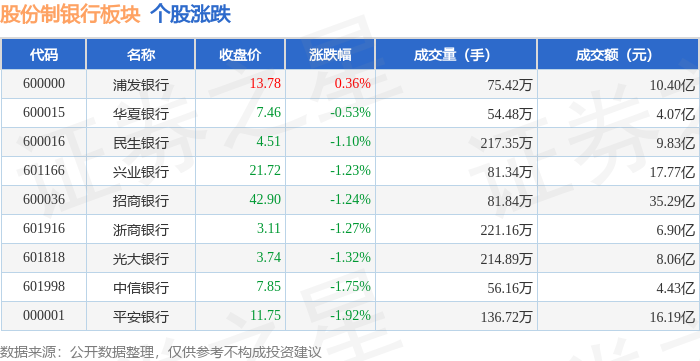
Market Overview - On September 3, the shareholding banks sector declined by 1.09%, with Ping An Bank leading the drop [1] - The Shanghai Composite Index closed at 3813.56, down 1.16%, while the Shenzhen Component Index closed at 12472.0, down 0.65% [1] Individual Bank Performance - The closing prices and changes for key banks are as follows: - Shanghai Pudong Development Bank: 13.78, up 0.36% - Huaxia Bank: 7.46, down 0.53% - Minsheng Bank: 4.51, down 1.10% - Industrial Bank: 21.72, down 1.23% - China Merchants Bank: 42.90, down 1.24% - Zhejiang Commercial Bank: 3.11, down 1.27% - Everbright Bank: 3.74, down 1.32% - CITIC Bank: 7.85, down 1.75% - Ping An Bank: 41.75, down 1.92% [1] Capital Flow Analysis - The shareholding banks sector experienced a net outflow of 273 million yuan from institutional investors and 224 million yuan from speculative funds, while retail investors saw a net inflow of 497 million yuan [1] - Detailed capital flow for individual banks shows: - Shanghai Pudong Development Bank: 157 million yuan net inflow from institutions, 47 million yuan net outflow from speculative funds, and 11 million yuan net outflow from retail investors - Minsheng Bank: 68 million yuan net inflow from institutions, 51 million yuan net outflow from speculative funds, and 17 million yuan net outflow from retail investors - Huaxia Bank: 25 million yuan net inflow from institutions, 9 million yuan net outflow from speculative funds, and 16 million yuan net outflow from retail investors - Other banks like CITIC Bank and Ping An Bank also showed significant net outflows from institutional and speculative funds [2]
A股上市银行上半年人均薪酬揭晓,五家银行月薪超4.5万元
Guan Cha Zhe Wang· 2025-09-03 07:48
【文/羽扇观金工作室】 具体而言,招商银行以人均月薪5.05万元位居榜首,南京银行紧随其后,为4.82万元。宁波银行、兴业 银行和北京银行人均月薪也均超过4.5万元,分别为4.54万元、4.54万元和4.52万元。此外,中信银行、 浙商银行、江苏银行、上海银行、成都银行和平安银行上半年人均月薪也均在4万元以上。 国有六大行方面,中国银行以2.82万元的人均月薪位列第一,交通银行为2.75万元,工商银行和建设银 行分别为2.63万元和2.62万元,农业银行和邮储银行则分别为2.52万元和2.49万元。 值得关注的是,农业银行和工商银行等大型国有银行在年报中明确提出,将优化薪酬结构并向基层员工 倾斜。农业银行强调加强对县域基层员工的薪酬激励,工商银行也表示将"加强薪酬资源向基层员工倾 斜",以增强一线网点的经营活力与服务韧性。 本文系观察者网独家稿件,未经授权,不得转载。 随着A股上市银行2025年半年报全部披露完毕,42家银行、约260万员工的薪酬水平也随之浮出水面。 整体来看,今年上半年银行业的薪酬总额同比略有上升,人均半年薪酬较去年同期增长约1300元,平均 月薪达3.02万元,较上年同期月薪水平上涨约21 ...
信用卡失速消费贷补位,上市银行零售信贷的“跷跷板”能稳吗
Nan Fang Du Shi Bao· 2025-09-03 04:01
Core Viewpoint - The retail credit market is experiencing a significant divergence between traditional credit card business contraction and the expansion of personal loans, driven by consumer demand and policy support [2][11]. Credit Card Business - The total number of credit cards and credit card loans has declined for 11 consecutive quarters, with a reduction of 12 million cards compared to the end of last year [2]. - Among 15 listed banks, 11 reported a decrease in credit card loan balances compared to the end of last year, highlighting a pronounced industry-wide contraction [3]. - The most significant decline in credit card loan balances was observed at Bank of China, with a drop of 13.89%, followed by Postal Savings Bank at 5.67% [4]. - Credit card transaction volumes have also decreased, leading to a decline in non-interest income, with some banks reporting drops exceeding 15% [2][6]. Personal Loans - In contrast to the credit card sector, personal loans, particularly consumer loans, have seen robust growth, with several banks reporting increases exceeding 10% [11]. - Among state-owned banks, personal loans and consumer loans have both shown positive growth, with Agricultural Bank leading at 5.60% [12]. - The consumer loan segment has become a key growth driver for banks, with many institutions launching tailored products to stimulate demand [2][11]. Asset Quality - The asset quality of retail credit is under pressure, with rising non-performing loan (NPL) ratios for personal loans and credit cards across many banks [16]. - State-owned banks generally exhibit higher NPL ratios, with notable increases in personal loan NPLs for several institutions [17]. - Credit card NPL ratios have also risen, particularly at Industrial and Commercial Bank of China, which reported a rate of 3.75% [18][20]. Market Dynamics - The decline in credit card usage reflects a broader shift in consumer spending patterns, with an increase in smaller, more frequent transactions [6][8]. - The overall market for credit cards is facing significant challenges, with many banks reporting double-digit declines in credit card income [9][10].




贵金属“完美风暴”已至?金价迭创新高!有色龙头ETF(159876)近两日吸金7560万元,规模创新高!
Xin Lang Ji Jin· 2025-09-03 01:35
Core Viewpoint - International gold prices have reached new highs, driven by expectations of interest rate cuts by the Federal Reserve, leading to significant inflows into the non-ferrous metals sector, particularly highlighted by the surge in the non-ferrous metal ETF (159876) which attracted 75.6 million yuan in just two days, reaching a new high of 207 million yuan as of September 2 [1][3]. Group 1: Gold Market Dynamics - On September 2, spot gold in London surpassed $3,500 per ounce, marking a new high, with Morgan Stanley projecting a year-end target of $3,800 per ounce [3]. - Multiple institutions predict that after four months of consolidation, precious metals are poised to enter a new upward trend [3]. - The macroeconomic environment is characterized by increased fiscal dominance in the U.S., leading to a trend of abundant dollar liquidity, which is favorable for global risk assets and supports gold as an anti-inflation asset [3]. Group 2: Non-Ferrous Metals Sector Outlook - The non-ferrous metals sector is experiencing a tight supply-demand balance, with high growth prospects due to several factors: 1. Supply-side improvements are expected as "anti-involution" initiatives accelerate the clearance of excess capacity, enhancing profitability for non-ferrous enterprises [3]. 2. Demand from emerging industries such as new energy, infrastructure, artificial intelligence, and robotics is increasing the need for non-ferrous metals [3]. 3. The global economic recovery, coupled with a depreciating dollar, is supporting non-ferrous metal prices [3]. - The industrial metals sector is currently undervalued, indicating potential for upward valuation adjustments, with a bullish market for non-ferrous metals beginning to take shape [4]. Group 3: Investment Strategy - The non-ferrous metal ETF (159876) and its linked funds are designed to track the CSI Non-Ferrous Metals Index, which includes significant weights in copper (25.3%), aluminum (14.2%), rare earths (13.8%), gold (13.6%), and lithium (7.6%), providing a diversified investment approach [5]. - The ETF's performance reflects a strategy to mitigate risks associated with investing in single metal sectors, making it suitable for inclusion in investment portfolios [5].
消费贷“国补”落地!五大行已上线“贴息专区” 中行嵌入现有业务流程
Xin Lang Cai Jing· 2025-09-03 00:31
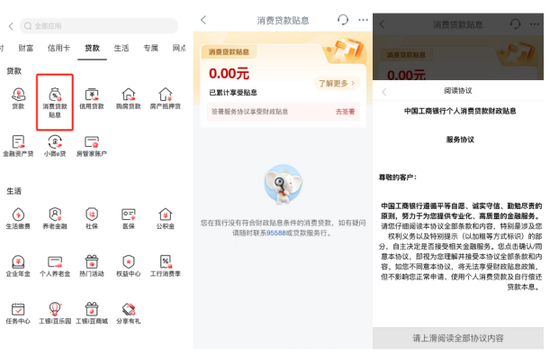
Core Viewpoint - The implementation plan for personal consumption loan interest subsidies has been officially launched, allowing residents to benefit from interest subsidies on personal consumption loans issued by various banks from September 1, 2025, to August 31, 2026, provided the loans are used for consumption and can be verified by the lending institutions [1]. Group 1: Policy Details - The interest subsidy policy applies to personal consumption loans (excluding credit card business) issued by six major state-owned banks, twelve national joint-stock banks, and five other lending institutions [1]. - The subsidy will be directly deducted from the loan interest charged to borrowers, calculated based on the specified subsidy ratio and upper limit [16]. Group 2: Bank Implementation - Major state-owned banks, including Industrial and Commercial Bank of China, Agricultural Bank of China, China Construction Bank, Bank of Communications, and Postal Savings Bank, have launched "subsidy zones" on their mobile banking apps [1][2]. - China Bank has integrated the subsidy agreement signing process into its existing loan application workflow, enhancing customer experience [13]. - Other joint-stock banks, such as Ping An Bank and CITIC Bank, have also introduced specific features for applying for the interest subsidy through their mobile banking platforms [15]. Group 3: User Experience - Borrowers can access the subsidy features through various pathways in their respective banking apps, such as "loan" sections or dedicated subsidy areas [3][6][10][12]. - The signing of the subsidy service agreement does not guarantee eligibility for the subsidy; eligibility will be determined based on the borrower's loan consumption records [8]. Group 4: Compliance and Warnings - Banks have emphasized that the subsidy policy does not cover credit card (including installment) business [16]. - Borrowers must follow the prescribed procedures to apply for the subsidy, and failure to sign the necessary agreements will be considered a waiver of the subsidy [16]. - Banks have warned against fraudulent activities related to obtaining subsidy funds and will take strict actions against any violations [17].


广州市嘉诚国际物流股份有限公司关于签订募集资金专户存储三方监管协议的公告
Shang Hai Zheng Quan Bao· 2025-09-02 20:42
Core Viewpoint - The company has signed a tripartite supervision agreement for the storage of raised funds to ensure proper usage and efficiency of the remaining funds from a completed project, reallocating approximately 239.89 million yuan to a new project [1][2]. Group 1: Fund Management - The company has decided to change the use of the remaining raised funds of 239.88 million yuan from the completed cross-border e-commerce smart logistics center project to the "Free Trade Port Cloud Intelligence International Distribution Center" project [1]. - A tripartite supervision agreement has been signed among the company, its subsidiary, the underwriting institution, and two banks to regulate the management of the raised funds [2][4]. - The agreement stipulates that the underwriting institution will supervise the usage of the raised funds and conduct semi-annual inspections [2][4]. Group 2: Fund Usage and Return - The company has approved the temporary use of idle raised funds amounting to no more than 295 million yuan to supplement working capital for a period not exceeding 12 months [7][8]. - The company has successfully returned all the temporarily used idle funds back to the dedicated storage account, ensuring that the investment plans remain unaffected [8].
