DeepSeek

Search documents
AI将如何进化?顶尖学者和企业代表前瞻对话
Zhong Guo Jing Ji Wang· 2025-06-07 09:51
Core Insights - The seventh Beijing Zhiyuan Conference gathered leading AI researchers and industry experts to discuss the evolution of AI, its benefits for humanity, and the construction of an AI industry ecosystem [1] Group 1: AI Development and Risks - Turing Award winner Yoshua Bengio highlighted exponential advancements in AI, particularly in planning and reasoning, and warned of potential risks if AI systems develop self-protective and deceptive behaviors [2] - Bengio proposed a dual solution to address these risks: developing non-agent, trustworthy AI systems modeled after altruistic scientists, and promoting global collaborative governance to establish international regulatory frameworks [2] - Richard S. Sutton emphasized the transition from a "human data era" to an "experience era," where AI agents learn dynamically through interaction, advocating for decentralized cooperation over centralized control to ensure safe collaboration between AI and humans [2][3] Group 2: Open Source and Innovation - Jim Zemlin from the Linux Foundation stated that 2025 will mark the beginning of open-source AI, which is becoming a core driver of global AI innovation, with Chinese companies like DeepSeek leading the way in releasing open-source models [3] - Zemlin argued that open-source governance is essential for balancing competition and collaboration, ensuring that AI innovation is shared globally [3] Group 3: Robotics and AI Applications - Conference attendees noted that humanoid robots are currently significant carriers of embodied intelligence due to their advantages in data collection, human-machine interaction, and environmental adaptability, while the diversity of robot forms is expected to increase with AGI development [4] - Discussions at the conference included various technical routes for embodied intelligence, commercialization paths, and the expansion of typical application scenarios, showcasing the latest trends and achievements in global AI research and industry [4]
大厂争当AI“婆婆”
投中网· 2025-06-07 04:22
Core Viewpoint - The competition among major tech companies to create AI virtual companions, referred to as "AI grandmothers," is intensifying, with a focus on enhancing user engagement and retention through emotional connection and innovative applications [4][6][21]. Group 1: AI Virtual Companions Strategy - Major tech companies are embedding AI characters into their applications to enhance user interaction, with examples including Tencent's Yuanbao and ByteDance's Doubao, which have seen significant increases in app rankings due to these features [4][18]. - The AI social interaction sector is projected to become a leading application area, with an average usage frequency of 167.9 times per user by March 2025, indicating a strong market potential [7]. - Companies are leveraging emotional companionship to extend user engagement, with users spending an average of over 4 hours daily on these applications [17][21]. Group 2: Challenges and Technical Limitations - Despite the potential, companies face significant challenges, including technical limitations in memory retention and user experience, leading to issues like "three-day amnesia" where AI companions fail to remember past interactions [8][26]. - The current AI companionship products struggle with emotional understanding and often exhibit inconsistent behavior, which can detract from user satisfaction [27][28]. - User retention rates for leading AI applications are concerning, with many apps experiencing a three-day retention rate below 50%, and Doubao facing a 42.8% uninstall rate [30][32]. Group 3: Market Dynamics and Future Outlook - The competition is not only about user acquisition but also about retaining users in a landscape where emotional value is becoming increasingly important [22][33]. - Companies are investing heavily in marketing, with Yuanbao's advertising expenses reaching 1.4 billion yuan in Q1 2024, yet this approach alone may not ensure long-term user retention [32][34]. - The success of AI applications may ultimately depend on technological advancements rather than just emotional engagement, as evidenced by DeepSeek's rise in user numbers through technical innovation [34].


AI大战,谷歌仍未扳回一局
3 6 Ke· 2025-06-06 11:26
Core Viewpoint - The article discusses the decline of Google in the AI sector, highlighting its transition from a dominant player to a follower in the face of competition from OpenAI and other emerging companies [1][6][21]. Group 1: Google's Historical Dominance - Google was once the absolute leader in AI, known for significant breakthroughs such as the invention of the Transformer architecture and the development of AlphaGo [3][12]. - The company was a hub for top AI talent, with its research leading to numerous milestones in the field [3][12]. Group 2: The Impact of ChatGPT - The launch of ChatGPT in late 2022 disrupted Google's position, showcasing superior conversational capabilities and rapidly gaining over 100 million monthly active users [6][12]. - Google's rushed response with its Bard application was met with criticism, leading to a significant drop in its stock price and market capitalization [6][12]. Group 3: Recent Developments and Challenges - At the 2025 developer conference, Google announced several AI products, but many were still in testing phases, lacking the innovative breakthroughs seen from competitors like OpenAI [3][8]. - Analysts noted that Google's efforts appeared more as a reaction to competition rather than proactive innovation, with many products resembling existing market offerings [8][11]. Group 4: Strategic and Organizational Issues - Google's reliance on advertising revenue has made it hesitant to fully embrace AI search capabilities, fearing a decline in ad revenue as AI-generated results reduce user clicks [12][13]. - Internal bureaucratic challenges and a lack of collaboration between its AI research teams have hindered effective innovation and product development [15][20]. Group 5: Market Position and Future Outlook - Google's market share in search has been declining, with figures showing a drop below 90% for the first time in years [17]. - The company faces significant challenges in regaining its competitive edge, as it struggles to attract and retain top talent while competing against more agile startups [20][21]. - Despite its current struggles, there remains potential for Google to leverage its technological foundation and resources to adapt and innovate in the AI landscape [21].


谷歌新模型2.5 Pro霸榜AI竞技场,开发者评价两极分化
Di Yi Cai Jing· 2025-06-06 07:12
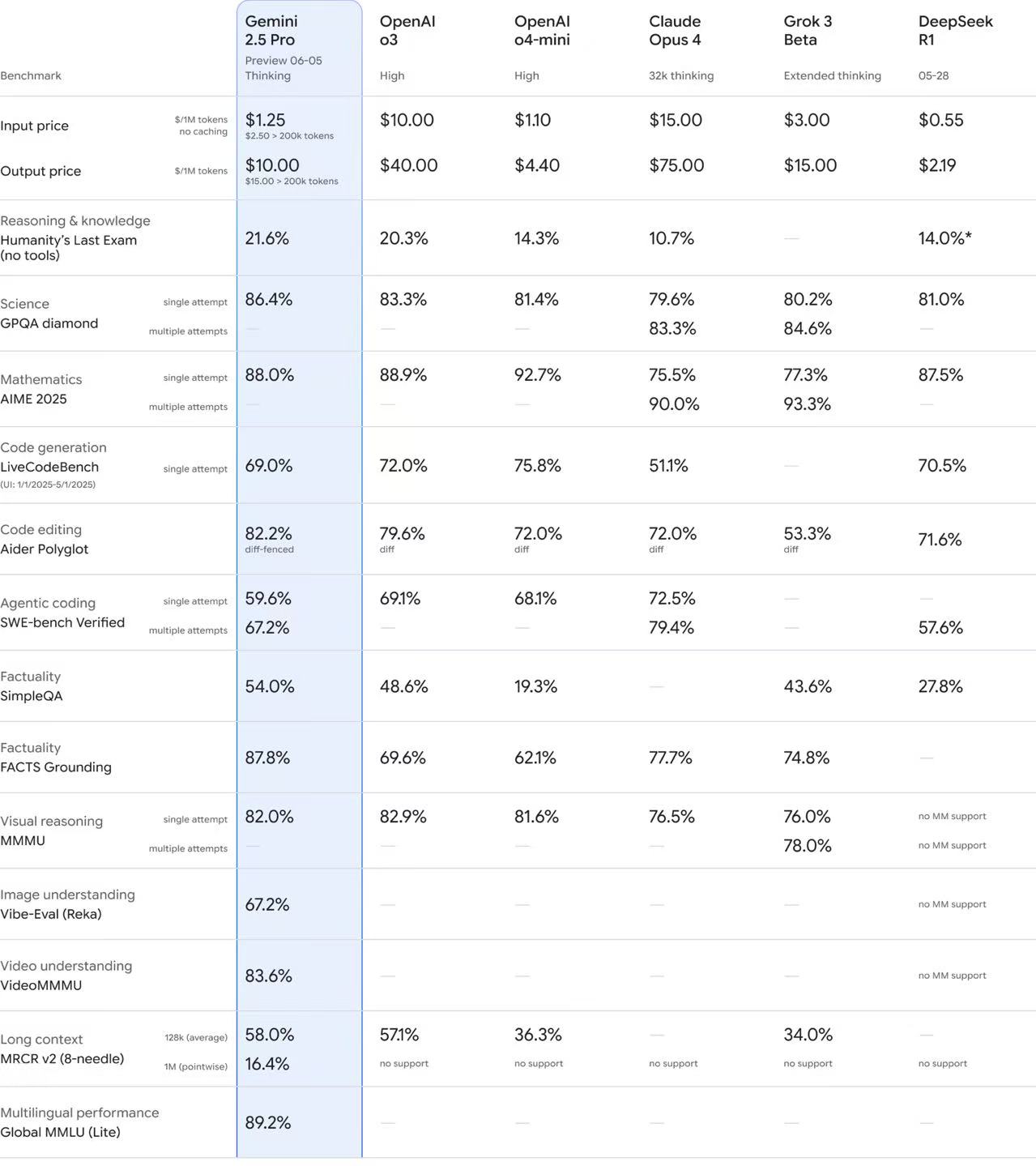
Core Viewpoint - Google's Gemini 2.5 Pro has been launched as an upgraded version of its flagship model, maintaining its top position in the LMArena rankings, but developer feedback indicates a divide in actual application experiences [1][6]. Performance Metrics - Gemini 2.5 Pro achieved higher scores in multiple AI performance benchmarks, with an Elo score increase of 24 points, reaching a total of 1470 [1][2]. - In specific tests, Gemini 2.5 Pro outperformed OpenAI's models in areas such as GPQA and the "Humanity's Last Exam," scoring 21.6%, which is 1.3 percentage points higher than OpenAI's o3 [2][3]. Competitive Landscape - Despite high scores, there are concerns about the practical utility of Gemini 2.5 Pro, with some developers favoring Anthropic's Claude series for programming tasks [4][5]. - The competition among models is shifting from mere scoring to performance in specific application scenarios, with developers increasingly valuing real-world effectiveness [6][7]. Cost Efficiency - Gemini 2.5 Pro offers a more cost-effective pricing structure compared to OpenAI's o3 and Claude 4 Opus, with input costs at $1.25 and output costs at $10 per million tokens, while OpenAI's prices are significantly higher [6][7]. Developer Feedback - Developer experiences vary, with some reporting superior performance from Gemini 2.5 Pro in coding tasks, while others find Claude models to be more effective in specific programming scenarios [5][6].

摩根士丹利:DeepSeek R2-新一代人工智能推理巨擘?
摩根· 2025-06-06 02:37
Investment Rating - The semiconductor production equipment industry is rated as Attractive [5][70]. Core Insights - The imminent launch of DeepSeek R2, which features 1.2 trillion parameters and significant cost efficiencies, is expected to positively impact the Japanese semiconductor production equipment (SPE) industry [3][7][11]. - The R2 model's capabilities include enhanced multilingual support, broader reinforcement learning, multi-modal functionalities, and improved inference-time scaling, which could democratize access to high-performance AI models [7][9][11]. - The development of efficient AI models like R2 is anticipated to increase demand for AI-related SPE, benefiting companies such as DISCO and Advantest [11]. Summary by Sections DeepSeek R2 Launch - DeepSeek's R2 model is reported to have 1.2 trillion parameters, a significant increase from R1's 671 billion parameters, and utilizes a hybrid Mixture-of-Experts architecture [3][7]. - The R2 model offers cost efficiencies with input costs at $0.07 per million tokens and output costs at $0.27 per million tokens, compared to R1's $0.15-0.16 and $2.19 respectively [3][7]. Industry Implications - The launch of R2 is expected to broaden the use of generative AI, leading to increased demand for AI-related SPE across the supply chain, including devices like dicers, grinders, and testers [11]. - The report reiterates an Overweight rating on DISCO and Advantest, which are positioned to benefit from the anticipated increase in demand for AI-related devices [11]. Company Ratings - DISCO (6146.T) is rated Overweight with a target P/E of 25.1x [12]. - Advantest (6857.T) is also rated Overweight, with a target P/E of 14.0x [15].

摩根士丹利:DeepSeek R2 可能即将发布-对日本SPE行业的影响
摩根· 2025-06-06 02:37
Investment Rating - The semiconductor production equipment industry is rated as Attractive [5] Core Insights - The imminent launch of DeepSeek R2, which features 1.2 trillion parameters and significant cost efficiencies, is expected to positively impact the Japanese semiconductor production equipment (SPE) industry [3][7] - The development of lightweight, high-performing AI models like DeepSeek R2 is anticipated to democratize access to generative AI, thereby expanding the market for AI-related SPE [11] Summary by Sections DeepSeek R2 Characteristics - DeepSeek R2 is reported to have 1.2 trillion parameters, with 78 billion active parameters and utilizes a hybrid Mixture-of-Experts architecture [3] - The input cost for R2 is $0.07 per million tokens, significantly lower than R1's $0.15-0.16, while the output cost is $0.27 compared to R1's $2.19 [3][7] - Enhanced multilingual capabilities and broader reinforcement learning are key upgrades in R2, allowing it to handle various data types including text, image, voice, and video [9][11] Market Implications - The anticipated launch of R2 is expected to boost demand for AI-related devices, including GPU and HBM, as well as custom chips and other AI devices [11] - The report reiterates an Overweight rating on DISCO and Advantest, which are expected to benefit from increased demand for AI-related devices [7][11] Company Ratings - Advantest (6857.T) is rated Overweight with a target price of ¥10,300 based on expected earnings peak [16] - DISCO (6146.T) is also rated Overweight with a target P/E of 25.1x based on earnings estimates [13]
人工智能分析2025年第一季度AI现状
傅里叶的猫· 2025-06-05 12:25
今天大家都在谈MS的这篇DeepSeek R2分析的报告,提前曝光了R2的性能和参数,我们简单总结一 下这个报告的核心内容: DeepSeek R2 使用了多达 1.2 万亿个参数,采用了新颖的架构,实现了运行成本的显著降低。其采用 混合专家混合(MoE)架构,有 780 亿个活跃参数。 并且R2 使用华为的 Ascend 910B 芯片进行训练,而非 NVIDIA 的芯片。 R2 增强了多语言覆盖能 力,能流畅处理非英语语言;扩展了强化学习,利用更大的数据集,使模型能够进行更具逻辑性和 更像人类的推理;增加了多模态功能,能够处理文本、图像、语音和视频数据;实现了推理时的缩 放,通过采用通用奖励模型(GRM),在推理过程中增加计算资源,从而提高了输出质量。 R2 具有高成本效益,输入成本为每百万代币 0.07 美元,输出成本为每百万代币 0.27 美元,而 R1 的 输入成本为 0.15-0.16 美元,输出成本为 2.19 美元。 由于这篇报告讲的人已经很多了,我们就不赘述了,而且报告也放到了星球中,有兴趣的朋友可以 到星球中看原文。 今天这篇文章来看另一篇AI的分析,Artificial Analysis ...
从OpenAI到DeepSeek:你必须知道认知型创新对企业家多重要
混沌学园· 2025-06-05 09:28
Core Viewpoint - The article discusses the emergence of AI and its transformative impact on industries, highlighting the importance of cognitive innovation and the role of organizations that can adapt and thrive in this new landscape [2][3][23]. Group 1: AI Development Milestones - The introduction of the Transformer model by Google's Brain Team in June 2017 laid the foundation for subsequent language model advancements [1]. - The explosive growth of ChatGPT in 2023 marked the beginning of AI commercialization, while DeepSeek's emergence in 2025 demonstrated a significant shift in industry perception by achieving technological parity at a fraction of the cost [3][12]. Group 2: Cognitive Innovation - The article emphasizes that the evolution of AI is not merely a technical race but a revolution in the underlying logic of cognitive innovation [4]. - The course led by Professor Li Shanyou aims to dissect the methods of innovation in the AI era, revealing the cognitive leap from technological breakthroughs to commercial applications [4][20]. Group 3: Case Studies and Competitive Dynamics - The course will analyze the rise of OpenAI, detailing its journey from Musk's vision to the rapid user adoption of ChatGPT, which reached over one million users in just five days [10][12]. - It will also explore DeepSeek's strategy of achieving a 90% reduction in training costs through its unique architecture, showcasing how a small team can outperform larger organizations [11][13]. Group 4: Practical Tools and Frameworks - The course will introduce a practical framework for innovation, focusing on model building, single-point breakthroughs, and team organization, which are essential for navigating the AI landscape [11][25]. - Participants will learn how to identify their business's cognitive axes and value dimensions, as well as the management principles of emergent organizations [11][25]. Group 5: Target Audience - The course is designed for various innovators, including entrepreneurs, executives, product managers, investors, and technology enthusiasts, who seek to leverage cognitive advantages in the AI era [17][18].

2025年大模型一体机服务商研究报告
EqualOcean· 2025-06-05 06:46
Investment Rating - The report indicates a strong investment outlook for the AI large model industry, particularly highlighting the rapid growth and commercialization of large model applications in China [6]. Core Insights - The report emphasizes that the dual drivers of policy and technology are accelerating the development of China's large model industry, with significant investments from state-owned enterprises and government sectors [7][9]. - The demand for integrated large model machines is surging due to challenges in application deployment, with the market expected to reach a scale of hundreds of billions [30][36]. - DeepSeek is highlighted as a leading open-source large model, achieving performance levels comparable to top models like OpenAI's o3 and Gemini 2.5 Pro, which has garnered significant attention in the market [11][12]. Summary by Sections 1. Policy and Technology Driving Large Model Industry - The report outlines a trend where AI policies are increasingly focused on industry applications, with multiple ministries issuing guidelines to empower AI large models across various sectors such as healthcare and education [10]. - A comprehensive review of policies from 2024 to 2025 shows a systematic push from national to local levels, with cities like Beijing and Shanghai implementing action plans for large model development [9][10]. 2. Challenges and Demand for Integrated Machines - The report identifies several challenges in deploying large models, including complex software stack deployment, high computational requirements, and data privacy concerns, which are driving the demand for integrated large model machines [30][31]. - The market for integrated large model machines is projected to grow significantly, with state-owned enterprises and government agencies being key customers due to their need for localized and private deployments [36][39]. 3. Case Studies and Market Examples - The report provides examples of successful deployments of DeepSeek in various sectors, including energy and finance, showcasing its effectiveness in enhancing operational efficiency [25][26]. - It highlights the rapid adoption of integrated large model machines by numerous enterprises, with a focus on their ability to simplify deployment and reduce operational costs [36][41]. 4. Future Trends and Innovations - The report anticipates that future developments in integrated large model machines will focus on lightweight deployment and high integration, with advancements in model compression and dynamic inference optimization [57][59]. - It also discusses the potential integration of emerging technologies such as quantum computing and brain-like intelligence to enhance the capabilities of large model machines [63][64].
Bonus独家|智谱COO张帆即将离职,智谱会是下一个商汤吗?
3 6 Ke· 2025-06-04 13:09
Group 1 - The commercialization challenges faced by large model companies, particularly Zhipu AI, are becoming increasingly prominent as it aims to target B-end and G-end markets [2][6] - Zhipu AI's COO Zhang Fan is set to leave the company at the end of June to pursue entrepreneurship in the AI Agent field, with the new project receiving investment support from Zhipu [2][5] - The restructuring of Zhipu AI's commercialization department has led to a shift in management responsibilities, moving away from the traditional ToB/ToG logic [6][8] Group 2 - Zhipu AI has experienced significant personnel turnover, including the departure of key figures such as VP Zhang Kuo, which has hindered its ability to secure new financing [5][6] - The company has received a total of 1.8 billion yuan in strategic investments from state-owned enterprises in Hangzhou, Zhuhai, and Chengdu since 2025 [5] - The slow progress in Zhipu's model capabilities and financing plans has raised concerns about its future in the competitive AI landscape [5][6] Group 3 - The B-end market for AI services is becoming increasingly challenging, with a shift in demand and a decrease in genuine needs from enterprises [8][9] - Zhipu AI's current workforce is approximately 800 to 1,000 people, with half of them in the commercialization team, although the company claims that over 70% of its workforce is dedicated to research and development [9][10] - The competitive landscape among large model service providers has led to price wars, impacting project quality and profitability [9][10] Group 4 - Zhipu AI's foundational model has not seen updates since December 2024, which is concerning in the rapidly evolving AI sector [11] - The company ranks lower in model performance compared to its peers in the "AI Six Dragons," indicating a potential lag in technological advancement [11][12] - The release of DeepSeek-R1 has intensified competition, making it harder for Zhipu to secure contracts as clients gravitate towards DeepSeek's offerings [9][11] Group 5 - Zhipu AI has initiated the IPO process, becoming the first among the "AI Six Dragons" to do so, which may provide a pathway for future growth [17][18] - The company aims to balance its academic roots with commercial success, similar to SenseTime, but faces challenges in transitioning from research to practical applications [18][19] - Internal management issues and overlapping authority among departments have been reported, which could affect operational efficiency as the company prepares for its IPO [23][24]