
浦发银行

Search documents
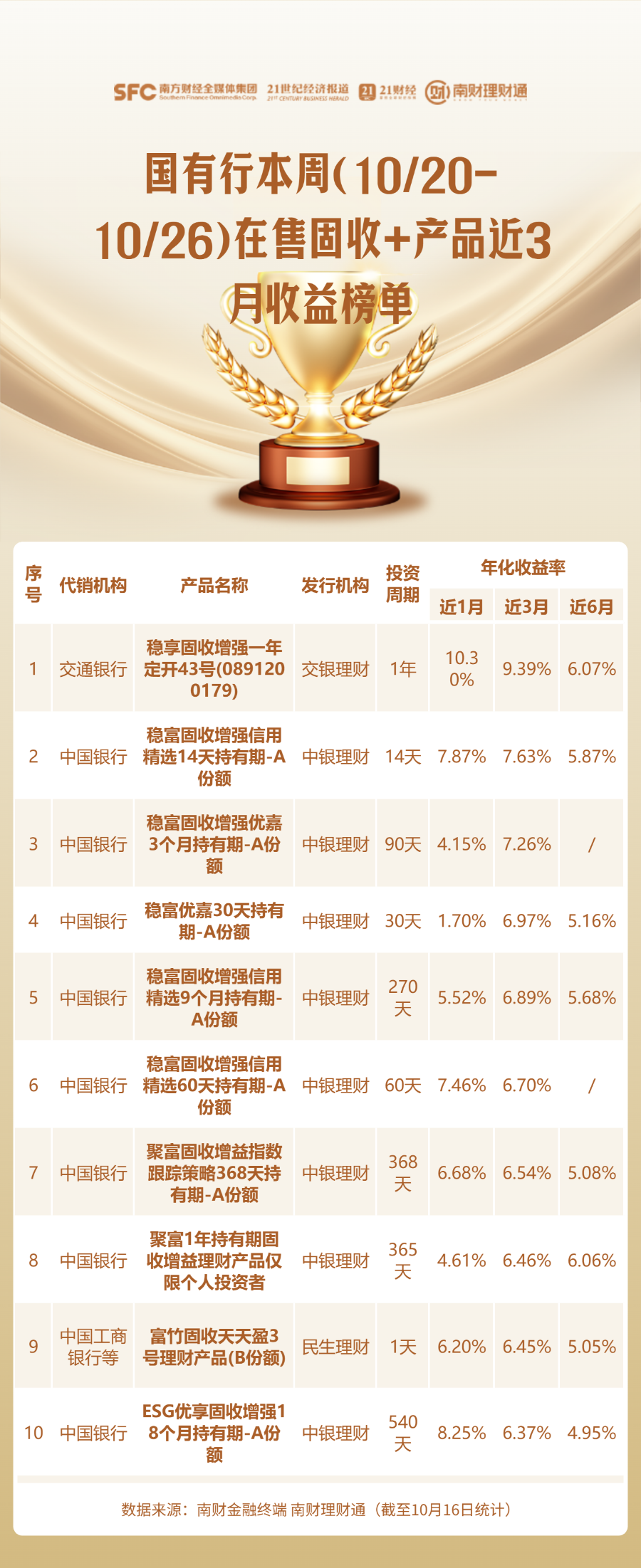
股份行、城商行本周均有近3月年化超14%固收+理财在售
2 1 Shi Ji Jing Ji Bao Dao· 2025-10-20 01:13
Core Insights - The article emphasizes the abundance of bank wealth management products with similar names and vague characteristics, urging investors to carefully select and differentiate among them [1] - The focus is on "fixed income +" products issued by wealth management companies, highlighting those with superior performance in the current market [1] Summary by Category Performance Metrics - The report provides a performance ranking of wealth management products based on their annualized returns over the past month, three months, and six months, sorted by the three-month annualized yield [1] - Notable products include: - China Bank's "Enhanced Fixed Income" with a 14-day holding period yielding 7.87% [4] - Industrial Bank's "Ruili Xingcheng Jinxin Daily Open" with a one-day holding period yielding 12.3% [6] Distribution Channels - The analysis includes 28 distribution institutions such as Industrial Bank, China Bank, Agricultural Bank, and others, indicating a wide range of available products [1] - The report suggests that the availability of products may vary based on actual sales conditions and customer-specific offerings [1] Recommendations for Investors - Investors are advised to refer to the actual product listings on the distribution banks' apps for the most accurate purchasing information, as the report's assessment of "on-sale" status is based on investment cycle projections [1]

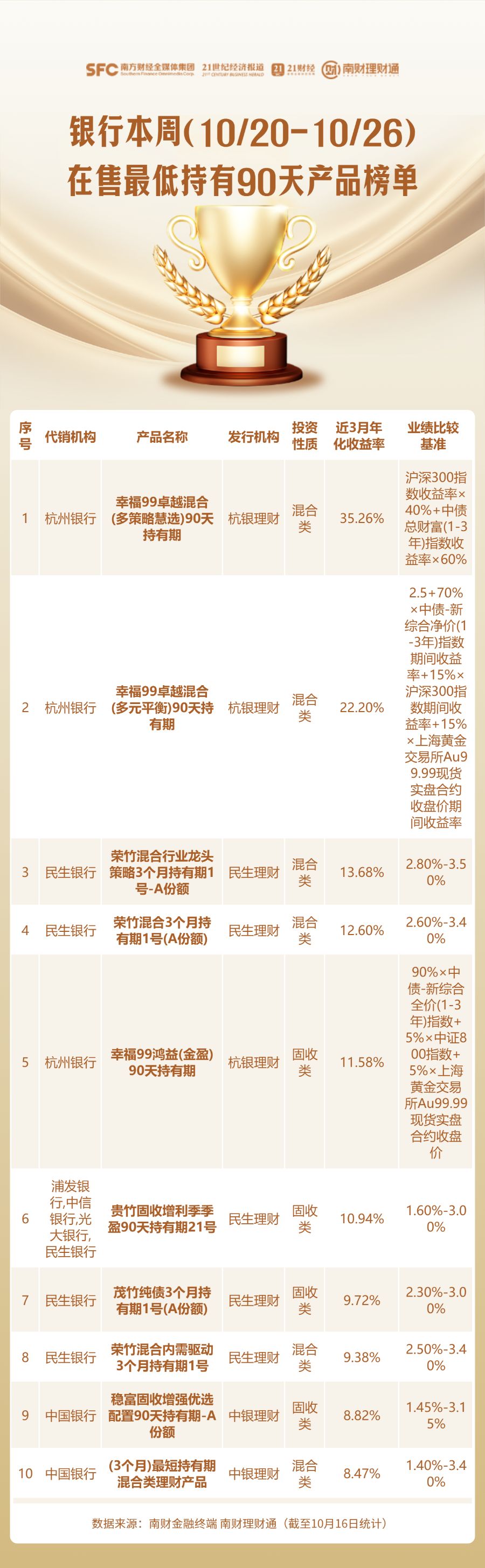
高含权产品强势领跑持有期榜单,榜首近3月年化收益超30%
2 1 Shi Ji Jing Ji Bao Dao· 2025-10-20 01:13
Core Insights - The article focuses on the performance of bank wealth management products with minimum holding periods, specifically highlighting the annualized returns of these products categorized by holding periods of 90 days, 180 days, and 365 days [1][6]. Group 1: Performance Rankings - The rankings are based on annualized returns calculated over the same period as the holding duration, with a focus on products currently available for sale [1]. - A total of 28 distribution institutions were analyzed, including major banks such as Industrial and Commercial Bank of China, Bank of China, and Agricultural Bank of China [1]. - The performance of various products is showcased, with notable returns such as 22.20% for Hangzhou Bank's "Happiness 99 Excellent Mixed" product with a 90-day holding period [4]. Group 2: Product Categories - The products are categorized based on their minimum holding periods: 90 days, 180 days, and 365 days, allowing investors to compare performance across different time frames [1][6]. - For the 180-day holding period, products like Hangzhou Bank's "Happiness 99 Excellent Mixed" achieved a return of 13.63% [7]. - The analysis also includes products with a 365-day holding period, with returns such as 11.89% for Hangzhou Bank's "Happiness 99 Excellent Mixed" [12]. Group 3: Investment Recommendations - The article emphasizes the importance of investors verifying the availability of products through the respective bank's app, as some products may be unavailable due to sold-out quotas or differences in product listings [1]. - It suggests that investors should consider the performance rankings as a reference point when selecting wealth management products [2].






中信证券:银行基本面稳定 绝对收益有望延续
智通财经网· 2025-10-20 00:19
Core Viewpoint - The macro-prudential management expansion and the enhancement of financial stability tools are expected to lead banks into a new phase of risk management, which will strengthen their balance sheets and accelerate the realization of net asset revaluation expectations [1][2]. Summary by Sections Macro-Prudential Management - The interview with the head of the Financial Stability Bureau of the People's Bank of China emphasizes the need to balance growth and risk prevention, expanding the macro-prudential management framework and enhancing the financial stability toolbox [2]. - Future regulations will likely deepen oversight of non-traditional banking activities, including wealth management and asset management subsidiaries [2]. Banking Sector Performance - The banking sector is expected to maintain a stable performance in Q3, with positive trends in interest margins and stable non-performing loan generation, although investment income may see a quarter-on-quarter decline [1][4]. - The KBW bank index experienced a significant drop due to concerns over credit risks in U.S. regional banks, leading to a market capitalization loss of over $100 billion for 74 major banks in a single day [3]. Stock Market Trends - Last week, both A-shares and H-shares in the banking sector outperformed the broader market, with notable gains in individual bank stocks, particularly Chongqing Bank and Agricultural Bank [4]. - The increase in mid-term dividends from banks, now reaching 17 institutions, contributes to the relative and absolute returns of bank stocks amid rising market uncertainties [4]. Investment Strategy - The banking sector is seen as offering significant value, with a shift towards alpha strategies in stock selection, focusing on companies with high and stable ROE and optimistic valuation space [1][4].

当AI与金融“双向奔赴”
Shang Hai Zheng Quan Bao· 2025-10-19 18:49
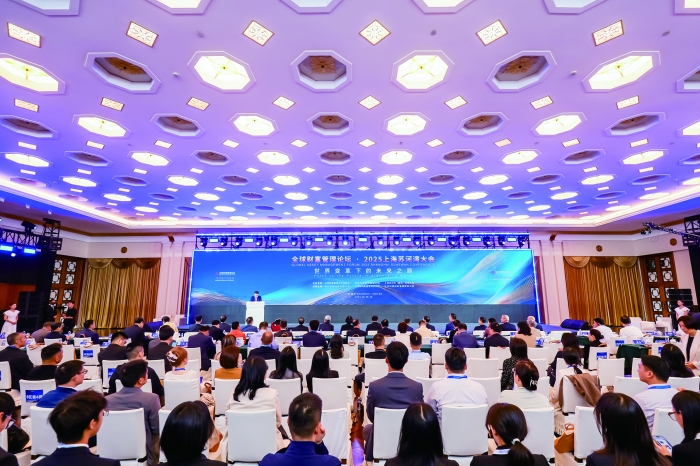
当AI与金融"双向奔赴" ◎记者 黄坤 10月18日至19日,在全球财富管理论坛·2025上海苏河湾大会上,中外头部金融机构代表、知名专家学 者汇聚一堂。与会嘉宾怀揣着对"世界变革下的未来之路"的思考,就"AI""金融""融合"等时下热词展开 交流。在全球经济格局深度调整、市场不确定性显著增加的当下,这场思想盛宴恰逢其时,勾勒出金融 与科技碰撞的新图景。 从"辅助工具"到"核心引擎": AI重塑金融业态 当前,人工智能等新兴技术正深刻重塑金融产业生态和发展模式。 AI在金融领域的角色正在发生转变,从原先简单的"辅助工具",逐步升级为驱动业务创新的"核心引 擎"。"当前,以人工智能为代表的科技成果在金融领域已经开始广泛应用,可以预期,对金融的促进与 影响可能是重大而根本性的。"金融监管总局副局长肖远企如是说。 全球财富管理论坛总干事、原国务院体改办副主任李剑阁认为,以人工智能为代表的金融科技,不仅改 变着金融服务的形态与逻辑,也重新定义了金融基础设施的构建方向,在持续打破传统金融业的竞争壁 垒、推动金融业的竞争范式的过程中实现深度变革。 技术变革持续驱动资本市场改革发展。国泰海通总裁李俊杰认为,以大数据、人工智 ...
股市必读:中国移动(600941)10月17日主力资金净流入6531.77万元,占总成交额4.93%
Sou Hu Cai Jing· 2025-10-19 17:07
Summary of Key Points Core Viewpoint - On October 17, 2025, China Mobile (600941) reported a closing price of 107.93 yuan, reflecting a slight increase of 0.11% with a trading volume of 12.27 million hands and a total transaction amount of 1.326 billion yuan [1]. Trading Information - On October 17, the net inflow of main funds was 65.32 million yuan, accounting for 4.93% of the total transaction amount - Retail investors experienced a net outflow of 14.60 million yuan, representing 1.1% of the total transaction amount [1][3]. Company Announcement - China Mobile's board announced that on October 17, 2025, Guangdong Mobile exercised its conversion rights, converting a total of 1.874 billion yuan (approximately 2.054 billion HKD) of Shanghai Pudong Development Bank's A-share convertible bonds into approximately 149.81 million A-shares at a conversion price of 12.51 yuan per share (approximately 13.71 HKD) - Following this conversion, the group's holdings in Shanghai Pudong Development Bank's A-shares increased to approximately 5.935 billion shares, representing about 18.15% of the expanded share capital - The newly issued shares are subject to a five-year transfer restriction, and the conversion is deemed fair and reasonable, aligning with the overall interests of the company and its shareholders [1][3].

如何展望银行股行情的持续性?
2025-10-19 15:58
Summary of Conference Call on Banking Sector Outlook Industry Overview - The conference call focuses on the banking sector, particularly the performance and outlook of bank stocks in the context of macroeconomic conditions and policy support [1][3][7]. Core Insights and Arguments - **Sustained Performance of Bank Stocks**: The banking sector is expected to maintain a positive trajectory, benefiting from the establishment of risk bottom lines in urban investment real estate, policy support for debt resolution, and capital replenishment in small and medium-sized banks [1][3]. - **Valuation Recovery**: The foundation for valuation recovery in the banking sector is solid, supported by effective risk control in urban investment real estate and high growth in net interest income. Major urban commercial banks are leading in balance sheet expansion and have stabilized net interest margins [1][5]. - **Market Discrepancies on Interest Rate Outlook**: There is a divergence in market views regarding future interest rate trends. Some investors are concerned about potential negative impacts on the bond market if rates rise. However, leading banks have shifted focus from non-interest income to net interest income growth, which is expected to continue into the next year [6]. - **Investment Recommendations**: The fourth quarter is identified as a key period for investment. Recommended stocks include quality urban commercial banks such as Nanjing Bank, Jiangsu Bank, Qilu Bank, and Hangzhou Bank due to their low valuations, high dividend yields, and strong profit growth. Large commercial banks like China Merchants Bank are suggested as core holdings [1][7]. - **Attractive Dividend Yields**: In the H-share market, large state-owned commercial banks like Industrial and Commercial Bank of China (ICBC) offer attractive dividend yields close to 6%, making them worthy of attention for their valuation recovery potential [1][7]. Additional Important Insights - **Capital Flows**: Despite a general outflow of active funds in the third quarter, local state-owned enterprises and industrial capital have been increasing their holdings in bank stocks, indicating optimism about the sector's future performance. For instance, Shanghai Pudong Development Bank received investment from an Asset Management Company (AMC), and several urban commercial banks have seen significant share purchases by major shareholders [8]. - **Performance Comparison**: In the recent trading week, bank stocks ended a continuous decline since July 10, achieving a 5% absolute return, outperforming the broader market indices [2]. This summary encapsulates the key points discussed in the conference call regarding the banking sector's outlook, investment strategies, and market dynamics.
多家银行信用卡与直销银行App逐步关停
Di Yi Cai Jing Zi Xun· 2025-10-19 13:55
Core Insights - The banking industry is experiencing a wave of app integration, with major banks like Beijing Bank and Bank of China shutting down independent apps in favor of consolidating functions into main banking apps, indicating a shift from quantity to quality in digital strategies [2][3][4] Group 1: App Integration Trends - Beijing Bank announced the closure of its direct banking app effective November 12, integrating its functions into the "Jingcai Life" app, following similar actions by other banks like Minsheng Bank and Kunlun Bank [3] - The credit card app sector is also seeing accelerated integration, with Bank of China migrating functions from its "Bountiful Life" app into its main app, marking a significant move in the industry [3] - Smaller banks are also following suit, with institutions like Beijing Rural Commercial Bank and Jiangxi Bank closing their credit card apps and merging functionalities into their primary mobile banking platforms [3] Group 2: Regulatory and Market Drivers - The integration trend is driven by regulatory requirements and the need for improved user experience, as highlighted by the National Financial Supervision Administration's directive to streamline low-activity and redundant apps [6] - High operational costs and low user engagement of standalone apps have become bottlenecks for digital development in banks, with many users preferring a single app for comprehensive financial services [7][8] Group 3: Future Directions - Post-integration, banks are expected to focus on four key areas: reshaping mobile ecosystems, enhancing digital capabilities with AI and big data, expanding value-added services, and ensuring data security and compliance [9] - The core of app integration is not merely reducing the number of apps but optimizing their structure to improve operational efficiency and user engagement [9]

多家银行信用卡与直销银行App逐步关停
第一财经· 2025-10-19 13:46
Core Viewpoint - The banking industry's app integration trend is accelerating, with major banks like Beijing Bank and Bank of China consolidating their digital banking services into fewer applications, indicating a shift from quantity expansion to quality enhancement in digital strategies [3][4]. Group 1: App Integration Trends - Beijing Bank announced the closure of its direct banking app, integrating its functions into the "Jingcai Life" app, marking a significant move in the consolidation of independent banking apps [5]. - The credit card app sector is also experiencing rapid integration, with Bank of China migrating functions from its "Bountiful Life" app into its main app, signaling a trend among major banks to streamline their digital offerings [6]. - Smaller banks are following suit, with institutions like Beijing Rural Commercial Bank and Jiangxi Bank shutting down their credit card apps and merging functionalities into their primary mobile banking applications [6][7]. Group 2: Regulatory and Market Drivers - The app integration trend is driven by regulatory requirements and the need for improved user experience, as highlighted by the National Financial Regulatory Administration's directive to optimize and consolidate low-activity and redundant apps [9]. - High operational costs and low user engagement of standalone apps have become bottlenecks for banks' digital development, with data showing that the monthly active users of some banking apps are significantly lower than their main banking apps [10][11]. Group 3: Strategic Focus Post-Integration - Post-integration, banks are advised to focus on four key areas: reshaping mobile ecosystems, enhancing digital capabilities with AI and big data, expanding value-added services, and solidifying security and compliance foundations [12]. - The core of app integration is not merely about reducing the number of apps but optimizing the structure to improve operational efficiency and user engagement [12].

银行业周度追踪2025年第41周:如何展望银行股行情的持续性?-20251019
Changjiang Securities· 2025-10-19 13:45
Investment Rating - The investment rating for the banking sector is "Positive" and is maintained [11] Core Viewpoints - There is still divergence in the market regarding the sustainability of the banking stock market. However, it is believed that valuation recovery will continue. From a strategic perspective, it is essential to view the relationship between banking stocks and market sentiment dialectically. In the medium to long term, undervalued banking stocks align with the market's slow bull direction, as the index has been reaching new highs over the past year. In the short term, the performance of growth stocks benefiting from high-risk preferences may diverge from low-risk banking stocks, which indirectly help stabilize the index [6][38] - The fundamental logic supporting the valuation recovery of banking stocks remains solid. The trend of establishing a bottom line for significant risks in urban investment, real estate, and capital is clear, with policies still supporting urban investment debt and orderly capital replenishment for important banks. Mainstream banks continue to show stable growth in performance, with revenue growth points shifting from investment income to net interest income since 2025. It is expected that more banks will see a reversal in net interest income growth as deposit costs continue to decline in 2026 [6][39] Summary by Sections Market Performance - This week, the banking index rose by 5.0%, outperforming the CSI 300 and ChiNext indices by 7.3% and 10.7%, respectively. The market's risk appetite has decreased since the fourth quarter, but the banking sector has seen significant relative gains due to a valuation recovery [2][8] - Individual stocks such as Chongqing Bank and Yunnan Rural Commercial Bank led the gains, while the stock price of Shanghai Pudong Development Bank showed notable elasticity as its convertible bonds approach maturity [19][21] Trading Dynamics - Each round of adjustment presents opportunities for low-valuation configurations. The mid-term dividend has already started, and the demand for dividend assets from absolute return funds remains unchanged. The pressure from new funds and the maturity of existing non-standard assets will push the dividend yield of banking stocks to continue declining [7][39] - The trading volume and turnover rate of state-owned banks, city commercial banks, and rural commercial banks have decreased compared to last week, but the turnover rate of banking stocks has begun to rise again, indicating a change in market risk appetite [10][31] Convertible Bonds - Attention is drawn to the strong redemption trading opportunities for convertible bonds in the banking sector. As the banking sector rises, the stock prices of convertible bond banks are approaching their strong redemption prices. The recent rebound in the stock price of Shanghai Pudong Development Bank has been driven by active conversions by major shareholders [9][26] Future Outlook - The market remains optimistic about the effectiveness of anti-involution measures and the expected recovery of the PPI next year. If macroeconomic recovery resolves the asset shortage contradiction, the fundamentals of banking stocks will benefit accordingly. Additionally, local state-owned assets and industrial capital continue to have a positive outlook on banking stocks, with frequent increases in holdings by major shareholders and management since the third quarter [7][39]

银行行业本周涨4.89%,主力资金净流入24.19亿元
Zheng Quan Shi Bao Wang· 2025-10-19 13:15
Core Insights - The Shanghai Composite Index fell by 1.47% this week, with only four sectors experiencing gains, notably the banking and coal industries, which rose by 4.89% and 4.17% respectively [1][2] - The banking sector led the gains, while the electronic and media sectors faced the largest declines, dropping by 7.14% and 6.27% respectively [1][2] Industry Performance - The banking sector saw a net inflow of 24.19 billion yuan, with 41 out of 42 listed banks experiencing price increases. Key performers included Chongqing Bank, Shanghai Pudong Development Bank, and Chongqing Rural Commercial Bank, which rose by 14.19%, 12.50%, and 12.17% respectively [3][4] - In contrast, the electronic industry faced the largest net outflow of funds, totaling 700.79 billion yuan, followed by the power equipment sector with a net outflow of 416.92 billion yuan [1][2] Fund Flow Analysis - Overall, the main funds in the two markets experienced a net outflow of 301.75 billion yuan this week, with only two sectors seeing net inflows: banking and coal [1][2] - The banking sector had 16 stocks with net inflows exceeding 100 million yuan, with Agricultural Bank of China leading at 24.72 billion yuan, followed by Industrial and Commercial Bank of China and China Construction Bank with inflows of 12.81 billion yuan and 3.94 billion yuan respectively [3][4]

