
东诚药业

Search documents
创新加速、市场空间大 我国核药产业全力突围
Zheng Quan Ri Bao· 2025-10-20 00:48
Core Viewpoint - The development of radiopharmaceuticals is revolutionizing cancer treatment, allowing targeted delivery of radiation to tumor cells while minimizing damage to surrounding healthy cells [1][3]. Industry Overview - The global nuclear medicine market is projected to grow from $12.6 billion in 2023 to $21 billion by the end of 2029, with a compound annual growth rate (CAGR) of 8.29% from 2024 to 2029 [2]. - Major pharmaceutical companies worldwide, including domestic firms like Fosun Pharma and Yanda Pharmaceutical, are actively entering the nuclear medicine sector [2]. Clinical Application - The clinical application of radiopharmaceuticals involves imaging techniques such as SPECT and PET to locate tumors and determine the appropriate dosage of nuclear medicine [3]. - The integration of diagnosis and treatment, referred to as "diagnosis-therapy integration," is a key feature that distinguishes nuclear medicine from traditional cancer treatments [3]. Innovation and Development - Companies are developing products that utilize different isotopes for both diagnosis and treatment, creating a closed-loop system for cancer precision therapy [4]. - The domestic market has seen a significant increase in the number of innovative radiopharmaceuticals, with 205 pipelines currently in clinical stages as of February 2024 [9][12]. Challenges and Solutions - The lack of domestic production capabilities for medical isotopes and imaging equipment has historically limited the development of innovative radiopharmaceuticals in China [5][6]. - Recent government policies aim to enhance the infrastructure and supply chain for nuclear medicine, including plans for comprehensive coverage of nuclear medicine departments in hospitals by 2025 [7][8]. Market Dynamics - The domestic PET market has seen substantial growth, with a reported 722 PET machines in use as of 2023, an increase of 80.8% since 2019 [8]. - Companies like United Imaging Healthcare have made significant advancements in the development of high-end imaging equipment, contributing to the proliferation of PET technology in medical institutions [8]. Collaborative Efforts - Multiple companies, including Fosun Pharma and Baiyang Pharmaceutical Group, are forming partnerships and investing in the nuclear medicine sector to accelerate innovation and market entry [12]. - The collaboration between pharmaceutical companies and government entities is expected to enhance the development and application of radiopharmaceuticals in China [12].
创新加速 市场空间大我国核药产业全力突围
Zheng Quan Ri Bao Zhi Sheng· 2025-10-19 17:40
Core Insights - The development of radiopharmaceuticals is revolutionizing cancer treatment by allowing targeted delivery of radiation to tumor cells while minimizing damage to surrounding healthy cells [1][3] - The global radiopharmaceutical market is projected to grow from $12.6 billion in 2023 to $21 billion by the end of 2029, with a compound annual growth rate (CAGR) of 8.29% from 2024 to 2029 [2] - The integration of diagnosis and treatment in nuclear medicine, referred to as "diagnosis-therapy integration," is a key feature that distinguishes it from existing cancer treatment methods [3][4] Industry Landscape - Major global pharmaceutical companies have entered the radiopharmaceutical sector, with domestic companies like Fosun Pharma, Yanda Pharmaceutical, and China Isotope & Radiation Corporation actively positioning themselves [2] - As of February 2024, there are 205 innovative radiopharmaceuticals in clinical development in China, indicating a significant increase in research and development activity [9][10] Challenges and Solutions - The lack of domestic production capabilities for medical isotopes and imaging equipment has hindered the development of innovative radiopharmaceuticals in China [6][8] - Recent government policies aim to enhance the infrastructure for nuclear medicine, including the development of imaging equipment and stable supply of medical isotopes [7][8] Innovations and Collaborations - Companies like Yanda Pharmaceutical and Baiyang Pharmaceutical are making strides in developing innovative radiopharmaceuticals and establishing comprehensive industry chains [10][11] - The establishment of partnerships and platforms, such as Fosun Pharma's nuclear medicine platform, is expected to accelerate the development and commercialization of radiopharmaceuticals [11]
东诚药业10月15日获融资买入763.95万元,融资余额9.99亿元
Xin Lang Cai Jing· 2025-10-16 01:35
Group 1 - The core viewpoint of the news highlights the trading performance and financial metrics of Dongcheng Pharmaceutical, indicating a mixed sentiment in the market with a slight increase in stock price but negative net financing [1] - On October 15, Dongcheng Pharmaceutical's stock rose by 1.31%, with a trading volume of 87.89 million yuan. The net financing amount was negative at -442.78 million yuan, with a total financing and securities balance of 999 million yuan [1] - The financing balance of Dongcheng Pharmaceutical is 999 million yuan, accounting for 8.26% of its market capitalization, which is above the 90th percentile of the past year, indicating a high level of financing activity [1] Group 2 - As of June 30, the number of shareholders of Dongcheng Pharmaceutical increased by 9.19% to 23,600, while the average circulating shares per person decreased by 8.42% to 31,554 shares [2] - For the first half of 2025, Dongcheng Pharmaceutical reported a revenue of 1.384 billion yuan, a year-on-year decrease of 2.60%, and a net profit attributable to shareholders of 88.65 million yuan, down 20.70% year-on-year [2] - Since its A-share listing, Dongcheng Pharmaceutical has distributed a total of 1 billion yuan in dividends, with 293 million yuan distributed over the past three years [3]

核医学投资价值分享
2025-10-14 14:44
Summary of Nuclear Medicine Investment Value Sharing Industry Overview - The nuclear medicine market is experiencing significant growth, particularly driven by successful commercialization of products like Bloviate. [1][3] - The overseas nuclear medicine market is projected to reach $1.4 billion in revenue for Novartis in 2024, representing a 42% year-over-year increase. [1][3] - The PSMA diagnostic drug market is expected to reach $1.9 billion, with a corresponding 525,000 treatment sessions anticipated by 2025. [1][7] Key Points and Arguments - **Overseas Market Growth**: Novartis's core products, Provenge and Lutathera, have shown significant growth, with Provenge expected to exceed $5 billion in peak revenue. [3][5] - **Domestic Market Development**: The domestic nuclear medicine market is entering a commercialization phase, with new drugs like Fluorobetaine for AD diagnosis launched and expected approvals for Provenge and Lutathera in Q4. [1][5] - **RDC Market Potential**: The Radiopharmaceutical Drug Conjugates (RDC) market is projected to reach $3.7 billion in 2024, with total estimates around $4-5 billion, comparable to the early stages of Antibody Drug Conjugates (ADC). [1][6] - **RDC vs. ADC**: RDC is structurally similar to ADC, replacing cytotoxic payloads with radionuclides, making it suitable for targeted radiotherapy. [1][7][10] Additional Important Insights - **Clinical Development**: Domestic companies like East China and Hengrui are advancing to clinical stages, narrowing the gap with international counterparts. [3][11] - **Market Trends**: The nuclear medicine sector is expected to maintain strong growth, with several catalysts anticipated in the near future, including new product approvals and market entries. [2][13] - **Investment Opportunities**: Companies like East China and Yuanda Pharmaceutical are highlighted as potential investment opportunities due to their low valuations and promising R&D progress. [2][14] Conclusion - The nuclear medicine industry is poised for substantial growth, driven by both domestic and international developments, with significant investment opportunities emerging as new products and companies enter the market. [2][13]
医保基金数据跟踪:8月医保结余持续优化
Ping An Securities· 2025-10-14 12:44
Investment Rating - The industry investment rating is "Outperform the Market" (预计6个月内,行业指数表现强于沪深300指数5%以上) [28] Core Insights - From January to August 2025, the overall medical insurance fund income maintained positive growth, with total income reaching 18809.94 billion yuan, a year-on-year increase of 6.91%. Total expenditure was 15432.20 billion yuan, a year-on-year decrease of 1.80%. The cumulative surplus for the same period was 3377.74 billion yuan, a year-on-year increase of 79.74% [2][3][13] - The surplus rate for January to August 2025 was 17.96%, an increase of 7.28 percentage points compared to the same period in 2024. The surplus rate for August 2025 was 11.62% [2][13][15] - The medical insurance fund's performance improved compared to 2024, with only May showing a deficit in monthly surplus [13] Summary by Sections Medical Insurance Fund Performance - The medical insurance fund income from January to August 2025 was 18809.94 billion yuan, with a year-on-year growth of 6.91%. Expenditure was 15432.20 billion yuan, down 1.80% year-on-year. The cumulative surplus was 3377.74 billion yuan, up 79.74% year-on-year [2][6][13] - The surplus rate for the same period was 17.96%, which is an improvement from the previous year [2][13] Employee and Resident Medical Insurance - Employee medical insurance income for January to August 2025 was 11954.62 billion yuan, a year-on-year increase of 5.43%. In August, the income was 1452.27 billion yuan, up 1.97% year-on-year. Expenditure for the same period was 8811.88 billion yuan, a year-on-year increase of 2.24% [3][21] - For residents, the income was 6855.32 billion yuan, a year-on-year increase of 9.59%, while expenditure decreased by 6.70% [21][26] Investment Recommendations - The report suggests focusing on innovative pharmaceutical companies with rich pipelines, such as Heng Rui Medicine, BeiGene, and China National Pharmaceutical Group. It also highlights companies with significant single-product potential and those leading in advanced technology platforms [4][26] - In the CXO sector, companies like WuXi AppTec and Kelun Pharmaceutical are recommended, along with medical device companies that have been undervalued due to previous price pressures [4][26]
多家药企冲刺“A+H”
Bei Jing Shang Bao· 2025-10-09 16:14
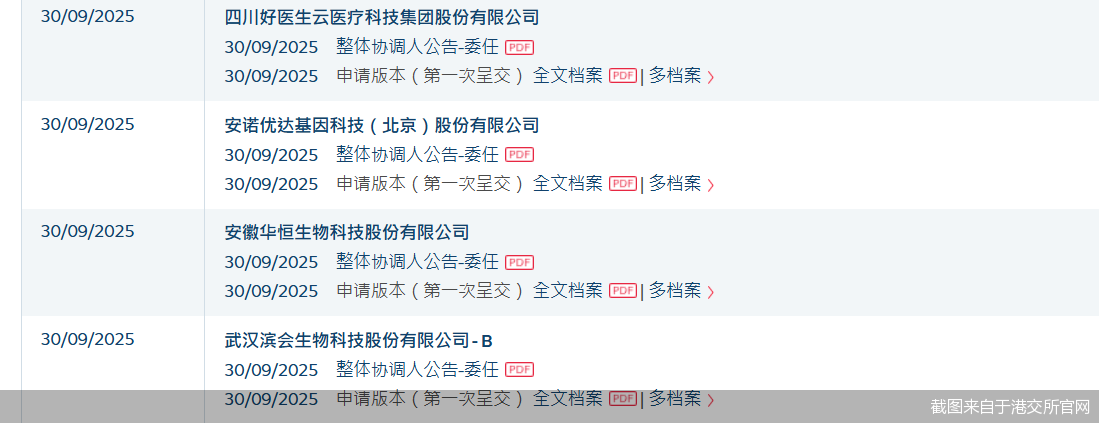
Core Viewpoint - The recent surge in pharmaceutical companies applying for listings on the Hong Kong Stock Exchange (HKEX) reflects a trend towards "A+H" dual-platform listings, which enhances financing channels and supports the domestic innovation of drugs and high-end medical devices [1][2][5][8]. Group 1: Listing Trends - Approximately 25 pharmaceutical companies have submitted listing applications to HKEX in September alone, with many already listed on A-shares, indicating a clear trend towards "A+H" dual-platform strategies [2][5]. - Notable companies such as Huaheng Biological and Baile Tianheng have recently applied for H-share listings, aiming to deepen their global strategic layout and enhance international financing capabilities [2][4]. Group 2: Industry Impact - The influx of companies seeking to list in Hong Kong is expected to accelerate industry consolidation, concentrating resources among financially robust listed companies and strengthening their market positions [4][8]. - Capital influx from these listings is anticipated to promote rapid development of innovative drugs and technologies, allowing companies to invest more in high-risk R&D projects, thereby improving overall industry innovation efficiency [4][8]. Group 3: Market Conditions - The favorable conditions for pharmaceutical companies include the advantages of the HKEX listing system, particularly the 18A listing rules introduced in 2018, which provide a pathway for unprofitable biotech companies to go public [5][8]. - The increasing demand for healthcare driven by population aging and accelerated regulatory approvals from domestic drug authorities create a conducive environment for pharmaceutical growth [5][8]. Group 4: Financial Performance - Many companies applying for listings are currently unprofitable, such as Maike Aote and its subsidiary Lanacheng, which reported significant losses during their respective financial periods [7][8]. - Financial data indicates that Maike Aote's R&D expenditures for 2023-2025 are projected to be approximately 87.01 million, 107 million, and 40.43 million yuan, with corresponding losses of about 195 million, 157 million, and 49.9 million yuan [7].
医药企业掀赴港上市潮,多家A股公司冲刺“A+H”
Bei Jing Shang Bao· 2025-10-09 12:41
Core Viewpoint - A new wave of pharmaceutical companies is applying for listings on the Hong Kong Stock Exchange (HKEX), with 11 companies submitting applications in a two-day period, indicating a significant uptick in market activity [1][3]. Group 1: Listing Activity - Approximately 25 pharmaceutical companies have submitted listing applications to HKEX since September, with a notable concentration of 11 applications on September 29-30 [3]. - Companies such as Sichuan Good Doctor Cloud Medical Technology Group and Annoroad Gene Technology are among those applying, with some indicating they are unprofitable biotech firms under the HKEX Chapter 18A rules [1][3]. - The trend of "A+H" dual listings is emerging, with several companies already listed on A-shares also seeking to list on HKEX, enhancing their financing capabilities [5][6]. Group 2: Market Drivers - The HKEX's 18A listing rules, introduced in 2018, have created a pathway for unprofitable biotech companies to go public, while the "Tech Company Fast Track" launched in 2025 further streamlines the listing process for tech firms [4]. - Increased demand for healthcare services due to population aging and accelerated regulatory approvals from domestic drug monitoring agencies are contributing to a favorable environment for pharmaceutical companies [4]. Group 3: Financial Performance - Many of the companies applying for listings are currently unprofitable, with significant losses reported. For instance, Meikang Aote and its subsidiary Blue Nancheng reported losses of approximately 195 million yuan and 112 million yuan, respectively, in recent financial periods [9][10]. - The trend of unprofitable companies seeking listings under the 18A rules highlights the role of HKEX as an "innovation incubator" for the biotech sector [10]. Group 4: Future Implications - The rise of "A+H" listings is expected to reshape the competitive landscape of the domestic biotech industry, potentially accelerating industry consolidation and enhancing the market position of well-capitalized firms [7]. - Increased capital influx is anticipated to boost the development of innovative drugs and technologies, thereby improving overall industry innovation efficiency [7].


烟台东诚药业集团股份有限公司关于分拆所属 子公司烟台蓝纳成生物技术股份有限公司至香港联合交易所有限公司主板上市的进展公告
Zhong Guo Zheng Quan Bao - Zhong Zheng Wang· 2025-10-09 04:58
Group 1 - The core point of the announcement is that Yantai Dongcheng Pharmaceutical Group Co., Ltd. plans to spin off its subsidiary Yantai Lanacheng Biotechnology Co., Ltd. for a listing on the main board of the Hong Kong Stock Exchange [1][2] - The company held board meetings and a shareholders' meeting on August 28 and September 15, 2025, respectively, to approve the spin-off plan and related proposals [1] - On September 29, 2025, Lanacheng submitted its application for an initial public offering and listing on the Hong Kong Stock Exchange, with the application materials prepared according to the requirements of the Hong Kong Securities and Futures Commission and the Hong Kong Stock Exchange [2]
烟台东诚药业集团股份有限公司关于分拆所属子公司烟台蓝纳成生物技术股份有限公司至香港联合交易所有限公司主板上市的进展公告
Shang Hai Zheng Quan Bao· 2025-10-08 19:38
Group 1 - The company, Yantai Dongcheng Pharmaceutical Group Co., Ltd., is proceeding with the spin-off of its subsidiary, Yantai Lanacheng Biotechnology Co., Ltd., for a listing on the main board of the Hong Kong Stock Exchange [2][3] - The board of directors and the company have approved the spin-off plan during meetings held on August 28 and September 15, 2025 [2] - On September 29, 2025, Lanacheng submitted its application for an initial public offering and listing on the Hong Kong Stock Exchange [3]
东诚药业所属子公司蓝纳成递交H股发行上市申请
Zhi Tong Cai Jing· 2025-09-30 04:05
Core Viewpoint - Dongcheng Pharmaceutical's subsidiary, Yantai Lannacheng Biotechnology Co., Ltd., has submitted an application for an initial public offering (IPO) and listing on the Hong Kong Stock Exchange [1] Group 1 - The application materials have been filed with the Hong Kong Stock Exchange [1] - The announcement has been published on the Hong Kong Stock Exchange's website [1]